

Process Validation statistics in 2026: GMP data analysis guide

Recent GMP inspection data shows that nearly 30% of manufacturing deviations in pharmaceutical facilities are linked to inadequate process control, incomplete PPQ datasets, or weak statistical evaluation, which directly impacts batch release decisions. Therefore, regulators increasingly expect companies to move beyond basic compliance and adopt robust Process Validation statistics frameworks that demonstrate real-time process capability and consistency. Moreover, modern Pharma Validation programs now rely heavily on metrics like Cp, Cpk, and control chart trends to prove that every batch stays within a validated state. As a result, manufacturers who fail to integrate strong statistical monitoring into validation often face repeated inspection findings and delayed product approvals.

Table of Contents

What is Process Validation statistics in pharmaceutical GMP systems

Process Validation statistics in pharmaceutical GMP systems use statistical tools to prove that a process consistently meets quality limits. In practice, teams apply Cp, Cpk, SPC, and trend analysis to monitor variability and detect early shifts. As a result, they prevent deviations, maintain control, and ensure compliance while improving manufacturing reliability.

Why statistical evaluation is essential for GMP validation success

Statistical evaluation is essential for GMP validation success because it turns production data into clear evidence of process consistency and control. In many inspections, regulators raise findings when companies fail to justify variability or ignore weak trends in PPQ data. Moreover, poor statistical support often delays approval and increases compliance risk. On the other hand, data-driven validation using tools like Cp/Cpk and control charts strengthens regulatory confidence and highlights process stability. Therefore, strong statistical justification reduces inspection issues and supports faster, more reliable GMP approval in pharmaceutical manufacturing.

Statistical framework used in pharmaceutical process validation lifecycle

A structured statistical framework drives every stage of pharmaceutical process validation and ensures consistent product quality under GMP requirements. Moreover, companies rely on integrated analytical tools to evaluate process stability, detect variability, and confirm long-term control. As a result, this framework supports data-driven decision-making across development, validation, and routine manufacturing, while strengthening regulatory confidence.

In this section, we will explore the key statistical components used in pharmaceutical process validation.

  • Process capability analysis Cp and Cpk in pharma validation (PDF)
  • Control charts for ongoing process monitoring (PDF)
  • Statistical sampling strategies in PPQ batches
  • Batch variability and process failure prediction models

Process capability analysis Cp and Cpk in pharma validation (PDF)

Process capability analysis using Cp and Cpk evaluates how well a pharmaceutical process can consistently produce output within GMP specification limits. In addition, Cp measures the potential capability of the process, while Cpk reflects the actual performance considering process centering and variation.

Download Process Validation in Pharmaceutical Manufacturing (IPA Guideline) Here

Control charts for ongoing process monitoring (PDF)

Control charts are a key tool in Statistical Process Control (SPC) that visualize process variation over time in pharmaceutical manufacturing. Moreover, they help GMP teams quickly detect abnormal trends and prevent out-of-specification (OOS) results before they occur.

Download Control Charts for Ongoing Process Monitoring in Pharmaceutical GMP Systems Here

Statistical sampling strategies in PPQ batches

Statistical sampling strategies in PPQ batches define how many samples must be collected to ensure reliable process validation conclusions. Additionally, these strategies help manufacturers accurately capture process variability under real production conditions and strengthen regulatory compliance.

Batch variability and process failure prediction models

Batch variability analysis and prediction models identify potential process failures by evaluating trends across historical manufacturing data. Furthermore, these models help predict deviations such as OOS and OOT by detecting early warning signals in process behavior.

Application of statistical tools in PPQ and commercial manufacturing

Statistical tools play a critical role in both PPQ studies and routine commercial manufacturing because they transform raw batch data into actionable quality insights. Moreover, companies apply methods such as Cp, Cpk, and Statistical Process Control (SPC) to confirm process stability during PPQ and to maintain continuous control during commercial production. As a result, these tools help detect early process shifts, reduce variability, and ensure every batch remains within validated limits throughout the product lifecycle. Therefore, statistical evaluation strengthens GMP compliance and supports consistent product quality in real manufacturing environments.

The table below summarizes the key statistical tools used across PPQ and commercial manufacturing stages.

Statistical Tool Application in PPQ Stage Application in Commercial Manufacturing Key Objective
Cp / Cpk Analysis
Evaluates process capability during qualification batches
Monitors long-term capability drift
Ensure process remains within specification limits
Control Charts (SPC)
Detects variation patterns in PPQ runs
Real-time monitoring of production stability
Early detection of out-of-control conditions
Process Trend Analysis
Assesses batch-to-batch variability in validation phase
Tracks performance trends over time
Identify gradual process shifts
Sampling Plans
Defines PPQ sampling frequency and locations
Optimizes routine quality control sampling
Ensure representative data collection

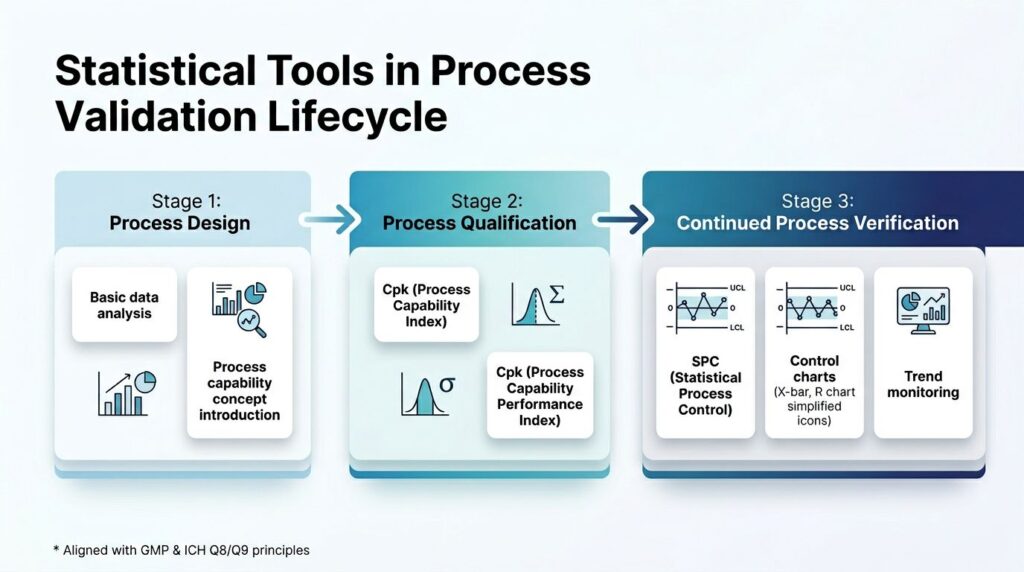
This infographic visually explains how statistical tools are integrated from PPQ studies to full-scale commercial manufacturing control.

Flow diagram of statistical tools in pharmaceutical process validation lifecycle including Cp, Cpk analysis, SPC control charts, PPQ studies, and commercial manufacturing monitoring.
Statistical tools in process validation lifecycle showing Cp, Cpk, and SPC integration from PPQ to commercial manufacturing control in GMP systems.

Common statistical deficiencies in GMP inspections

Statistical deficiencies are a common cause of GMP inspection findings because many companies lack robust data analysis. For example, auditors often flag missing Cp/Cpk, weak sampling, and poor trend analysis. As a result, these gaps reduce confidence in process consistency and increase regulatory risk. Therefore, companies must strengthen statistical methods and data integrity to maintain compliance.

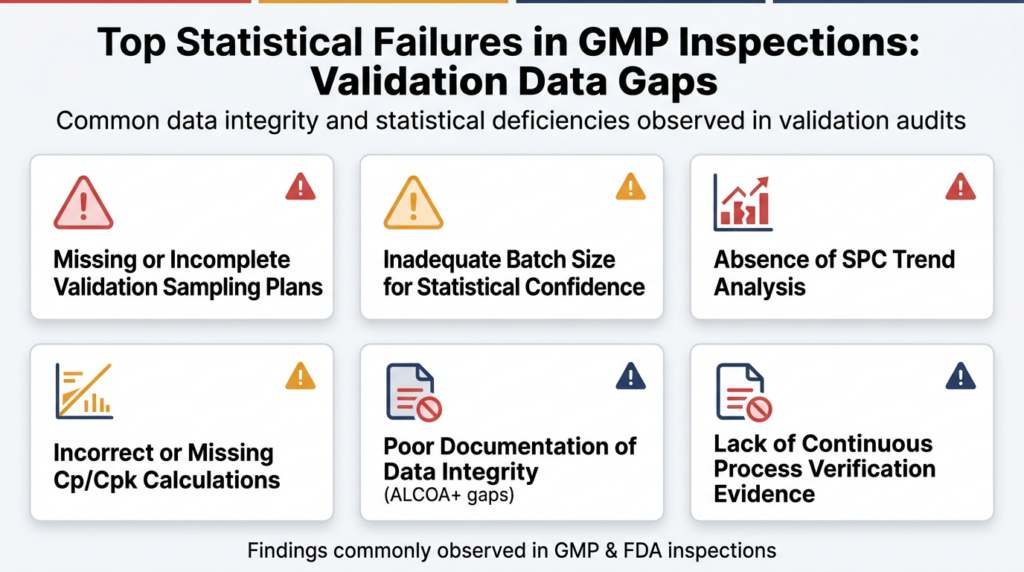
This infographic highlights the most common statistical failures observed in GMP inspections, focusing on critical validation data gaps in pharmaceutical manufacturing.

Infographic illustrating top statistical failures in GMP inspections, including validation data gaps, inadequate sampling plans, missing SPC analysis, Cp/Cpk calculation errors, and pharmaceutical data integrity issues in manufacturing processes.
Key statistical failures in GMP inspections driven by validation data gaps and weak analytical control.

Final words

Recent global GMP inspection trends show that around 25–30% of critical observations in pharmaceutical manufacturing are directly linked to weak statistical justification or incomplete validation data analysis in Process Validation. Moreover, this pattern clearly highlights that companies still struggle to integrate robust tools like Cp/Cpk and SPC into routine decision-making. As a result, regulators increasingly focus on data integrity and statistical evidence during inspections, not just procedural compliance. Therefore, strengthening Process Validation statistics is no longer optional; it has become a core requirement for sustaining GMP compliance and avoiding repeated inspection findings in modern pharmaceutical manufacturing.

FAQ

1️⃣What statistical tools are used to demonstrate process consistency in validation and routine production?

Cp/Cpk analysis, SPC, and control charts are commonly used to confirm process stability and capability. Moreover, they help detect variability early and ensure results stay within limits.

2️⃣Why do GMP inspections often highlight weak statistical justification in validation studies?

Because companies sometimes fail to properly justify variability or provide complete PPQ statistical evidence. As a result, inspectors question process control and data reliability.

3️⃣How does statistical evaluation support decision-making in qualification and routine manufacturing?

It turns raw data into clear insights for quality decisions. Therefore, it helps detect deviations early and ensures consistent batch performance.

Picture of Mahtab Shardi
Mahtab Shardi

Mahtab is a pharmaceutical professional with a Master’s degree in Physical Chemistry and over five years of experience in laboratory and QC roles. Mahtab contributes reliable, well-structured pharmaceutical content to Pharmuni, helping turn complex scientific topics into clear, practical insights for industry professionals and students.

Pharmaceutical process validation metrics showing process capability analysis pharma Cp Cpk, control chart application pharmaceutical GMP, and batch variability analysis pharma in a modern validation and quality control environment.

Process Validation statistics in 2026: GMP data analysis guide

This article explains how pharmaceutical process validation metrics and statistical tools improve GMP compliance through Cp Cpk analysis, control charts, and PPQ batch performance statistics. It highlights how data-driven validation increases process stability, reduces variability, and supports inspection readiness.

Read More »
Technician performing pharmaceutical HVAC validation with focus on HEPA filter integrity testing, cleanroom differential pressure control, and environmental monitoring as part of cleanroom HVAC qualification ISO 14644 and GMP compliance.

HVAC validation in pharma in 2026: GMP & ISO 14644 guide

This article explains HVAC validation in pharmaceutical cleanrooms, covering IQ OQ PQ qualification stages, HEPA filter integrity testing, and environmental monitoring. It highlights how GMP requirements and ISO 14644 standards ensure contamination control and consistent sterile manufacturing performance.

Read More »
Laboratory scene illustrating ISO 9000 pharma compliance with GMP quality standards, showing documentation control, CAPA system processes, and internal audit pharmaceutical GMP practices aligned with regulatory compliance pharma requirements.

ISO 9000 in pharma industry in 2026: GMP compliance guide

This article explains how ISO 9000 in pharma industry strengthens GMP compliance by improving documentation control, CAPA systems, and internal audit effectiveness. It highlights key regulatory compliance pharma practices that enhance inspection readiness and reduce pharmaceutical quality management system gaps.

Read More »

Share