


Pharma QMS Interview Questions and Answers: GMP and QA Guide in 2026

In pharmaceutical hiring environments, inspection trends consistently show that nearly 60–70% of QA interview rejections are linked to weak GMP documentation and poor deviation handling performance. As a result, companies now prioritize candidates who demonstrate strong regulatory thinking, CAPA awareness, and FDA inspection readiness in real scenarios. Today, pharma QMS interview questions and answers assess practical GMP decision-making rather than theory alone. Moreover, platforms like Pharma Jobs help candidates identify regulated roles where these competencies are actively tested, especially in QA/QC and compliance-driven positions.

Table of Contents

What is pharma QMS interview questions and answers in regulatory context

Pharma QMS interview questions and answers in regulatory environments assess a candidate’s ability to apply GMP compliance, documentation control, and quality system principles in real operations. Moreover, interviewers evaluate how professionals manage deviations, CAPA decisions, and inspection scenarios under pressure. As a result, the focus shifts from theory to practical regulatory thinking. Therefore, candidates with strong audit awareness and quality system understanding perform better in pharma QA hiring.

Role in GMP inspection readiness for QA professionals

GMP inspection readiness is a key factor in evaluating QA professionals during hiring and performance reviews. Recruiters focus on documentation accuracy, deviation handling, and CAPA effectiveness linked to real inspection standards. As a result, candidates with strong pharma QMS interview questions and answers understanding demonstrate both knowledge and practical readiness for FDA or EMA audits.

How pharma QA interviewers assess real-world GMP competence

Pharma QA interviews focus on evaluating how candidates apply GMP principles, make compliance decisions, and respond to real regulatory scenarios in practice rather than relying on theoretical knowledge.

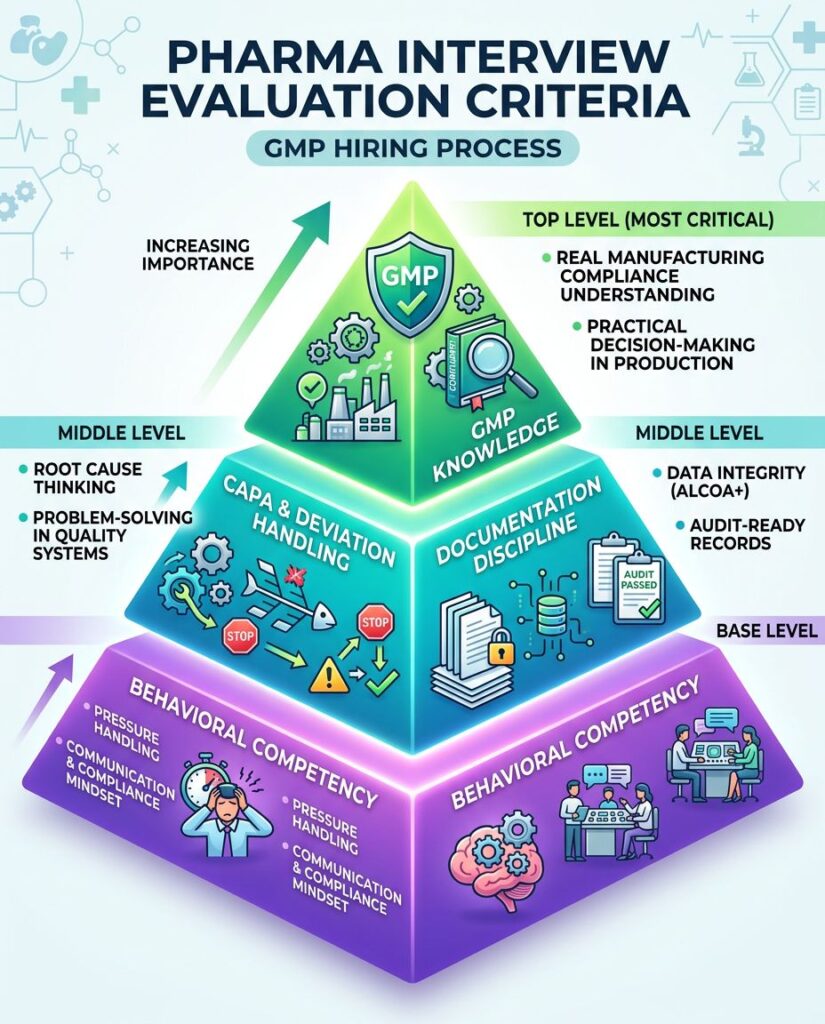
This infographic presents the key evaluation criteria used in pharma GMP hiring interviews, focusing on how recruiters assess GMP knowledge, CAPA handling, behavioral skills, and documentation discipline.

Pharma GMP interview evaluation criteria showing recruiter focus on GMP knowledge, CAPA handling, behavioral competency, and documentation discipline in pharmaceutical QA hiring interviews.
Pharma GMP interview evaluation criteria highlighting CAPA scenarios, GMP knowledge, and documentation control in QA hiring decisions.

This section explains the key competency areas recruiters use to evaluate candidates during QA interview assessments.

  • H4: GMP documentation control and data integrity assessment
  • H4: Deviation handling and root cause investigation approach
  • H4: CAPA system understanding in real inspection scenarios
  • H4: FDA inspection readiness and regulatory behavior under pressure

GMP documentation control and data integrity assessment

Q1: What is QMS?
A QMS is a structured system of processes and procedures used to ensure product quality, compliance, and continuous improvement in regulated pharmaceutical operations.

Q2: Explain data integrity and ALCOA+ principles
Data integrity ensures data is complete, consistent, and reliable. ALCOA+ means Attributable, Legible, Contemporaneous, Original, Accurate, plus Complete, Consistent, Enduring, and Available.

Q3: How do you ensure documentation control in GMP systems?
By using controlled SOPs, version management, approval workflows, and ensuring traceable and audit-ready records across all GMP processes.

Q4: What are the key requirements of 21 CFR Part 211?
It defines GMP requirements for finished pharmaceuticals including documentation, production controls, quality systems, and laboratory practices.

Q5: How is training compliance maintained in GMP environments?
Through documented training programs, periodic assessments, and ensuring personnel qualification before performing GMP-critical tasks.

Deviation handling and root cause investigation approach

Q6: Describe your experience in deviation handling
Deviations are documented, assessed for impact, investigated for root cause, and followed by corrective and preventive actions.

Q7: How do you perform root cause analysis?
Using structured tools like 5 Whys or Fishbone diagrams to identify systemic causes rather than symptoms.

Q8: What are common GMP failures in manufacturing?
Typical failures include documentation errors, process deviations, contamination risks, and equipment qualification gaps.

Q9: How do you handle OOS results?
Through immediate investigation, lab review, hypothesis testing, and determining product impact before batch disposition.

Q10: How do you manage recurring deviations?
By identifying systemic issues, strengthening CAPA effectiveness, and updating procedures or training programs.

CAPA system understanding in real inspection scenarios

Q11: How do you evaluate CAPA effectiveness?
By verifying that corrective actions eliminate root causes and preventive actions reduce recurrence risk.

Q12: What are the key steps in an FDA inspection or audit?
Opening meeting, facility walkthrough, document review, interviews, and closing meeting with observations.

Q13: What is the QA role in batch release decisions?
QA ensures all GMP requirements are met, deviations resolved, and documentation approved before batch release.

Q14: How do you manage change control compliance?
By assessing impact, documenting justification, obtaining approvals, and ensuring implementation is verified.

FDA inspection readiness and regulatory behavior under pressure

Q15: How would you handle a critical FDA inspection finding?
Acknowledge the issue, initiate immediate investigation, implement CAPA, and ensure documented remediation within timelines.

How to prepare for pharma QMS interview questions effectively

Preparing for pharma QMS interviews requires a structured focus on GMP knowledge, CAPA understanding, and FDA inspection readiness. Moreover, candidates should align preparation with real regulatory expectations instead of memorizing answers. As a result, success depends on applying quality system knowledge in practical interview scenarios.

The table below summarizes key preparation areas and how to approach them effectively.

Preparation Area What to Focus On How to Prepare Effectively
GMP Knowledge
Documentation, production controls, compliance systems
Study real GMP scenarios and connect them with daily manufacturing practices
CAPA Understanding
Root cause analysis, corrective & preventive actions
Practice structured RCA methods like 5 Whys and real deviation cases
FDA Inspection Readiness
Audit behavior, inspection flow, regulatory expectations
Review FDA inspection steps and simulate mock interview audit situations
Documentation Control
Data integrity, ALCOA+, 21 CFR Part 211
Learn documentation hierarchy and real audit trail examples
Behavioral Response
Pressure handling, compliance mindset
Prepare STAR-based answers for regulatory stress scenarios

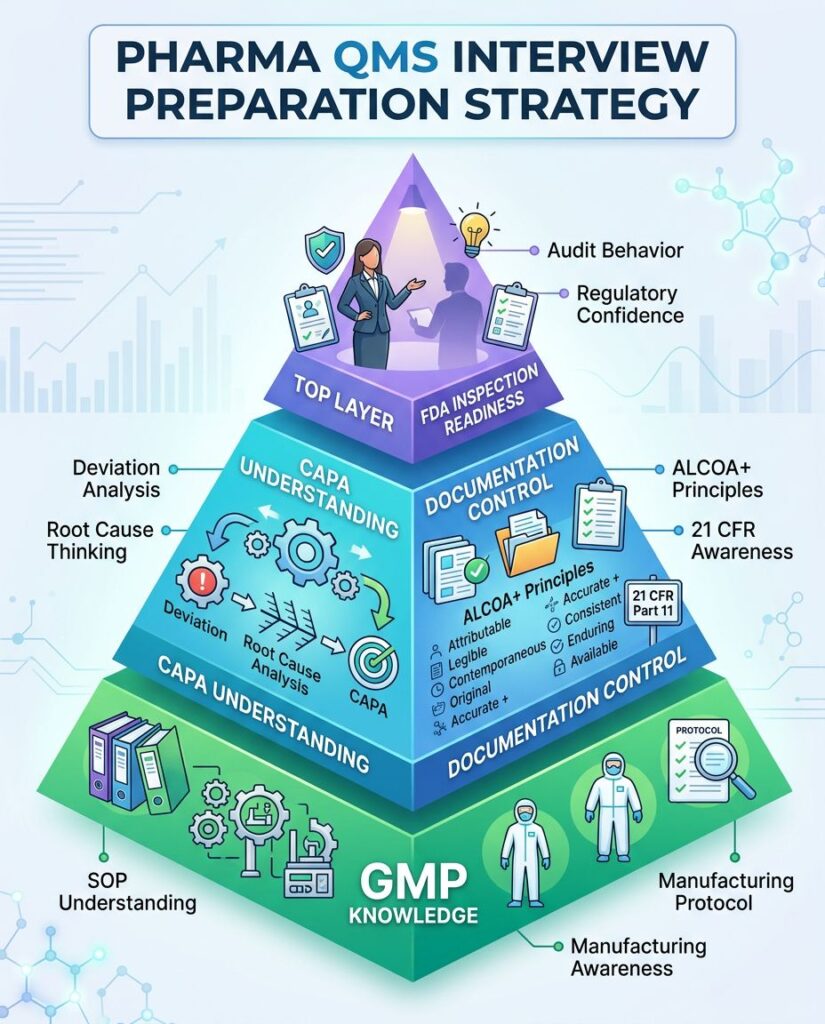
This infographic summarizes the key preparation strategy for pharma QMS interview questions, focusing on GMP knowledge, CAPA understanding, and FDA inspection readiness in regulated quality environments.

Pharma QMS interview preparation strategy showing GMP knowledge, CAPA understanding, documentation control, and FDA inspection readiness in pharmaceutical QA hiring process.
Pharma QMS interview preparation strategy highlighting GMP compliance, CAPA processes, and FDA inspection readiness for QA professionals.

How to Evaluate pharma QMS interview preparation resources and QA job opportunities

Pharma QMS interview preparation and job evaluation should focus on GMP exposure, CAPA understanding, and FDA inspection readiness. Moreover, candidates must check whether resources reflect real regulatory scenarios. As a result, using Explore Pharma Jobs helps identify QA roles aligned with compliance expectations.

Infographic showing how to evaluate pharma QMS interview preparation resources and QA job opportunities using GMP compliance, CAPA management, deviation handling, and FDA inspection readiness criteria.
Pharma QA interview preparation guide based on GMP, CAPA, and FDA inspection readiness requirements.

Final words

Pharma QMS interview questions and answers have become increasingly critical in regulated hiring processes, as inspection trends indicate that nearly 50–60% of QA-related findings are still linked to weaknesses in documentation control and deviation handling. Therefore, candidates who demonstrate strong GMP thinking, CAPA understanding, and inspection readiness are more likely to succeed in competitive pharma QA roles. As a result, focusing on practical regulatory behavior rather than theory remains essential in modern pharmaceutical hiring decisions.

FAQ

1️⃣How should candidates prepare for GMP-based interview questions in regulated environments?

Focus on real GMP scenarios such as deviations, documentation control, and inspection readiness instead of memorizing theoretical answers.

They assess structured root cause thinking, effectiveness of corrective actions, and ability to prevent recurrence in real quality systems.

3️⃣Why is FDA inspection readiness important during QA interviews?

Because it demonstrates how well a candidate can perform under regulatory pressure while maintaining compliance, data integrity, and audit readiness.

Picture of Mahtab Shardi
Mahtab Shardi

Mahtab is a pharmaceutical professional with a Master’s degree in Physical Chemistry and over five years of experience in laboratory and QC roles. Mahtab contributes reliable, well-structured pharmaceutical content to Pharmuni, helping turn complex scientific topics into clear, practical insights for industry professionals and students.

Share