


Pharma Job Interviews in 2026: GMP Questions, Compliance Skills and Hiring Expectations

In regulated pharmaceutical hiring, candidates are increasingly assessed on GMP knowledge, compliance thinking, and real-world decision-making skills, as inspection trends show that nearly 60–70% of QA-related hiring rejections are linked to weak understanding of documentation and deviation handling. In today’s competitive market, companies expect professionals to demonstrate practical readiness for FDA inspection scenarios, CAPA execution, and 21 CFR compliance awareness. As a result, pharma job interviews have become more structured and evidence-driven, where recruiters evaluate how candidates respond under regulatory pressure and how effectively they apply GMP principles in real operational situations. For professionals aiming to enter or advance in this field, platforms like Pharma Jobs provide access to roles aligned with strict compliance requirements and modern pharmaceutical quality expectations.

Table of Contents

What pharma job interviews mean in regulated pharmaceutical environments?

Pharma job interviews in regulated environments go beyond technical questions and focus on how candidates think under real GMP conditions. Interviewers assess compliance understanding, documentation discipline, and responses to deviations, CAPA decisions, and inspection scenarios. As a result, candidates who demonstrate practical GMP thinking and connect theory to real operations stand out more effectively.

Why GMP compliance defines hiring decisions in pharma companies

In pharmaceutical companies, GMP compliance directly shapes hiring decisions because regulators expect consistent inspection readiness across all quality functions. Therefore, recruiters prioritize candidates who understand documentation control, deviation handling, and CAPA systems in real operational settings. Moreover, regulatory pressure from agencies like FDA and EMA forces companies to reduce compliance risks during hiring. As a result, they evaluate how candidates apply GMP principles in day-to-day decisions, not just in theory. In addition, strong GMP awareness signals that a candidate can support audit readiness and maintain product quality under strict regulatory standards.

How pharma recruiters assess GMP competence in job interviews

During pharmaceutical job interviews, recruiters evaluate candidates by focusing on how they apply GMP principles, regulatory thinking, and quality decision-making in real operational scenarios rather than relying on theoretical knowledge alone.

In this section, we will cover key evaluation areas that shape recruiter decisions in GMP-focused pharma hiring.

  • H4: GMP knowledge applied in real manufacturing scenarios (PDF)
  • H4: CAPA and deviation handling during interview assessment (PDF)
  • H4: Behavioral competency in regulated pharma environments (PDF)
  • H4: Documentation discipline and audit readiness expectations (PDF)

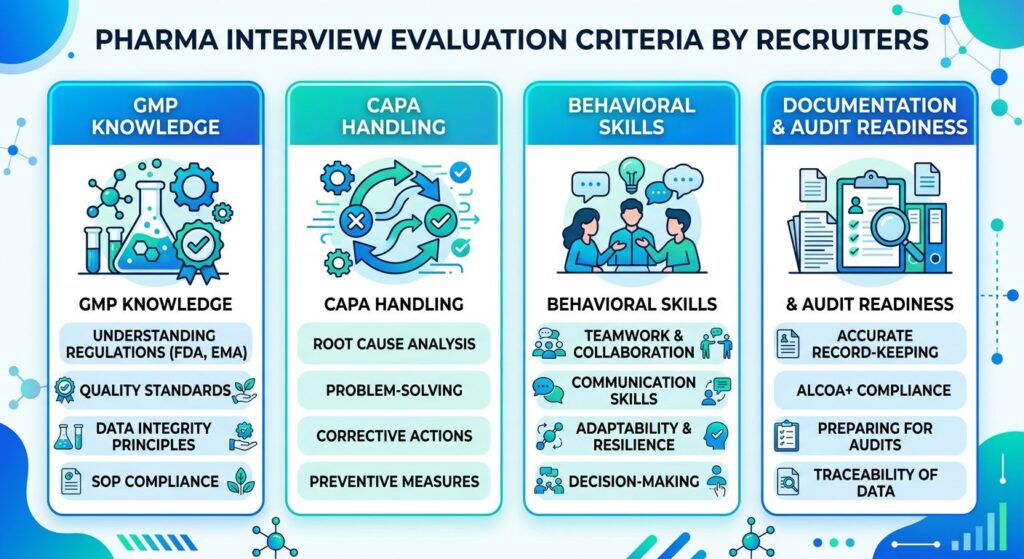
This infographic highlights how pharma recruiters evaluate candidates across GMP knowledge, CAPA handling, behavioral skills, and documentation discipline during structured interview processes.

Pharma recruiter evaluation criteria showing GMP knowledge, CAPA handling, behavioral competency, and documentation discipline in pharma job interviews
Key criteria used by pharma recruiters to assess GMP compliance, behavioral readiness, and audit preparedness in regulated pharmaceutical job interviews.

GMP knowledge applied in real manufacturing scenarios (PDF)

During GMP-focused interview assessments, recruiters evaluate how candidates apply GMP principles in real manufacturing environments rather than recalling theoretical definitions. They focus on how professionals ensure batch consistency, prevent contamination, and maintain compliance during production activities.


Download FDA 21 CFR Part 211 – Current Good Manufacturing Practice Regulations for Finished Pharmaceuticals Here

CAPA and deviation handling during interview assessment (PDF)

Interviewers assess how candidates manage deviations and implement CAPA systems in real-time GMP environments. They expect structured thinking in root cause analysis, corrective actions, and effectiveness verification.

Download FDA Quality Systems Approach to CGMP Regulations – CAPA and Compliance Framework Here

Behavioral competency in regulated pharma environments (PDF)

Pharma recruiters evaluate behavioral skills such as decision-making under pressure, communication with QA teams, and compliance mindset. They focus on how candidates respond during audit pressure and regulatory questioning.

Download WHO Technical Report Series – Good Manufacturing Practices Guidelines for Pharmaceuticals Here

Documentation discipline and audit readiness expectations (PDF)

Candidates are assessed on their ability to maintain accurate documentation, ensure traceability, and follow ALCOA+ principles. Strong documentation discipline is critical for FDA inspection readiness and audit success.

Download FDA 21 CFR Part 211 Subpart I – Laboratory Controls and Documentation Requirements Here

Pharma interview question patterns recruiters focus on

Pharma recruiters follow structured question patterns to assess GMP understanding, CAPA decision-making, and compliance behavior under regulatory pressure. Moreover, they focus on how candidates think in real inspection scenarios rather than how they recall definitions. As a result, interviews emphasize deviation handling, audit readiness, and practical GMP application. Therefore, understanding these patterns helps candidates align their answers with regulatory expectations.

Below is a structured table showing the most common pharma interview question patterns and what recruiters actually assess behind each question type:

Question Pattern What Recruiters Test Example Focus Area
GMP scenario-based questions
Practical GMP application in real operations
Batch deviations, contamination control, documentation handling
CAPA & deviation questions
Root cause thinking and corrective action logic
OOS investigation, deviation closure, effectiveness checks
Behavioral compliance questions
Decision-making under regulatory pressure
Handling FDA audit questions, escalation behavior
Documentation integrity questions
Accuracy, traceability, and ALCOA+ understanding
Record keeping, data integrity, audit trail management
Quality system understanding questions
Knowledge of integrated QMS structure
Change control, training systems, deviation lifecycle
Inspection readiness questions
Response under FDA/EMA inspection scenarios
Mock audits, inspector interaction, compliance mindset

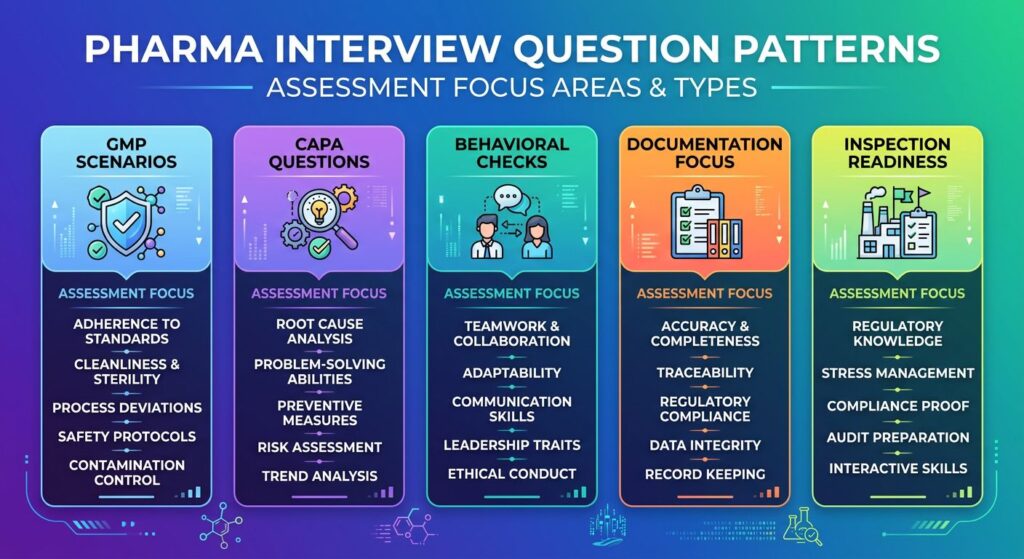
This infographic highlights the key pharma interview question patterns recruiters use to assess GMP knowledge, CAPA thinking, and behavioral compliance in regulated hiring processes.

Pharma interview question patterns showing GMP scenarios, CAPA evaluation, behavioral compliance, and documentation integrity assessment in pharma hiring
Key question patterns used by pharma recruiters to evaluate GMP compliance knowledge, CAPA decision-making, and behavioral readiness in regulated job interviews.

How to assess pharma interview roles and career opportunities

Pharmaceutical interview processes require candidates to evaluate each role based on GMP exposure, QA and QC responsibilities, CAPA complexity, and regulatory compliance expectations to ensure the position aligns with real industry standards. Moreover, they should review validation scope, employer type, and inspection readiness focus to understand how the role operates in practice. As a result, a more informed evaluation helps professionals avoid roles with limited quality impact and instead target positions with strong regulatory depth. To simplify this process, you can use Explore Pharma Jobs to filter opportunities based on compliance requirements, QA responsibilities, and GMP-driven career growth, and therefore make more strategic career decisions in the pharmaceutical industry.

Infographic showing how to evaluate pharma job interview opportunities using GMP experience, QA QC responsibilities, CAPA complexity, validation roles, pharmaceutical employer types, salary expectations, and regulatory compliance focus in pharma careers.
Pharma job interview comparison based on GMP, QA/QC, validation, and compliance experience.

Final words

Inspection trends consistently show that more than 50% of FDA Form 483 observations relate to gaps in documentation, quality systems, and employee training. Therefore, success in pharma job interviews depends on demonstrating practical GMP thinking, strong CAPA understanding, and real inspection readiness rather than theoretical knowledge alone.

FAQ

1️⃣What questions do recruiters ask to assess GMP readiness in interviews?

They focus on deviation handling, CAPA logic, documentation control, and real inspection scenarios to evaluate practical compliance understanding.

2️⃣How can candidates demonstrate FDA inspection readiness during an interview?

They should explain real examples of audit participation, show knowledge of data integrity, and describe how they handle regulatory pressure situations.

3️⃣What is the biggest reason candidates fail QA and compliance interviews?

Most candidates fail due to weak understanding of GMP documentation, poor deviation investigation logic, and inability to apply quality systems in practice.

Picture of Mahtab Shardi
Mahtab Shardi

Mahtab is a pharmaceutical professional with a Master’s degree in Physical Chemistry and over five years of experience in laboratory and QC roles. Mahtab contributes reliable, well-structured pharmaceutical content to Pharmuni, helping turn complex scientific topics into clear, practical insights for industry professionals and students.

Share