


An EU MDR consultant helps manufacturers navigate the medical device regulation while protecting patient safety and European market access. The European Commission, national competent authorities and the Medical Device Coordination Group (MDCG) shape its implementation. The US FDA and UK MHRA oversee separate regulatory frameworks, making jurisdiction-specific planning essential.
By February 2026, the Commission reported 32,898 MDR applications and 18,010 certificates in its annex-based survey dataset. These figures illustrate the scale of conformity assessment, not an approval rate. Manufacturers need credible evidence, coordinated documentation and realistic certification plans to avoid preventable delays.
Table of Contents
Who Is an EU MDR Consultant?
An EU MDR consultant is a regulatory specialist who translates Regulation (EU) 2017/745 into practical actions for medical device manufacturers. The role spans product development, conformity assessment and post-market activities.
- Assess regulatory gaps and establish a compliance roadmap.
- Coordinate clinical, technical and quality-system evidence.
Unlike a notified body, a consultant does not issue MDR certificates. The manufacturer retains legal responsibility for compliance, including its quality management system and applicable Person Responsible for Regulatory Compliance (PRRC) arrangements.
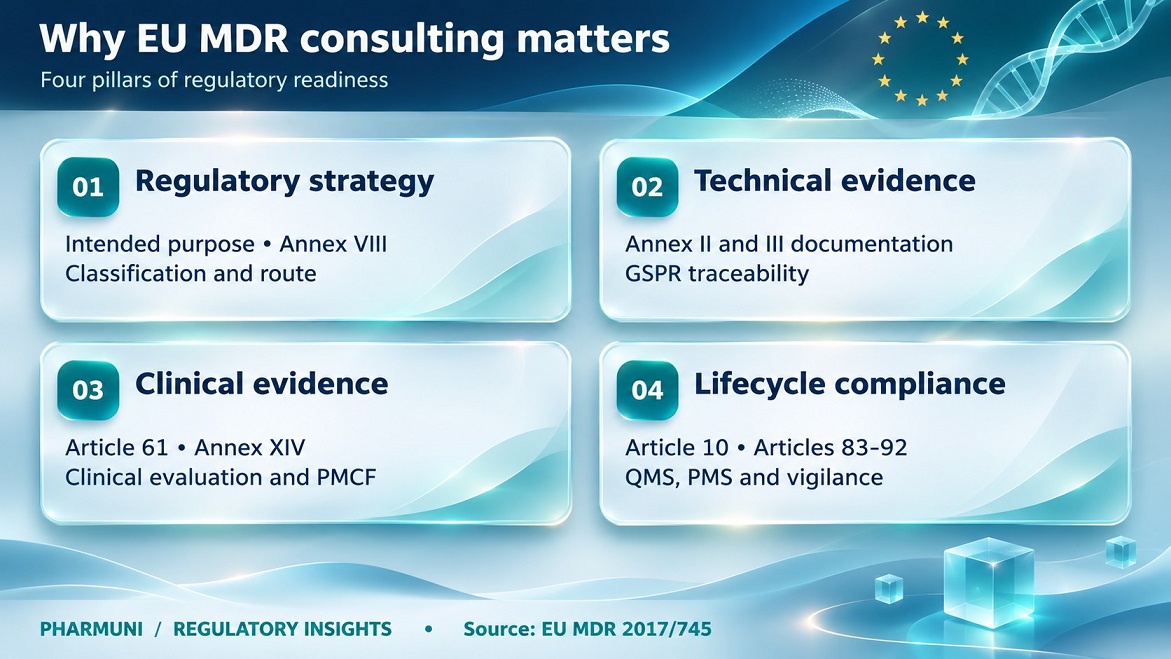
Core Elements of EU MDR Consulting Services
EU MDR consulting services combine classification, conformity assessment planning, medical device technical documentation and clinical evidence review. Each workstream should have an accountable owner and a defined output.
A medical device regulatory consultant may also assess ISO 13485 compliance, supplier controls, risk management and labeling. ISO 13485 certification alone does not demonstrate full MDR conformity; the QMS must address applicable Article 10 obligations and device-specific evidence.
What Influences EU MDR Consultant Cost and Scope?
Consulting effort depends on device class, intended purpose, technological novelty, clinical evidence maturity and the condition of existing documentation. A legacy device with fragmented records may require substantial remediation even when its design is mature.
Ask for an itemized proposal covering the MDR gap analysis, deliverables, review rounds and assumptions. Separate professional fees from testing, clinical investigations, translations and notified body charges. This prevents a low initial quotation from masking downstream costs.
Five Hidden Risks That Threaten MDR Compliance
The most damaging gaps often appear between otherwise acceptable documents. A well-written procedure cannot compensate for inconsistent claims, missing evidence or a missed regulatory dependency.
These five risks deserve early assessment because they can affect certification readiness and continued market access. Each risk should be recorded with an owner, a remediation deadline and objective closure evidence.
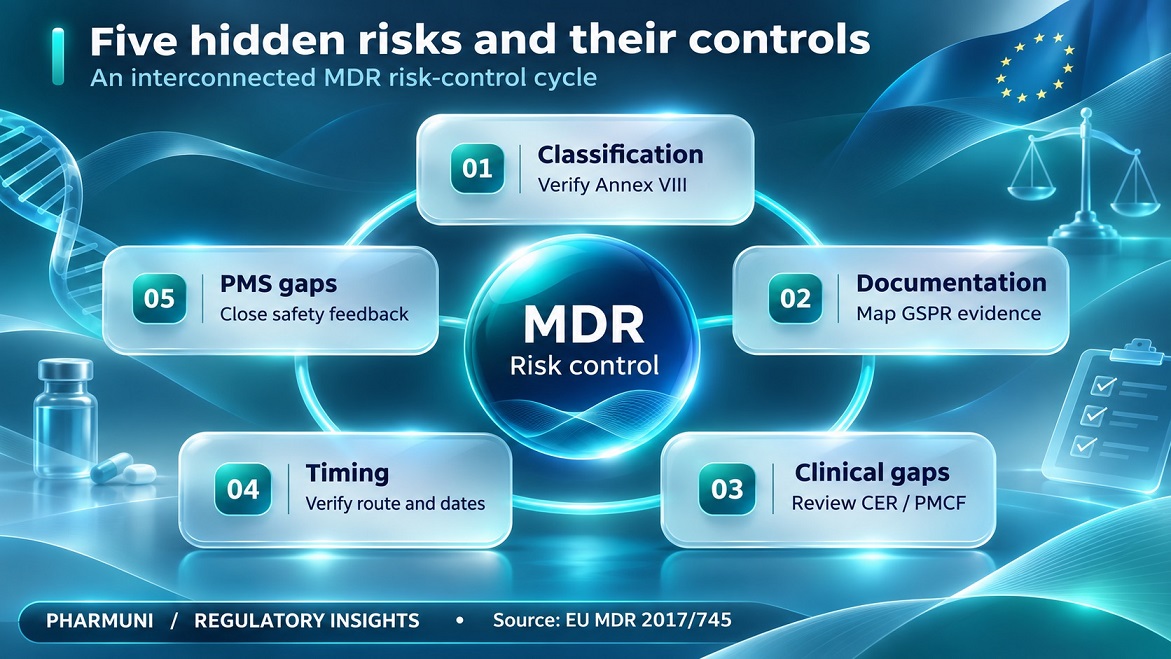
Risk Number 1: Incorrect Device Classification
A small change in intended purpose can alter the classification rule or conformity assessment route. An incorrect class may leave the manufacturer with an unsuitable evidence plan or notified body scope.
- Check intended users, indications and duration of use.
- Document applicable Annex VIII rules, including software rules where relevant.
Reconcile the classification rationale with labeling and clinical claims before committing resources to testing or certification.
Risk Number 2: Fragmented Technical Documentation
Medical device technical documentation can look complete while hiding contradictory specifications, obsolete drawings or unverified safety claims. Annex II and III require structured evidence that supports the device and its lifecycle.
- Map applicable GSPRs to controlled evidence.
- Check design, verification and labeling version alignment.
A traceability review exposes missing links before assessment and helps prevent repeated requests for clarification from the notified body.
Risk Number 3: Weak Clinical Evidence
A clinical evaluation report may contain extensive literature without demonstrating that the evidence supports the actual device, indication or patient population. Equivalence claims require appropriate technical, biological and clinical comparisons.
An EU MDR consultant should evaluate evidence relevance, quality and residual uncertainty, including whether further clinical investigation or post-market clinical follow-up is necessary. Unsupported equivalence can undermine the entire clinical strategy.
Risk Number 4: Certification and Transition Delays
Manufacturers may underestimate notified body review cycles, internal remediation or availability of assessment expertise. For eligible legacy devices, the 2027 and 2028 transition dates are conditional rather than automatic extensions.
The manufacturer must verify its eligibility, including applicable historical application and agreement deadlines. A late discovery of an unmet transition condition may threaten lawful market access. Build a schedule with dependencies, evidence milestones and contingency time.
Risk Number 5: Incomplete Post-Market Surveillance
Post-market surveillance can fail when complaint records, clinical follow-up and risk management operate independently. This creates a blind spot after CE marking, especially when emerging signals do not trigger evaluation or corrective action.
- Define PMS data sources and review frequency.
- Link safety signals to risk files and CAPA.
Maintain class-appropriate reports and verify applicable vigilance obligations. EUDAMED registration responsibilities must also be assigned.
How an EU MDR Consultant Builds a Risk-Based Strategy
Effective MDR compliance consultant support begins with a device-specific baseline rather than a generic checklist. Assess the intended purpose, class, applicable requirements and maturity of the evidence package.
Prioritize gaps by patient safety, legal market access and certification impact. Assign deliverables and acceptance criteria to each finding. This makes the remediation plan measurable and helps management distinguish critical blockers from routine improvements.
Perform an MDR Gap Analysis and Classification Review
Compare existing evidence against applicable MDR provisions and relevant guidance. Confirm the intended purpose and classification rationale before establishing the conformity assessment route.
- Create a requirement-to-evidence matrix.
- Assign risk priority, owner and closure criteria.
Reassess gaps when device claims, design or legislation change. A practical internal target is zero unresolved critical gaps before submission; this is a recommended project gate, not a statutory threshold.
Strengthen Medical Device Technical Documentation
A CE marking consultant can coordinate the Annex II and III dossier with design, quality and clinical teams. Use controlled document identifiers and cross-references to connect requirements with verification and validation evidence.
- Align the GSPR checklist with test reports.
- Reconcile labeling, risk files and clinical claims.
Review the clinical evaluation report and PMCF strategy together. Where equivalence is claimed, document its scientific justification and applicable access-to-data requirements.
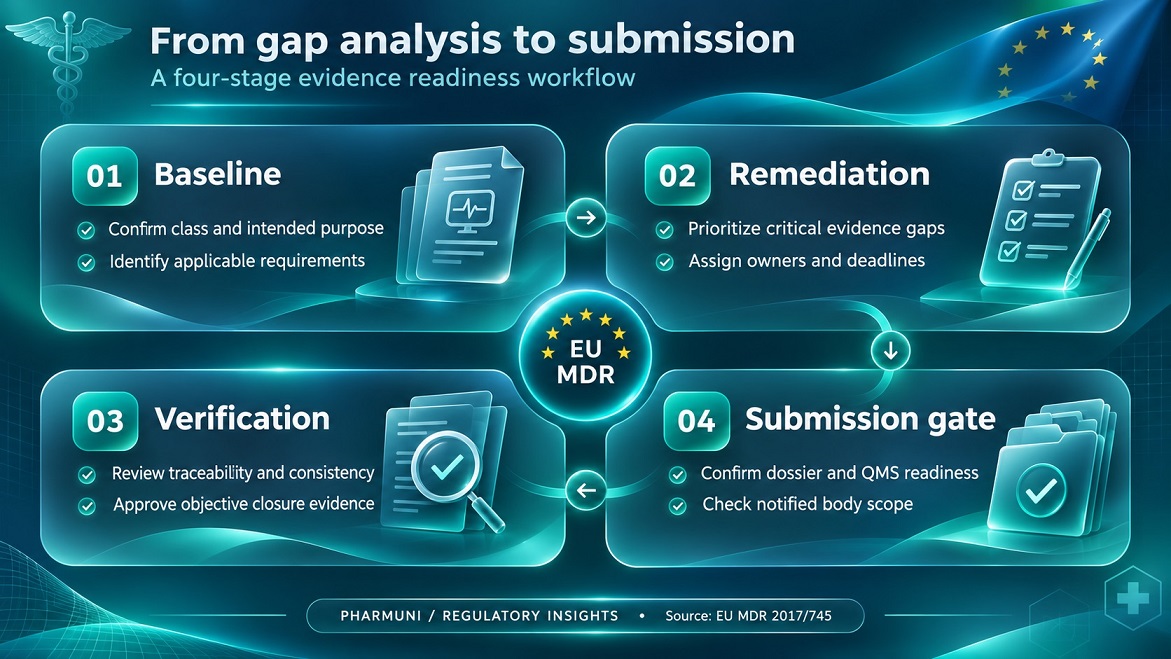
How to Choose EU MDR Certification Support
EU MDR certification support should combine relevant device experience, documented methods and clear project governance. Select a consultant who understands the intended technology and applicable conformity assessment pathway rather than relying solely on general regulatory credentials.
Confirm the notified body separately when its involvement is required. No consultant can guarantee certification or substitute for independent conformity assessment. The manufacturer must maintain ownership of compliance decisions and records.Select the Right Consultant and Notified Body
Evaluate candidates using relevant project examples, qualifications and their approach to complex evidence gaps. For notified body assessment, confirm designation scope and the suitability of the selected route.
- Request a scoped proposal and sample deliverables.
- Define responsibilities, escalation and review milestones.
For eligible legacy devices, verify Article 120 transition conditions before using extended deadlines in the project plan. The 2027 and 2028 dates depend on device category and eligibility.
Integrate ISO 13485, PMS and EUDAMED Controls
A sustainable compliance model connects QMS processes with post-market surveillance, clinical evaluation and risk management. Assign responsibility for complaints, trend evaluation, CAPA and regulatory reporting.
- Review PMS outputs and class-specific reporting schedules.
- Maintain controlled actor and UDI/device data where required.
The Commission confirms that four EUDAMED modules became mandatory on 28 May 2026: Actor, UDI/Devices, Notified Bodies and Certificates, and Market Surveillance. Apply the obligations relevant to each actor and device.
Practical MDR Readiness Checklist
Use this compact checklist as a management review tool. The proposed gates are internal project controls, not additional legal requirements.
Record the evidence and responsible person for each workstream before advancing to the next milestone.
Key MDR readiness checkpoints
| Workstream | Evidence to review | Readiness gate |
|---|---|---|
|
Classification |
Intended purpose and Annex VIII rationale |
Route justified |
|
Technical / clinical |
GSPR matrix, tests, CER and PMCF |
Critical gaps closed |
|
Lifecycle / QMS |
PMS, CAPA, registration and QMS records |
Owners and controls verified |
Final words
An EU MDR consultant adds the most value when regulatory risks are identified before they become expensive redesigns, evidence gaps or market access problems. Manufacturers should connect classification, technical documentation, clinical evaluation and quality management through a single risk-based strategy rather than treating certification as an isolated administrative task.
With 52 MDR-designated notified bodies reported in the February 2026 Commission survey, choosing a suitable assessment partner remains important. Combine expert guidance with internal accountability, measurable readiness gates and continuous surveillance to protect patient safety and maintain sustainable compliance across the product lifecycle.
FAQs
A consultant helps assess regulatory requirements, identify gaps, plan evidence generation and prepare for conformity assessment. The manufacturer remains responsible for compliance.
There is no universal fee. Costs vary by device class, scope, evidence gaps and engagement model. Request a detailed quotation that separates consulting from testing and assessment fees.
No. A designated notified body issues applicable MDR certificates. Manufacturers affix CE marking after completing the applicable conformity assessment and declaration of conformity.
References

Ershad Moradi, a Content Marketing Specialist at Zamann Pharma Support, brings 6 years of experience in the pharmaceutical industry. Specializing in pharmaceutical and medical technologies, Ershad is currently focused on expanding his knowledge in marketing and improving communication in the field. Outside of work, Ershad enjoys reading and attending industry related networks to stay up-to-date on the latest advancements. With a passion for continuous learning and growth, Ershad is always looking for new opportunities to enhance his skills and contribute to pharmaceutical industry. Connect with Ershad on Facebook for more information.

EU MDR Consultant: Powerful Ways to Overcome Hidden Risks
Learn how to choose an EU MDR consultant, avoid costly compliance mistakes, and streamline your medical device regulatory journey.

GMP Cleaning Services: Hidden Risks That Threaten Pharmaceutical Compliance
GMP cleaning services are more than routine housekeeping. In pharmaceutical manufacturing, cleaning must control contamination, protect product quality, and produce documented evidence that procedures are consistently performed and effective.

FDA Form 483 Response: A Practical Guide to Inspection Remediation
An FDA Form 483 response is more than a corrective-action letter. Learn how to assess observations, investigate systemic causes, build credible CAPA, and present evidence that demonstrates sustainable control.
Lorem ipsum dolor sit amet, consectetur adipiscing elit. Ut elit tellus, luctus nec ullamcorper mattis, pulvinar dapibus leo.