


An FDA Form 483 response gives a company an opportunity to explain how inspectional observations are being addressed with evidence, risk assessment, and corrective actions. A strong response does more than promise future fixes: it demonstrates control, defines scope, and connects each observation to sustainable remediation.
Within the pharma regulation, a response depends on the quality system, data, investigations, and CAPA. FDA states that Form 483 is not an agency determination, while firms have 15 business days to submit a response. FDA’s 2026 draft guidance recommends a structured approach.
Table of Contents
Definition, Purpose, and Regulatory Meaning of FDA Form 483
FDA Form 483 is an inspectional observations document presented to firm management at the conclusion of an FDA inspection when investigators observe conditions they believe may constitute violations of the Federal Food, Drug, and Cosmetic Act or related requirements. It is important to distinguish an observation from a final enforcement determination.
FDA explains that the Form 483 is considered together with the Establishment Inspection Report (EIR), evidence collected during the inspection, and the firm’s response when the agency determines whether further action is appropriate. A 483 is therefore a critical regulatory signal, but it is not itself a final finding of violation.
- Observation ≠ final determination
- Evidence must be traceable
- Scope matters
- CAPA must be systemic
Why the FDA Form 483 Response Matters
The response can help FDA understand what the firm has done, what remains open, how the issue affects product quality, and whether the problem is isolated or systemic. FDA’s current pharmaceutical inspection page states that firms generally have 15 business days to provide a voluntary response.
The response should not be written as a defensive argument. Its purpose is to communicate a controlled, evidence-based remediation strategy. Unsupported statements such as “we retrained the employee” are weak when the underlying system allowed the event to occur.
Common FDA Form 483 Response Challenges
A strong FDA Form 483 response addresses more than the record cited by the investigator. It shows the scope of the issue, any product impact, the cause, and how corrective actions will be verified. The four challenges below can weaken that evidence.
Challenge 1. Treating the Observation as an Isolated Event
A recurring failure is responding only to the exact record sampled by the investigator. A stronger approach evaluates whether the same failure could exist in other batches, products, departments, systems, sites, suppliers, or time periods.
Challenge 2. Weak Root Cause Analysis
A response that stops at human error, inadequate training, or procedural noncompliance may fail to address the management-system conditions that enabled the event. Root cause analysis should be proportionate to risk and supported by objective evidence.
Challenge 3. Promising CAPA Without Evidence
Future actions need owners, due dates, interim controls, deliverables, and effectiveness checks. If an action cannot be completed before submission, the response should explain its status and provide a credible implementation plan.
Challenge 4. Ignoring Product and Patient Impact
Where relevant, assess whether the observation affects distributed product, released batches, stability, complaints, recalls, data used for regulatory decisions, or other products. FDA’s 2026 draft guidance specifically recommends addressing scope and impact.
How to Respond to an FDA Form 483 in Three Stages
An effective response starts with a clear understanding of each observation. It then shows how the company protected product, investigated the wider issue, and addressed its cause. Finally, it connects every commitment to evidence and a realistic completion plan. FDA encourages companies to respond in writing and promptly implement their corrective actions.
Stage 1 — Understand the Observation and Protect Product
Bring the right functions together as soon as the inspection ends. Confirm what the investigator observed and which requirement may apply. At the same time, assess whether immediate controls are needed to protect patients, product, and records while the investigation continues.
- Assign a lead and create a controlled record for each observation.
- Verify the cited requirement against the observation and supporting records.
- Identify potentially affected product, processes, and decisions.
- Put interim controls in place and document who approved them.
Stage 2 — Investigate the Scope and Build the CAPA Plan
Look beyond the example FDA sampled. Determine whether the same condition affects other batches, products, departments, systems, sites, suppliers, or time periods. Use objective evidence to identify the underlying cause. Then link each corrective and preventive action to that cause and the risks found.
- Document the root cause and the evidence supporting it.
- Assess product and patient impact across the relevant scope.
- Assign CAPA owners, milestones, and deliverables.
- Define how effectiveness will be checked after implementation.
Stage 3 — Support, Approve, and Submit the Response
Build a response that clearly separates completed actions from planned work. Attach relevant records and explain any actions still in progress. Before submission, have Quality and authorized leadership check that the response is accurate, consistent, and achievable. Track outstanding commitments after the response is sent.
- Organize evidence by observation and action.
- Include completed records, investigation results, and interim controls.
- Give target dates and progress updates for unfinished actions.
- Review the response for accuracy, confidentiality, and approval.
How to Structure Each Observation Response
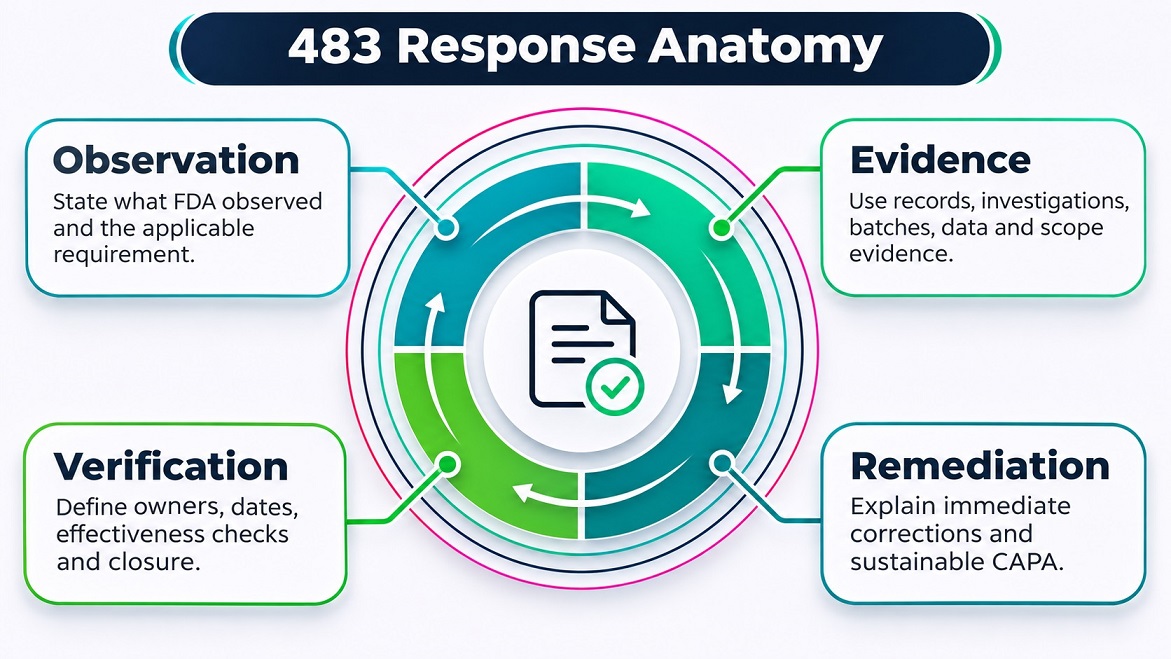
FDA’s March 2026 draft guidance recommends that a response be accurate, clear, concise, well organized, and comprehensive. It also recommends a table of contents and discussion of the observations, supporting evidence, remediation, and underlying issues.
- Observation restatement
- Management position
- Immediate correction
- Root cause and systemic assessment
- Product/patient impact
- CAPA and remediation plan
- Supporting evidence
- Milestones and completion dates
- Effectiveness verification
What Evidence Should Be Included in FDA 483 Obvervation?
Evidence should demonstrate that the company has actually controlled the problem or has a credible, documented plan to do so. The evidence package should be proportional to the observation and should reconcile with the inspection record.
FDA Form 483 Response Evidence: What to Include and How to Verify It
| Evidence type | Purpose | Example | Quality check |
|---|---|---|---|
|
Investigation |
Explain cause and scope |
Deviation/RCA report |
Approved and traceable |
|
CAPA |
Prevent recurrence |
CAPA record |
Owner + due date |
|
Procedure |
Control the process |
Revised SOP |
Effective version |
|
Training |
Demonstrate implementation |
Training records |
All affected roles |
Move From Correction to Sustainable Control
A correction fixes the immediate condition. Corrective action addresses the cause of a detected nonconformity, while preventive actions address potential recurrence or related risks. A mature response distinguishes these concepts and shows how the quality system will remain in control after the inspection closes.
Effectiveness checks should be defined before CAPA closure. Depending on the issue, this could involve trend review, targeted record review, repeat audit, process monitoring, validation evidence, complaint trends, or other objective measures.
- Immediate correction
- Root cause
- CAPA
- Effectiveness check
FDA 483 Response vs Warning Letter
A Form 483 does not automatically become a Warning Letter. FDA reviews the inspection record, evidence, the EIR, and the firm’s response before determining what further action, if any, is appropriate. A Warning Letter may be issued when FDA identifies significant violations and communicates concerns that require correction.
This distinction matters when writing the response. The goal is not to “argue away” every observation. The stronger strategy is to accurately establish the facts, address legitimate deficiencies, demonstrate risk control, and provide a credible path to sustainable compliance.
What Not to Write in an FDA 483 Response
Avoid These Weak Patterns
- “The employee was retrained, so the issue is closed.”
- “This was an isolated incident” without a documented scope assessment.
- “We will improve the procedure” without identifying the specific control gap.
- “No product impact” without a documented impact assessment.
- “CAPA will be completed soon” without owner, milestone, due date, and effectiveness criteria.
- Long explanations that do not directly answer the observation.
Final words
An FDA Form 483 response is a regulatory communication and a test of the site’s quality maturity. The strongest responses connect every observation to facts, risk, root cause, remediation, and objective evidence. Companies should use the response window to demonstrate control rather than simply defend the past.
By combining accurate investigation, meaningful CAPA, systemic assessment, and disciplined evidence management, a firm can give FDA a clearer picture of how it is protecting product quality and sustaining CGMP compliance.
FAQs
FDA’s current pharmaceutical inspection page states that a company generally has 15 business days to provide a voluntary response. The inspection close-out instructions and applicable circumstances should always be checked.
A strong response should address each observation, explain corrections and underlying causes, assess scope and product impact where relevant, describe CAPA and timelines, and provide objective supporting evidence.
The response should address the observation and its underlying issue. Whether a formal CAPA is required depends on the site’s quality system, risk assessment, investigation results, and applicable requirements.
References

Ershad Moradi, a Content Marketing Specialist at Zamann Pharma Support, brings 6 years of experience in the pharmaceutical industry. Specializing in pharmaceutical and medical technologies, Ershad is currently focused on expanding his knowledge in marketing and improving communication in the field. Outside of work, Ershad enjoys reading and attending industry related networks to stay up-to-date on the latest advancements. With a passion for continuous learning and growth, Ershad is always looking for new opportunities to enhance his skills and contribute to pharmaceutical industry. Connect with Ershad on Facebook for more information.

FDA Form 483 Response: A Practical Guide to Inspection Remediation
An FDA Form 483 response is more than a corrective-action letter. Learn how to assess observations, investigate systemic causes, build credible CAPA, and present evidence that demonstrates sustainable control.

Medical Device Test Method Validation: Guide for Reliable Results
Medical device test method validation proves that a test method is fit for its intended use. This practical guide covers QMSR, ISO 13485, risk-based validation, measurement variation, documentation, and lifecycle control.

21 CFR Part 210 vs 211: What Every QA Professional Needs to Get Right
21 CFR Part 210 vs 211 is more than a regulatory numbering question. Learn how the two FDA cGMP parts work together and what QA teams must control, document, investigate, and defend during inspection.
Lorem ipsum dolor sit amet, consectetur adipiscing elit. Ut elit tellus, luctus nec ullamcorper mattis, pulvinar dapibus leo.