


GMP cleaning services are part of pharmaceutical contamination control, covering cleaning and sanitation of manufacturing areas, equipment, utilities, and product-contact surfaces. The objective is not simply to make a facility look clean; it is to reduce residues, microorganisms, particulates, and cross-contamination risks.
Within the quality system, Good Manufacturing Practices (GMP) connect cleaning activities with validated procedures, trained personnel, documentation, and quality oversight. WHO states that GMP minimizes production risks, while FDA requirements such as 21 CFR 211.67 require equipment to be cleaned at intervals to prevent contamination affecting drug quality.
Table of Contents
What Are GMP Cleaning Services?
GMP cleaning services are controlled cleaning activities performed under pharmaceutical quality requirements to maintain premises, equipment, and other relevant surfaces in a state suitable for manufacturing. Depending on the facility, the scope can include production rooms, corridors, warehouses, equipment exteriors, product-contact surfaces, cleanrooms, controlled areas, and specialized systems.
The defining difference from conventional commercial cleaning is the evidence system around the work. A GMP program must connect the cleaning method to an approved SOP, trained personnel, defined materials, equipment status, records, inspection criteria, and—where applicable—cleaning validation or verification.
WHO describes GMP as part of quality assurance that ensures medicinal products are consistently produced and controlled to appropriate quality standards. WHO also emphasizes sanitation and hygiene across personnel, premises, equipment, materials, and cleaning or disinfection products.
- Validated procedures
- Trained operators
- Controlled chemicals
- Traceable records
GMP Cleaning Importance in Pharmaceutical Manufacturing
Cleaning is a contamination-control activity. A residue left on shared equipment can become carryover into the next product; a poorly controlled cleaning chemical can introduce another contaminant; and moisture or inaccessible surfaces can create conditions favorable to microbial growth. WHO identifies prevention of contamination and cross-contamination as core GMP objectives.
FDA’s CGMP requirements specifically address equipment cleaning and maintenance in 21 CFR 211.67. FDA explains that cleaning procedures should be adequate to prevent contamination that could alter the safety, identity, strength, quality, or purity of a drug product.
- Patient protection
- Cross-contamination control
- Batch integrity
- Inspection readiness
Core Challenges in GMP Cleaning Services
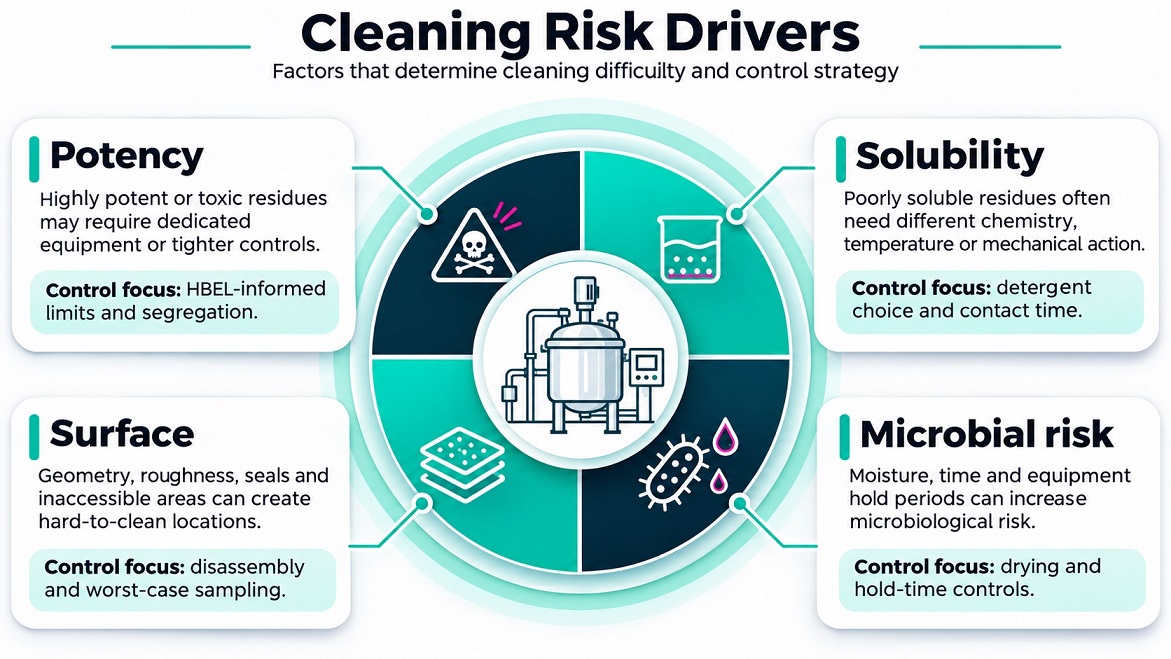
The hardest cleaning problems are rarely solved by adding more labor alone. They usually require understanding the residue, equipment design, cleaning chemistry, mechanical action, temperature, time, operator technique, and sampling strategy.
- Highly potent or toxic residues may require dedicated equipment or enhanced containment.
- Poorly soluble, sticky, oily, or degraded residues may need specialized cleaning development.
- Complex equipment geometries can create hard-to-clean locations and sampling challenges.
- Manual cleaning is inherently variable, so operator training and periodic supervision are important.
- Outsourced services can create gaps if responsibilities, change control, deviations, and QA oversight are not clearly defined.
EU GMP Annex 15 states that cleaning procedures should follow carefully established and validated methods, while cleaning records should identify the area or equipment, operator, time, SOP, and previously processed product.
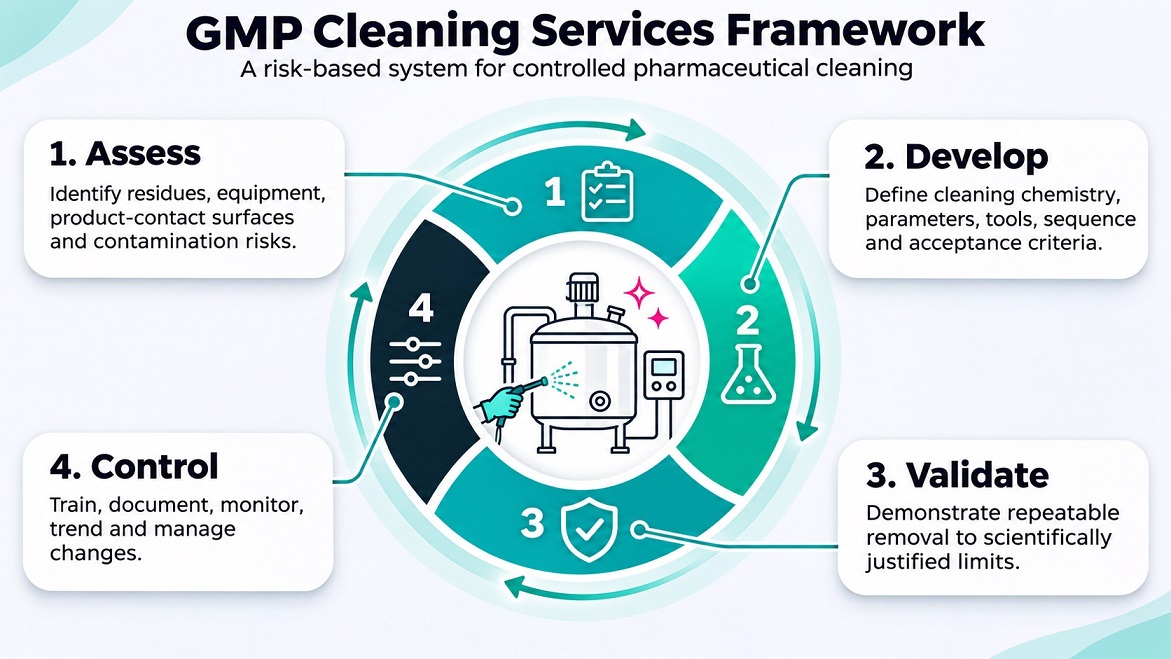
The 7 Steps of a GMP Cleaning Program
A GMP cleaning program should show that cleaning methods protect products and remain effective in routine use. Start by identifying contamination risks, then define a repeatable method and justified limits. Validation establishes that the method works; monitoring, training, and change control help keep it under control.
Step 1 — Define Scope and Risk
Identify the rooms, equipment, product-contact surfaces, and activities covered by the program. Assess product residues, cleaning agents, microbial risks, and areas that are difficult to clean. Include outsourced cleaning where relevant. Use the assessment to prioritize equipment and locations that need the strongest controls.
- List equipment, surfaces, and cleaning responsibilities.
- Identify products and residues handled in shared areas.
- Assess hard-to-clean locations and contamination routes.
- Document the risk map and its rationale.
Step 2 — Develop the Cleaning Method
Write a procedure that operators can follow consistently. Define the cleaning sequence, agent and concentration, temperature, contact time, mechanical action, rinsing, and drying. Include equipment disassembly, status labeling, and dirty and clean hold times where applicable. Record the parameters that could affect cleaning performance.
Step 3 — Establish Acceptance Criteria
Set justified limits before validation begins. Consider product residues, cleaning agents, and microbial or endotoxin risks where applicable. Toxicological evaluation and health-based exposure limits (HBELs) can inform carryover decisions; document how these relate to practical cleaning limits and maximum allowable carryover (MACO). An HBEL should not automatically become the cleaning limit.
Step 4 — Validate the Cleaning Process
Use an approved protocol to demonstrate that the cleaning method meets its predefined criteria. Select representative equipment and justify any grouping or worst-case choices. Identify sampling locations, methods, and recovery expectations. Perform a risk-justified number of successful cleaning runs and investigate any failure.
– Approve the protocol before execution.
– Justify equipment, products, and sampling locations.
– Use suitable swab, rinse, or other sampling methods.
– Compare every run with the acceptance criteria.
Step 5 — Verify Routine Performance
After validation, confirm that cleaning continues to work under normal operating conditions. Use visual inspection, analytical sampling, or other controls according to documented risk. Trend results and investigate adverse patterns. For shared facilities, any decision to reduce analytical testing at product changeover needs a robust, documented justification.
- Check equipment status before use.
- Record visual inspections and required test results.
- Trend residue and microbiological data where relevant.
- Investigate excursions and confirm corrective action works.
Step 6 — Control People and Materials
Train personnel to perform the approved method, including disassembly, difficult locations, inspection, and documentation. Control cleaning agents, tools, PPE, and gowning so they are suitable and used correctly. Pay particular attention to manual cleaning, where differences between operators can affect the result.
Step 7 — Manage Change and CAPA
Review the cleaning strategy when a product, equipment item, detergent, procedure, limit, or facility changes. Also respond to deviations, repeated excursions, and adverse trends. Assess the impact before implementation, decide whether verification or revalidation is needed, and check that corrective actions restore control.
- Record and assess proposed changes.
- Review their effect on limits and validated conditions.
- Investigate deviations and recurring failures.
- Document CAPA effectiveness and revalidation decisions.
Cleaning Validation and Verification
Cleaning validation demonstrates through documented evidence that a cleaning procedure consistently reduces residues and contaminants to predefined acceptance limits. Routine cleaning verification confirms that the established cleaning procedure has been performed effectively and that applicable acceptance criteria are met during ongoing operations.
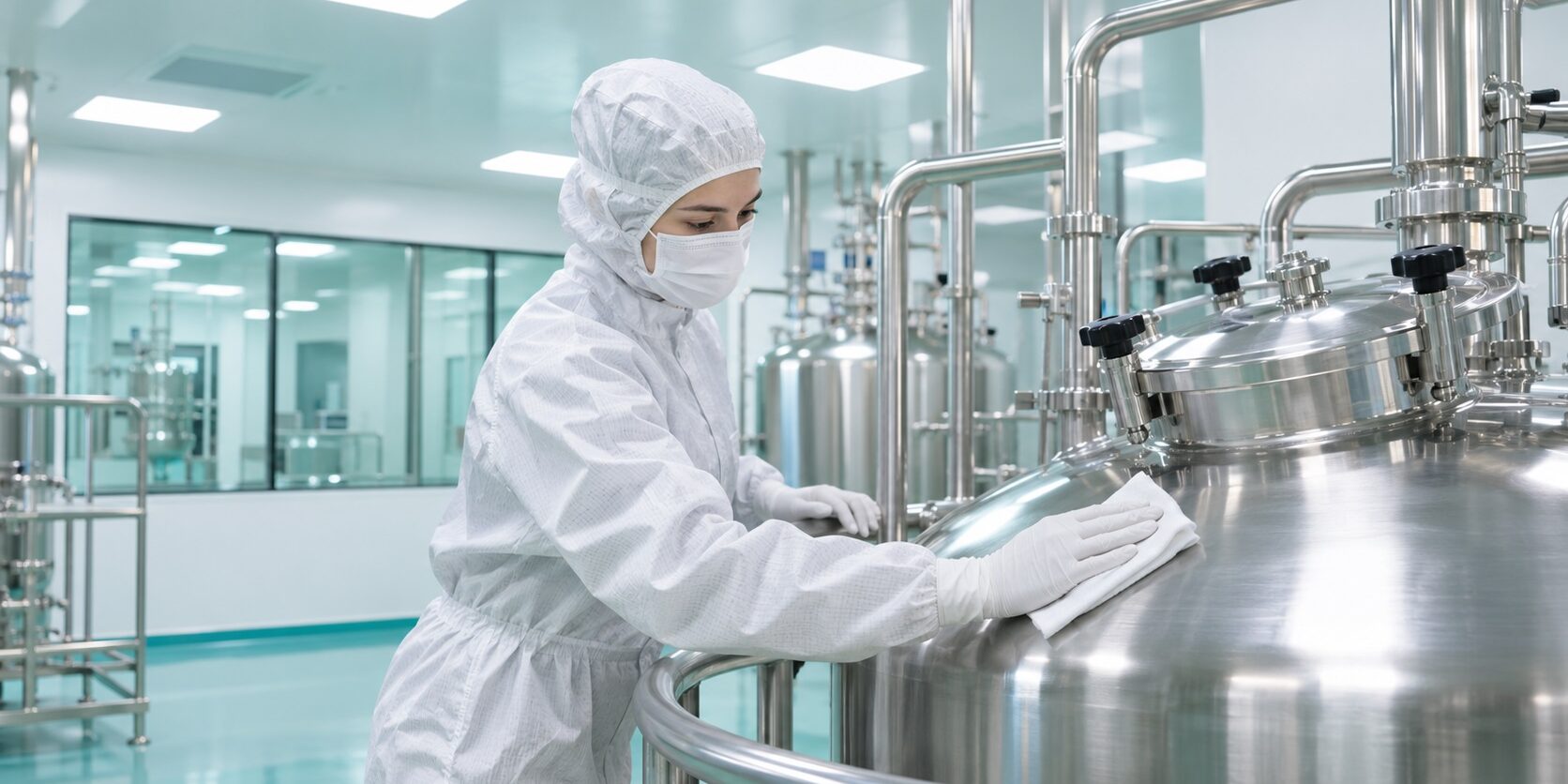
Cleaning Validation Provides Documented Evidence
Cleaning validation is documented evidence that an approved cleaning procedure consistently produces equipment suitable for its intended use. EU GMP Annex 15 describes this principle and states that cleaning procedures for product changeover should be fully validated. WHO similarly describes cleaning validation as evidence that equipment is consistently cleaned of product, detergent, and microbial residues to acceptable levels.
FDA’s inspection guide expects firms to define responsibilities, acceptance criteria, revalidation triggers, sampling procedures, analytical methods, protocols, and final reports. FDA also states that the scientific data should demonstrate that the cleaning system consistently meets predetermined specifications.
Sampling and Analytical Controls
Sampling should be designed around the risk and the equipment. Swab sampling can directly assess selected surfaces, while rinse sampling can help evaluate larger or inaccessible areas when the rinse solvent and recovery have been demonstrated to be suitable. FDA notes that rinse sampling alone is not always sufficient and recommends direct surface measurement when feasible.
- Swab recovery
- Rinse recovery
- Analytical sensitivity
- Worst-case locations
- Visual inspection
HBEL, MACO and Risk-Based Limits
Modern cleaning programs increasingly use health-based exposure limits (HBELs) and scientifically justified carryover calculations to define acceptable residue limits. The calculation should be supported by toxicological and pharmaceutical knowledge and should consider the most hazardous relevant residue rather than selecting limits simply because they are easy to measure.
WHO guidance on HBELs emphasizes documented risk management, appropriate equipment coverage, justified surface-area calculations, and cleaning validation master plans.
What a GMP Cleaning Service Provider Should Deliver
Service Scope and Quality Documentation
- Approved cleaning SOPs and task instructions
- Personnel qualification and training records
- Controlled cleaning agents with documented specifications
- Equipment and tool identification
- Cleaning logs and completed records
- Deviation and incident reporting
- Change-control participation
- Cleaning validation or verification support where contracted
- Trend reports and periodic performance review
- Clear escalation to the pharmaceutical site’s QA function
A contractor can perform cleaning activities, but the pharmaceutical manufacturer’s quality system remains responsible for ensuring outsourced activities are appropriately defined, controlled, and monitored. Contract responsibilities should therefore be explicit in quality or technical agreements.
GMP Cleaning Controls: Evidence and QA Focus
| Control area | What to define | Evidence | QA focus |
|---|---|---|---|
|
Cleaning SOP |
Sequence, chemistry, parameters |
Approved SOP |
Current version |
|
Personnel |
Training, qualification, supervision |
Training records |
Competency |
|
Validation |
Protocol, limits, sampling |
Report + raw data |
Scientific rationale |
|
Routine control |
Inspection and monitoring |
Logs/trends |
Continued state |
Inspection Readiness: Questions QA Should Be Able to Answer
An inspection-ready cleaning program connects risk assessment, cleaning development, SOPs, validation, training, execution, deviations, analytical results, and change control. If the written procedure says one thing while operators perform another, the gap can undermine confidence in the entire control strategy.
- Why was this cleaning method selected?
- Which residues are worst case and why?
- How were limits scientifically justified?
- Where are the hardest-to-clean locations?
- How was analytical recovery demonstrated?
- When is revalidation required?
- How are cleaning deviations investigated?
- How does QA verify continued effectiveness?
Final words
GMP cleaning services are a quality-control activity, not simply a facility-support function. Effective pharmaceutical cleaning connects contamination control, validated methods, trained personnel, scientifically justified limits, reliable sampling, and complete documentation.
A strong program does more than pass a visual inspection: it demonstrates that equipment and areas remain suitable for their intended use and that the risk of cross-contamination is controlled. When cleaning is treated as a lifecycle process—supported by risk assessment, validation, routine monitoring, change control, and CAPA—it becomes a defensible part of the pharmaceutical quality system.
FAQs
No. The need and extent should be risk-based. Critical product-contact cleaning and product changeovers generally require strong validation or verification evidence, while some non-critical cleaning may not require formal validation.
Validation establishes documented evidence that a defined cleaning process can consistently meet predetermined criteria. Verification is ongoing or periodic evidence that the validated state continues to perform as intended.
Yes, but responsibilities must be clearly defined and the pharmaceutical manufacturer’s quality system must appropriately qualify, control, and monitor the outsourced activity.
References
1-WHO — Medicines: Good manufacturing practices (GMP).
2-WHO — Good Manufacturing Practices for pharmaceutical products, TRS 986 Annex 2.
3-WHO — Good manufacturing practices: guidelines on validation, TRS 1019 Annex 3.
4-FDA — Questions and Answers on Current Good Manufacturing Practice Requirements: Equipment.
5-FDA — Guide to Inspections: Validation of Cleaning Processes.
6-European Commission — EU GMP Annex 15: Qualification and Validation.
7-WHO — Points to consider when including HBELs in cleaning validation.
Ershad Moradi, a Content Marketing Specialist at Zamann Pharma Support, brings 6 years of experience in the pharmaceutical industry. Specializing in pharmaceutical and medical technologies, Ershad is currently focused on expanding his knowledge in marketing and improving communication in the field. Outside of work, Ershad enjoys reading and attending industry related networks to stay up-to-date on the latest advancements. With a passion for continuous learning and growth, Ershad is always looking for new opportunities to enhance his skills and contribute to pharmaceutical industry. Connect with Ershad on Facebook for more information.
GMP Cleaning Services: Hidden Risks That Threaten Pharmaceutical Compliance
GMP cleaning services are more than routine housekeeping. In pharmaceutical manufacturing, cleaning must control contamination, protect product quality, and produce documented evidence that procedures are consistently performed and effective.
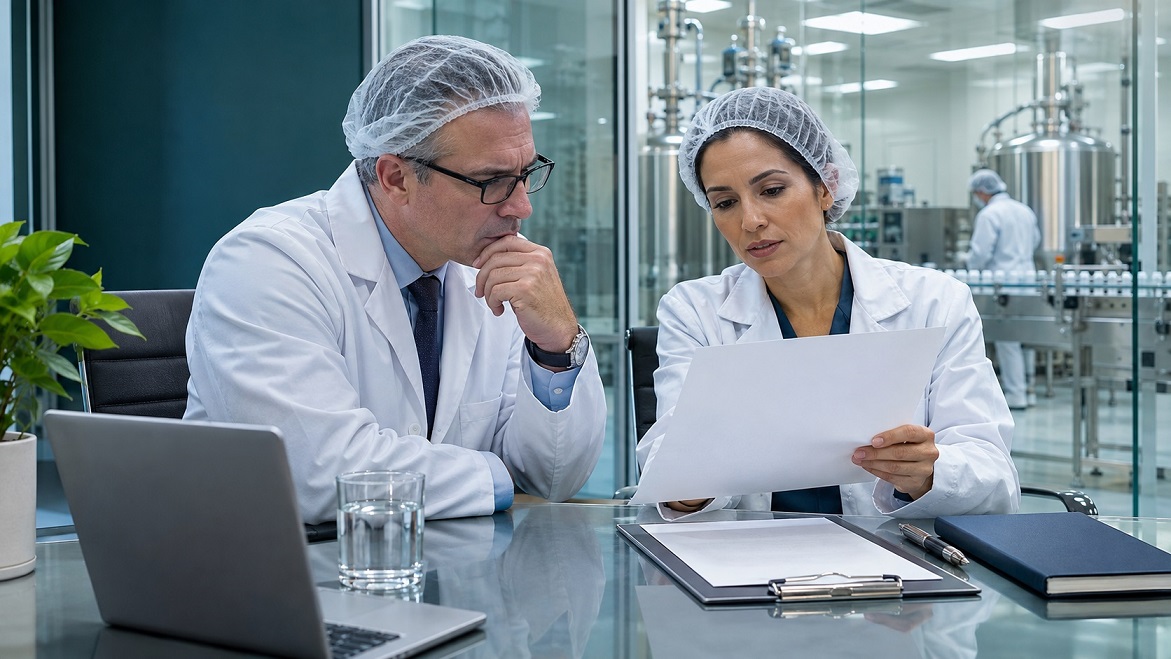
FDA Form 483 Response: A Practical Guide to Inspection Remediation
An FDA Form 483 response is more than a corrective-action letter. Learn how to assess observations, investigate systemic causes, build credible CAPA, and present evidence that demonstrates sustainable control.
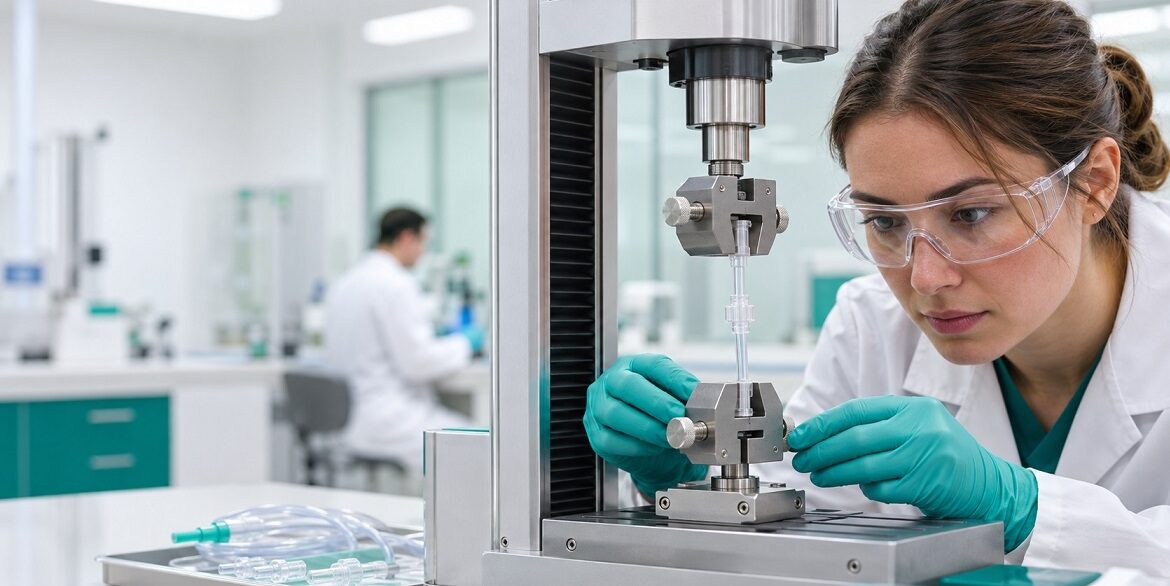
Medical Device Test Method Validation: Guide for Reliable Results
Medical device test method validation proves that a test method is fit for its intended use. This practical guide covers QMSR, ISO 13485, risk-based validation, measurement variation, documentation, and lifecycle control.
Lorem ipsum dolor sit amet, consectetur adipiscing elit. Ut elit tellus, luctus nec ullamcorper mattis, pulvinar dapibus leo.