


Medical device test method validation is the demonstration that a testing procedure is fit for its intended use and can generate reliable evidence for process decisions. Weak methods can create false pass or fail results, affecting safety, performance, release decisions, and regulatory submissions.
As manufacturers strengthen systems, Pharma Validation principles provide discipline for defining intended use, risk, acceptance criteria, statistical evidence, and lifecycle controls. FDA’s Quality Management System Regulation (QMSR) became effective February 2, 2026, incorporating ISO 13485:2016 into 21 CFR Part 820 and changing quality system and inspection expectations.
Table of Contents
What Is Medical Device Test Method Validation?
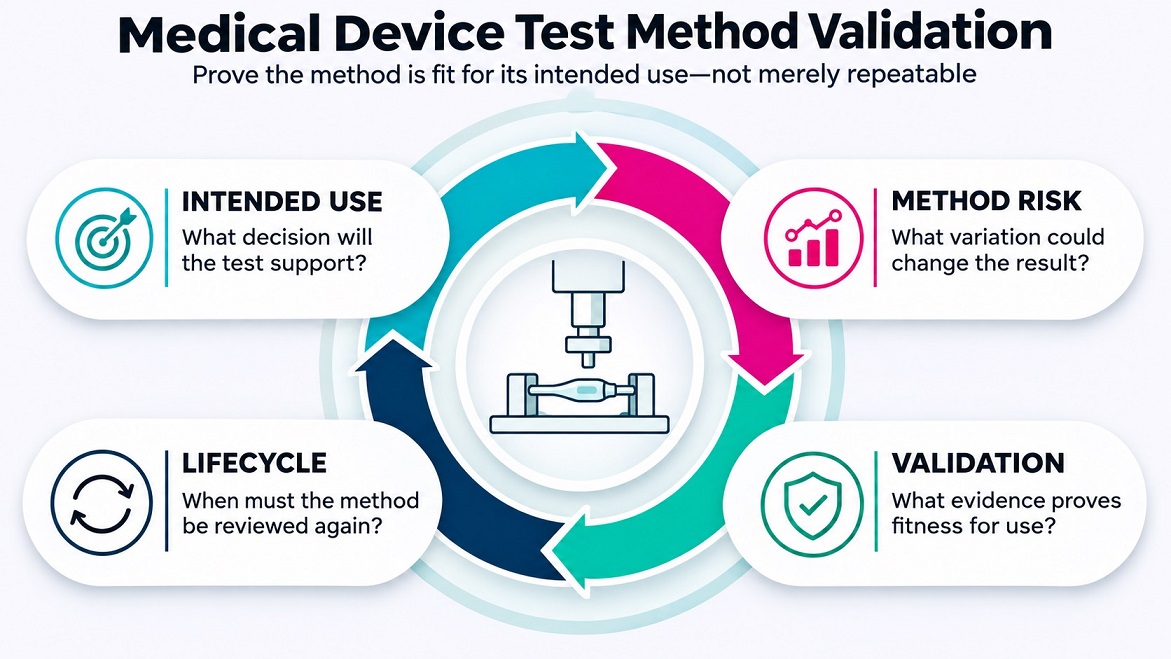
Medical device test method validation (TMV) is the documented process of establishing, with objective evidence, that a test method is suitable for its intended purpose. The question is not simply whether a laboratory can obtain a result; it is whether the method can reliably support the specific decision for which the result will be used.
The method may be quantitative or qualitative, destructive or non-destructive, laboratory-based or production-facing. Examples include dimensional measurement, tensile strength, leakage, particulate testing, bioburden, bacterial endotoxin testing, package integrity, electrical performance, and functional testing.
A published standard does not automatically make the laboratory’s implementation valid. ISO 11607-2 explicitly requires test methods used to demonstrate conformity to be validated and documented by the laboratory performing the test, including repeatability, reproducibility, and sensitivity for integrity tests.
Why it matters:
- Patient safety
- Reliable decisions
- Regulatory evidence
- Reduced false failures
Test Method Validation Under the 2026 QMSR
The regulatory context changed materially on February 2, 2026. FDA’s QMSR amended 21 CFR Part 820 and incorporated ISO 13485:2016 by reference. FDA also moved away from the former QSIT inspection model to the inspection process described in Compliance Program.
This does not mean every medical device test automatically requires a standalone validation study with the same parameters. The scope and rigor should be justified by intended use, risk, method characteristics, applicable standards, regulatory commitments, and the consequences of an incorrect result.
For test and measurement equipment, the legacy 21 CFR 820.72 language required equipment to be suitable for its intended purpose and capable of producing valid results, with calibration and documentation controls. Under the current QMSR, manufacturers should map their procedures and evidence to the applicable ISO 13485 requirements and retained FDA provisions rather than relying on obsolete QSR terminology alone.
Core Validation Characteristics
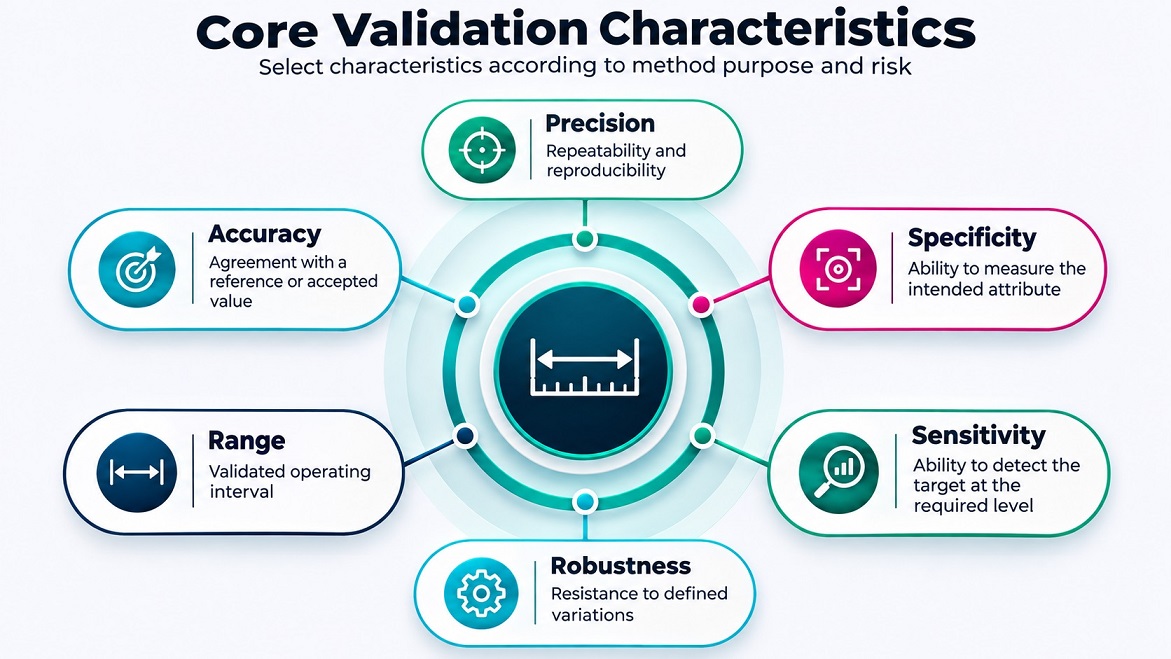
The performance characteristics selected for a validation should match what the method is intended to measure and the decision it supports. A dimensional test, microbial recovery method, packaging integrity method, and functional performance test will not necessarily require identical studies.
Accuracy and Bias
Accuracy addresses agreement between the observed result and an accepted reference or known value. Where a suitable reference exists, the validation plan should define how bias will be estimated and what level is acceptable.
Precision: Repeatability and Reproducibility
Repeatability examines variation under closely controlled conditions, while reproducibility examines variation when relevant factors such as operators, days, instruments, laboratories, or other conditions change.
Specificity and Selectivity
The method should demonstrate that it measures the intended attribute without unacceptable interference from the device, materials, matrix, fixtures, environmental conditions, or other factors.
Range, Robustness, and Sensitivity
Range defines the validated operating interval. Robustness examines whether controlled variations materially affect the result. Sensitivity is particularly important for detection or integrity methods.
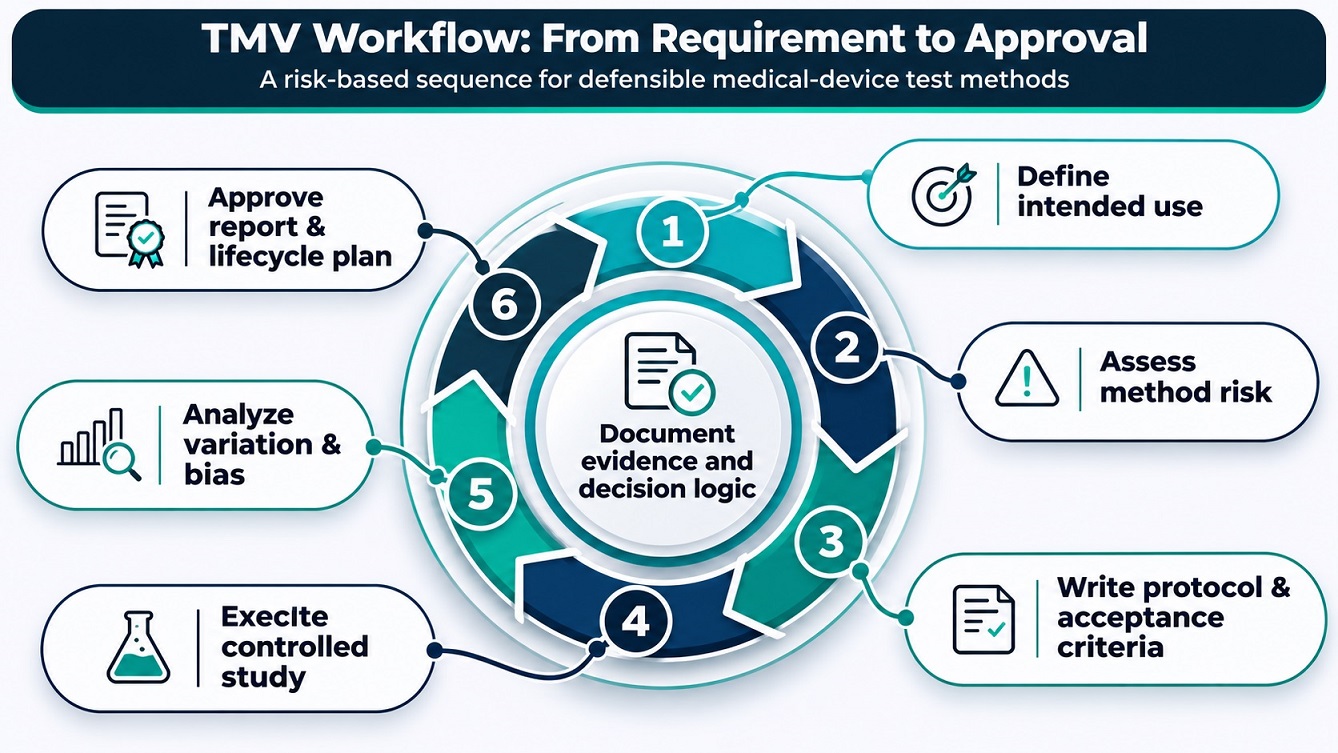
A Practical Medical Device Test Method Validation Process
A strong validation begins before experimental work. The protocol should make the intended use, method scope, risk rationale, sample strategy, variables, acceptance criteria, statistical approach, deviations, and approval responsibilities explicit.
Phase 1 — Define the Intended Use and Decision
Describe what the method measures, the devices or materials it covers, and the conditions under which it will be used. Identify the decision the result supports, such as accepting a component or confirming a performance specification. This scope sets the basis for choosing relevant validation characteristics and acceptance criteria.
Phase 2 — Assess Method Risk and Criticality
Consider what could happen if the method produces an incorrect result. A false acceptance could allow a nonconforming device to pass; a false rejection could discard acceptable product. Assess these consequences alongside method complexity and likely sources of variation. Use the documented rationale to determine the study’s depth.
- Identify the decision that depends on the result.
- Compare the consequences of false acceptance and false rejection.
- List likely sources of measurement variation.
- Justify the validation characteristics selected.
Phase 3 — Predefine the Validation Protocol
Write the protocol before generating validation data. Specify the test procedure, representative samples, study conditions, operators, instruments, and characteristics to evaluate. Set acceptance criteria and the analysis plan in advance, and explain how deviations will be documented and assessed. The protocol should make the final conclusion traceable to planned evidence.
- Define sample selection and justify sample size.
- Specify relevant operators, instruments, and conditions.
- Set acceptance criteria for each characteristic.
- Predefine calculations and statistical methods.
- Assign responsibilities for execution, review, and approval.
Phase 4 — Verify Measurement System Readiness
Check the full measurement setup before the study begins. Confirm that equipment and fixtures suit the intended test, calibration is current, software is appropriately controlled, and operators are trained. Record relevant environmental conditions and identify each test specimen. Readiness checks help distinguish method variability from problems with the setup.
Phase 5 — Execute and Preserve the Study Evidence
Perform the experiments as approved, using representative conditions and justified challenging conditions where relevant. Record results as they occur, including unexpected or anomalous findings. Document protocol deviations and assess whether they affect the data or conclusions. Retain enough detail to reconstruct what was tested, how, and by whom.
- Identify specimens, operators, instruments, and test dates.
- Capture original readings and relevant observations.
Phase 6 — Analyze Results and Decide Fitness for Use
Apply the predefined analysis to every relevant result. Depending on the method, evaluate characteristics such as accuracy, bias, repeatability, reproducibility, robustness, or operating range. Compare findings with the approved criteria, investigate failures, and assess the impact of deviations. Conclude whether the evidence supports the method’s stated intended use.
Phase 7 — Approve and Control the Method Lifecycle
Summarize the study in a report that links the intended use, protocol, results, deviations, and conclusion. Obtain approval from authorized reviewers before routine use. Define how performance will be monitored and which changes require assessment. A new instrument, site, operator population, or method revision may trigger transfer work or revalidation.
- Approve the report and controlled test procedure.
- Set routine checks and monitoring limits.
- Define change assessment triggers.
- Document transfer or revalidation decisions.
Test Method Validation vs Measurement System Analysis
Measurement system analysis (MSA) examines how much variation comes from the measurement system and its components. Test method validation is broader: it establishes that the complete method is fit for its intended purpose. Depending on the method, MSA tools such as gauge R&R can provide important evidence, but a complete TMV may also require accuracy, bias, specificity, robustness, sensitivity, method suitability, or other studies.
A common failure is to validate the instrument while leaving the method itself poorly controlled. A calibrated instrument cannot compensate for ambiguous sample preparation, uncontrolled fixtures, operator-dependent steps, inadequate environmental controls, or poorly defined acceptance criteria.
• Instrument
• Procedure
• Operator
• Environment
• Data analysis
Examples of Medical Device Test Methods
Packaging and Sterile Barrier Testing
For sterile barrier systems, ISO 11607-2 provides a particularly clear validation expectation: methods used to demonstrate conformity must be validated and documented by the testing laboratory. The standard specifically identifies repeatability, reproducibility, and sensitivity for integrity tests as validation elements.
- Seal strength
- Package integrity
- Leak detection
- Visual inspection
Microbiological and Endotoxin Methods
Microbiological methods can introduce product-specific interference and recovery challenges. FDA enforcement history shows that inadequate validation of bacterial endotoxin and bioburden methods can become a significant compliance issue. In a 2023 warning letter, FDA cited failures involving BET and bioburden test method validation, including invalid runs and unvalidated calculation changes.
- Recovery
- Interference
- Controls
- Invalid runs
Common Validation Challenges and Failure Modes
1. Validating the Wrong Question
A protocol can be statistically sophisticated yet fail to demonstrate fitness for the actual intended use. Start with the decision the method supports, then define the performance characteristics that matter.
2. Using a Standard Without Verifying the Laboratory Implementation
A standard method provides a framework, but the laboratory’s instruments, fixtures, sample preparation, operators, environmental conditions, and software can change performance. Verify or validate the actual implementation.
3. Weak Acceptance Criteria
Acceptance criteria should be justified before testing. Post-hoc limits create a risk that the study is being interpreted to fit the observed results rather than demonstrating a pre-defined requirement.
4. Ignoring False Acceptance and False Rejection
The consequences of method error are asymmetric. A method that passes defective devices can create patient risk; a method that rejects conforming devices can create waste and supply disruption.
5. Poor Change and Revalidation Control
A method can become unsuitable after changes to device design, materials, software, fixtures, instruments, sample preparation, laboratories, or acceptance criteria. Define triggers for impact assessment and revalidation before changes are implemented.
What Should the Validation File Demonstrate?
An inspection-ready package should tell a coherent story from requirement to conclusion. FDA states that manufacturers should be prepared after QMSR implementation to discuss and provide records demonstrating compliance with the QMSR.
- Intended use and scope
- Risk assessment
- Approved protocol
- Equipment and calibration evidence
- Training records
- Raw data
- Statistical analysis
- Deviations and investigations
- Validation report
- Approval
- Change/revalidation criteria
Method lifecycle triggers
| Change | Potential impact | Initial action | Possible outcome |
|---|---|---|---|
|
Device design |
Method response |
Impact assessment |
Revalidate if needed |
|
Instrument |
Measurement variation |
Calibration / study |
Verification or revalidation |
|
Lab transfer |
Reproducibility |
Transfer protocol |
Comparability evidence |
|
Software / calculation |
Data integrity |
Change assessment |
Regression / revalidation |
Final words
Medical device test method validation is ultimately about confidence in the evidence behind a quality decision. A method should be designed around its intended use, challenged according to risk, supported by objective data, and controlled throughout its lifecycle.
With the FDA QMSR now effective, manufacturers should ensure that validation procedures, measurement systems, records, and revalidation triggers are mapped to the current regulatory framework and ISO 13485. A defensible method is not simply one that generates numbers—it is one that reliably supports the right decision.
FAQs
Not every method requires the same validation package. The scope should be justified by intended use, risk, applicable regulatory requirements, standards, method characteristics, and the consequences of incorrect results. Certain standards, such as ISO 11607-2, explicitly require validation of methods used to demonstrate conformity.
Validation establishes that a method or process is fit for its intended use. Verification commonly confirms that an implementation meets specified requirements. The exact terminology and evidence should follow the applicable QMS, standard, and regulatory framework.
FDA’s QMSR became effective February 2, 2026, incorporating ISO 13485:2016 into 21 CFR Part 820 and replacing the former QSIT inspection approach with the QMSR-aligned inspection process.
References
1-FDA. Quality Management System Regulation (QMSR). Updated February 2, 2026.
2-FDA. Quality Management System Regulation – Frequently Asked Questions. Updated February 2, 2026.
3-FDA. Quality and Compliance (Medical Devices). Updated February 2, 2026.
4-FDA. Certain PTCA Catheters – Class II Special Controls Guidance. Method Validation section.
5-FDA. Integra LifeSciences Corporation Warning Letter, July 17, 2023.
6-ISO 11607-2:2019. Packaging for terminally sterilized medical devices — Part 2.
7-FDA. Medical Devices; Quality System Regulation Amendments. Federal Register, 89 FR 7496.

Ershad Moradi, a Content Marketing Specialist at Zamann Pharma Support, brings 6 years of experience in the pharmaceutical industry. Specializing in pharmaceutical and medical technologies, Ershad is currently focused on expanding his knowledge in marketing and improving communication in the field. Outside of work, Ershad enjoys reading and attending industry related networks to stay up-to-date on the latest advancements. With a passion for continuous learning and growth, Ershad is always looking for new opportunities to enhance his skills and contribute to pharmaceutical industry. Connect with Ershad on Facebook for more information.

Medical Device Test Method Validation: Guide for Reliable Results
Medical device test method validation proves that a test method is fit for its intended use. This practical guide covers QMSR, ISO 13485, risk-based validation, measurement variation, documentation, and lifecycle control.

21 CFR Part 210 vs 211: What Every QA Professional Needs to Get Right
21 CFR Part 210 vs 211 is more than a regulatory numbering question. Learn how the two FDA cGMP parts work together and what QA teams must control, document, investigate, and defend during inspection.

Pharmaceutical Market Access: Why Good Evidence Matters for Drug Coverage
Pharmaceutical market access bridges regulatory approval and real-world patient access. This guide explains HTA, pricing, reimbursement, payer engagement, launch strategy, evidence, and access barriers.
Lorem ipsum dolor sit amet, consectetur adipiscing elit. Ut elit tellus, luctus nec ullamcorper mattis, pulvinar dapibus leo.