


21 CFR Part 210 vs 211 is a distinction for manufacturers under FDA CGMP requirements. Part 210 establishes the CGMP framework for manufacturing, processing, packing, or holding drugs, while Part 211 provides requirements for finished pharmaceuticals. Understanding how they interact helps QA teams translate expectations into controlled procedures and inspection-ready evidence.
A quality system connects these requirements with controls, including pharma quality assurance, supporting procedures, records, audits, deviations, and investigations. FDA explains that Parts 210 and 211 establish minimum CGMP requirements, while quality systems provide a framework for managing risk.
Table of Contents
What Are 21 CFR Parts 210 and 211?
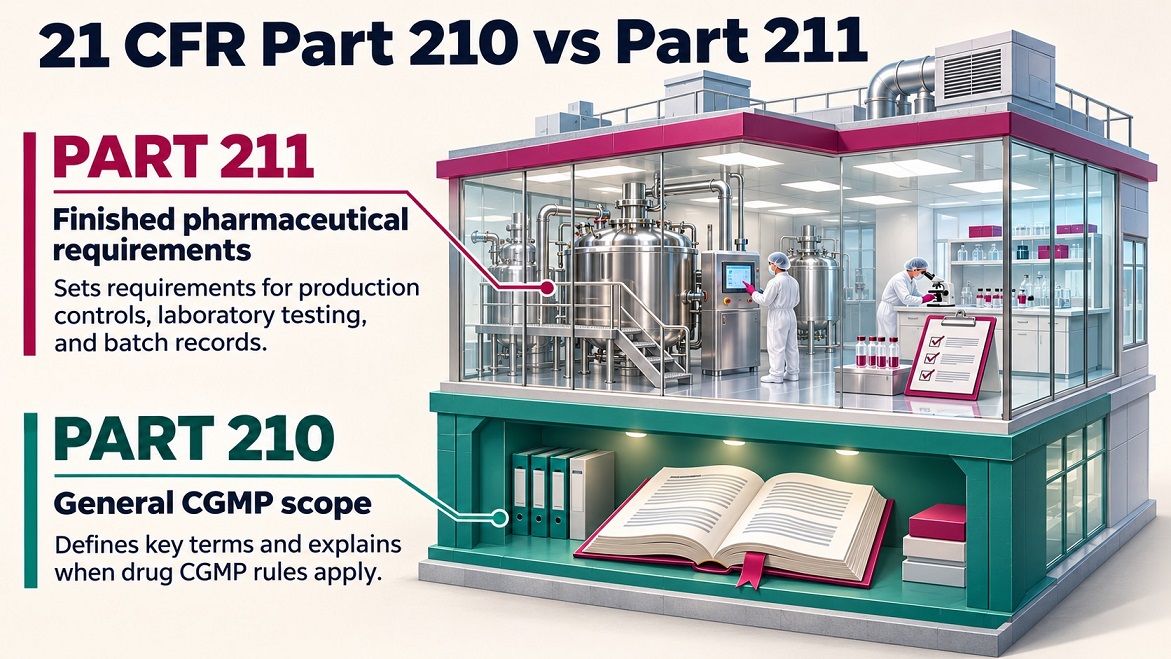
Part 210 is the general CGMP framework for the manufacturing, processing, packing, or holding of drugs. Part 211 contains detailed CGMP requirements for finished pharmaceuticals. They are complementary: Part 210 establishes general applicability and terminology, while Part 211 provides operational requirements that finished-drug manufacturers must meet. The parts should be read together with the FD&C Act, applicable product-specific requirements, FDA guidance, and other relevant regulations.
Key Differences Between 21 CFR Part 210 and Part 211
Part 210 is broader in scope and provides the general CGMP framework. Part 211 is focused on finished pharmaceuticals and contains detailed requirements covering personnel, facilities, equipment, materials, production, packaging, laboratory controls, records, and returned or salvaged drug products. A useful QA mental model is: Part 210 defines the regulatory context; Part 211 defines many of the controls used to demonstrate compliant finished-pharmaceutical manufacturing.
- Part 210 = general framework
- Part 211 = detailed controls
- Both support CGMP compliance
- Quality Unit = critical authority
Part 211: The Operational Control Layer
Part 211 is where many day-to-day GMP expectations become specific regulatory requirements. For example, §211.22 addresses the responsibilities of the quality control unit; §211.68 addresses automatic, mechanical, and electronic equipment; §211.100 addresses written procedures for production and process control; §211.165 addresses testing and release for distribution; and §211.192 addresses production record review and investigation of discrepancies.
The Quality Unit and QA Responsibilities
Section 211.22 gives the quality control unit authority and responsibility for approving or rejecting components, drug product containers, closures, in-process materials, packaging and labeling materials, and drug products. It also covers review of production records and investigation of unexplained discrepancies. FDA’s quality-systems guidance uses the broader term quality unit to reflect modern quality-system practice.
The quality unit should not absorb the responsibilities of manufacturing, engineering, or development. FDA’s quality-systems model emphasizes that manufacturing personnel and the quality unit are both critical to producing quality products, with appropriate independence between functions.
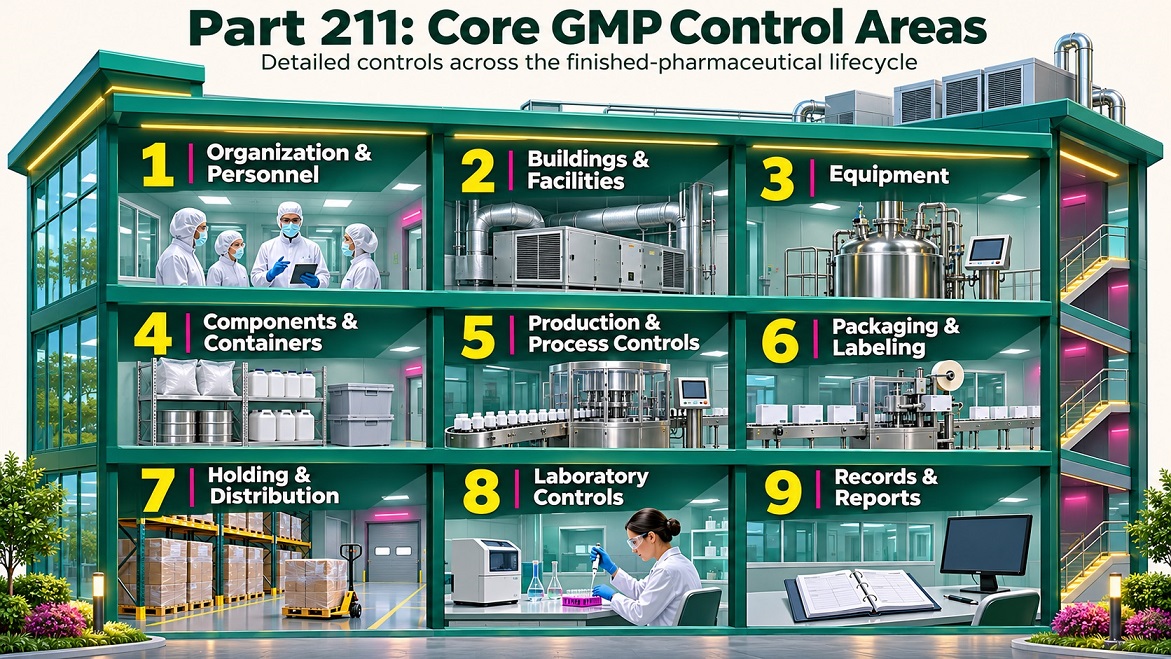
Essential 21 CFR Part 211 Control Areas for QA Teams
Part 211 covers the controls used to make and assess finished pharmaceuticals. For QA teams, each area raises two practical questions. Is there an approved procedure for the work, and do the records show what happened? The eight stages below connect common GMP activities with the evidence QA reviews.
Stage 1 — Personnel and Organization
People need clear responsibilities and training for the work they perform. Hygiene practices also help protect the product.
- Controlled procedure: Define responsibilities, training, and hygiene requirements.
- Objective evidence: Review training records and documented role assignments.
QA should check that personnel were qualified when they performed the recorded activity.
Stage 2 — Buildings and Facilities
Facility design and upkeep should support sanitary operations and reduce contamination risks. Material and personnel movement need appropriate control.
- Controlled procedure: Define cleaning, maintenance, and environmental controls.
- Objective evidence: Review cleaning logs, maintenance records, and monitoring results.
QA should investigate conditions that could affect product quality.
Stage 3 — Equipment
Equipment must be suitable for its intended use and kept in a controlled condition. Automated systems need appropriate safeguards.
- Controlled procedure: Define equipment cleaning, maintenance, calibration, and system controls.
- Objective evidence: Review equipment logs, calibration records, and documented checks.
QA should confirm that equipment was ready for use during the batch.
Stage 4 — Components and Containers
Incoming materials and drug-product containers need controls before they enter production. Required testing or examination supports their approval.
- Controlled procedure: Define receipt, identification, sampling, testing, and release.
- Objective evidence: Review supplier records, test results, and approval status.
QA should confirm that only approved materials were used.
Stage 5 — Production and Process Controls
Written instructions and in-process checks help teams produce consistent batches. Results also help identify problems during manufacturing.
- Controlled procedure: Define processing steps, sampling, checks, and acceptance criteria.
- Objective evidence: Review batch records, in-process results, and deviations.
Stage 6 — Packaging and Labeling
Packaging controls protect against product mix-ups and labeling errors. Checks must cover the materials and operations used for each batch.
- Controlled procedure: Define label issuance, line clearance, and packaging checks.
- Objective evidence: Review label reconciliation and packaging records.
QA should confirm that the finished pack matches the approved product information.
21 CFR Part 210 vs 211: Common Compliance Challenges
Understanding the difference between Parts 210 and 211 is only the starting point. QA teams must apply the requirements across production, laboratories, documentation, and quality decisions. The challenges and FDA quality-system mappings below show where those connections need attention.
Where Companies Commonly Struggle
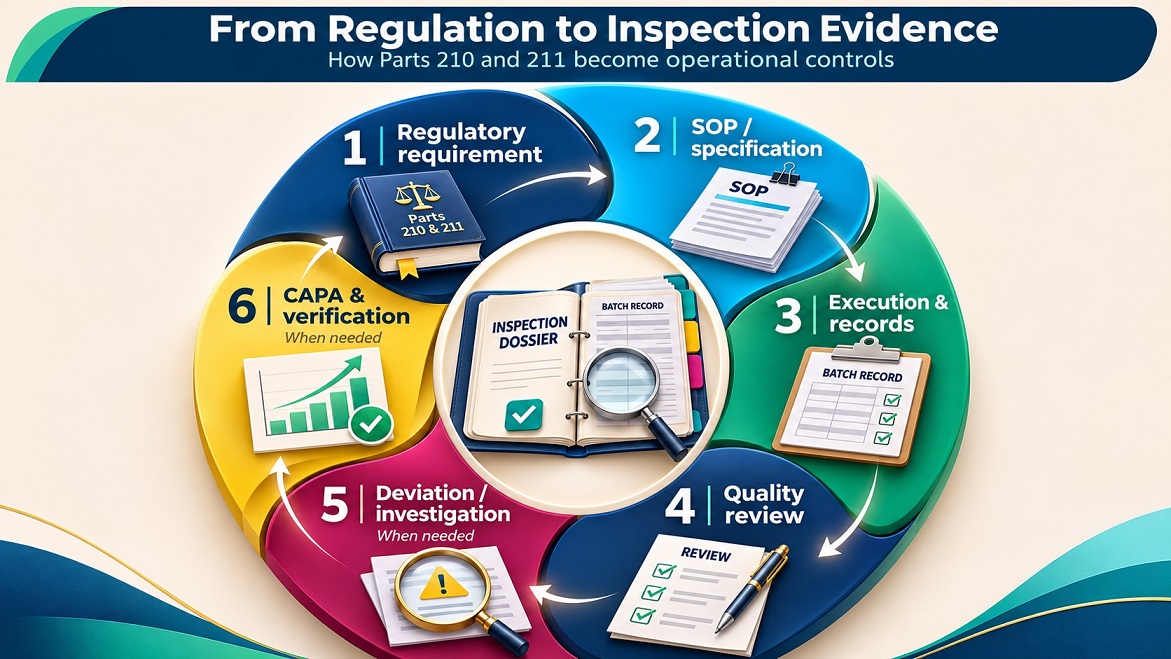
The biggest problems often occur at the interface between departments rather than inside one regulation. Examples include a production deviation that is documented but poorly investigated, a validated process with weak ongoing monitoring, a laboratory result that is technically reviewed but not connected to the batch decision, or a CAPA that is closed without evidence of effectiveness.
- Over-reliance on testing instead of process control
- Procedures that do not match actual practice
- Incomplete or delayed records
- Insufficient investigation depth
- Weak root-cause analysis
- CAPA without effectiveness verification
- Poor data-integrity controls
How FDA Quality Systems Map to Parts 210 and 211
FDA’s Quality Systems Approach guidance demonstrates that modern quality-system elements can be mapped to CGMP requirements. For example, examining inputs connects with §§210.3(b), 211.80–211.94, 211.101, 211.122, and 211.125; monitoring operations connects with §§211.100, 211.103, 211.110, 211.111, and 211.113; and addressing nonconformities connects with requirements such as §§211.22, 211.100, 211.115, 211.192, and 211.198.
Data Integrity Under 21 CFR 210 and 211
Data integrity connects daily GMP work with the evidence QA uses to make quality decisions. Under 21 CFR Parts 210 and 211, records must accurately show what happened and support a justified review. The same evidence helps teams remain ready for inspection.
Records Must Support the Quality Decision
FDA’s Data Integrity guidance states that data-integrity expectations apply to CGMP under Parts 210, 211, and 212. For QA teams, this means electronic and paper records must be reliable enough to support decisions about manufacturing, testing, investigations, release, and ongoing control. Data integrity is therefore not a standalone IT issue; it affects laboratory systems, manufacturing records, computerized equipment, audit trails, access controls, review practices, and corrections.
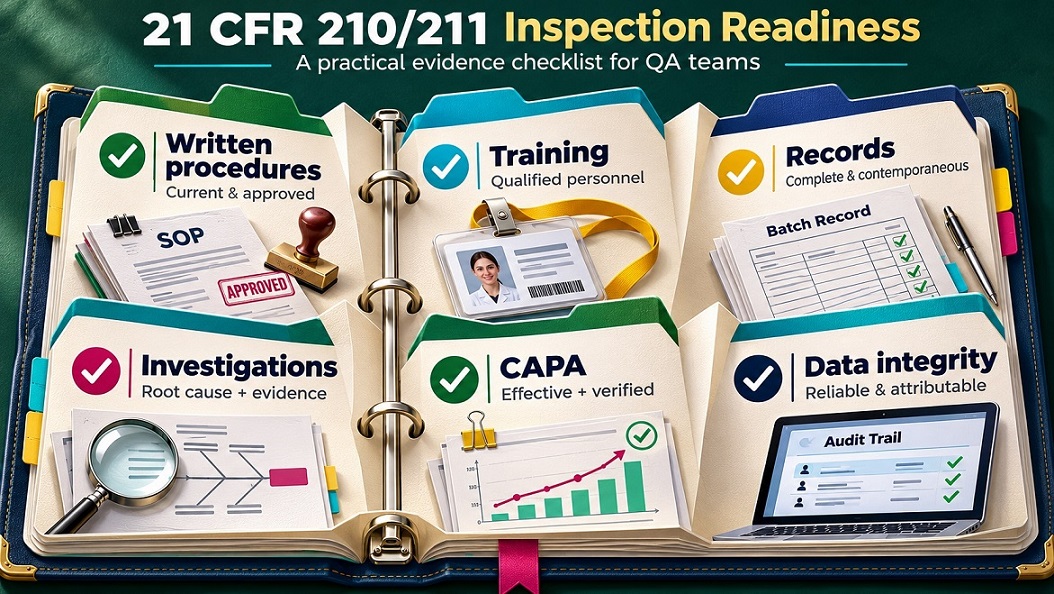
Inspection Readiness: What Evidence Should QA Have?
Inspection readiness should be treated as a state of control rather than a document-collection exercise. FDA’s CGMP framework emphasizes reliable operations, appropriate procedures, quality-unit oversight, investigation of discrepancies, and records that demonstrate compliance.
- Current approved SOPs
- Training records
- Batch and laboratory records
- Deviation investigations
- CAPA effectiveness checks
- Equipment and calibration records
- Data-integrity controls
- Quality-unit decisions
Final words
21 CFR Part 210 vs 211 should be understood as a connected CGMP framework, not a choice between two separate rulebooks. Part 210 establishes the general foundation, while Part 211 translates that foundation into detailed controls for finished pharmaceuticals.
For QA professionals, the real test is whether requirements are converted into effective procedures, trained execution, reliable records, robust investigations, sound quality-unit decisions, and verified CAPA. Strong pharmaceutical quality assurance turns regulatory text into evidence that can withstand routine operations and FDA inspection.
FAQs
Part 210 provides the general CGMP framework for manufacturing, processing, packing, and holding drugs, while Part 211 provides detailed CGMP requirements for finished pharmaceuticals.
It establishes important responsibilities and authority for the quality control unit, including approval or rejection decisions, production-record review, and investigation of unexplained discrepancies.
ISO 9001 is a general quality-management standard, while Part 211 contains legally enforceable FDA CGMP requirements for finished pharmaceuticals. A company may use a broader quality system to support compliance, but ISO 9001 does not replace applicable CGMP requirements.
References
1-FDA. Current Good Manufacturing Practice (CGMP) Regulations.
2-FDA. Quality Systems Approach to Pharmaceutical Current Good Manufacturing Practice Regulations.
3-FDA. Questions and Answers on Current Good Manufacturing Practice Regulations.
4-FDA. Q&A on CGMP Requirements.
5-FDA. Data Integrity and Compliance With Drug CGMP: Questions and Answers.
6-FDA. Process Validation: General Principles and Practices.
7-FDA. Facts About Current Good Manufacturing Practice (CGMP).

Ershad Moradi, a Content Marketing Specialist at Zamann Pharma Support, brings 6 years of experience in the pharmaceutical industry. Specializing in pharmaceutical and medical technologies, Ershad is currently focused on expanding his knowledge in marketing and improving communication in the field. Outside of work, Ershad enjoys reading and attending industry related networks to stay up-to-date on the latest advancements. With a passion for continuous learning and growth, Ershad is always looking for new opportunities to enhance his skills and contribute to pharmaceutical industry. Connect with Ershad on Facebook for more information.

21 CFR Part 210 vs 211: What Every QA Professional Needs to Get Right
21 CFR Part 210 vs 211 is more than a regulatory numbering question. Learn how the two FDA cGMP parts work together and what QA teams must control, document, investigate, and defend during inspection.

Pharmaceutical Market Access: Why Good Evidence Matters for Drug Coverage
Pharmaceutical market access bridges regulatory approval and real-world patient access. This guide explains HTA, pricing, reimbursement, payer engagement, launch strategy, evidence, and access barriers.

Pharmaceutical Cold Chain Excursion: Causes, Impact, and a Practical Management Guide
A pharmaceutical cold chain excursion can threaten medicine quality, stability, and patient safety. Learn how to detect, document, assess, and manage temperature deviations using current guidance and science-based risk assessment.
Lorem ipsum dolor sit amet, consectetur adipiscing elit. Ut elit tellus, luctus nec ullamcorper mattis, pulvinar dapibus leo.