


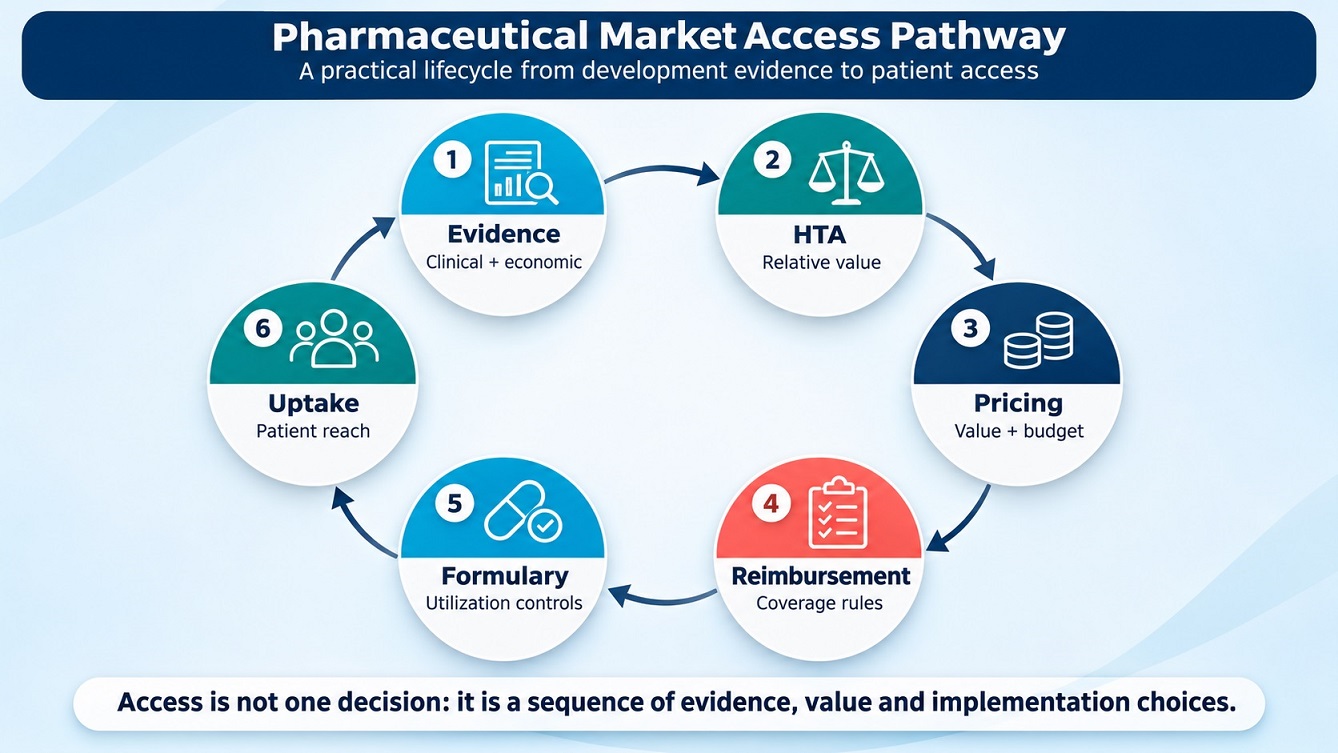
Pharmaceutical market access determines whether an approved medicine can reach patients at a sustainable price, through a reimbursement pathway, and within systems that need it. Regulatory approval does not automatically secure coverage, affordability, formulary placement, or rapid uptake. Market access connects clinical evidence with payer expectations, health technology assessment, pricing, reimbursement, patient needs, and execution across markets.
Today, teams coordinate access planning with evidence generation, stakeholder engagement, and compliant communication. Strong pharma marketing strategies support this work by translating product value into evidence-based messages for healthcare professionals, payers, and stakeholders.
Table of Contents
What Is Pharmaceutical Market Access?
Pharmaceutical market access is the multidisciplinary process of ensuring that an approved medicine can be appropriately funded, reimbursed, distributed, prescribed, and used by eligible patients. It sits between regulatory authorization and real-world uptake. In practice, market access teams evaluate clinical value, unmet need, comparative effectiveness, economic impact, pricing, reimbursement rules, payer requirements, utilization management, and implementation barriers.
The concept has expanded as healthcare systems have become more evidence-driven and payers have gained greater influence over treatment funding. A 2024 scoping review describes market access as an evolving professional and organizational function within pharmaceutical companies, reflecting its broader role beyond pricing alone.
A 2025 primer similarly identifies pricing, reimbursement, and patient access as central elements of market access and notes that regulatory approval alone does not guarantee commercial success.
- Clinical value
- Economic value
- Payer acceptance
- Patient access
Why Pharmaceutical Market Access Matters
The commercial consequences of access decisions can be substantial. Deloitte’s analysis of U.S. launches from 2012–2021 found that 34% missed launch forecasts and identified market access strategy and execution as important contributors to launch performance. The analysis emphasizes earlier access planning, stakeholder engagement, pricing, contracting, reimbursement, affordability, and fulfillment.
Market access also affects patients directly. A medicine can be clinically effective yet remain difficult to obtain because of restrictive coverage, high patient cost sharing, prior authorization, limited distribution, formulary placement, or uncertainty about its value. A strong access strategy therefore asks not only whether a product can be approved, but whether the healthcare system can adopt it.
- Launch readiness
- Coverage breadth
- Time to access
- Affordability
The Core Stakeholders in Market Access
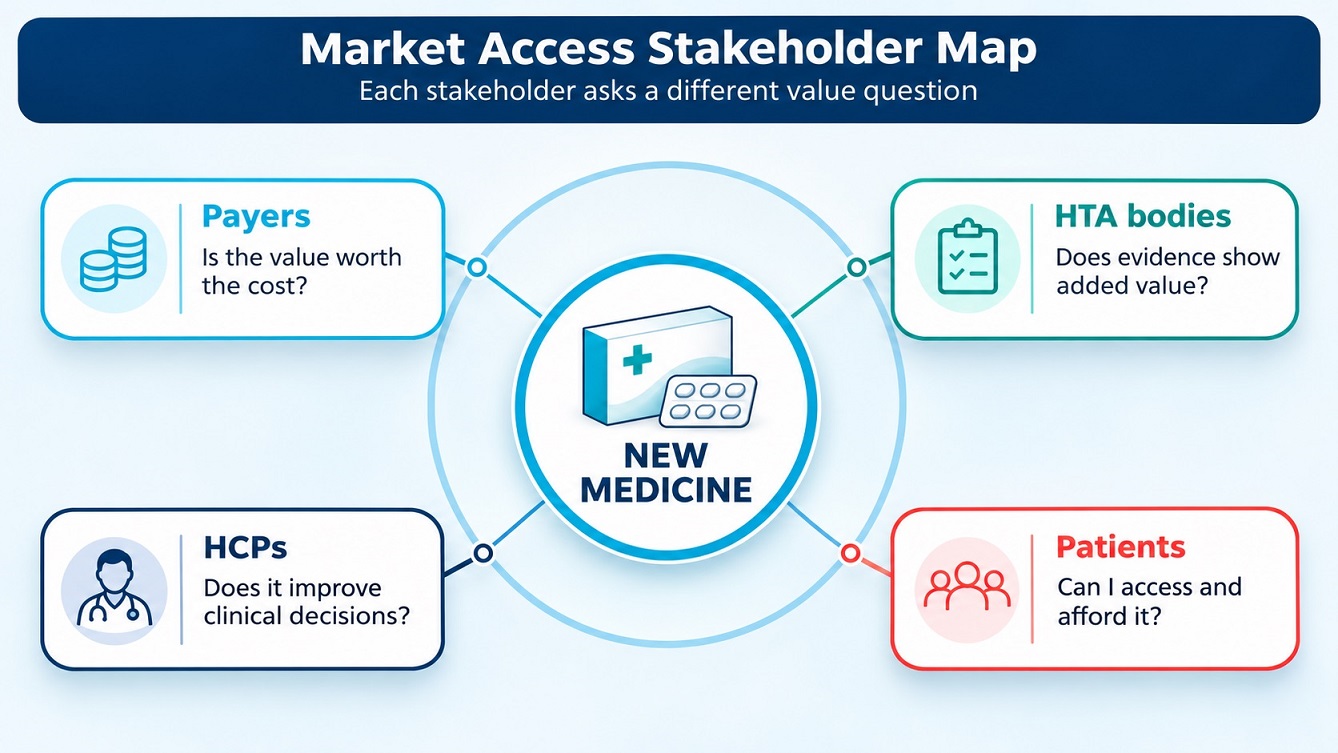
Market access is a stakeholder ecosystem rather than a single negotiation. Each stakeholder evaluates a different part of the product’s value proposition.
Payers and PBMs: Evaluate budget impact, clinical value, utilization, and coverage conditions.
HTA agencies: Assess evidence, comparative effectiveness, and sometimes broader economic or societal value.
Healthcare professionals: Need credible evidence and practical information to support treatment decisions.
Patients: Experience affordability, eligibility, access pathways, administration burden, and support services.
Regulators: Establish marketing authorization and the legal framework for product communication and use.
Manufacturers: Integrate evidence, pricing, contracting, supply, access operations, and commercial objectives.
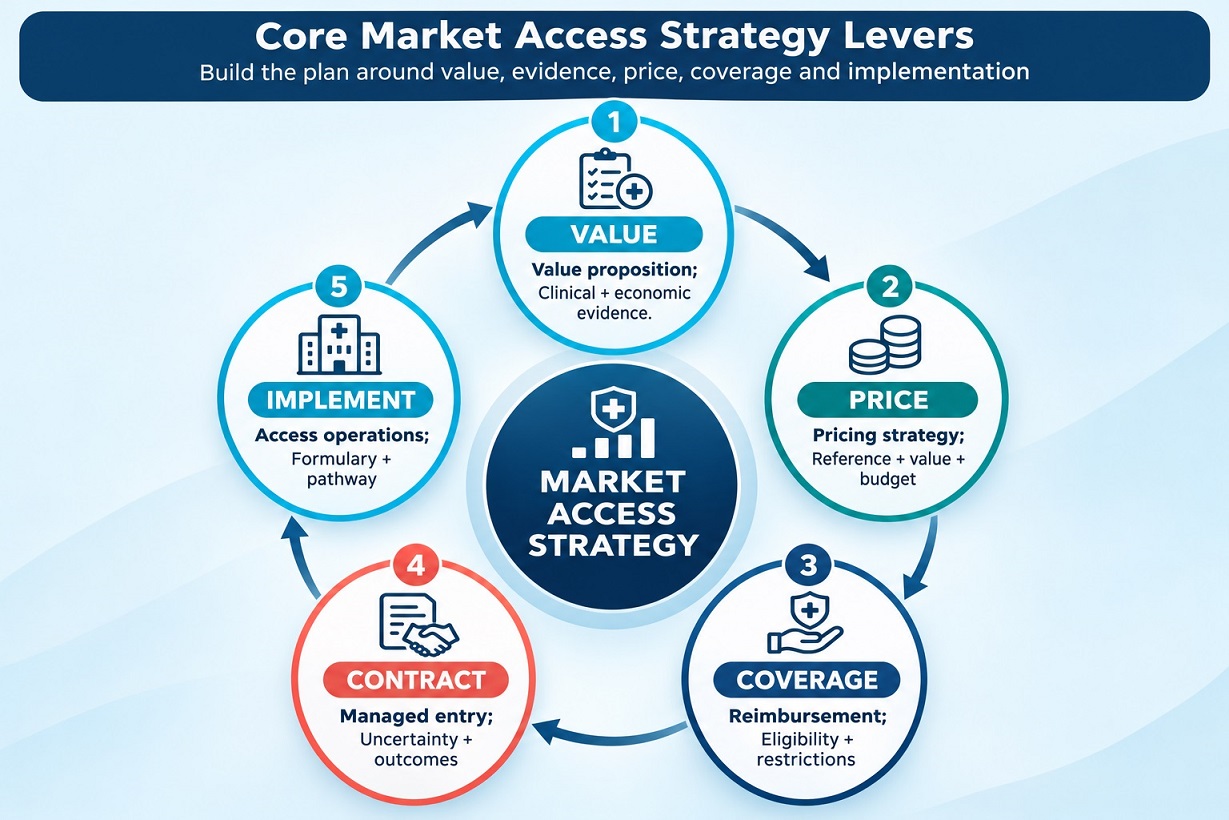
6 Key Areas in a Pharmaceutical Market Access Strategy
A market access strategy should start before regulatory approval. It should adapt as evidence, policies, competition, and payer needs change.
Area 1: Set Access Goals
Set clear goals before launch. Define which patients the medicine should reach. Choose the markets to prioritize. Consider the main barriers to access.
- Target patient group
- Priority markets
- Coverage goals
Area 2: Identify Key Stakeholders
Area 3: Show the Medicine’s Value
Explain how the medicine may benefit patients. Compare it with current treatment options. Show its potential clinical and economic value. Support the value story with reliable evidence.
- Clinical benefits
- Economic value
- Supporting evidence
Area 4: Plan Evidence Generation
Plan evidence collection early in development. Choose comparators that reflect current care. Measure outcomes that matter to decision-makers. Consider how real-world evidence can support future decisions.
- Relevant comparators
- Meaningful outcomes
- Real-world evidence
Area 5: Plan Pricing and Reimbursement
Pricing and reimbursement plans may differ by market. Model possible prices and their budget impact. Review local coverage pathways and requirements. Prepare for negotiations and possible access restrictions.
Area 6: Prepare for Launch
Launch planning connects access decisions with practical delivery. Plan formulary submissions and contracting needs. Coordinate distribution and patient support services. Prepare teams to communicate the medicine’s value.
- Formulary planning
- Contracts and distribution
- Patient support
Pricing and Reimbursement Strategy
Pricing and reimbursement decisions affect both company returns and patient access. The Medicare Drug Price Negotiation Program, created under the 2022 Inflation Reduction Act, took effect in 2026. CMS’s framework extends the program to 2029, when up to 20 drugs may be selected for each initial price applicability year.
From Price to Value
Pricing strategy is one component of market access, not the entire strategy. A sustainable approach considers the product’s clinical benefit, unmet need, competitive landscape, treatment setting, payer affordability, reference pricing or external benchmarks, budget impact, and expected utilization.
Reimbursement strategy then translates product value into the rules by which healthcare systems or insurers pay for treatment. Depending on the market, this may involve national assessment, payer negotiation, formulary decisions, coding, coverage criteria, prior authorization, step therapy, or other utilization controls.
The 2026 U.S. environment illustrates how policy can reshape pricing assumptions. CMS’s November 5, 2026 final rule codifies the Medicare Drug Price Negotiation Program for initial price applicability year 2029 and beyond. CMS states that up to 20 drugs may be selected for each initial price applicability year, subject to statutory criteria.
Managed Entry and Uncertainty
Where clinical or economic uncertainty is high, managed entry agreements can link access or payment arrangements to evidence development, outcomes, or defined conditions. WHO/Europe published a 2026 policy framework with eight core principles for managed entry agreements, including principles addressing uncertainty and outcome-based approaches.
- Value-based pricing
- Budget impact
- Coverage criteria
- Managed entry
Market Access Metrics That Matter
A market access dashboard should connect strategic activity to actual access outcomes. The exact metrics depend on product and market, but useful measures include:
- Time from approval to reimbursement
- Coverage rate and covered population
- Formulary position
- Restriction severity
- Prior authorization burden
- Time to treatment
- Patient out-of-pocket exposure
- Payer acceptance and objection trends
- Contract performance
- Launch uptake versus access assumptions
Common Pharmaceutical Market Access Challenges
Market access teams face four linked challenges. Regulatory approval may not resolve payer questions about comparative effectiveness, long-term outcomes, resource use, or real-world performance.
High-cost therapies can create budget uncertainty, requiring price scenarios, budget-impact models, or flexible agreements. A 2026 analysis mapped assessment, pricing, and reimbursement pathways across 30 European countries and found procedural differences as EU joint clinical assessment develops.
Key Market Access Challenges
| Challenge | Concern | Response |
|---|---|---|
|
Evidence |
Payer questions remain |
Generate relevant evidence |
|
Budget |
Costs may limit access |
Model budget impact |
|
Pathways |
Country rules differ |
Adapt local plans |
|
Compliance |
Claims must be supported |
Review all messaging |
Final words
Pharmaceutical market access is the bridge between regulatory approval and meaningful patient reach. The strongest strategies integrate clinical evidence, HTA, pricing, reimbursement, payer engagement, implementation, and compliant communication from early development through post-launch. As healthcare systems place greater emphasis on comparative value, affordability, and outcomes, market access teams must continuously adapt their evidence and access plans.
Companies that treat access as a late commercial task risk avoidable delays and restrictions; companies that build it into development and launch planning can create a clearer path from innovation to patients.
FAQs
It is the multidisciplinary process of enabling appropriate patient access to an approved medicine through evidence, pricing, reimbursement, coverage, distribution, and implementation decisions.
Regulatory approval establishes that a medicine meets applicable requirements for authorization. Market access determines how the medicine is funded, covered, reimbursed, distributed, prescribed, and adopted in real-world healthcare.
HTA evaluates clinical and other relevant dimensions of health technologies and can inform national decisions about value, pricing, reimbursement, and healthcare resource allocation.
References

Ershad Moradi, a Content Marketing Specialist at Zamann Pharma Support, brings 6 years of experience in the pharmaceutical industry. Specializing in pharmaceutical and medical technologies, Ershad is currently focused on expanding his knowledge in marketing and improving communication in the field. Outside of work, Ershad enjoys reading and attending industry related networks to stay up-to-date on the latest advancements. With a passion for continuous learning and growth, Ershad is always looking for new opportunities to enhance his skills and contribute to pharmaceutical industry. Connect with Ershad on Facebook for more information.

Pharmaceutical Market Access: Why Good Evidence Matters for Drug Coverage
Pharmaceutical market access bridges regulatory approval and real-world patient access. This guide explains HTA, pricing, reimbursement, payer engagement, launch strategy, evidence, and access barriers.

Pharmaceutical Cold Chain Excursion: Causes, Impact, and a Practical Management Guide
A pharmaceutical cold chain excursion can threaten medicine quality, stability, and patient safety. Learn how to detect, document, assess, and manage temperature deviations using current guidance and science-based risk assessment.

Pharmaceutical Supply Chain: The Ultimate Guide to Hidden Risks and Challenges
Protocol deviations can threaten participant protection and trial reliability. This practical guide explains risk-based classification, documentation, escalation, CAPA, and preventive oversight.
Lorem ipsum dolor sit amet, consectetur adipiscing elit. Ut elit tellus, luctus nec ullamcorper mattis, pulvinar dapibus leo.