


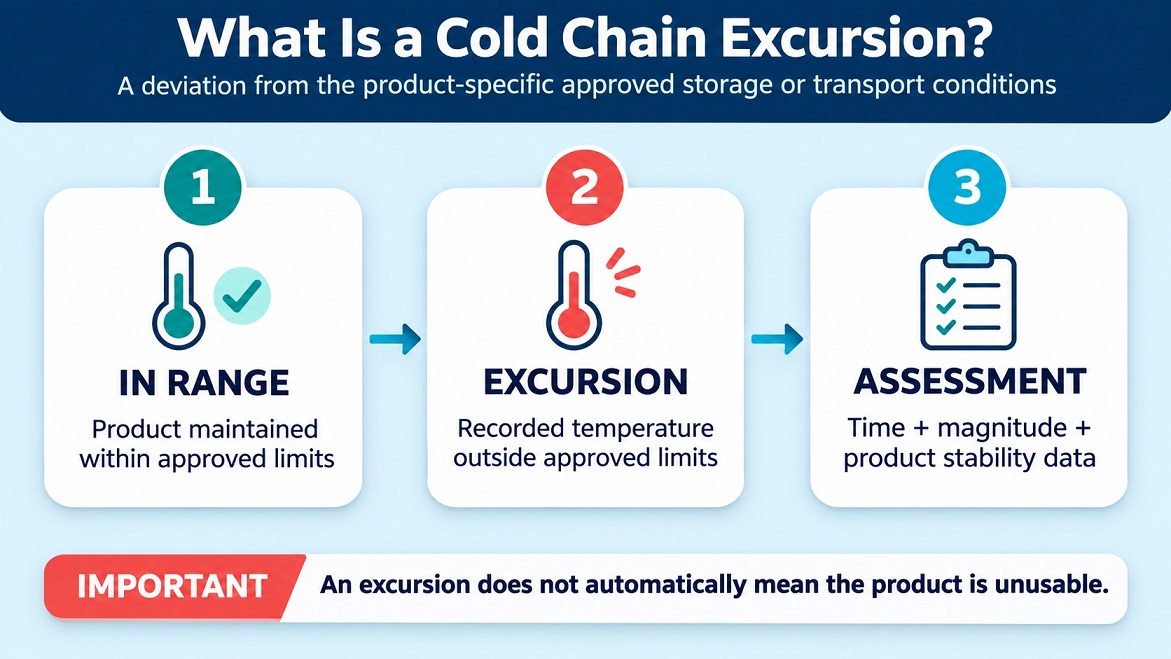
A pharmaceutical cold chain excursion occurs when a medicine is exposed to temperatures outside its approved storage or transport conditions. For vaccines, biologics, insulin and other temperature-sensitive products, even a brief deviation may affect potency, stability or performance and may require investigation.
A 2026 review outlines how regulatory expectations and stability data can guide decisions about temperature-compromised medicines across the pharmaceutical supply chain. An alarm alone does not determine a product’s fate. Teams should preserve the evidence, assess the product-specific exposure, consult qualified sources and document an authorized quality decision before releasing or rejecting affected stock.
Table of Contents
What Is a Pharmaceutical Cold Chain Excursion?
A pharmaceutical cold chain excursion is an unintended exposure of a time- and temperature-sensitive pharmaceutical product to a temperature outside the range specified by its approved labelling, product stability data, or qualified shipping conditions. WHO defines a temperature excursion for time- and temperature-sensitive pharmaceutical products as exposure outside the prescribed storage or transport range; the manufacturer establishes the applicable ranges using stability data.
The cold chain extends from manufacturing and packaging through storage, transport, wholesale distribution, healthcare storage, and—where relevant—preparation or administration. It is not limited to refrigerated vaccines: products may require controlled room temperature, refrigeration, freezing, or ultra-low storage.
Why the topic matters:
- Product potency
- Patient safety
- Regulatory compliance
- Supply continuity
Common Causes and Operational Challenges
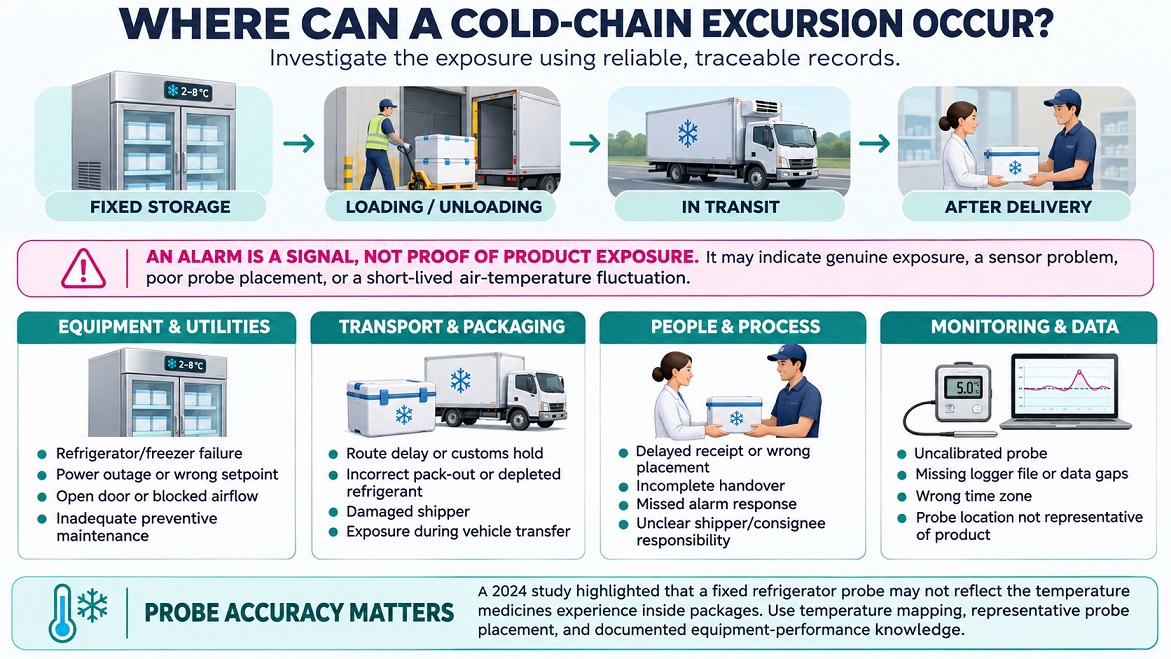
Excursions can occur at fixed storage sites, during loading and unloading, in transit, or after delivery. A temperature alarm may reflect a genuine product exposure, a sensor problem, poor probe placement, or a short-lived air-temperature fluctuation. Investigation must distinguish these possibilities using reliable records.
- Equipment and utilities: refrigerator or freezer failure, power outage, incorrect setpoint, door left open, blocked airflow, or inadequate preventive maintenance.
- Transport and packaging: route delay, customs hold, incorrect pack-out, depleted refrigerant, damaged shipper, or exposure during transfer between vehicles.
- People and process: delayed receipt, incorrect product placement, incomplete handover, failure to respond to alarms, or unclear responsibility between the shipper and consignee.
- Monitoring and data: uncalibrated probes, missing logger files, wrong time zone, gaps in records, or a sensor location that does not represent the product environment.
A 2024 study of refrigerator probe accuracy highlighted that a fixed probe may not always reflect the temperature experienced by medicines inside packages. This supports the need for temperature mapping, representative probe placement, and a documented understanding of equipment performance.
Potential Impact on Product Quality and Patient Safety
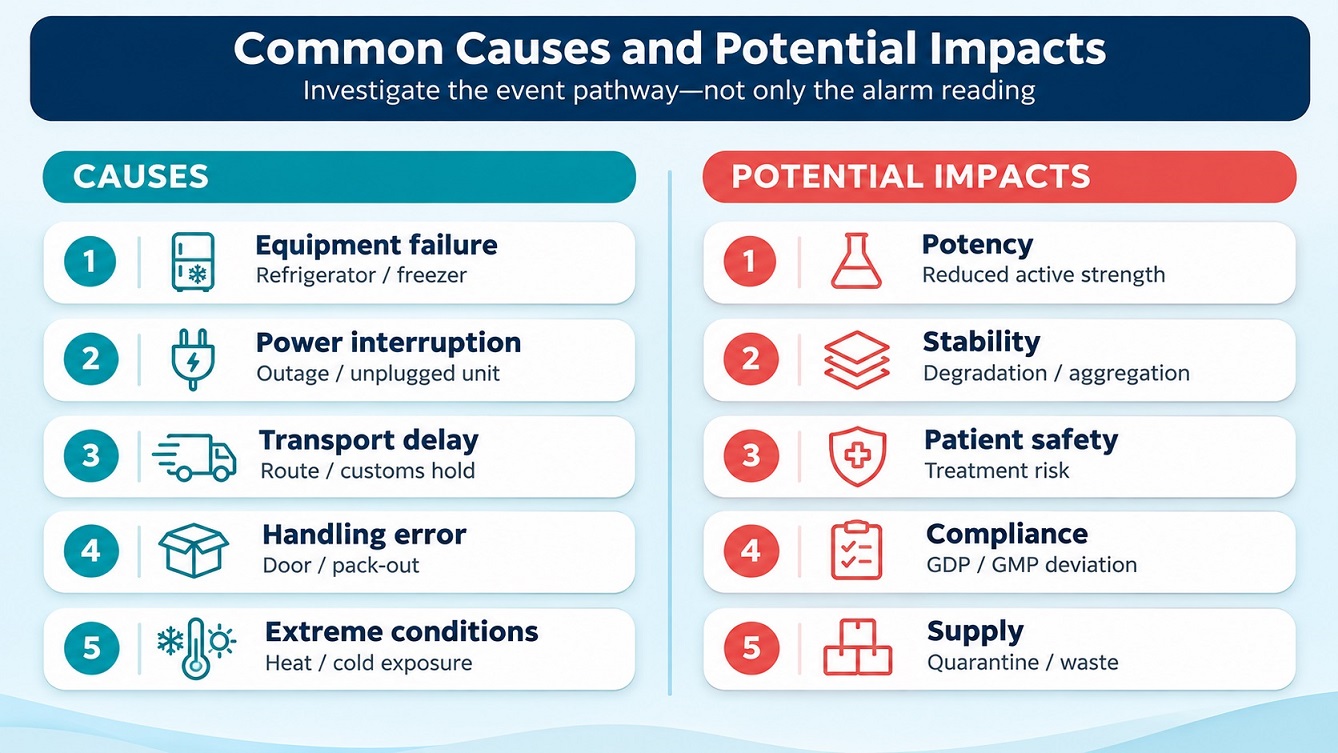
Temperature stress may accelerate chemical degradation, reduce potency, alter physical properties, or affect biological structure. For protein-based products, heat exposure can contribute to denaturation or aggregation; freezing can also damage products that are not designed to tolerate it. The actual impact depends on the formulation, container closure system, exposure profile, cumulative history, and available stability data.
The 2026 AAPS Open review describes clinical, regulatory, and business risks and cites real-world recalls associated with shipping temperature excursions: an enoxaparin injection lot in 2021, diagnostic panels in 2023, and glucose test strips in 2025. These examples demonstrate that excursion-related risks are not limited to vaccines.
Main Stages of a Temperature Excursion Investigation
A controlled investigation should move from detection to containment, evidence collection, technical assessment, authorized disposition, and prevention. The numbered stages below can be adapted into an SOP or deviation workflow.
Stage 1: Detect and Confirm the Event
Review the alarm and confirm the reading using the calibrated monitoring device. Check it against the product label and the approved storage or transport range. Record the key details as soon as possible:
- Alarm time
- Probe status
- Approved setpoint or temperature range
Stage 2: Protect and Segregate Affected Stock
Stage 3: Capture the Exposure Profile
Collect the available temperature data before making a disposition decision. The assessment should establish the minimum and maximum temperatures, the duration of the exposure, and when and where it occurred. Include transport milestones, handovers and any gaps in the data. Preserve the original logger file, along with relevant records, so the exposure profile can be reviewed and traced.
Key details include:
- Minimum and maximum temperatures
- Exposure duration, start time and end time
- Location and transport milestones
- Data gaps and the original logger file
Stage 4: Investigate Root Cause
Review the event from the equipment and shipment records through to the actions taken by personnel. This helps determine whether the cause was a power interruption, equipment fault, door event, pack-out issue, route delay or a problem during handover. Depending on the event, the investigation may include 5 Whys, equipment alarms, calibration and maintenance records, carrier documentation, and relevant personnel actions.
Stage 5: Assess Product-Specific Impact
Do not make a disposition decision from the alarm alone. Compare the complete exposure profile with approved stability data, relevant excursion studies and the product labelling. Consider whether the product experienced previous excursions, since cumulative exposure may affect the assessment. Where needed, seek scientific advice from the manufacturer or marketing authorisation holder, and document the evidence and rationale used to assess the product.
Stage 6: Approve Disposition and CAPA
An authorized quality function should document whether the affected product may be released, restricted, returned or rejected. The decision should be supported by the investigation and product-specific assessment, with the rationale and approval recorded.
Then link corrective and preventive actions (CAPA) to the identified root cause. Define how each action will be completed and how its effectiveness will be checked. Close the event only when the disposition and CAPA records are complete and the effectiveness review has been documented.
How to Assess a Temperature Excursion
Assess excursions using the full temperature history, product-specific stability evidence, packaging and lot details, prior exposure, and documented QA review. MKT may support assessment but cannot replace product-specific data or override approved limits.
Use Time, Magnitude, Product, and History
An effective excursion assessment is not based on a single peak temperature. Review the complete temperature-time profile, the magnitude and duration of the deviation, the product’s approved storage conditions, packaging configuration, batch or lot details, and any earlier excursions. Where available, use product-specific stability or excursion studies rather than generic assumptions.
Health Canada GUI-0069 states that brief excursions may be acceptable when stability data and scientific or technical justification demonstrate that product quality is not affected. The guidance expects a quality risk management approach based on scientific knowledge and patient protection.
The 2026 AAPS Open review discusses stress testing, thermal cycling, transport simulation, and Mean Kinetic Temperature (MKT), including the role of USP <1079.2>. MKT can be useful for certain temperature-history assessments, but it must not be treated as a universal substitute for product-specific stability data or as permission to ignore a temperature limit.
Evidence Checklist for QA Review
- Approved label and storage range
- Complete logger download
- Min/max and excursion duration
- Probe calibration status
- Product and lot identification
- Previous exposure history
- Packaging and route details
- Manufacturer stability assessment
- Documented QA disposition
Immediate Response: What Should Staff Do?
For vaccine programmes, CDC’s July 2026 Vaccine Storage and Handling Toolkit directs staff to notify the responsible coordinator, mark affected stock DO NOT USE, keep it separate from usable inventory, document the event, correct the storage problem, and contact the immunization programme or manufacturer. Do not discard affected vaccine until the appropriate authority provides disposition guidance.
For other medicines, follow the approved site SOP and product-specific quality agreement. The same core principles apply: protect the product, preserve the evidence, notify QA, maintain labelled conditions, and obtain an authorized assessment.
Regulatory and Guidance Expectations
WHO, FDA, CDC, Health Canada and GDP guidance provide a framework for maintaining required conditions and assessing temperature excursions. Apply the requirements relevant to the product, jurisdiction and supply-chain role, using scientific reviews as supporting evidence rather than as regulations.
Cold-Chain Excursions: Regulatory Guidance at a Glance
| Source | Main focus | Application to excursions |
|---|---|---|
|
WHO |
Monitoring, transport and qualified equipment |
Maintain conditions and retrieve reliable records |
|
EU GDP |
Product quality and integrity during transport |
Keep medicines within required transport conditions |
|
Health Canada GUI-0069 |
Drug storage and transportation |
Maintain required conditions across the supply chain |
|
FDA / CDC |
Stability evidence; vaccine response procedures |
Record storage conditions and follow product-specific response steps |
WHO, FDA, CDC, Health Canada, and GDP Principles
WHO guidance for time- and temperature-sensitive pharmaceutical products describes monitoring systems, transport operations, qualified equipment, and data retrieval. EU GDP expects medicinal products to be transported in conditions that do not adversely affect their quality or integrity. Health Canada GUI-0069 applies to parties involved in drug storage and transportation and emphasizes maintaining required conditions throughout the supply chain.
FDA’s stability guidance explains that stability conclusions must be supported by appropriate data and that actual storage conditions should be recorded. For vaccines, CDC provides a detailed operational response framework. These sources are complementary: the applicable legal requirements depend on the product, jurisdiction, licence, and supply-chain role.
Risk-Based Product Disposition
A product disposition decision should be made by the designated quality authority using documented evidence. Potential outcomes include release with justification, continued quarantine pending additional data, return to the manufacturer, restricted use where legally and scientifically supported, or rejection and destruction. The selected outcome must be traceable to the assessment and approved under the quality system.
Final words
A pharmaceutical cold chain excursion is a quality event that demands fast containment and careful scientific assessment—not an automatic decision to release or discard a product.
By preserving temperature records, reviewing product-specific stability data, involving the authorized quality function, and correcting the root cause, organizations can protect patients while avoiding unnecessary product loss. Strong GDP controls, qualified equipment, trained staff, and effective CAPA turn each excursion into an opportunity to strengthen cold-chain reliability.
FAQs
No. The product should be quarantined and assessed using the complete time-temperature profile, product-specific stability data, cumulative exposure history, and authorized quality or manufacturer advice.
Capture the product and lot, date and time, minimum and maximum temperatures, full logger data, excursion duration, location, equipment status, transport history, calibration status, and any previous excursions.
MKT may support certain assessments when appropriate, but it is not a universal acceptance criterion and cannot replace product-specific stability evidence, approved procedures, or QA authorization.
References

Ershad Moradi, a Content Marketing Specialist at Zamann Pharma Support, brings 6 years of experience in the pharmaceutical industry. Specializing in pharmaceutical and medical technologies, Ershad is currently focused on expanding his knowledge in marketing and improving communication in the field. Outside of work, Ershad enjoys reading and attending industry related networks to stay up-to-date on the latest advancements. With a passion for continuous learning and growth, Ershad is always looking for new opportunities to enhance his skills and contribute to pharmaceutical industry. Connect with Ershad on Facebook for more information.

Pharmaceutical Cold Chain Excursion: Causes, Impact, and a Practical Management Guide
A pharmaceutical cold chain excursion can threaten medicine quality, stability, and patient safety. Learn how to detect, document, assess, and manage temperature deviations using current guidance and science-based risk assessment.

Pharmaceutical Supply Chain: The Ultimate Guide to Hidden Risks and Challenges
Protocol deviations can threaten participant protection and trial reliability. This practical guide explains risk-based classification, documentation, escalation, CAPA, and preventive oversight.

Protocol Deviations in Clinical Trials: Build an Audit-Ready Record
Protocol deviations can threaten participant protection and trial reliability. This practical guide explains risk-based classification, documentation, escalation, CAPA, and preventive oversight.
Lorem ipsum dolor sit amet, consectetur adipiscing elit. Ut elit tellus, luctus nec ullamcorper mattis, pulvinar dapibus leo.