


The pharmaceutical supply chain connects raw-material suppliers, manufacturers, logistics providers, distributors, and healthcare settings. Its performance determines whether medicines remain available, authentic, and within approved quality conditions. Because ingredients, components, and finished products may cross several borders, every handoff needs clear ownership, reliable records, and effective oversight.
In 2025, the FDA reported preventing 330 drug shortages while identifying four new shortages. Yet WHO estimates that at least one in ten medicines in low- and middle-income countries is substandard or falsified. These figures show why resilience, traceability, and distribution controls matter.
Table of Contents
What Is the Pharmaceutical Supply Chain?
The pharmaceutical supply chain is the regulated, end-to-end network that sources materials, manufactures and releases medicines, stores and transports them under controlled conditions, and delivers them to patients.
Historically, medicine distribution evolved from fragmented local wholesaling into international, multi-tier networks as manufacturing, contract services, global sourcing, and cross-border trade expanded. Modern frameworks such as EU GDP (2013), WHO storage and distribution guidance (2020), and the U.S. DSCSA (2013) formalized stronger controls over distribution integrity and traceability.
Its importance is practical: a failure at one node can affect product quality, patient access, or continuity of treatment. Key exposure areas include:
- Shortages
- Temperature excursions
- Counterfeiting
- Supplier failure
Key Challenges in Pharmaceutical Supply Chain Management
Pharmaceutical supply chain management must balance cost, speed, regulatory compliance, and product integrity. The most difficult challenges are often interconnected: a delayed API shipment can stop production, while a quality investigation can restrict release even when inventory exists.
- Supply concentration: dependence on a limited number of API, excipient, packaging, or finished-dose suppliers.
- Demand volatility: sudden changes in clinical demand, tenders, seasonality, or market allocation.
- Quality variation: inconsistent supplier controls, incomplete documentation, or repeated deviations.
- Regulatory complexity: different licensing, GDP, serialization, import, and record-retention expectations across markets.
- Visibility gaps: limited access to real-time inventory, shipment status, and upstream supplier data.
The FDA’s 2025 shortage report illustrates both progress and remaining vulnerability: the agency reported 330 shortages prevented during the year, but also identified four new shortages. The report emphasizes that shortages can delay or deny needed care, especially when critical therapies are affected.
Pharmaceutical Logistics, GDP, and Product Integrity
Pharmaceutical logistics covers qualified storage, handling, packaging, transportation, delivery, returns, and—in applicable cases—temperature-controlled distribution. EU GDP guidance (2013/C 343/01) treats wholesale distribution as an important part of integrated supply chain management and requires controls that preserve medicinal-product quality and integrity.
WHO’s Good Storage and Distribution Practices (TRS 1025, Annex 7, 2020) identify risks across purchasing, storage, repackaging, relabelling, transportation, and distribution. The practical control system should include:
- Qualified premises
- Approved carriers
- Mapped routes
- Temperature records
- Deviation handling
- Returns control
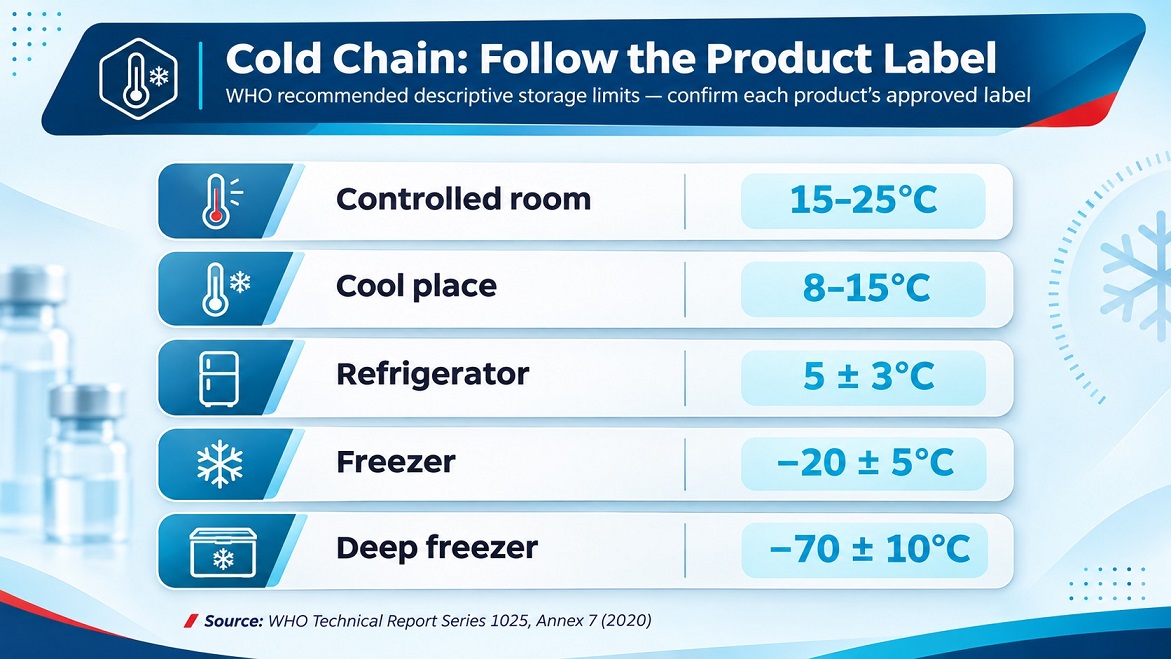
Cold-chain logistics is product-specific. WHO’s recommended descriptive limits include 5 ± 3°C for refrigerated storage and −20 ± 5°C for freezer storage; the approved product label and manufacturer’s stability data remain controlling. A temperature excursion should trigger documented assessment—not an automatic assumption that the product is either acceptable or unusable.
Main Stages of the Pharmaceutical Supply Chain
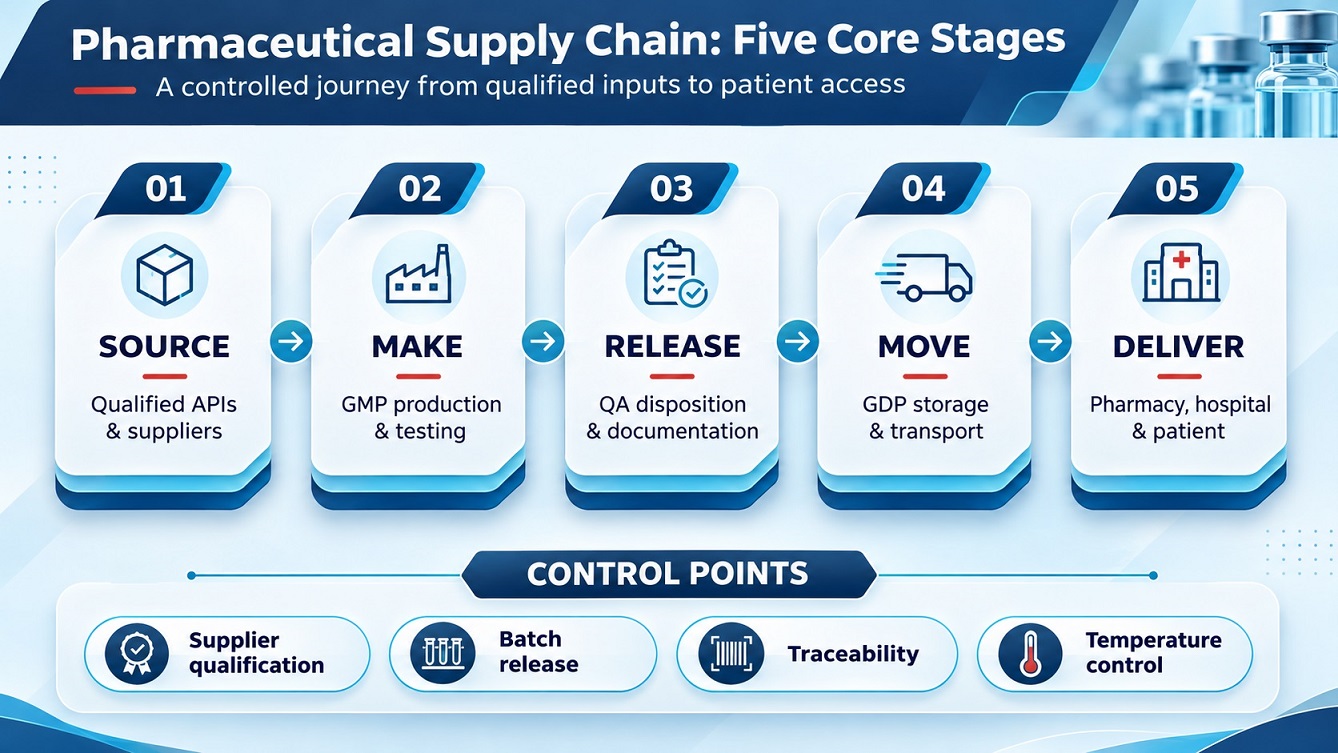
The pharmaceutical supply chain consists of several interconnected stages, each playing a critical role in ensuring product quality, regulatory compliance, and uninterrupted medicine availability. From raw material sourcing to final patient delivery, every stage requires clear responsibilities, documented procedures, defined acceptance criteria, and controlled handoffs. Effective coordination across these stages helps minimize supply disruptions, maintain product integrity, and protect patient safety.
Stage 1: Raw Material Sourcing
Identify, evaluate, and qualify reliable suppliers of active pharmaceutical ingredients (APIs), excipients, and packaging materials. Supplier qualification should include technical assessments, regulatory compliance reviews, quality agreements, and ongoing performance monitoring to ensure consistent material quality and supply reliability.
Stage 2: Procurement and Planning
Convert market demand forecasts and production requirements into structured procurement plans. This stage coordinates purchasing activities, inventory policies, supplier allocation, and production schedules to ensure that materials are available when needed without creating excessive inventory or unnecessary costs.
Demand Forecasting
Purchase Orders
Inventory Planning
Supplier Allocation
Procurement Monitoring
Stage 3: Manufacturing and Packaging
Transform qualified raw materials into finished pharmaceutical products through controlled manufacturing and packaging operations. All activities must follow applicable Good Manufacturing Practices (GMP), approved master production records, validated processes, and established contamination-control measures.
Material Dispensing: Verify material identity, status, and quantities before dispensing. Ensure that weighing and dispensing activities are performed using calibrated equipment and approved procedures.
Process Execution: Perform manufacturing operations according to approved batch manufacturing instructions. Monitor critical process parameters (CPPs) and critical quality attributes (CQAs) throughout production.
Stage 4: Quality Control and Release
Verify that manufactured products meet established quality specifications before they are released for distribution. This stage combines laboratory testing, documentation review, deviation assessment, and independent quality oversight to ensure that only compliant batches enter the pharmaceutical supply chain.
Stage 5: Warehousing and Distribution
Maintain the quality, safety, and integrity of pharmaceutical products during storage, handling, and transportation. Warehousing and distribution activities must comply with applicable Good Distribution Practices (GDP), product-specific storage requirements, and documented shipment controls.
Storage Conditions
Inventory Management
Transportation Control
Shipment Traceability
Security Measures
Supply Chain Risk Management and Resilience
Supply chain resilience requires more than maintaining inventory and securing suppliers; it depends on proactively identifying vulnerabilities and strengthening quality management across the entire pharmaceutical network.
A structured risk management approach helps manufacturers anticipate disruptions, protect product quality, maintain regulatory compliance, and ensure uninterrupted access to essential medicines.
Identify and Prioritize Critical Risks
A risk-based approach starts by mapping products, sites, suppliers, lanes, and dependencies. Prioritization should consider patient impact, probability, detectability, recovery time, and the availability of alternatives. Risk registers should be linked to quality risk management, business continuity, and management review.
- Single-source APIs
- Long replenishment times
- Unqualified lanes
- Weak data exchange
- Cybersecurity exposure
Strengthen Quality Management Maturity
FDA’s CDER Quality Management Maturity (QMM) program encourages manufacturers to go beyond baseline CGMP compliance by strengthening quality culture, continuous improvement, and operational robustness. FDA states that mature quality practices can reduce quality-related failures and support reliable product availability during expected and unexpected disruptions.
Pharmaceutical Supply Chain Resilience: Critical Risks and Strategic Controls
| Risk Area | Typical Exposure | Potential Impact |
|---|---|---|
|
Supplier Dependency |
Single-source APIs and limited alternatives |
Supply interruption and patient impact |
|
Logistics & Data |
Long replenishment times, unqualified lanes, and weak data exchange |
Delays, reduced visibility, and difficult recovery |
|
Cybersecurity |
Exposure across digital supply-chain systems |
Data disruption, operational downtime, and loss of visibility |
|
Quality Maturity |
Baseline cGMP compliance without mature quality practices |
Quality failures and reduced supply reliability |
Cold Chain Management and Temperature Control
Temperature requirements vary by product and presentation. WHO TRS 1025, Annex 7 provides recommended descriptive limits, including controlled room temperature at 15–25°C, cool storage at 8–15°C, refrigerated storage at 5 ± 3°C, freezer storage at −20 ± 5°C, and deep-freezer storage at −70 ± 10°C. These are general descriptive limits; product-specific approved labelling and stability data take precedence.
A robust programme includes temperature mapping, calibrated monitoring devices, alarm response, excursion assessment, qualified packaging, route qualification, and documented corrective actions.
Digital Traceability and Regulatory Frameworks
GMP controls manufacturing; GDP controls storage and distribution; DSCSA adds U.S. package-level electronic tracing for covered prescription drugs; and QMM encourages more mature quality systems. These frameworks are complementary rather than interchangeable. Organizations should map each requirement to process owners, records, systems, and verification activities.
End-to-end drug supply chain visibility depends on consistent identifiers, reliable master data, shipment events, inventory status, and rapid exception handling. Serialization can support product verification and investigation, but it does not replace supplier qualification, physical security, or quality oversight.
Practical Resilience Checklist
A practical pharmaceutical supply chain risk management programme should translate risk findings into actions, owners, deadlines, and effectiveness checks. Consider the following controls:
- Map critical products, APIs, suppliers, sites, and logistics routes.
- Qualify alternate suppliers and periodically test continuity assumptions.
- Set inventory policies using criticality, demand variability, and replenishment time.
- Review temperature excursions, deviations, complaints, and supplier performance trends.
- Maintain recall readiness and test traceability data across trading partners.
- Use management review to monitor resilience indicators and overdue actions.
Final words
The pharmaceutical supply chain is more than a route from factory to pharmacy: it is a patient-safety system that depends on reliable suppliers, controlled manufacturing, compliant distribution, and trustworthy data. FDA and WHO evidence shows that shortages and product-quality risks remain important public-health concerns.
By combining GMP, GDP, cold-chain controls, serialization, and mature quality management, pharmaceutical organizations can strengthen resilience, protect medicine integrity, and support continuous patient access.
FAQs
GMP focuses on manufacturing quality and controls; GDP focuses on maintaining product quality and integrity during storage, handling, and distribution.
Temperature-sensitive medicines can lose quality or stability when exposed to conditions outside their approved limits. Monitoring, qualified equipment, and excursion assessment help protect product integrity.
The U.S. Drug Supply Chain Security Act establishes an interoperable electronic system to identify and trace certain prescription drugs at the package level as they move through the U.S. supply chain.
References
1-FDA. Drug Shortages: CY 2025 Report to Congress (2026).
2-FDA. Drug Supply Chain Security Act (DSCSA).
3-WHO. Substandard and Falsified Medical Products (3 December 2024).
4-European Commission. Guidelines on Good Distribution Practice, 2013/C 343/01.
5-WHO. TRS 1025, Annex 7: Good Storage and Distribution Practices (2020).

Ershad Moradi, a Content Marketing Specialist at Zamann Pharma Support, brings 6 years of experience in the pharmaceutical industry. Specializing in pharmaceutical and medical technologies, Ershad is currently focused on expanding his knowledge in marketing and improving communication in the field. Outside of work, Ershad enjoys reading and attending industry related networks to stay up-to-date on the latest advancements. With a passion for continuous learning and growth, Ershad is always looking for new opportunities to enhance his skills and contribute to pharmaceutical industry. Connect with Ershad on Facebook for more information.
Pharmaceutical Cold Chain Excursion: Causes, Impact, and a Practical Management Guide
A pharmaceutical cold chain excursion can threaten medicine quality, stability, and patient safety. Learn how to detect, document, assess, and manage temperature deviations using current guidance and science-based risk assessment.

Pharmaceutical Supply Chain: The Ultimate Guide to Hidden Risks and Challenges
Protocol deviations can threaten participant protection and trial reliability. This practical guide explains risk-based classification, documentation, escalation, CAPA, and preventive oversight.

Protocol Deviations in Clinical Trials: Build an Audit-Ready Record
Protocol deviations can threaten participant protection and trial reliability. This practical guide explains risk-based classification, documentation, escalation, CAPA, and preventive oversight.
Lorem ipsum dolor sit amet, consectetur adipiscing elit. Ut elit tellus, luctus nec ullamcorper mattis, pulvinar dapibus leo.