


Protocol deviations in clinical trials occur when the conduct of a study departs from the approved protocol. Some deviations may have limited consequences, while others can affect participant rights, safety, well-being, or the completeness and reliability of trial data. The critical task is not simply counting incidents: it is identifying their actual or potential impact, documenting decisions, and managing risks consistently across sites.
A reliable deviation process belongs within Good Clinical Practice (GCP) and the broader quality-management system. ICH E6(R3) calls for trial-specific criteria for important deviations and proportionate oversight. FDA’s December 2024 protocol-deviations document is a draft rather than final binding guidance, while EU rules distinguish important deviations from serious breaches. These differences make a clear reporting matrix essential.
Table of Contents
What Are Protocol Deviations in Clinical Trials?
A protocol deviation is a departure from procedures or requirements described in the approved clinical trial protocol. Examples include a visit performed outside its permitted window, use of prohibited concomitant medication, or omission of a required endpoint assessment. Deviations should be distinguished from planned, formally authorized protocol amendments. Assessment should cover the approved version in force, participant exposure, data criticality, whether the event was isolated or systemic, and the applicable reporting pathway. The sponsor should establish definitions and classification criteria in advance rather than rely on ad hoc site judgments. An incident with no immediate harm may still merit corrective action when recurrence could threaten trial quality.
- Compare the event with the protocol version and approved window.
- Evaluate participant protection and critical-to-quality data.
- Record the rationale, owner, actions and escalation decision.
Routine Versus Important Deviations
ICH E6(R3) describes important protocol deviations as a subset that may significantly affect participant rights, safety or well-being, or the completeness, accuracy or reliability of trial data. Routine events still require proportionate documentation and follow-up. Terminology such as “major” and “minor” can appear in organization-specific procedures, but the classification must be defined consistently and justified. A delayed noncritical visit might have little effect, whereas enrolling an ineligible participant or omitting a primary endpoint assessment may have substantial implications. Impact should be evaluated using context, not a rigid list detached from the study design.
Deviation Versus Violation and Amendment
The term protocol violation is used inconsistently across organizations and should not substitute for a defined classification system. A deviation records what happened; an amendment prospectively changes the approved plan through the required review and approval route. Sponsors should not use retrospective documentation to make an unauthorized departure seem preapproved.
Protocol Deviation Management Workflow: 5 Essential Steps
A controlled workflow protects participants, preserves data reliability, and creates a traceable record. Follow the approved protocol unless urgent action is needed to remove an immediate hazard.
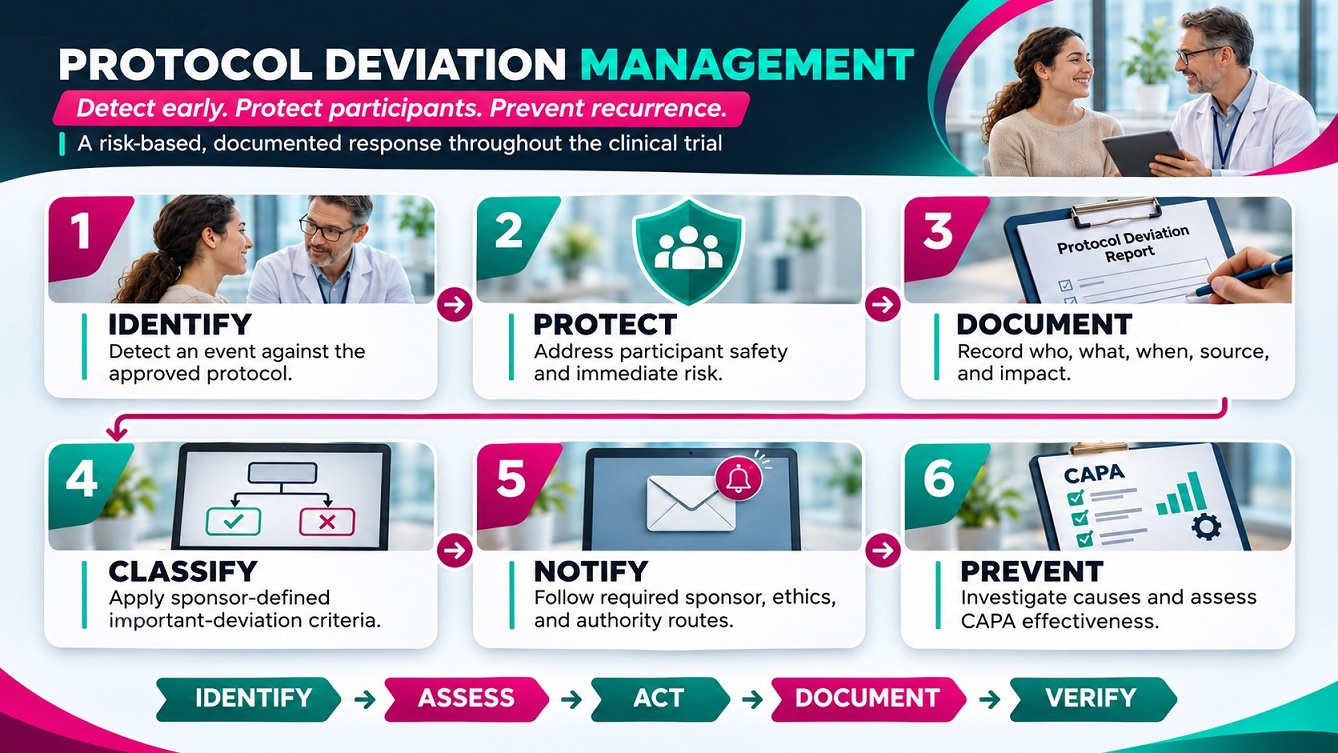
Step 1: Detect and Protect
Identify the deviation promptly and protect trial participants.
Record when and how the deviation was discovered.
Address any immediate risk to participant safety.
Deviate without prior approval only when needed to remove an immediate hazard.
Step 2: Document the Facts
Step 3: Classify and Assess Impact
Use the study’s predefined criteria to evaluate significance and impact.
Assess effects on participant safety and rights.
Check potential impact on eligibility, endpoints, and data reliability.
Document the classification rationale and trial-integrity assessment.
Step 4: Notify and Investigate
Escalate the deviation through the applicable study procedures.
Notify the sponsor and investigator under required procedures and timelines.
Inform the IRB/IEC and authorities when required.
Investigate contributing factors and document escalation decisions.
Step 5: Correct, Prevent, and Close
Use proportionate actions and verify the record is complete before closure.
Implement corrections, CAPA, or protocol amendments as justified.
Communicate actions and train affected staff when needed.
Verify completion and effectiveness; check for recurrence.
How to Detect and Document Deviations
Sites should detect deviations through source data review, investigator oversight, remote or on-site monitoring, data queries, safety reconciliation, and participant feedback.
Each event record should specify its unique identifier, participant or site reference, protocol requirement, event date, discovery date, factual narrative, preliminary impact, and reviewer. Attach relevant source documentation while respecting privacy and access control. Record the chronology of notifications and decisions in an auditable system.
Do not change original records to conceal an error; correct them through approved procedures. Documentation should distinguish established facts from pending assessment, and use consistent terminology so that trends can be aggregated reliably.
- Capture detection date separately from occurrence date.
- Keep original evidence and a traceable correction history.
- Record initial risk, assessment owner and follow-up status.
Illustrative Risk-Based Deviation Classification
| Event | Potential impact | Typical assessment |
|---|---|---|
|
Visit slightly outside a noncritical window |
Limited if no key assessment affected |
Document and assess against protocol criteria |
|
Key eligibility criterion not met |
Potential safety and population validity impact |
Likely important; urgent clinical review |
|
Missing key endpoint measurement |
Possible effect on interpretability |
Likely important; data/statistics review |
|
Dose administration error |
Potential direct safety effect |
Immediate clinical assessment; report as applicable |
|
Pattern of missed safety laboratories |
Potential systemic participant risk |
Escalate, trend, investigate; consider serious-breach criteria |
Which Deviations Most Often Threaten Trial Quality?
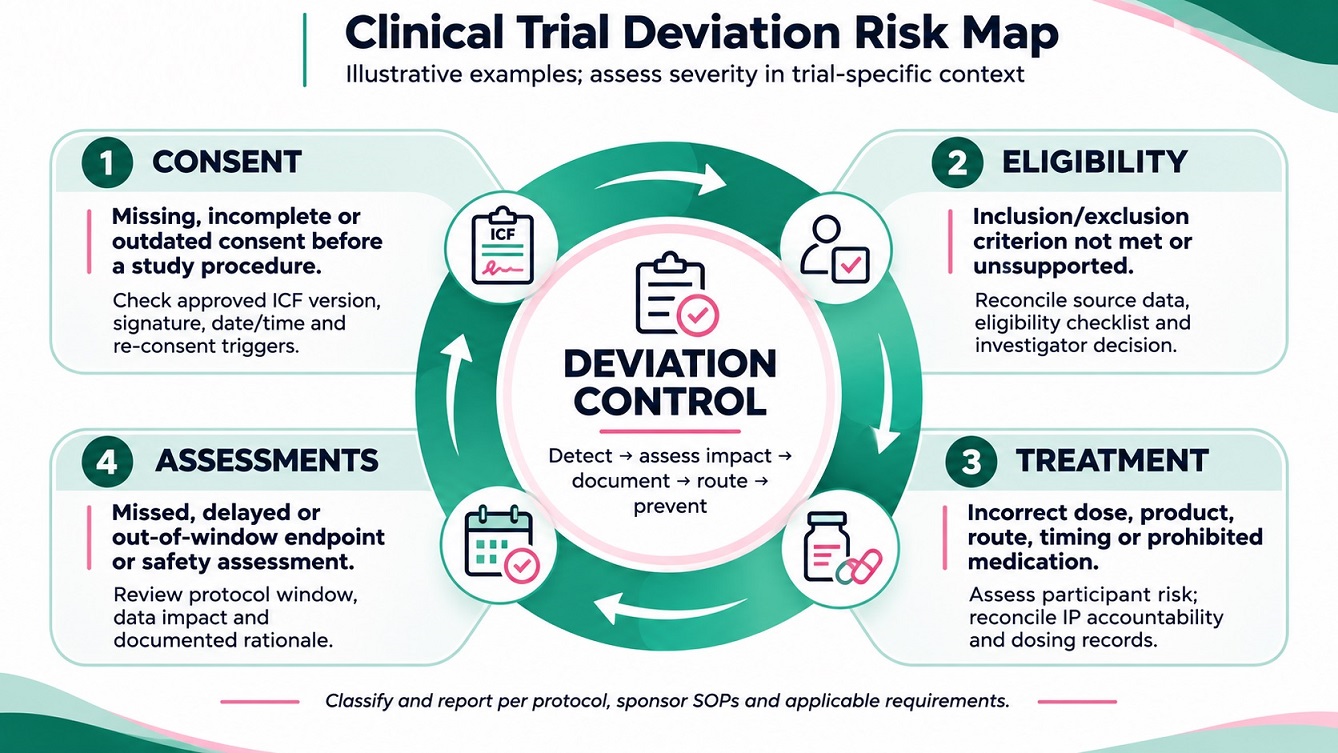
Not every common operational error has the same clinical or statistical consequence. A missed visit, a late assessment, and an incorrect dose must each be evaluated against the protocol, indication, study phase and endpoint strategy. The highest-risk events often involve consent, key eligibility criteria, intervention exposure, safety monitoring, prohibited treatments, and primary endpoint capture.
Evaluate the duration of exposure, potential mitigation, and whether multiple participants are affected. A classification catalogue can accelerate triage, but site personnel must still explain the event-specific rationale. Incorporate recurring categories into training and monitoring plans so that the system learns from emerging patterns.
- Consent and participant protection
- Eligibility and investigational product use
- Critical safety and endpoint assessments
Risk-Based Monitoring to Prevent Recurrence
Risk-based oversight should concentrate on factors critical to participant protection and the reliability of results. Central monitoring can flag unexpected missing data, repeating timing errors, outlier event rates, or delayed closure across sites. Such signals are triggers for assessment, not proof of misconduct.
Sponsors should periodically review root-cause patterns with investigators and vendors, revise supporting tools, and check that changes work in practice.
Training should target a specific failure mode and include confirmation of understanding. A redesigned visit checklist or automated window alert may prevent recurrence more effectively than another generic presentation on GCP principles.
- Review deviation trends by site and event category.
- Monitor closure timeliness and CAPA recurrence.
- Target preventive controls at critical-to-quality risks.
Five Essential Regulatory References
The following five regulatory and technical sources offer complementary views of deviation management. ICH E6(R3) describes sponsor and investigator responsibilities and risk-proportionate quality systems. The FDA draft guidance proposes consistent definitions and reporting approaches, but remains draft.
The EU serious-breach guidance clarifies a separate regulatory reporting test. ICH E3 and its questions and answers support transparent reporting of important deviations in clinical study reports. EMA’s GCP Q&A explains why planned waivers are not an appropriate replacement for amendments. Read these sources alongside applicable national requirements and study-specific procedures rather than treating one jurisdiction’s reporting rules as universal.
ICH E6(R3): Good Clinical Practice
ICH E6(R3) requires sponsors to establish trial-specific criteria for important deviations and apply risk-based quality management. Investigator documentation, participant protection, and sponsor oversight are central. The guidance gives a principled framework, not a universal fixed list of major and minor events.
FDA: Protocol Deviations Draft Guidance (2024)
The FDA document proposes definitions, documentation and reporting recommendations covering drugs, biological products, and devices. As of the cited version, it is explicitly a draft that is not for implementation. Treat its classification examples as recommendations under discussion, not an enforceable standalone regulation.
EMA: Serious Breach Reporting Guideline
The EU guideline distinguishes important protocol deviations from serious breaches under Regulation (EU) No 536/2014. These categories overlap but are not equivalent. Reporting decisions therefore require a separate assessment of the legal serious-breach criteria and applicable notification obligations.
ICH E3: Clinical Study Reports
ICH E3 provides the reporting structure for clinical study reports; the associated questions and answers clarify the concept of important deviations. Sponsors should predefine approach and preserve traceability from source records through listings, analysis decisions and the final study report.
EMA: GCP Questions and Answers
EMA explains that prospectively approved departures from key eligibility rules can undermine protocol approval and ethical oversight.
When the intended study population or procedures need systematic change, the appropriate pathway is usually a formally reviewed protocol amendment rather than an informal waiver.
Final words
Protocol deviation management should safeguard participants and credible evidence, not merely produce a complete log. The most defensible approach defines important events before the first participant is enrolled, trains teams on consistent assessment, and supports rapid escalation when safety or critical data may be affected.
Accurate records, appropriate reporting, root-cause analysis and effective CAPA turn isolated incidents into learning opportunities. As ICH E6(R3) emphasizes, oversight should remain proportional to the risks of the trial. Focus on the events that genuinely matter, retain the reasoning behind each decision, and verify that preventive changes reduce recurrence.
FAQs
A documented departure from the approved clinical protocol, assessed against the requirements and version applicable at the time of the event.
Not necessarily. Major/minor terminology varies by organization; ICH E6(R3) specifically describes important deviations based on potential significant impact.
No universal rule applies. Follow the protocol, ethics committee policies, relevant regulation, and safety-related escalation requirements.
References

Ershad Moradi, a Content Marketing Specialist at Zamann Pharma Support, brings 6 years of experience in the pharmaceutical industry. Specializing in pharmaceutical and medical technologies, Ershad is currently focused on expanding his knowledge in marketing and improving communication in the field. Outside of work, Ershad enjoys reading and attending industry related networks to stay up-to-date on the latest advancements. With a passion for continuous learning and growth, Ershad is always looking for new opportunities to enhance his skills and contribute to pharmaceutical industry. Connect with Ershad on Facebook for more information.

Protocol Deviations in Clinical Trials: Build an Audit-Ready Record
Protocol deviations can threaten participant protection and trial reliability. This practical guide explains risk-based classification, documentation, escalation, CAPA, and preventive oversight.

eCTD Publishing Software: The Right Features for Submission Success
Discover how eCTD publishing software organizes regulatory dossiers, validates electronic submissions, manages document lifecycles, and supports FDA and EMA workflows.

Pharmaceutical Analytical Testing Services: Essential Quality Insights
A practical guide to pharmaceutical analytical testing services: assay, impurities, dissolution, stability, microbial testing, validation and outsourced-laboratory oversight.
Lorem ipsum dolor sit amet, consectetur adipiscing elit. Ut elit tellus, luctus nec ullamcorper mattis, pulvinar dapibus leo.