


eCTD publishing software turns approved regulatory documents into structured electronic Common Technical Document (eCTD) submission packages that can be checked, transmitted, and tracked. It connects document organization with region-specific metadata, lifecycle instructions, technical validation, and submission evidence.
A compliant electronic dossier sits within the broader discipline of pharma regulation. FDA reports that it accepts new eCTD v4.0 applications and, beginning October 16, 2026, supports forward compatibility for eligible existing v3.2.2 applications. Yet requirements remain regional: ICH provides a harmonized technical foundation while FDA and European agencies issue their own Module 1 rules and validation criteria. Software therefore needs configurable jurisdictional controls, supported standard versions, clear approvals, and continuously maintained regulatory knowledge
Table of Contents
What Is eCTD Publishing Software?
eCTD publishing software is an application used by regulatory operations teams to assemble, validate, and package electronic submissions in the prescribed eCTD format. It organizes source documents into dossier modules, applies lifecycle and metadata conventions, checks technical rules, and produces files suitable for agency submission. It is not a substitute for authorship, scientific judgment, or the regulator’s acceptance process. A useful distinction is that publishing tools build and verify the delivery package, whereas regulatory information management systems maintain broader product, market, and registration data. These functions may be integrated, but their ownership and validation should remain explicit.
- Creates reproducible submission sequences and organized output
- Flags technical issues before external transmission
- Preserves document lineage, approvals, and submission evidence
How Does the eCTD Submission Workflow Operate?
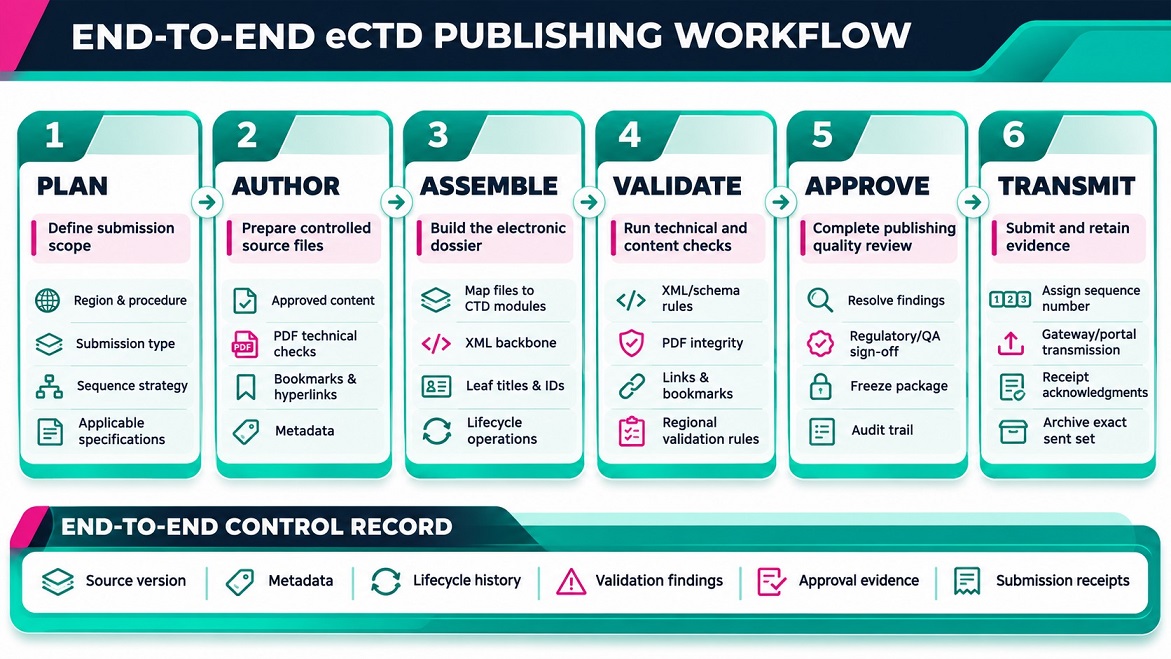
A controlled workflow starts with a regulatory plan identifying product, application type, sequence, and authority. Authors then provide approved source files, while publishing specialists verify document properties, place content into dossier modules, and assign lifecycle actions. Validation tests the resulting structure against the appropriate agency rules. Regulatory reviewers inspect unresolved warnings, confirm the intended submission scope, and authorize transmission. Finally, the operations team reconciles agency acknowledgment messages and archives the released package. Each stage should produce evidence so errors can be reconstructed rather than guessed at after a deadline.
- Intake and metadata reconciliation
- Technical validation and peer review
- Transmission, receipt tracking, and archival
Which Documents and CTD Modules Are Included?
The Common Technical Document (CTD) divides pharmaceutical registration content into five modules. Module 1 contains region-specific administrative information such as application forms and labeling, while Modules 2 through 5 address the shared technical structure. Publishers must distinguish a document’s regulatory meaning from its electronic placement: a scientifically correct PDF can still be rejected if it belongs to the wrong node or uses invalid metadata.
Companies should establish a content map, review responsibility, and controlled naming practices before publication. Confirm file-level requirements against each target agency’s current specifications rather than assuming a universal PDF checklist.
CTD Module Mapping for Publishing Teams
| Module | Content focus | Publishing control |
|---|---|---|
|
1 |
Regional administrative information |
Country-specific placement and metadata |
|
2 |
Overviews and summaries |
Structured headings and cross-references |
|
3 |
Quality / CMC |
Correct granularity and technical document control |
|
4 |
Nonclinical reports |
Report placement and lifecycle integrity |
|
5 |
Clinical reports |
Study-report organization and links |
Module 1: Regional Administrative Information
Publishing teams must configure Module 1 for the target authority and submission type. Validate regional forms, document placement, metadata, sequence identifiers, and the applicable regional specification.
- Confirm the application type and procedure.
- Place forms and regional documents in the required sections.
- Check required metadata and controlled terms.
- Apply the correct regional validation rules.
Module 2: Overviews and Summaries
Module 2 contains structured overviews and summaries that guide reviewers to supporting evidence. Preserve its section hierarchy and verify references against the assembled Modules 3–5.
- Check headings and numbering across sections 2.3–2.7.
- Reconcile claims with their supporting dossier sections.
Module 3: Quality / CMC
Module 3 publishing requires correct placement and document granularity for quality information. Granularity guidance can depend on the eCTD version, so configure publishing rules for the target standard and region.
- Map substance and product information to the relevant 3.2.S and 3.2.P sections.
- Separate documents at the required dossier leaf level.
- Control titles, metadata, versions, and source status.
- Verify additions and replacements in the lifecycle.
Module 4: Nonclinical Reports
Module 4 organizes nonclinical study reports and related evidence. Publishing checks should confirm section placement, report identity, appendices, and lifecycle relationships when documents change.
- Map reports to the appropriate Module 4 sections.
- Match study identifiers to report titles and referenced summaries.
- Preserve appendices and supporting documents.
- Confirm replacements affect the intended files and sequence.
Module 5: Clinical Reports
Module 5 holds clinical study reports and supporting documentation. Confirm that reports, study identifiers, appendices, and links align with the dossier structure and applicable publishing requirements.
- Place reports in the appropriate Module 5 sections.
- Check study IDs, titles, and supporting documents.
- Verify links to summaries and related reports.
How Should eCTD v4.0 Readiness Be Evaluated?
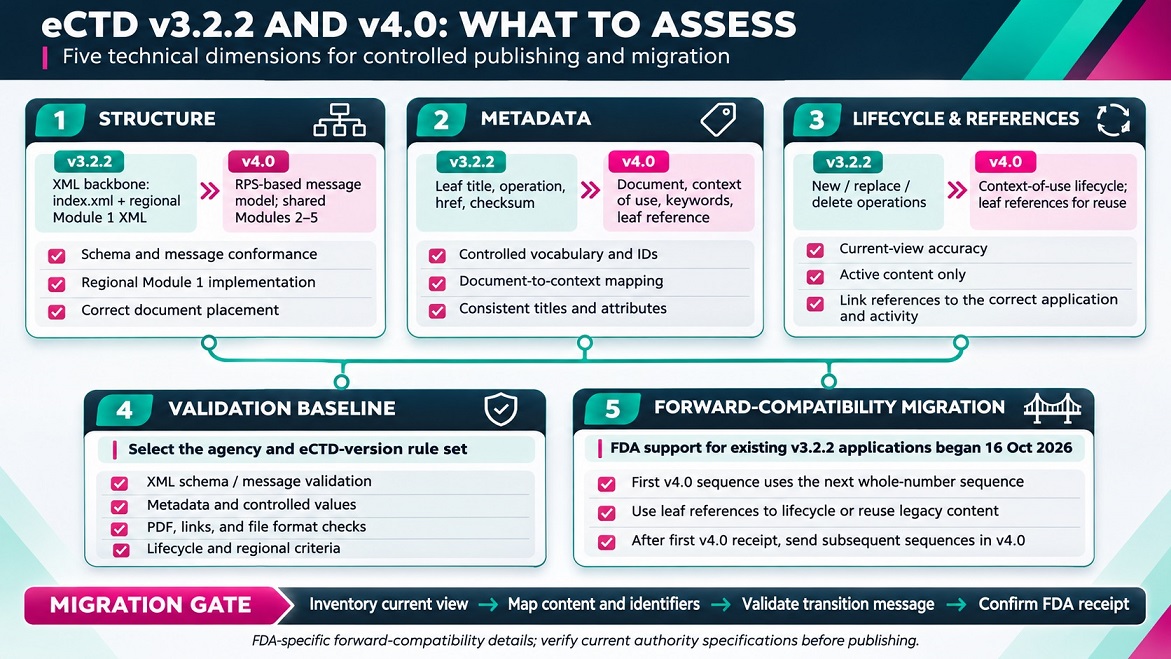
eCTD v4.0 changes important technical and lifecycle concepts, so readiness must be demonstrated for each applicable region and application. FDA supports new v4.0 applications and began supporting forward compatibility for existing v3.2.2 applications on October 16, 2026; these facts do not mean all submissions must immediately migrate.
The ICH implementation guide and controlled vocabulary have evolved, and agencies publish separate versions of regional documentation. An implementation project should combine system testing, training, pilot sequences, and regulatory monitoring. Avoid interpreting an old industry roadmap as a binding date without checking the latest agency announcement.
- Confirm market-specific eligibility and current standards.
- Test lifecycle transitions and controlled vocabulary updates.
Submission Lifecycle Management
Lifecycle management records whether an incoming document is new, replacing an earlier document, or otherwise changing dossier content under the applicable technical model.
Correct operation depends on the submitted sequence, existing application history, and authority-specific rules. Publishing software should make it easy to identify orphan references, duplicate content, and inappropriate sequence assumptions. It should also show reviewers what will become current after the new sequence is processed.
For ongoing applications, controlled lifecycle records reduce the risk of reconstructing regulatory history from uncontrolled folders. The final published package must remain immutable once formally released and submitted.
How Should Organizations Measure Publishing Performance?
Performance measures should reveal controllable weaknesses, not reward faster output at the expense of quality.
Useful indicators include first-pass technical validation, unresolved warnings at approval, source-document rework, publication cycle time, and receipt reconciliation. Define denominators, reporting frequency, and exclusions before comparing teams or vendors. For example, a high first-pass rate has little meaning if the group only validates easy sequences or ignores warning severity.
Trend metrics alongside complexity, jurisdiction, and submission volume, and review recurring failures through corrective action. Keep operational targets internal: there is no universal regulatory threshold for these business performance indicators.
- Trend error categories and remediation lead time
- Measure acknowledgments received and reconciled
- Review corrective actions for repeated submission defects
What Are the Six Most Important Regulatory References?
Reference management is a continuous responsibility for electronic publishing teams. The list below separates harmonized ICH specifications from regional agency controls, while retaining official document locations for later verification. Implementation guides, controlled vocabularies, technical conformance guidance, validation criteria, and public notices can change independently; a software feature is not compliant merely because it once passed an old rule set.
ICH eCTD v4.0 Implementation Guide
The harmonized eCTD v4.0 technical package describes common message and lifecycle structures. The ICH page identifies version 1.7 of the implementation guide endorsed in June 2026 and explains that regional Module 1 information must be used alongside it. Treat this as a technical baseline, not a complete country-specific submission rule.
FDA eCTD Submission Standards v4.0
FDA publishes supported implementation packages, controlled vocabulary, technical conformance guides, and validation criteria. The published list changes over time and includes support dates for specific versions. Publishing software must use the current supported specifications when targeting CDER or CBER and retain a traceable record of the rules used.
FDA eCTD v4.0 Implementation Status
FDA confirms support for new eCTD v4.0 applications from September 16, 2024, and forward compatibility for existing v3.2.2 applications from October 16, 2026. This is support information rather than a general claim that every previously filed application must migrate. Eligibility and submission type still require verification.
Final words
Choosing eCTD publishing software is a regulatory operations decision, not merely an IT procurement. The most valuable platform makes approved content easy to trace, regional rules easy to maintain, and submission outcomes easy to reconcile. Start with real application scenarios, challenge the validation and lifecycle functions, and insist on a documented approach to ongoing changes.
As agencies expand eCTD v4.0 support, organizations should follow current official notices rather than relying on vendor claims or obsolete timelines. Strong publishing governance complements scientific review, responsible authorization, and a durable submission archive.
FAQs
CTD defines dossier content organization, whereas eCTD is the electronic submission framework with region-specific metadata and lifecycle rules.
It typically assembles and validates approved content; scientific writing and accountable content approval remain separate responsibilities.
No universal v4.0-only mandate is stated on the FDA resources cited here. FDA supports both currently accepted versions, subject to its published standards.
References

Ershad Moradi, a Content Marketing Specialist at Zamann Pharma Support, brings 6 years of experience in the pharmaceutical industry. Specializing in pharmaceutical and medical technologies, Ershad is currently focused on expanding his knowledge in marketing and improving communication in the field. Outside of work, Ershad enjoys reading and attending industry related networks to stay up-to-date on the latest advancements. With a passion for continuous learning and growth, Ershad is always looking for new opportunities to enhance his skills and contribute to pharmaceutical industry. Connect with Ershad on Facebook for more information.

eCTD Publishing Software: The Right Features for Submission Success
Discover how eCTD publishing software organizes regulatory dossiers, validates electronic submissions, manages document lifecycles, and supports FDA and EMA workflows.

Pharmaceutical Analytical Testing Services: Essential Quality Insights
A practical guide to pharmaceutical analytical testing services: assay, impurities, dissolution, stability, microbial testing, validation and outsourced-laboratory oversight.

Medical Device Distribution Quality: Essential Safeguards Against Failures
Medical device distribution quality protects device conformity from receipt to delivery. Explore EU distributor obligations, ISO 13485 principles, UDI traceability, storage controls, complaint handling, and audit-ready records.
Lorem ipsum dolor sit amet, consectetur adipiscing elit. Ut elit tellus, luctus nec ullamcorper mattis, pulvinar dapibus leo.