


Pharmaceutical analytical testing services provide the scientific evidence used to evaluate drug identity, strength, purity, quality and performance. A competent laboratory combines suitable methods, qualified instruments, representative sampling and traceable results to support decisions about active pharmaceutical ingredients (APIs), excipients, in-process materials and finished products. Its role extends beyond generating a number: it must show that the number is reliable, relevant to a specification and defensible during an inspection.
These services are one component of a wider pharma quality assurance system, which connects testing with change control, investigations, supplier oversight and continual improvement. In the United States, 21 CFR 211.194 addresses laboratory records, while ICH Q2(R2) sets out principles for validating analytical procedures.
This guide compares practical testing options and explains how to evaluate contract laboratory performance without confusing method validation, compendial verification and routine system suitability.
Table of Contents
What Are Pharmaceutical Analytical Testing Services?
Pharmaceutical analytical testing services are specialized laboratory activities that establish whether materials and medicines meet predefined quality attributes. They may be performed internally or by a contracted testing organization under an appropriate quality agreement. The scope ranges from identity and potency tests to impurities, microbial quality, stability and dissolution. Results must be interpreted against approved specifications rather than treated as isolated instrument outputs. A capable provider also controls sample handling, method status, reference standards and electronic records.
The decision to outsource a test does not transfer the manufacturer’s overall responsibility for product quality or regulatory compliance. Service scope, responsibilities and reporting arrangements must therefore be documented before samples are shipped
Which Samples and Products Are Tested?
Testing laboratories work with raw materials, APIs, excipients, manufacturing intermediates, packaging-related samples and finished dosage forms. Each material needs specifications and sampling instructions suited to its intended use.
A tablet might require assay, content uniformity, dissolution and related-substance tests, while a sterile solution may also require product-specific microbiological assessments. Development samples can require exploratory methods, but commercial release methods need an appropriate state of qualification or validation.
Sample identity, batch number, storage condition and custody records protect the connection between a reported result and the physical material. Mixing investigational results with formal release testing without clear labeling creates avoidable compliance risk.
What Does a Contract Testing Laboratory Deliver?
A contract laboratory normally delivers an agreed analytical report or certificate of analysis (COA), together with retained supporting records. The customer should specify which methods, specifications, reporting units, acceptance criteria and deviation notification rules apply.
A useful report identifies the sample, analytical procedure, results, relevant limits, analyst or reviewer approvals and any qualifying observations. The underlying raw data, audit trails, calculations and chromatograms must remain retrievable under the defined retention and access arrangements.
Not every COA proves that the manufacturing batch is releasable: the responsible quality unit must evaluate all required information, including manufacturing and investigation records, before making the disposition decision
How Do Quality Control and Quality Assurance Differ?
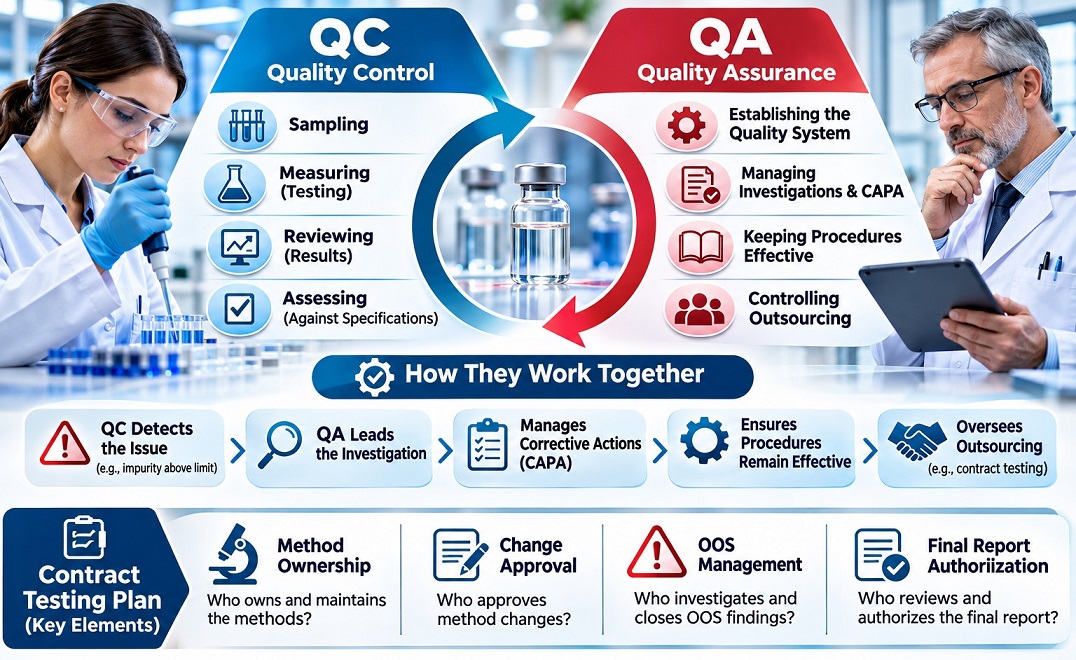
Quality control (QC) focuses on sampling, measuring, reviewing and assessing product attributes against specifications. Quality assurance (QA) establishes and maintains the broader quality system that makes those operations dependable.
QC may detect an impurity above its limit; QA ensures that the event is investigated, corrective actions are managed, procedures remain effective and outsourcing is controlled. Both functions depend on sound data governance and competent personnel. The boundary can vary across organizations, so responsibilities should be documented rather than assumed.
Contract testing plans should state who owns methods, approves changes, manages out-of-specification findings and authorizes the final report. These interfaces matter as much as instrument capability.
Which Analytical Techniques Are Most Important?
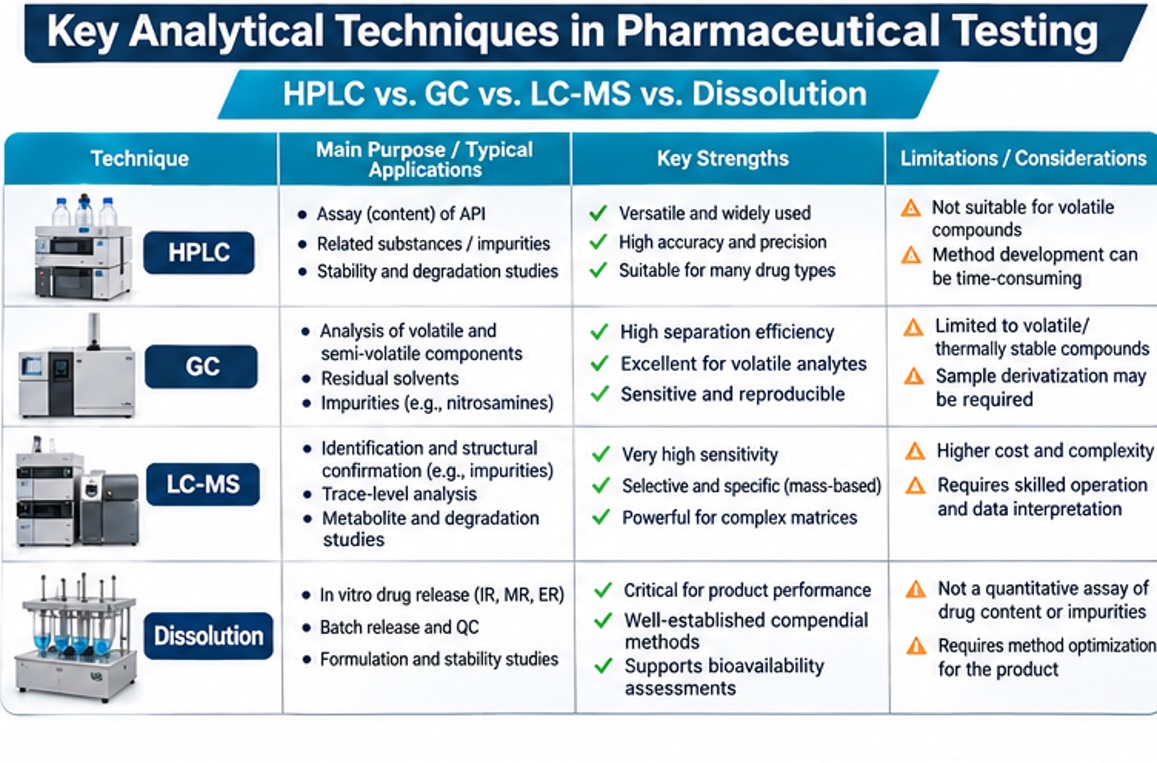
Technique selection begins with the analytical question: identity, assay, impurity content, biological activity or dosage-form performance. High-performance liquid chromatography (HPLC) is widely used for nonvolatile analytes; gas chromatography (GC) is useful for volatile compounds; liquid chromatography–mass spectrometry (LC–MS) provides selective mass-based information; and dissolution testing evaluates release behavior for applicable dosage forms. No platform is universally superior. Method suitability depends on analyte properties, concentration, sample matrix, required sensitivity and the established procedure.
Laboratories should avoid presenting an instrument list as proof of capability: evidence of method fitness, qualified equipment, trained analysts and robust data review is equally important.
- Match the test objective to analyte chemistry and specification limits.
- Confirm method suitability and applicable system-suitability requirements.
- Review instrument qualification, maintenance and analyst competency.
How Are Analytical Procedures Developed and Validated?
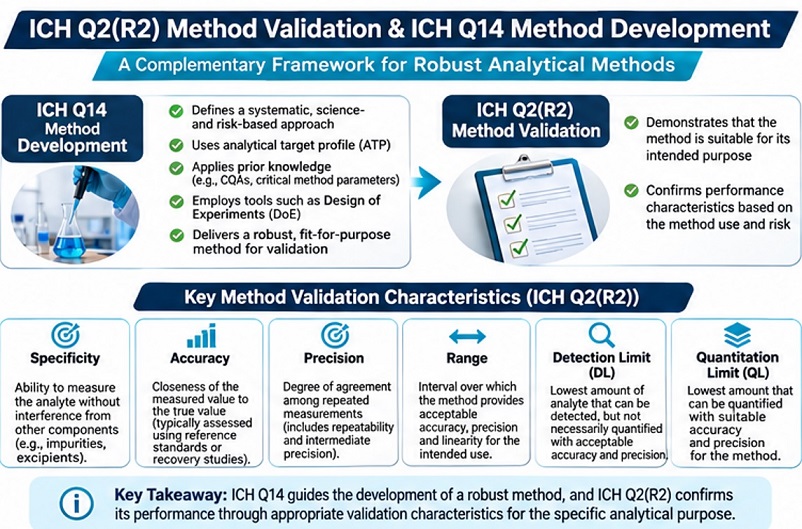
ICH Q14 describes scientific, risk-based development of analytical procedures, including a clear understanding of intended purpose and method parameters.
ICH Q2(R2) provides a validation framework to demonstrate that a procedure is fit for that purpose. Depending on the type of test, relevant characteristics may include specificity, accuracy, precision, reportable range, detection limit and quantitation limit. A predefined protocol and acceptance criteria help prevent retrospective adjustment to convenient results.
Compendial procedures may require verification under actual conditions of use rather than repeating a complete validation program, depending on the applicable standards and circumstances. Routine system suitability is a separate ongoing performance control and does not replace validation.
- Define an analytical target and intended reportable result.
- Justify the applicable validation characteristics and acceptance limits.
- Document deviations, calculations, approval and lifecycle changes.
Validation Characteristics and Example Evidence
| Characteristic | Scientific question | Typical evidence |
|---|---|---|
|
Specificity / selectivity |
Can the analyte be distinguished from interference? |
Blank, matrix and impurity interference studies |
|
Accuracy |
How close is a result to a reference value? |
Recovery or comparison studies |
|
Precision |
How consistent are repeated results? |
Repeatability / intermediate-precision data |
|
Range |
Across which interval is performance suitable? |
Results across justified levels |
|
DL / QL |
What can be detected or quantified? |
Low-level performance evaluation |
When Are Stability, Dissolution and Microbial Tests Needed?
The test package should reflect dosage form, route of administration, product risk and approved specifications. Stability studies evaluate quality changes over time under defined conditions and support shelf-life decisions. Dissolution can monitor release behavior and manufacturing consistency for suitable oral solid products.
Microbiological programs may address microbial limits, specified organisms, sterility, bacterial endotoxins or other product-specific needs. The precise tests and acceptance limits must not be copied from unrelated products. Sampling intervals, storage chambers, method capability and handling of atypical data are equally important.
A laboratory should show that its program captures the relevant attributes without inflating scope with nonessential tests or overlooking high-risk characteristics.
- Confirm the approved specification and stability protocol.
- Use methods suitable for product matrix and acceptance limits.
- Trend data, document excursions and investigate unexpected results.
What Are the 5 Most Important Reference Frameworks?
Pharmaceutical analytical testing relies on a combination of regulatory requirements, scientific guidelines, and quality management principles. The following five reference frameworks provide essential guidance for method development, analytical validation, data integrity, laboratory controls, and outsourced testing, helping laboratories maintain reliable results and regulatory compliance.
Number 1. 21 CFR Part 211 — Laboratory Controls
Sections 211.160, 211.165 and 211.194 address laboratory controls, testing connected with release and laboratory records for applicable finished drug manufacturing.
They establish a legal context for written procedures, suitability of methods, complete data and review. Always check current applicability and the exact section before converting guidance into a site procedure.
Number 2. ICH Q2(R2) — Validation of Analytical Procedures
ICH Q2(R2) explains how to select and demonstrate appropriate validation characteristics for the intended analytical purpose.
It covers assay, identity, impurities and other qualitative or quantitative measurements. The correct study design depends on measurement goals; a generic checklist is not a replacement for a scientifically justified protocol.
Number 3. ICH Q14 — Analytical Procedure Development
ICH Q14 complements validation by emphasizing scientific understanding during method development and lifecycle management. Knowledge of analytical target, critical parameters, robustness and risk helps laboratories build methods that remain reliable when transferred, maintained or changed. Not every optional enhanced development activity is universally mandatory.
Number 4. FDA Data Integrity Guidance
FDA’s data integrity questions-and-answers guidance explains expectations for reliable CGMP records and risk-based controls.
It is especially relevant to laboratory information systems, chromatographic data systems, audit trails and original electronic records. Policies should address both people and computerized systems rather than simply adding more signatures.
Number 5. EU GMP Chapters 6 and 7
EU GMP Chapter 6 addresses quality control and Chapter 7 addresses outsourced activities. Together they help define laboratory operations, technical competence, contracts and the allocation of responsibilities between a contract giver and acceptor. Apply them according to the relevant market and operating arrangement. [6]
Final words
Pharmaceutical analytical testing services deliver value when results are scientifically suitable, traceable and connected to real quality decisions. Buyers should compare laboratories on technical expertise, method lifecycle controls, auditability and escalation practices, not merely cost per sample.
A defensible testing program starts with fit-for-purpose methods and ends with complete records, meaningful review and responsible disposition. Strong governance helps manufacturers avoid preventable release delays, compliance weaknesses and patient risk.
FAQs
Typical services include identity, assay, impurities, dissolution, stability and relevant microbiological analyses. The scope depends on the product and defined specifications.
No. HPLC is versatile but analyte chemistry and method purpose determine whether GC, LC–MS, spectroscopic or other techniques are more suitable.
Validation demonstrates fitness for a defined intended purpose. Verification confirms that an applicable established or compendial procedure performs suitably under actual conditions of use.
References

Ershad Moradi, a Content Marketing Specialist at Zamann Pharma Support, brings 6 years of experience in the pharmaceutical industry. Specializing in pharmaceutical and medical technologies, Ershad is currently focused on expanding his knowledge in marketing and improving communication in the field. Outside of work, Ershad enjoys reading and attending industry related networks to stay up-to-date on the latest advancements. With a passion for continuous learning and growth, Ershad is always looking for new opportunities to enhance his skills and contribute to pharmaceutical industry. Connect with Ershad on Facebook for more information.

Pharmaceutical Analytical Testing Services: Essential Quality Insights
A practical guide to pharmaceutical analytical testing services: assay, impurities, dissolution, stability, microbial testing, validation and outsourced-laboratory oversight.

Medical Device Distribution Quality: Essential Safeguards Against Failures
Medical device distribution quality protects device conformity from receipt to delivery. Explore EU distributor obligations, ISO 13485 principles, UDI traceability, storage controls, complaint handling, and audit-ready records.

Biotechnology Regulatory Affairs: Common Errors and Mistakes
Biotechnology Regulatory Affairs, Biologics Approval, FDA BLA, IND Application, FDA and EMA Regulations, Biologics CMC, eCTD Submission, Biosimilar Regulation, Cell and Gene Therapy, ICH Q5E Comparability
Lorem ipsum dolor sit amet, consectetur adipiscing elit. Ut elit tellus, luctus nec ullamcorper mattis, pulvinar dapibus leo.