


Medical device distribution quality is the system of checks, records, handling practices, and escalation processes that preserves a device’s safety, performance, and legal conformity after it leaves a manufacturer. A shipment can be commercially on time yet operationally unacceptable if storage limits were exceeded, seals were compromised, or an affected lot cannot be located. Distribution therefore belongs within the product lifecycle rather than being treated as transport alone.
This is also a question of pharma regulation: different economic operators have different responsibilities, and the relevant law depends on the market and the activity performed. In the European Union, Article 14 of Regulation (EU) 2017/745 specifies distributor checks and escalation duties; FDA’s Quality Management System Regulation (QMSR) became effective on 2 February 2026 for covered finished-device manufacturers, incorporating ISO 13485:2016 by reference.
Table of Contents
What Is Medical Device Distribution Quality?
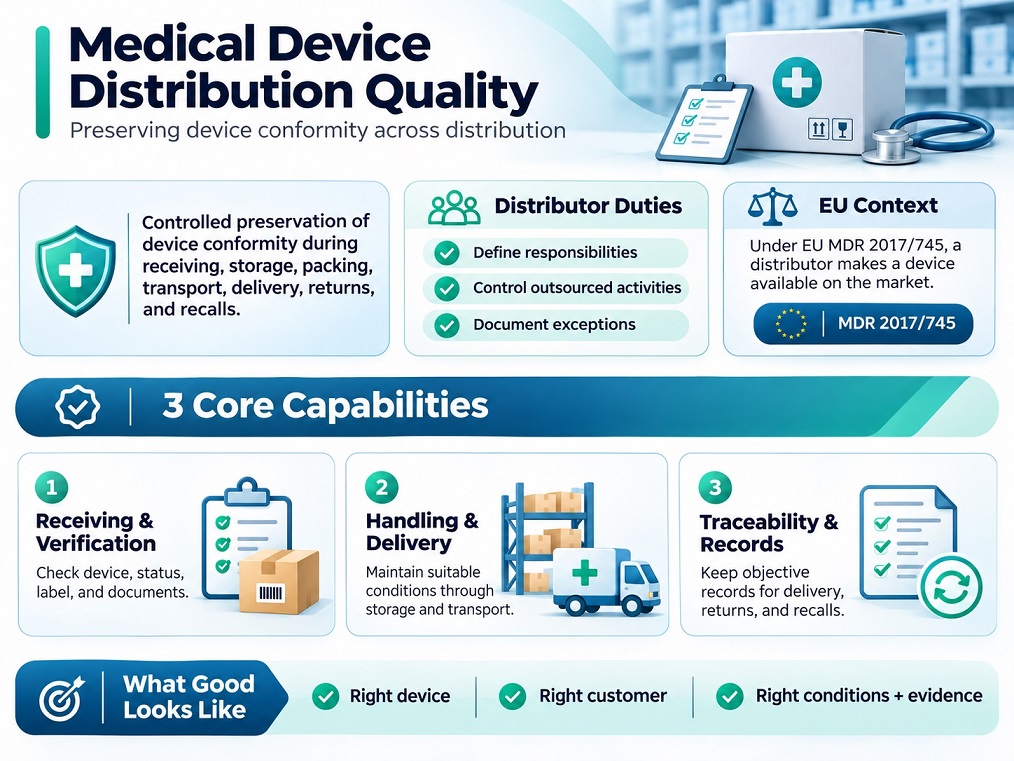
Medical device distribution quality is the controlled preservation of medical-device conformity while products are received, stored, picked, packed, transported, delivered, returned, or recalled. It is not simply the absence of broken boxes: objective records must show the correct device went to the correct customer under suitable conditions.
A distributor should define responsibilities, control outsourced activities, and document exceptions without assuming that the manufacturer’s entire quality system automatically becomes its legal obligation.
In the European Union, Regulation (EU) 2017/745 defines a distributor by the activity of making a device available on the market. The following three capabilities convert this concept into daily, evidence-based controls.
Receiving and Release Verification
At receipt, staff should establish identity, shipment condition, traceability information, and the acceptability of any delivery damage or environmental incident. For devices supplied in the European Union, distributors verify applicable CE marking, declaration of conformity, manufacturer information, importer checks where relevant, and unique device identification (UDI), subject to the regulation’s permitted representative sampling approach for specified checks. Do not confuse a product-level verification with a claim that every shipment needs every document physically attached. Route missing evidence and damaged seals to a controlled hold pending a documented decision.
- Compare received quantities and device identifiers with the order.
- Document packaging damage, missing labels, and exceptions.
- Block release until an authorized disposition is recorded.
Storage and Transportation Conditions
Quality conditions depend on each device’s validated or manufacturer-specified limits, rather than one universal warehouse temperature. A responsible operation identifies vulnerable devices, designs appropriate storage zones, monitors environmental conditions where required, and assesses deviations using product-specific evidence. Transport providers need clear written instructions and escalation triggers, especially where handling or packaging could affect conformity.
- Define product-specific conditions and handling instructions.
- Review excursions and preserve monitoring records.
- Qualify outsourced logistics according to actual risks.
Traceability and Documented Evidence: A Five-Stage Process
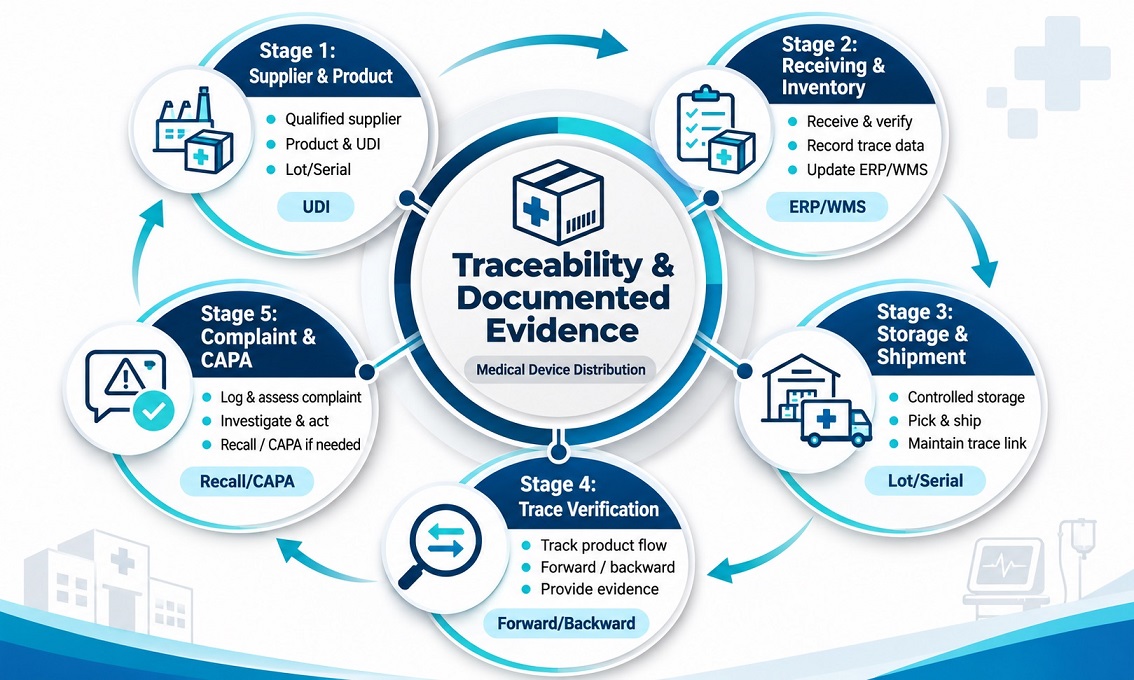
An effective medical device distributor should establish a structured traceability process that connects suppliers, product identifiers, shipments, customers, and corrective actions. The following five-stage approach helps maintain reliable documentation, support regulatory compliance, and enable rapid product identification during complaints, recalls, or field safety actions.
Stage 1 — Supplier and Product Identification
Traceability begins with accurate identification of suppliers and medical devices entering the distribution network. Distributors should verify applicable product identifiers, supplier details, and relevant regulatory documentation before accepting inventory. Unique Device Identification (UDI), lot numbers, and serial numbers should be recorded where applicable and required. These records establish the foundation for tracking products throughout the distribution lifecycle.
Verify supplier identity and approval status.
Record applicable UDI and product codes.
Capture lot or serial numbers when required.
Stage 2 — Receiving and Inventory Registration
Upon receipt, medical devices should undergo documented verification against purchase orders and shipping records. Warehouse personnel should inspect packaging integrity, product quantities, and applicable storage conditions. Accepted products should be registered in the warehouse management system (WMS) or equivalent controlled records.
Stage 3 — Storage, Handling, and Shipment Tracking
Medical devices must be stored and handled according to the manufacturer’s specified conditions. Inventory systems should maintain sufficient information to link applicable device identifiers with storage locations and outgoing shipments. Each dispatch should generate records identifying the product, quantity, shipment date, and destination. Where third-party logistics providers are involved, responsibilities for data capture and retrieval should be clearly established.
Monitor applicable environmental conditions.
Maintain inventory location and movement records.
Link outgoing shipments to customer destinations.
Document transportation exceptions and deviations.
Stage 4 — Traceability Verification and Record Integrity
Distributors should periodically verify whether their traceability records support accurate backward and forward tracking. Backward tracing identifies the supplier and source of an affected device, while forward tracing identifies downstream recipients. Records maintained across enterprise resource planning (ERP), warehouse, and logistics systems should remain consistent and accessible.
Stage 5 — Complaint Investigation, Recall, and Corrective Action
When a complaint, suspected nonconformity, or field safety issue occurs, traceability records should enable prompt identification of potentially affected devices. Distributors should coordinate with manufacturers and other responsible parties to determine the affected products and distribution destinations.
Which Regulations Govern Distribution Quality?
The answer depends on jurisdiction, device category, and the organization’s function. In the EU, Medical Device Regulation (MDR) Article 14 sets direct distributor duties, while Article 13 addresses importers; in vitro diagnostic devices have a parallel framework under Regulation (EU) 2017/746.
ISO 13485:2016 provides a quality management framework that may be contractually relevant and can support organizational control, but certification alone does not demonstrate compliance with every applicable law.
In the United States, FDA’s QMSR governs covered finished-device manufacturers, not every logistics intermediary merely because it stores products. Teams should map the actual activity to each market’s obligations before building procedures.
How Should a Distributor Control Complaints and Recalls?
Complaints, suspected nonconformities, serious-risk signals, and manufacturer field actions need an established receiving and escalation route. Under the EU MDR, distributors have duties to inform relevant economic operators and, in specified circumstances, competent authorities; they must also cooperate on risk-elimination activities. Build an intake log that distinguishes customer dissatisfaction from a potential product safety event without delaying escalation for uncertain cases. Make responsibilities clear when a distributor learns about a suspect device before the manufacturer. Recall exercises should challenge completeness of distribution lists, speed of customer contact, and reconciliation of returned or quarantined stock.
- Escalate suspect or dangerous products using defined triggers.
- Maintain complaint and nonconforming-device records.
- Reconcile recall outreach, responses, and final dispositions.
Distribution Quality Control Matrix
| Control area | Primary risk | Owner |
|---|---|---|
|
Receipt checks |
Wrong or nonconforming device |
Warehouse / QA |
|
Environment |
Damage from unsuitable conditions |
Logistics / QA |
|
Traceability |
Unlocated affected product |
Operations / IT |
|
Complaints |
Delayed safety escalation |
QA / Regulatory |
What Should a Risk-Based Quality Agreement Include?
A written quality agreement translates regulatory role definitions into practical handoffs. It should identify who approves shipping configurations, supplies up-to-date storage instructions, handles excursions, maintains traceability records, conducts complaint investigations, and notifies customers during field actions. Agreements cannot contract away statutory responsibilities, so use them to specify interfaces rather than redefine a party’s legal status.
Consider subcontracted warehouses and carriers, including access to records and audit arrangements. Require notification of significant process changes and define how long records remain accessible after contract termination.
- Assign decisions for excursions, returns, and quarantine.
- Specify notification times and data-sharing formats.
How Can Distribution Quality Performance Be Measured?
Good metrics reveal weakened controls before a complaint or recall exposes them. Pair operational speed with evidence of product protection: receipt exceptions, overdue excursion investigations, trace-test completion, complaints awaiting disposition, and recall reconciliation rates. A low complaint rate is not proof of compliance if records are missing or staff do not know how to report issues. Set risk-sensitive thresholds, review trends, and investigate recurring causes rather than reacting only to single outliers. Segregate data by device type, lane, warehouse, or logistics supplier when this makes patterns clearer.
- Trend deviations by product family and distribution route.
- Test traceability completeness using sampled real orders.
- Verify corrective-action effectiveness after closure.
Five Essential Regulatory and Quality References
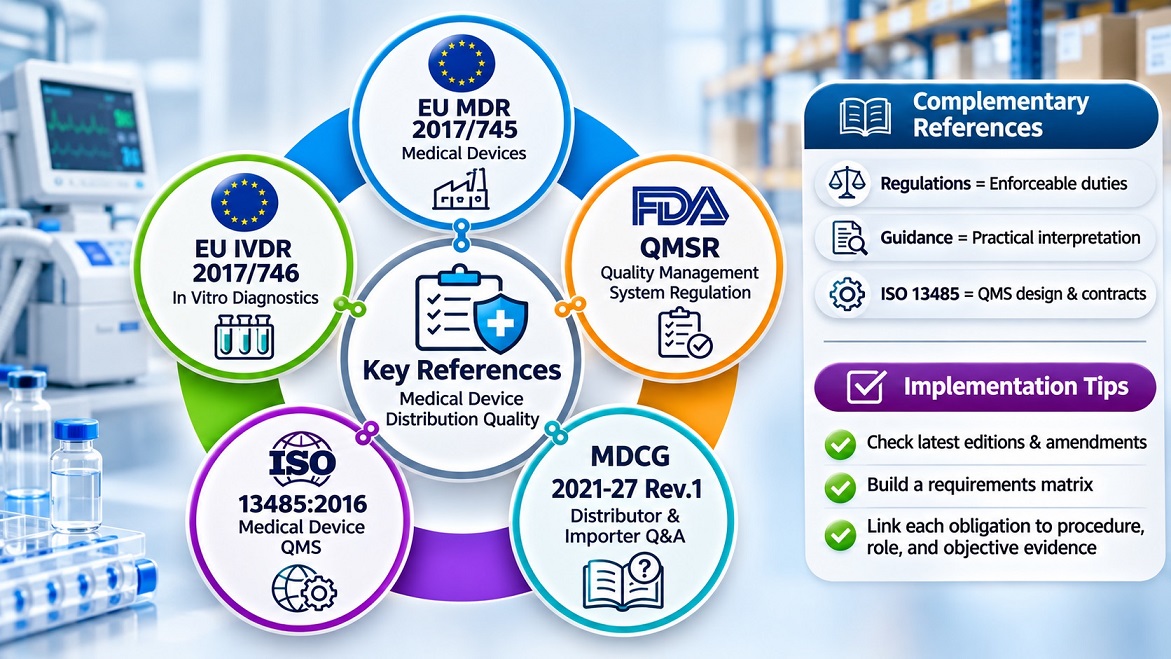
Quality teams should maintain controlled access to the texts that directly affect their products and markets. The following five references provide complementary—not interchangeable—perspectives. Legal regulations define enforceable duties; regulator guidance explains practical interpretation; and ISO 13485 supports quality-system design and contractual expectations.
Check amendments and consolidated editions before relying on a provision. For implementation, create a traceable requirements matrix linking each relevant obligation to the company’s procedure, responsible role, and objective evidence.
- EU Medical Device Regulation (EU) 2017/745
- EU In Vitro Diagnostic Regulation (EU) 2017/746
- FDA Quality Management System Regulation
- ISO 13485:2016 Medical Device QMS
- MDCG 2021-27 Rev.1 Distributor and Importer Q&A
Final words
Medical device distribution quality is proven through controlled operations and retrievable evidence—not a policy binder.
Strong programs verify the right device at receipt, maintain manufacturer-defined conditions, preserve traceability, quarantine uncertainty, and escalate quality signals without delay. Start with the obligations that apply to each market and business role, then build risk-based work instructions and practical monitoring.
Regular trace exercises, complaint reviews, and credible corrective actions help teams detect weak points before they harm customers or patients. The result is a distribution network that is not only efficient but also more resilient, inspection-ready, and accountable.
FAQs
No. ISO 13485 provides a quality management framework, but EU MDR Article 14 imposes distinct legal verification, storage, reporting, and cooperation obligations on distributors. The organization must demonstrate compliance with the provisions applying to its activities.
Yes. If it first places an individual device from a third country onto the Union market, it may assume importer obligations; MDCG 2021-27 Rev.1 provides practical examples. The role is determined by the transaction and activities.
Segregate or hold affected stock, record the condition, investigate impact on the device or sterile barrier as relevant, and obtain authorized disposition. Do not silently return questionable goods to saleable inventory.
References

Ershad Moradi, a Content Marketing Specialist at Zamann Pharma Support, brings 6 years of experience in the pharmaceutical industry. Specializing in pharmaceutical and medical technologies, Ershad is currently focused on expanding his knowledge in marketing and improving communication in the field. Outside of work, Ershad enjoys reading and attending industry related networks to stay up-to-date on the latest advancements. With a passion for continuous learning and growth, Ershad is always looking for new opportunities to enhance his skills and contribute to pharmaceutical industry. Connect with Ershad on Facebook for more information.

Medical Device Distribution Quality: Essential Safeguards Against Failures
Medical device distribution quality protects device conformity from receipt to delivery. Explore EU distributor obligations, ISO 13485 principles, UDI traceability, storage controls, complaint handling, and audit-ready records.

Biotechnology Regulatory Affairs: Common Errors and Mistakes
Biotechnology Regulatory Affairs, Biologics Approval, FDA BLA, IND Application, FDA and EMA Regulations, Biologics CMC, eCTD Submission, Biosimilar Regulation, Cell and Gene Therapy, ICH Q5E Comparability

Clinical Trial Source Documents: Important GCP Mistakes
Clinical trial source documents support reliable GCP records. Learn seven common documentation mistakes and how to improve accuracy, traceability, data integrity, and inspection readiness.
Lorem ipsum dolor sit amet, consectetur adipiscing elit. Ut elit tellus, luctus nec ullamcorper mattis, pulvinar dapibus leo.