


Biotechnology regulatory affairs connects scientific evidence with decisions about whether biologic medicines reach patients. In the United States, investigational development uses the IND framework, while marketing authorization for many biologics requires a Biologics License Application (BLA). [1, 2] Regulatory planning begins before dossier assembly and continues throughout the product lifecycle.
From monoclonal antibodies to cell and gene therapies, teams coordinate manufacturing evidence, clinical studies, labeling, and post-approval changes. This guide explains the process, risks, and controls for submission readiness. To build skills in pharma regulation, explore Pharmuni’s regulatory-affairs resources alongside the technical recommendations below.
Table of Contents
What Is Biotechnology Regulatory Affairs?
Biotechnology regulatory affairs is the strategic management of regulatory evidence, authority interactions, submissions, and commitments for biological medicines. It connects product science with legal requirements across development, authorization, and commercialization.
Unlike a one-time application task, this discipline tracks a changing product, process, and evidence base.
- Product strategy: classify the medicine and select an appropriate route.
- Evidence control: integrate quality, nonclinical, and clinical findings.
- Lifecycle oversight: manage commitments, changes, and safety updates.
Key Components and Biotechnology Regulatory Requirements
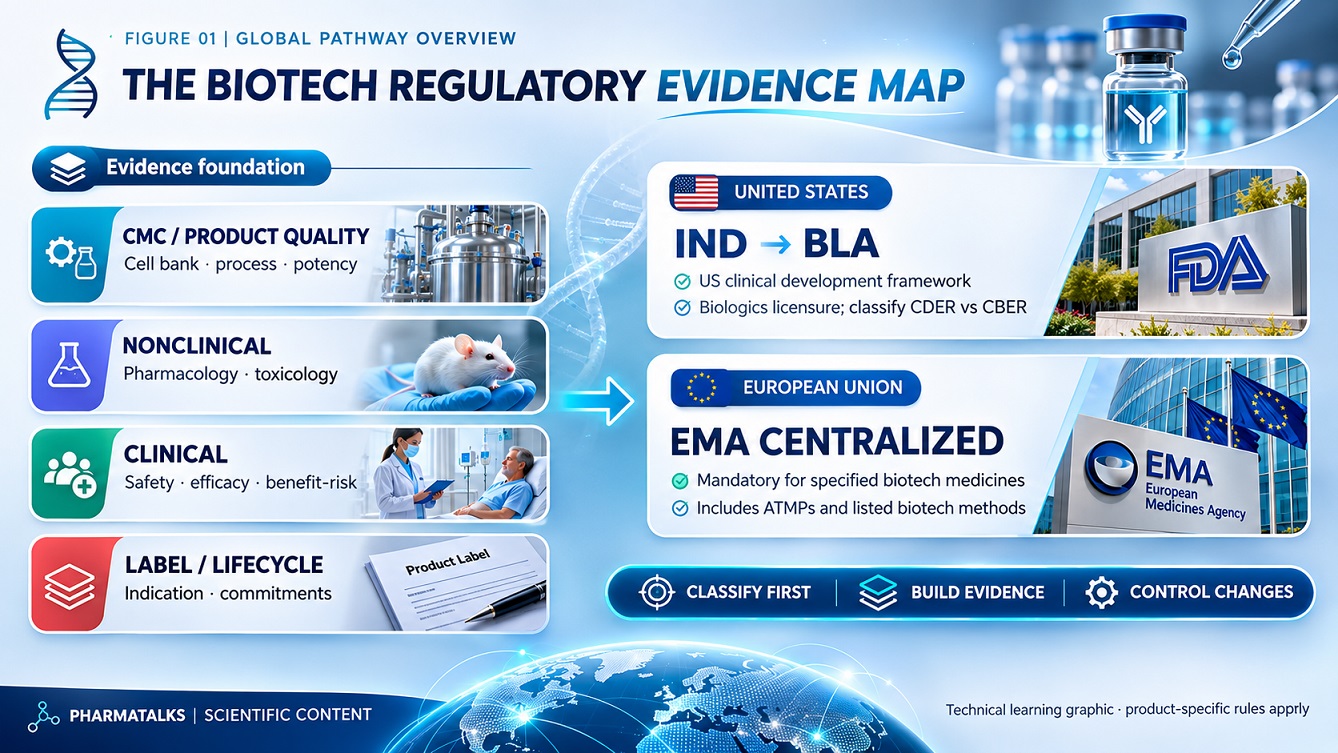
A complete regulatory strategy begins with the modality: a recombinant protein, monoclonal antibody, vaccine, biosimilar, cell therapy, or gene therapy can raise materially different questions. It then identifies the appropriate regulator, application pathway, required studies, manufacturing controls, and critical decision dates.
In the US, regulatory responsibility is divided by product type between FDA centers, including CDER and CBER. A Biologics License Application is a request for licensure and generally integrates manufacturing and quality information, nonclinical evidence, clinical findings, and proposed labeling. The product’s actual classification matters more than the company’s description of it.
For many biotechnology-derived medicines in the EU, the centralized procedure is mandatory. EMA specifically identifies medicines developed using recombinant DNA methods, controlled gene expression, and monoclonal antibody methods, along with advanced therapy medicinal products, within the mandatory scope.
How the Biologics Regulatory Approval Process Works
Regulatory affairs translates research decisions into an evidence plan. In early development, teams define the intended indication, proposed clinical population, product characterization strategy, manufacturing process, and foreseeable quality risks. Scientific advice or FDA interactions help surface disagreements before irreversible development choices are made.
As development advances, CMC specialists document cell substrates, materials, process controls, analytical methods, stability, facilities, and lot consistency. Nonclinical and clinical teams generate evidence appropriate to their programs. Regulatory affairs coordinates submission content, document versions, authority questions, and inspection preparation.
Step-by-Step Biotechnology Regulatory Strategy
Use a four-gate model to keep scientific and regulatory decisions aligned. The gates below are a planning framework, not a prescribed FDA or EMA checklist.
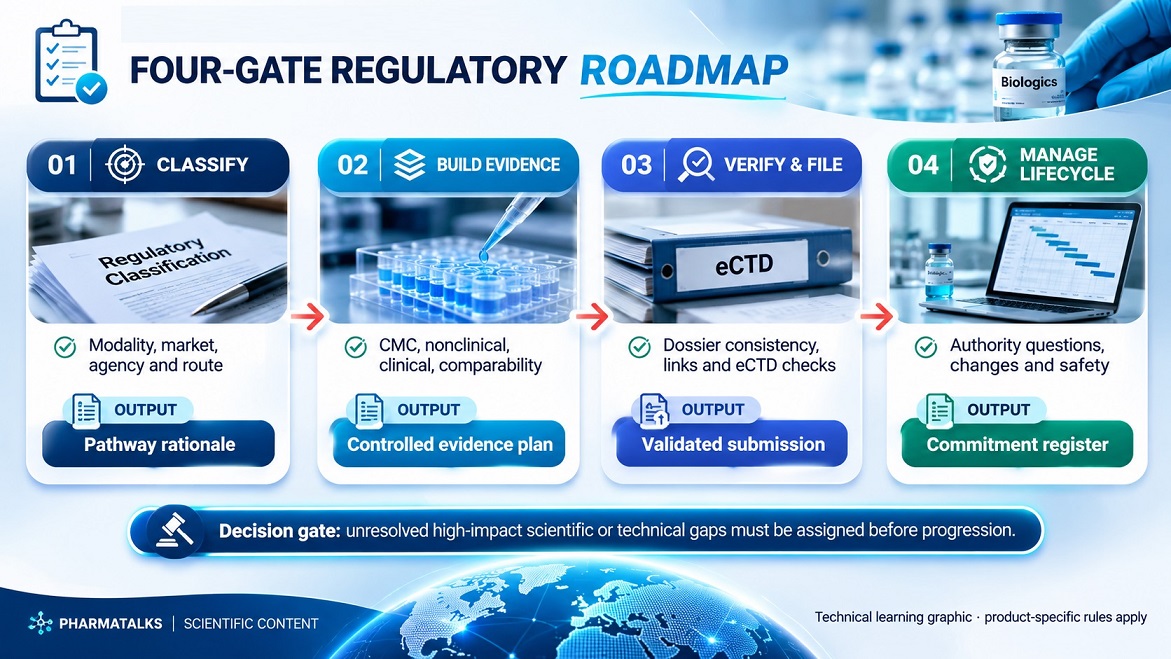
Step 1: Classify the Product and Map the Route
Step 2: Build the Evidence and CMC Control Plan
Map required quality, nonclinical, and clinical evidence to dossier sections. Identify critical quality attributes, process controls, viral-safety considerations where applicable, analytical comparability needs, and meaningful evidence gaps before pivotal decisions.
Step 3: Verify the Dossier and Submission Readiness
Reconcile specifications, process descriptions, stability results, study reports, labeling, and eCTD metadata. Test document links and technical validation. Ensure reviewers can trace claims to approved, version-controlled source records.
Step 4: Submit, Respond, and Maintain Compliance
Submit through the relevant authorized channel, manage agency questions with controlled response ownership, and record agreed actions. After authorization, assess changes, monitor safety, and update the dossier and internal commitments as required.
Biotechnology Regulatory Affairs Applications and Industry Use Cases
Biotechnology regulatory affairs supports the development, approval, and commercialization of biologics, biosimilars, cell and gene therapies, and other innovative treatments.
Key applications include regulatory strategy, CMC compliance, clinical trial submissions, FDA and EMA approvals, and post-approval lifecycle management.
Monoclonal Antibodies, Recombinant Proteins, and Vaccines
Monoclonal antibodies and recombinant proteins are highly sensitive to manufacturing conditions that can affect product quality, safety, and efficacy. Regulatory teams must establish scientifically justified specifications based on product characterization, process knowledge, and development-stage requirements. For vaccines and other biologics, regulatory strategies should address product-specific evidence, FDA center classification, and regional requirements.
Critical Quality Attributes (CQAs)
Process Characterization
Regulatory Requirements
Manufacturing Changes
Comparability Assessment
Cell and Gene Therapy Regulatory Affairs
Cell and gene therapies require specialized regulatory strategies due to their complex manufacturing processes and safety considerations. Regulatory teams must coordinate quality controls, clinical documentation, and product-specific regulatory requirements. Both FDA and EMA provide regulatory frameworks for these advanced therapies.
Starting Materials: Control raw materials, cell sources, and vector-related impurities.
Potency & Quality: Establish scientifically justified potency assays and manage manufacturing variability.
Traceability: Maintain chain of identity, batch records, and clinical administration traceability.
Regulatory Pathways: Address FDA requirements and EU centralized authorization, including EMA’s Committee for Advanced Therapies.
Lifecycle Management: Coordinate regulatory submissions, manufacturing changes, and long-term safety monitoring.
Biosimilars and Regulatory Pathway Selection
Biosimilars are biological products that are highly similar to an approved reference product, with no clinically meaningful differences in safety, purity, and potency. Unlike generic medicines, biosimilars require a comparative evidence strategy tailored to the product. In the US, reference biologics may be licensed under section 351(a), while eligible biosimilars follow the section 351(k) pathway.
Analytical Comparability: Evaluate structural, physicochemical, and functional similarity.
Reference Product: Ensure appropriate sourcing, selection, and documentation.
Clinical Evidence: Determine the necessary comparative studies based on residual uncertainty and applicable requirements
Representative Biologics Regulatory Applications
| Product category | Typical regulatory focus | Key evidence example |
|---|---|---|
|
Monoclonal antibody |
Structure and consistency |
Potency and purity |
|
Cell or gene therapy |
Traceability and control |
Identity and process records |
|
Biosimilar |
Reference comparison |
Comparative analytics |
|
Vaccine |
Product-specific safety and quality |
Manufacturing and clinical data |
FDA and EMA Regulations: Seven Costly Errors and Best Practices
FDA and EMA regulatory compliance requires careful planning, accurate documentation, and alignment with product-specific requirements. Common mistakes in regulatory strategy, clinical evidence, CMC documentation, and submission planning can lead to costly delays, additional studies, or regulatory rejection. Understanding seven critical errors and applying proven best practices can improve submission quality, reduce compliance risks, and support faster regulatory approvals.
FDA IND, BLA, eCTD, and European Authorization Requirements
In the US, clinical trials follow 21 CFR Part 312 (IND), while commercial biologics require a BLA under 21 CFR Part 601, with ongoing post-approval obligations. FDA supports eCTD v3.2.2 and v4.0, with v4.0 available for new applications since September 16, 2024. Sponsors must verify current submission standards before filing.
In the EU, EMA’s centralized procedure enables EU-wide marketing authorization, while applicable national requirements for clinical trials, manufacturing, and implementation still apply.
The Seven Common Regulatory Affairs Errors
- Wrong product classification: choosing a route without documenting the modality and jurisdiction.
- Late quality planning: collecting CMC information only when writing submission modules.
- Weak comparability justification: overlooking process-change implications for safety, quality, or efficacy.
- Inadequate viral-safety rationale: applying insufficient or inapplicable controls to relevant cell-line products.
- Misaligned dossier versions: inconsistent methods, batch data, or specifications across documents.
- Assuming eCTD equals scientific readiness: passing electronic validation without resolving evidence gaps.
- Uncontrolled lifecycle commitments: losing track of authority questions, variations, and post-approval actions.
These are seven practical risk categories, not a claim about the statistical frequency of FDA findings. Their severity varies by program
CMC, Comparability, and Inspection-Ready Documentation
The most effective control is a traceable evidence system. For each significant claim in the dossier, the sponsor should identify its data source, responsible function, approved version, and applicable study or process context. A mature workflow links quality agreements, change controls, clinical records, stability data, and regulatory commitments.
A common failure mode is technical inconsistency. Consider a process description stating one filtration condition while an approved batch record uses another. The problem is not solved by correcting a narrative sentence alone.
Final words
Biotechnology regulatory affairs works best when it begins with product strategy rather than document assembly. Effective biologics regulatory approval depends on traceable quality evidence, transparent scientific reasoning, and early dialogue with the appropriate authority. Teams should connect biotechnology CMC documentation to clinical data, apply risk-based comparability assessments, and validate electronic submissions against current standards. The resulting system supports fewer avoidable inconsistencies and more resilient lifecycle management.
Whether developing monoclonal antibodies, advanced therapies, or biosimilars, the strongest regulatory teams treat compliance as a continuous scientific and operational responsibility—not a final publishing task.
FAQs
A specialist translates scientific and clinical information into regulatory strategies, submissions, and responses to health authorities. Responsibilities may include pathway assessment, CMC dossier coordination, eCTD publishing, labeling support, tracking commitments, and evaluating post-approval changes. The precise role depends on the product and company structure; technical decisions require collaboration with scientific subject-matter experts.
An Investigational New Drug (IND) application relates to the conduct of covered clinical investigations under the US development framework. A Biologics License Application (BLA) seeks licensure to market an eligible biological product. The two have distinct purposes, contents, and legal requirements. See FDA’s IND and BLA explanations for product-specific details
For specified products, yes. EMA identifies medicines produced by defined biotechnology processes, such as recombinant DNA and monoclonal antibody methods, within the mandatory centralized scope. Advanced therapy medicinal products are also centrally authorized. However, product eligibility, procedural steps, and other regional obligations must be checked against the current EMA guidance.
References

Ershad Moradi, a Content Marketing Specialist at Zamann Pharma Support, brings 6 years of experience in the pharmaceutical industry. Specializing in pharmaceutical and medical technologies, Ershad is currently focused on expanding his knowledge in marketing and improving communication in the field. Outside of work, Ershad enjoys reading and attending industry related networks to stay up-to-date on the latest advancements. With a passion for continuous learning and growth, Ershad is always looking for new opportunities to enhance his skills and contribute to pharmaceutical industry. Connect with Ershad on Facebook for more information.

Biotechnology Regulatory Affairs: Common Errors and Mistakes
Biotechnology Regulatory Affairs, Biologics Approval, FDA BLA, IND Application, FDA and EMA Regulations, Biologics CMC, eCTD Submission, Biosimilar Regulation, Cell and Gene Therapy, ICH Q5E Comparability

Clinical Trial Source Documents: Important GCP Mistakes
Clinical trial source documents support reliable GCP records. Learn seven common documentation mistakes and how to improve accuracy, traceability, data integrity, and inspection readiness.

Ethical Pharmaceutical Marketing: Must-Know Rules for Trusted Growth
Discover the must-know principles of ethical pharmaceutical marketing, from balanced clinical claims and HCP transparency to digital compliance, performance KPIs, and trust-driven growth.
Lorem ipsum dolor sit amet, consectetur adipiscing elit. Ut elit tellus, luctus nec ullamcorper mattis, pulvinar dapibus leo.