


Clinical trial source documents preserve the evidence behind each participant visit, endpoint, and safety decision. They include consent records, clinical notes, laboratory results, and electronic measurements. The FDA’s September 2025 ICH E6(R3) guidance emphasizes participant protection and reliable trial results. Without trustworthy records, monitors and inspectors may struggle to reconstruct how a study was conducted.
An effective workflow connects original observations to reported data without losing authorship or timestamps. Good Clinical Practice (GCP) provides the wider framework. This guide explains FDA expectations, source verification, audit trails, and practical inspection controls.
Table of Contents
What Are Clinical Trial Source Documents?
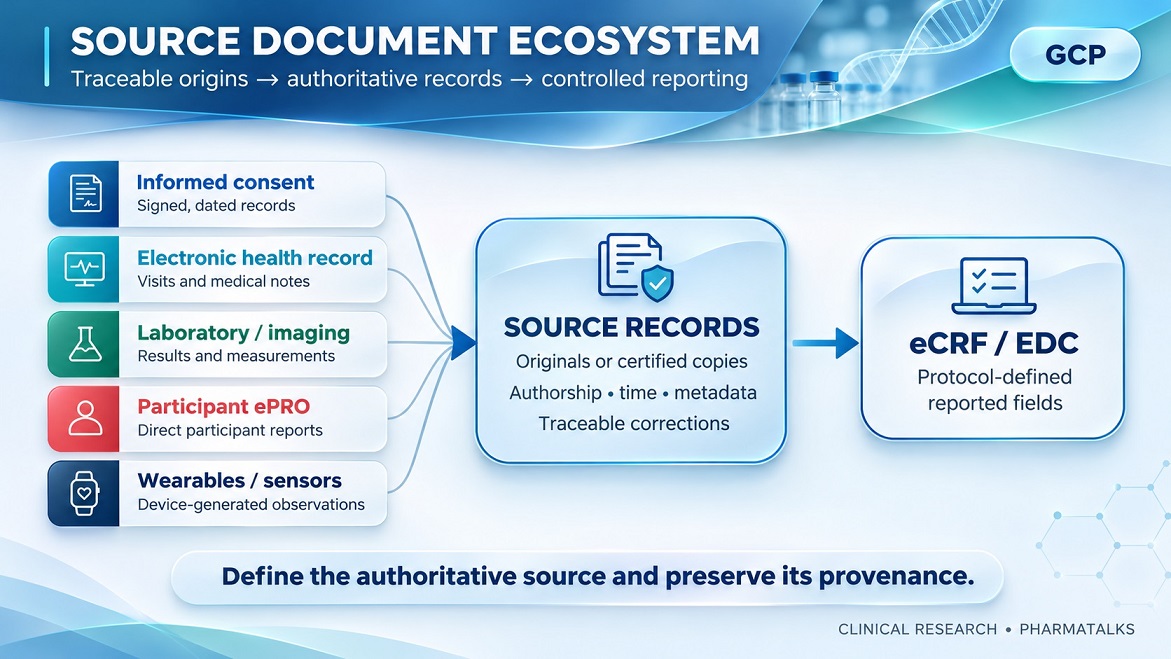
Clinical trial source documents are original records—or certified copies—that show what occurred during a study. They provide context, authorship, dates, and evidence behind clinical decisions.
These records may be paper, electronic, or device-generated. Their integrity matters more than the medium used to capture them.
- Traceability: Link each observation to its participant, originator, and time.
- Reliability: Preserve original entries, corrections, and relevant metadata.
- Verifiability: Allow monitors and inspectors to reconstruct trial events.
Which Records Qualify as Clinical Trial Source Documentation?
Common examples include signed informed consent forms, progress notes, medication histories, eligibility assessments, vital signs, laboratory reports, imaging results, investigational product accountability records, and serious adverse event documentation. Electronic patient-reported outcomes (ePROs), wearable measurements, and direct-entry systems may also generate source records.
The classification depends on where information was first captured and the documented data flow. A scanned note is not automatically a certified copy, and an eCRF field is not automatically secondary data. Protocol requirements, system design, and the source data agreement should make the origin clear.
How Are Source Records Different From an eCRF?
An electronic case report form (eCRF) reports protocol-specified information to the sponsor. A source record preserves the original observation and relevant metadata. If a nurse records blood pressure in the hospital EHR and a coordinator later enters it into an eCRF, the EHR entry normally serves as the source.
However, data entered directly into an authorized eCRF can be the source when the system is designed for direct capture and preserves the necessary controls. The essential question is not paper versus digital; it is whether the record is attributable, accurate, complete, and reconstructable.
FDA and ICH E6(R3) Clinical Trial Documentation Requirements
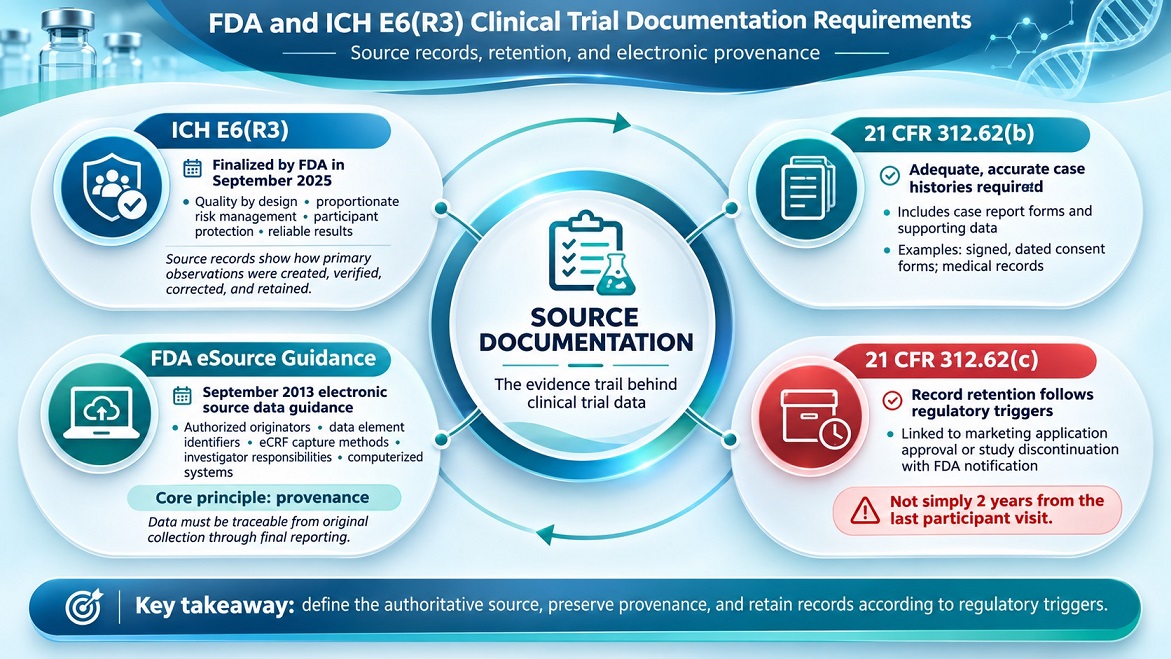
The FDA finalized E6(R3) Good Clinical Practice guidance in September 2025, emphasizing quality by design, proportionate risk management, participant protection, and reliable results. Source records support these goals by showing how primary observations were created, verified, corrected, and retained.
For FDA-regulated investigational drug studies, 21 CFR 312.62(b) calls for adequate, accurate case histories, including case report forms and supporting data such as signed, dated consent forms and medical records. 21 CFR 312.62(c) specifies a retention period linked to marketing application approval or discontinuation and FDA notification—not simply two years from the last participant visit.
FDA’s September 2013 electronic source data guidance addresses authorized originators, data element identifiers, methods of eCRF capture, investigator responsibilities, and computerized systems. Its central point is provenance: a reviewer must be able to follow the data from original collection through eventual reporting.
A Four-Step Source Documentation Workflow for Clinical Trials
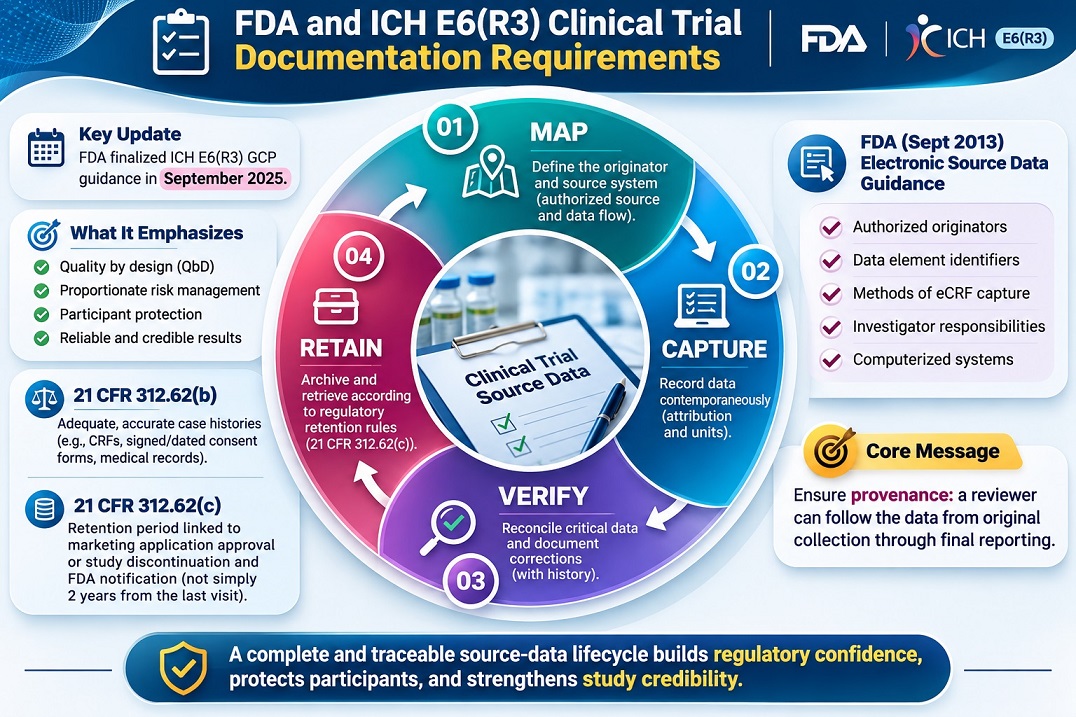
Step 1: Define Source Data Originators
Map each endpoint and safety variable to its original system, authorized recorder, and review owner. FDA’s 2013 eSource guidance explicitly addresses source data originators.
Step 2: Capture Data Contemporaneously
Record observations at the point of care or measurement; retain timestamps, units, authorship, and relevant metadata. ICH E6(R3), finalized by FDA in 2025, supports trustworthy records.
Step 3: Reconcile and Correct Transparently
Compare critical eCRF fields with source evidence. Preserve the original value, change date, responsible user, and reason where applicable; FDA’s 2024 electronic-records guidance addresses audit trails.
Step 4: Retain and Retrieve Records
Apply a trial-specific retention schedule and test retrieval before site closeout. For applicable IND investigator records, 21 CFR 312.62(c) uses an event-dependent two-year rule.
Source Data Verification Versus Source Data Review
Source data verification (SDV) compares reported data against original source records. Source data review (SDR) evaluates whether the available documentation demonstrates appropriate clinical conduct and supports safety, eligibility, endpoints, and protocol compliance. These complementary activities should follow the monitoring plan rather than a universal percentage rule.
Consider a study with a primary endpoint measured at three visits. Monitoring may prioritize that endpoint, consent timing, eligibility criteria, and safety events; a lower-risk administrative field might receive a different level of checking. This is a risk-based allocation example, not a regulatory requirement that every field must be verified.
Source Records, eCRFs, and Review Controls
| Record or activity | Primary purpose | Review focus |
|---|---|---|
|
Signed consent record |
Document consent process |
Version, signature, timing |
|
EHR / laboratory result |
Preserve original observation |
Author, units, date |
|
eCRF entry |
Report protocol data |
Source match, queries |
|
Audit trail |
Reconstruct modifications |
Who, when, why |
Five Essential Clinical Trial Source Document Checks
Use these five checks to protect source document integrity. They help keep trial records traceable and inspection-ready.
- Identify the original source.
- Confirm consent predates every procedure.
- Record the author and timestamp.
- Preserve each change and its reason.
- Verify secure, retrievable retention.
How Source Documents Support Patient Safety and Reliable Trial Results
A signed form alone may not tell the full story. The case history should demonstrate that informed consent was obtained before participation, as specified by 21 CFR 312.62(b). Sites should retain the approved form version, signature dates, documentation of the consent discussion as appropriate, and any required reconsent records. Missing chronology can make a genuine consent process hard to verify.
Eligibility documentation should similarly link each inclusion and exclusion criterion to supporting evidence. A checkbox marked “eligible” is weak if the supporting laboratory value, medical history, or investigator assessment cannot be located. When a criterion uses a test result, preserve the date, measurement, units, and reference context as needed for interpretation.
Safety Narratives and Endpoint Traceability
Safety events often evolve across multiple encounters. An initial symptom note, follow-up examination, laboratory result, severity assessment, causality judgment, and reporting record may sit in different systems. A robust source workflow preserves their chronology and allows the investigator to explain clinical decisions without reconstructing the case from memory.
For primary endpoints, teams should agree in advance which instrument or database creates the authoritative source. An automated blood-pressure device or electronic diary may produce the original measurement; the eCRF may merely receive a selected result. File exports must preserve needed units, dates, identity links, and metadata, particularly when measurements are corrected or excluded.
A Practical Quality-Control Example
Assume a hypothetical monthly review samples 25 high-risk records: 10 consent records, 10 primary-endpoint records, and 5 safety records. Reviewers identify 3 documentation gaps. The observed sample gap rate is 3 ÷ 25 = 12%. This example is arithmetic for training, not a published industry error rate and not an FDA threshold.
The useful output is the root-cause analysis: Were gaps caused by late entry, ambiguous source mapping, insufficient training, or inaccessible system exports? A corrective action should address the process and include a follow-up effectiveness check. A simple denominator makes an internal quality trend interpretable, but clinical significance and risk remain more important than the percentage alone.
Final words
Clinical trial source documents are the foundation of credible evidence, participant protection, and defensible regulatory submissions.
Effective clinical trial source documentation begins with clear ownership of original records and continues through source data verification, controlled corrections, and reliable archiving. Whether teams use paper charts, electronic health records, or eSource platforms, ALCOA+ data integrity and ICH E6(R3) principles should guide decisions. The FDA’s 2013 eSource and 2024 electronic-records guidances reinforce traceability and trustworthy systems. Prioritize critical data, train staff with realistic examples, and test inspection retrieval before a record becomes difficult to reconstruct.
FAQs
Examples include signed and dated consent forms, clinician progress notes, hospital charts, nursing notes, laboratory results, imaging reports, medication records, ePRO entries, and device-generated measurements. Whether a record is the source depends on the first authoritative capture and trial-specific data-flow arrangements
Yes. When an authorized system captures an observation directly and preserves appropriate attribution, dates, metadata, and auditability, the eCRF or data acquisition tool can hold source data. When information is copied from an EHR, the original EHR record normally remains the source.
SDV checks agreement between reported values and source records. SDR evaluates clinical context, protocol compliance, participant safety, and whether records adequately explain trial conduct. They are complementary; the study’s risk-based monitoring strategy determines the extent and priority of review.
References

Ershad Moradi, a Content Marketing Specialist at Zamann Pharma Support, brings 6 years of experience in the pharmaceutical industry. Specializing in pharmaceutical and medical technologies, Ershad is currently focused on expanding his knowledge in marketing and improving communication in the field. Outside of work, Ershad enjoys reading and attending industry related networks to stay up-to-date on the latest advancements. With a passion for continuous learning and growth, Ershad is always looking for new opportunities to enhance his skills and contribute to pharmaceutical industry. Connect with Ershad on Facebook for more information.

Clinical Trial Source Documents: Important GCP Mistakes
Clinical trial source documents support reliable GCP records. Learn seven common documentation mistakes and how to improve accuracy, traceability, data integrity, and inspection readiness.

Ethical Pharmaceutical Marketing: Must-Know Rules for Trusted Growth
Discover the must-know principles of ethical pharmaceutical marketing, from balanced clinical claims and HCP transparency to digital compliance, performance KPIs, and trust-driven growth.

Drug Commercialization Process: Avoid Costly Mistakes and Launch with Confidence
Master the drug commercialization process, from regulatory approvals and GMP launch readiness to market access, pricing, compliant marketing, and post-launch KPIs. Discover strategies to minimize risks and achieve a successful pharmaceutical launch.
Lorem ipsum dolor sit amet, consectetur adipiscing elit. Ut elit tellus, luctus nec ullamcorper mattis, pulvinar dapibus leo.