


Ethical pharmaceutical marketing protects patients by aligning commercial messages with evidence, approved labeling, and balanced benefit–risk communication. Effective pharma marketing strategies must account for distinct national rules, not merely attractive campaigns. In the United States, FDA requirements address misleading claims and fair balance; European Union rules prohibit advertising prescription-only medicines to the general public in most circumstances.
These obligations are operational, not abstract: commercial, medical, legal, regulatory, and pharmacovigilance teams must coordinate before and after release. The EFPIA Code additionally addresses interactions with healthcare professionals and disclosure of transfers of value
Table of Contents
What Is Ethical Pharmaceutical Marketing?
Ethical pharmaceutical marketing is the planning, review, distribution, and monitoring of medicine-related communications that are accurate, balanced, appropriately targeted, and transparent about commercial interests. The World Health Organization’s ethical criteria emphasize rational medicine use rather than demand generation alone.
Standards differ by jurisdiction and product type; scientific exchange, disease awareness, and product promotion can face different requirements. Teams should define the intended audience, product indication, approved claims, limitations, references, and escalation pathway before approving each campaign. Good governance also documents rejected claims and version history, preventing an approved message from being reused outside its authorized context.
Why Pharmaceutical Marketing Ethics Matter
Promotional failure can distort treatment decisions, undermine patient trust, and expose a manufacturer to regulatory scrutiny. The FDA intensified action against deceptive promotion in September 2025, including approximately 100 cease-and-desist letters reported in its announcement . This figure reflects a specific enforcement action, not the annual prevalence of noncompliance. Strong ethics programs emphasize preventive controls and timely correction rather than treating approval as a one-off activity.
- Protect clinical decisions with accurate risk information.
- Maintain claim evidence, dates, and approved references.
- Train content creators, field teams, and external agencies.
Regulatory Framework: FDA, EU and Industry Codes
US prescription-drug promotion is principally governed by the Federal Food, Drug, and Cosmetic Act and FDA rules, including 21 CFR 202.1. EU Directive 2001/83/EC requires advertising to reflect the Summary of Product Characteristics, avoid misleading presentations, and support rational use; Article 88 restricts public advertising of prescription-only medicines.
The EFPIA Code provides additional member-company ethical commitments, while WHO criteria frame rational promotion internationally. Companies must also apply local law and local industry codes. A single global creative asset should never be presumed lawful in every territory.
The Main Rules of Ethical Drug Promotion
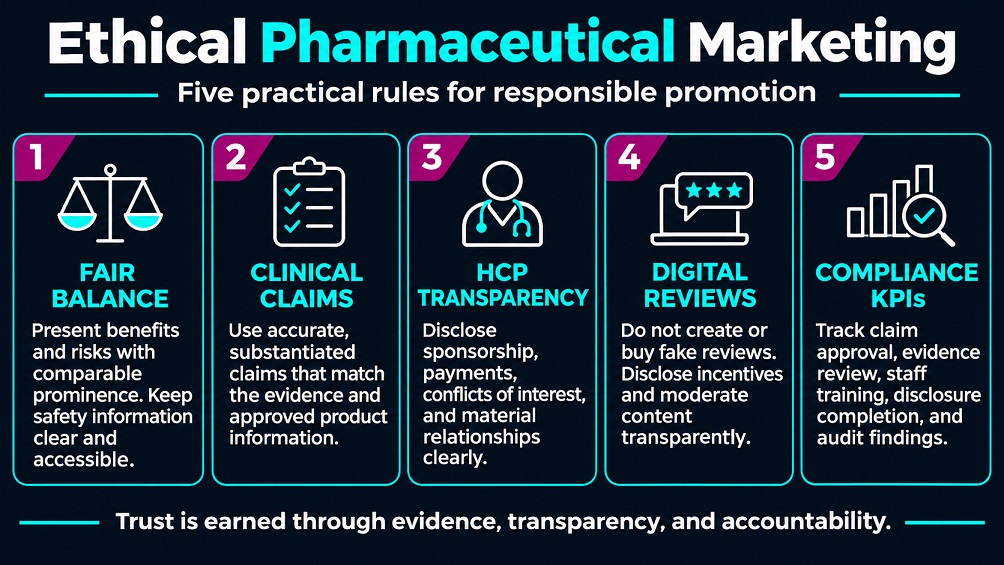
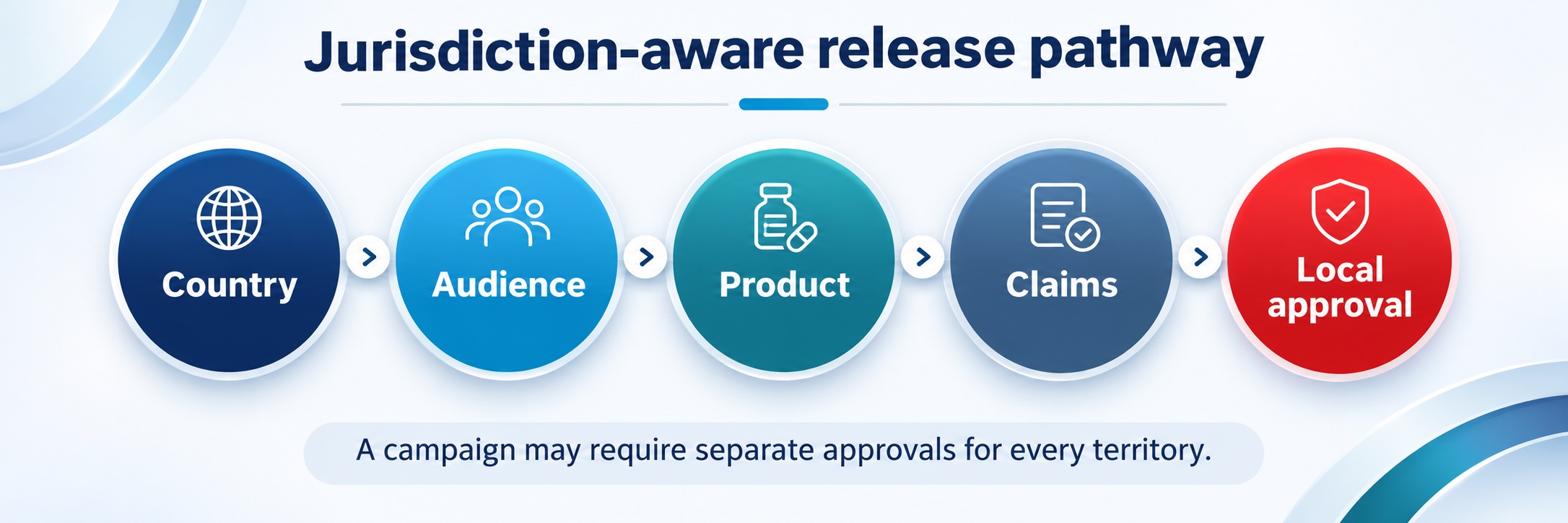
A practical control model translates regulations into five repeatable actions. Each rule should have an accountable owner, documented evidence, and measurable acceptance criteria. Their application varies with the country, audience, product classification, and communication channel. For multinational campaigns, local affiliates must verify language, indication, promotional status, and applicable country codes before reuse. The following rules form a working checklist rather than a substitute for legal advice or market-specific SOPs.
Number 1. Substantiate Every Clinical Claim
Link each efficacy, safety, comparative, or quality-of-life claim to an appropriate scientific source and approved labeling. Check population, endpoint, confidence interval, absolute versus relative effects, and study limitations.
Avoid implying superiority from exploratory analyses. Store the exact supporting citation and permitted wording in a controlled claim library; reassess when labeling or evidence changes.
Number 2. Present Fair Benefit–Risk Balance
Give material risks visibility appropriate to the benefit claims and communication format. Review typography, narration, scrolling, imagery, prominence, and contextual impressions—not just the presence of a risk statement.
In US prescription-drug advertising, fair-balance requirements are expressly addressed in 21 CFR 202.1. Apply channel-specific rules before adapting content for short videos.
Number 3. Separate Education From Promotion
Identify whether an activity is disease awareness, scientific exchange, medical education, or product promotion; do not assume labels determine regulatory status. Evaluate commercial intent, brand cues, target audience, and control of content.
Put medical-information requests through approved nonpromotional channels. Ensure training materials do not covertly drive prescriptions or circumvent advertising restrictions.
Number 4. Make HCP Relationships Transparent
Document legitimate purpose, selection criteria, fair-market-value methodology, contracts, deliverables, hospitality controls, and applicable transfer-of-value disclosures. EFPIA requirements cover multiple HCP and healthcare-organization interactions, including disclosure.
An honorarium does not validate an otherwise unnecessary service. Medical, compliance, and procurement teams should challenge exceptions and track corrective action.
Number 5. Monitor Digital Content After Launch
Inventory owned channels, agency content, sponsored posts, paid search, and influencer arrangements. Track approved versions, audience targeting, consent and privacy obligations, complaints, and adverse-event escalation.
Establish deadlines for correcting or removing outdated messages. Capture potential safety information through approved pharmacovigilance processes and audit content periodically, including screenshots and archived landing pages.
Building a Medical–Legal–Regulatory Review Workflow
Medical–legal–regulatory (MLR) review works best when promotional claims are structured before creative production. Assign a source document to each statement, define the audience, review labeling alignment, and classify major risks. Reviewers should evaluate implicit visual and comparative messages as well as explicit text. Digital variants need controlled change management; even a shortened caption can alter the meaning of an approved claim. Build a review log that identifies what was approved, for which country and medium, and until when.
- Medical verifies clinical evidence and limitations.
- Regulatory assesses labeling and market restrictions.
- Legal/compliance evaluates promotion, privacy, and HCP interactions.
Metrics for Ethical Pharmaceutical Marketing
Measure compliance outcomes alongside reach and engagement. Useful measures include first-pass MLR approval, overdue review actions, expired-asset incidents, substantiation completeness, and time to remove inaccurate content. Define both numerator and denominator before comparing across teams. For example, first-pass approval equals assets approved without material revision divided by all assets reviewed.
A high approval rate can reflect good upstream controls, but may also signal insufficient challenge; therefore combine quantitative indicators with sampling and audit findings. Use dashboards for process improvement, never as incentives to minimize safety reports.
Example Compliance KPI Dashboard
| KPI | Numerator | Denominator | Purpose |
|---|---|---|---|
|
First-pass approval |
Approved first pass |
All submitted assets |
Upstream quality |
|
Late withdrawals |
Overdue removed assets |
Assets due for removal |
Timely control |
|
Claim traceability |
Claims with current sources |
Claims sampled |
Evidence quality |
Common Digital Compliance Risks and Controls
Short-form video, personalized advertising, search snippets, generative AI content, and external influencers can create new ways for claims to lose context. A compliant long-form page does not automatically make a cropped social post compliant. Establish preapproved templates, visible sponsorship identification, audience restrictions, link governance, and periodic channel surveillance.
Monitor vendors and affiliates as extensions of the quality system. Where automated tools draft content, require human review of clinical meaning, source provenance, and jurisdiction-specific restrictions. Maintain a documented escalation route for inappropriate claims, adverse events, privacy incidents, and public corrections.
Final words
Ethical pharmaceutical marketing is a disciplined process for communicating useful clinical information without distortion. Effective teams substantiate each claim, communicate material risks fairly, separate promotion from independent scientific exchange, make HCP relationships transparent, and monitor live channels. FDA, EU, EFPIA, and WHO frameworks provide complementary reference points, but local rules govern actual execution.
Start with a controlled claim library, a risk-based MLR workflow, and clearly defined compliance KPIs. Better marketing should not simply increase demand: it should support informed decisions, rational medicine use, accountable collaboration, and lasting confidence among patients and healthcare professionals.
FAQs
Accurate, substantiated, balanced, appropriately targeted communications with transparent commercial relationships and auditable review controls.
Rules differ: US prescription-drug DTC advertising may be permitted under conditions; EU rules generally prohibit advertising prescription-only medicines to the public.
In US prescription-drug ads, benefits must not dominate material risk information in a misleading manner; context and presentation matter as well as wording.
References

Ershad Moradi, a Content Marketing Specialist at Zamann Pharma Support, brings 6 years of experience in the pharmaceutical industry. Specializing in pharmaceutical and medical technologies, Ershad is currently focused on expanding his knowledge in marketing and improving communication in the field. Outside of work, Ershad enjoys reading and attending industry related networks to stay up-to-date on the latest advancements. With a passion for continuous learning and growth, Ershad is always looking for new opportunities to enhance his skills and contribute to pharmaceutical industry. Connect with Ershad on Facebook for more information.

Ethical Pharmaceutical Marketing: Must-Know Rules for Trusted Growth
Discover the must-know principles of ethical pharmaceutical marketing, from balanced clinical claims and HCP transparency to digital compliance, performance KPIs, and trust-driven growth.

Drug Commercialization Process: Avoid Costly Mistakes and Launch with Confidence
Master the drug commercialization process, from regulatory approvals and GMP launch readiness to market access, pricing, compliant marketing, and post-launch KPIs. Discover strategies to minimize risks and achieve a successful pharmaceutical launch.

Medical Device CRO: Hidden Secrets of Successful Clinical Trials
Discover how a medical device CRO supports safer clinical trials, ensures ISO 14155, FDA IDE, and EU MDR compliance, strengthens monitoring and data quality, and helps you choose the right clinical research partner.
Lorem ipsum dolor sit amet, consectetur adipiscing elit. Ut elit tellus, luctus nec ullamcorper mattis, pulvinar dapibus leo.