


Drug commercialization process planning turns clinical evidence into reliable patient access through regulatory authorization, manufacturing scale-up, reimbursement, distribution, and compliant communication. FDA identifies five broad drug-development stages, ending with post-market safety monitoring, while European centralized authorization uses a 210-day active scientific assessment clock that excludes clock stops. Commercial launch teams must connect these requirements with sustainable supply and measurable adoption rather than assume approval guarantees market uptake.
For teams already developing pharma marketing strategies, successful commercialization requires evidence-based value messages, payer segmentation, medical governance, and ongoing benefit-risk surveillance. A cross-functional launch plan helps reduce preventable access delays without sacrificing compliance.
Table of Contents
What Is the Drug Commercialization Process?
The drug commercialization process connects the scientific, regulatory, operational, and market activities that make an authorized treatment available to appropriate patients. Unlike drug discovery, commercialization addresses delivery at scale: validated manufacturing, distribution licensing, product labeling, distribution agreements, pricing, reimbursement, medical information, and compliant promotion.
A commercialization strategy must define target patients and geographies, the approved indication, the evidence package, the required legal permissions, and a financially sustainable operating model.
The exact pathway varies by jurisdiction, product class, funding system, and whether the asset is a new molecular entity, biologic, or generic.
How Pharmaceutical Commercialization Differs From Drug Development
Drug development generates essential evidence of quality, safety, and efficacy for regulatory approval. Commercialization transforms approved therapies into accessible treatments through strategic planning. However, successful clinical results do not guarantee rapid market access, reimbursement, or widespread patient availability.
Clinical Evidence: Demonstrate safety and efficacy.
Regulatory Approval: Meet FDA and EMA requirements.
Market Access: Address reimbursement and coverage barriers.
Commercial Readiness: Align supply, pricing, and promotion.
Patient Access: Reduce launch delays and geographic gaps.
Regulatory Approval and Pharmaceutical Go-to-Market Strategy
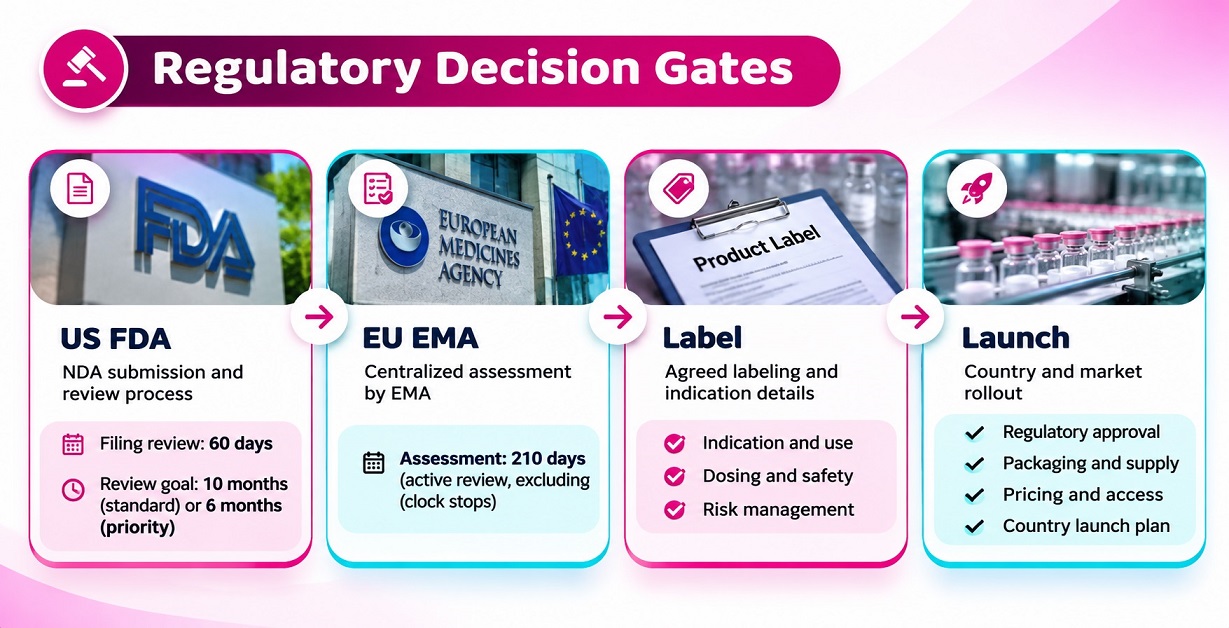
In the United States, an NDA includes clinical, nonclinical, and manufacturing evidence supporting drug approval. FDA review goals are generally 10 months for standard review and 6 months for priority review. In Europe, EMA assessment typically takes 210 active days, excluding clock stops.
NDA Submission: Compile safety, efficacy, and manufacturing data.
FDA Filing Review: Initial 60-day filing assessment.
Standard Review: Generally a 10-month review goal.
Priority Review: Generally a 6-month review goal.
EU Authorization: 210 active assessment days, followed by a European Commission decision.
Five Critical Stages of the Drug Commercialization Process
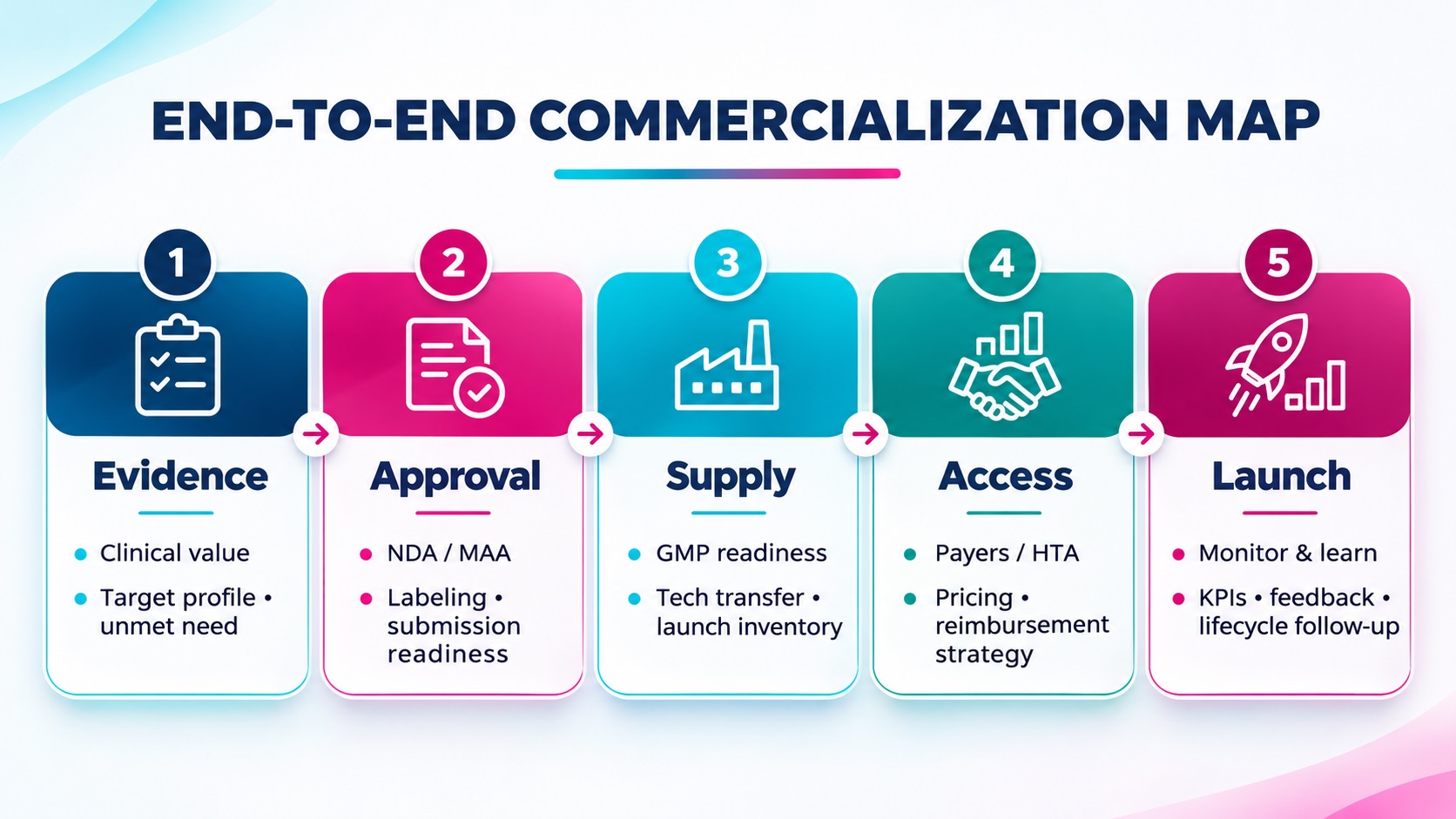
A robust launch follows five connected workstreams rather than a simple sales handoff. Their outputs form evidence-based gates that determine whether the next investment is justified. The stages below are intentionally sequential for governance, although many tasks run in parallel.
Typical cross-functional owners include regulatory affairs, medical affairs, quality, manufacturing, supply chain, market access, commercial operations, legal, and pharmacovigilance. The steering team should track decision quality, accountable owners, unresolved risks, and corrective actions for each gate.
The commercial plan should remain adaptable when new clinical data, authority questions, or payer conditions emerge.
Stage 1. Define Patient Need and Target Product Profile
Segment the epidemiology by indication, line of therapy, and treatment setting. Align the target product profile with clinical differentiation, prescribing constraints, and the evidence likely to matter to payers. Document realistic addressable populations and major uncertainties instead of treating prevalence as equivalent to demand.
Stage 2. Secure Regulatory and Label Readiness
Build submission and response plans for each jurisdiction; connect approved indications, contraindications, warnings, and claims to a version-controlled label matrix. Regulatory affairs should own approval dependencies, while medical and legal teams verify that launch materials do not outrun authorization or available evidence.
Stage 3. Qualify Commercial Manufacturing and Supply
Commercial supply requires validated processes and reliable quality controls. FDA defines process validation in three stages: design, qualification, and continued verification. These stages support consistent product quality throughout commercialization.
Process Qualification: Verify manufacturing performance.
Stability Testing: Confirm shelf life with supporting data.
Packaging Validation: Ensure protection and required serialization.
Batch Release: Verify compliance with quality specifications.
Supply Readiness: Qualify logistics and maintain contingency stock.
Stage 4. Design Market Access, Pricing, and Reimbursement
Assess payer evidence requirements, HTA submissions where relevant, price corridors, tender schedules, affordability, and distribution channels. Model net revenue after rebates, discounts, fees, and patient-support costs. Market access should distinguish authorization to sell from a payer decision to reimburse.
Stage 5. Execute a Compliant Launch and Optimize
Commercial teams must use approved, evidence-based promotional messages. FDA OPDP emphasizes truthful, balanced, and accurate communication. Continuous monitoring strengthens patient safety and launch performance.
Field Team Training: Deliver approved, substantiated product messages.
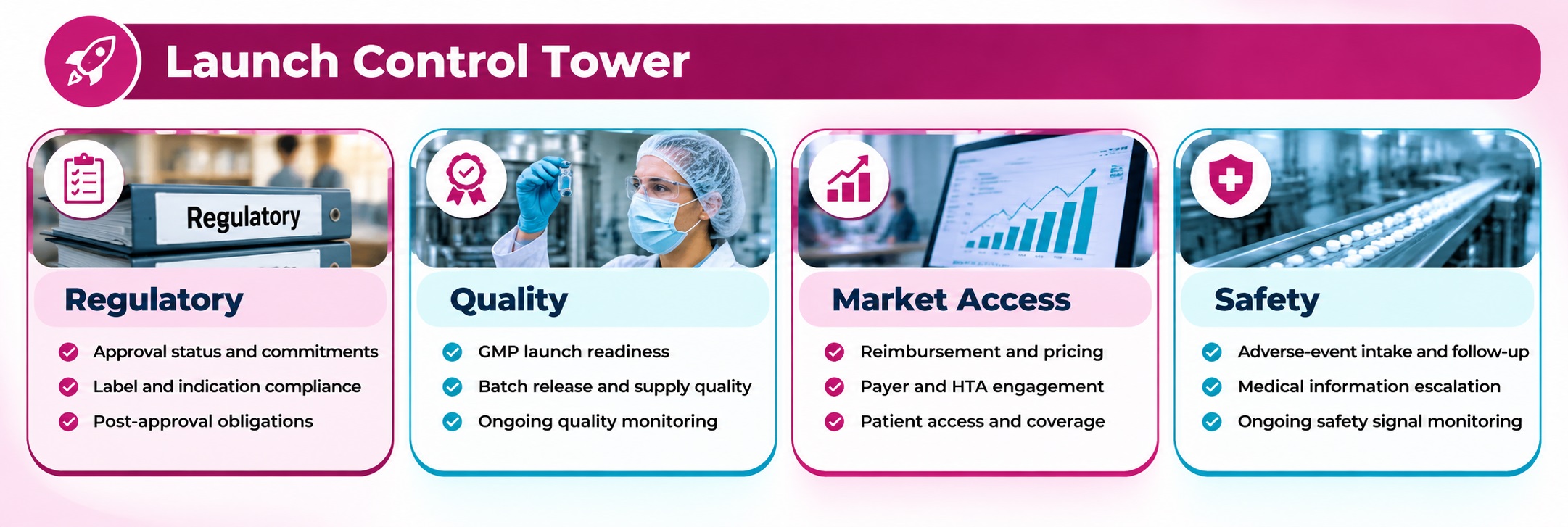
Safety Reporting: Establish adverse-event intake procedures.
Medical Information: Define clear escalation pathways.
Launch KPIs: Track market access, supply, and safety.
Performance Monitoring: Evaluate forecasts and launch execution through a shared dashboard.
Drug Launch Strategy: Commercial Readiness Checklist
Commercial readiness is best audited using evidence, not a binary presentation slide. Before release to the market, verify authorized labeling, qualified distribution routes, appropriately released inventory, validated order-to-cash processes, and a functioning adverse-event intake system. For each territory, confirm local pricing and promotional restrictions, healthcare professional engagement rules, and required product information. Assign an owner, verification date, and escalation threshold to every critical dependency. A launch readiness index may summarize execution progress, but an average score must never conceal an unresolved patient-safety or legal blocker.
Medical Device Marketing Channels: Audiences, Content, and KPIs
| Workstrep | Release evidence | Owner | Red flag |
|---|---|---|---|
|
Regulatory |
Approved label / authorization |
RA |
Pending approval |
|
Quality & supply |
Released stocks / validated route |
QA / Supply |
Unresolved deviation |
|
Market access |
Price / coverage plan |
Access |
No payer path |
|
Medical & safety |
PV intake / MLR approval |
Medical / PV |
Unsupported claim |
Market Access Strategy Pharma: Pricing and Reimbursement
Payer access depends on demonstrating therapeutic value within local decision rules. Evidence plans may use randomized trials, comparative effectiveness, resource utilization, quality-of-life outcomes, or economic models; each method has assumptions that should be transparent. In markets using health technology assessment, stakeholders may evaluate clinical benefit and budget impact separately. Launch teams should therefore triangulate medical evidence, payer feedback, patient pathways, and distribution economics. The manufacturer must also prepare for confidential net-pricing arrangements without presenting hypothetical discounts as published facts. A country launch sequence should reflect actual access constraints, not just commercial ambition.
Commercial Manufacturing Readiness and Pharmaceutical Lifecycle Management
Commercial quality readiness extends beyond the initial process qualification report. FDA lifecycle validation emphasizes continued process verification during routine manufacture.
ICH Q12 provides tools to manage certain post-approval chemistry, manufacturing, and controls changes more predictably, with jurisdiction-specific implementation considerations. Quality and regulatory teams should maintain established conditions, change-control records, product quality review outputs, supplier qualification, and shortage-prevention measures.
Final words
The drug commercialization process is successful only when regulatory evidence, reliable product quality, payer access, patient safety, and ethical promotion operate as one system. A clear launch strategy links approved labeling to manufacturing readiness, distribution controls, payer decisions, and measurable treatment access. FDA review milestones and EMA assessment clocks provide important planning boundaries, but neither replaces country-specific access or operational preparation. Build evidence-based decision gates, assign cross-functional owners, and measure patient access alongside supply and safety. Commercial excellence is not simply faster market entry: it is responsible, sustainable availability of an effective medicine across its lifecycle.
FAQs
It is the coordinated set of regulatory, manufacturing, market-access, distribution, medical, and promotional activities needed to make an authorized drug consistently available to appropriate patients.
Planning often starts during clinical development, when teams can define target populations, evidence gaps, production scale-up, and future reimbursement needs; promotional activity still must comply with applicable authorization rules.
There is no universal duration. For context, applicable FDA standard and priority review goals may be 10 and 6 months, while EU centralized scientific assessment uses 210 active days excluding clock stops; commercial access can take additional time.
References

Ershad Moradi, a Content Marketing Specialist at Zamann Pharma Support, brings 6 years of experience in the pharmaceutical industry. Specializing in pharmaceutical and medical technologies, Ershad is currently focused on expanding his knowledge in marketing and improving communication in the field. Outside of work, Ershad enjoys reading and attending industry related networks to stay up-to-date on the latest advancements. With a passion for continuous learning and growth, Ershad is always looking for new opportunities to enhance his skills and contribute to pharmaceutical industry. Connect with Ershad on Facebook for more information.

Drug Commercialization Process: Avoid Costly Mistakes and Launch with Confidence
Master the drug commercialization process, from regulatory approvals and GMP launch readiness to market access, pricing, compliant marketing, and post-launch KPIs. Discover strategies to minimize risks and achieve a successful pharmaceutical launch.

Medical Device CRO: Hidden Secrets of Successful Clinical Trials
Discover how a medical device CRO supports safer clinical trials, ensures ISO 14155, FDA IDE, and EU MDR compliance, strengthens monitoring and data quality, and helps you choose the right clinical research partner.

Medical Device Marketing: Powerful Strategies for Trusted Growth
Explore compliant medical device marketing, FDA and EU MDR advertising rules, evidence-based messaging, HCP targeting, and campaign KPIs.
Lorem ipsum dolor sit amet, consectetur adipiscing elit. Ut elit tellus, luctus nec ullamcorper mattis, pulvinar dapibus leo.