


Medical device CRO partnerships help manufacturers plan, conduct, monitor, and report clinical investigations while protecting participants and maintaining credible evidence. Effective outsourcing requires familiarity with medical device regulation, clinical evaluation, and country-specific authorization requirements. Unlike drug trials, device investigations must account for operator learning, usability, device iteration, and technical performance throughout the study lifecycle.
The regulatory landscape has also evolved: ISO 14155:2026 supersedes ISO 14155:2020, while the FDA Quality Management System Regulation became effective on February 2, 2026. This guide outlines CRO responsibilities, measurable selection criteria, and practical controls that support compliant device evidence generation across the United States and European Union.
Table of Contents
What Does a Medical Device CRO Do?
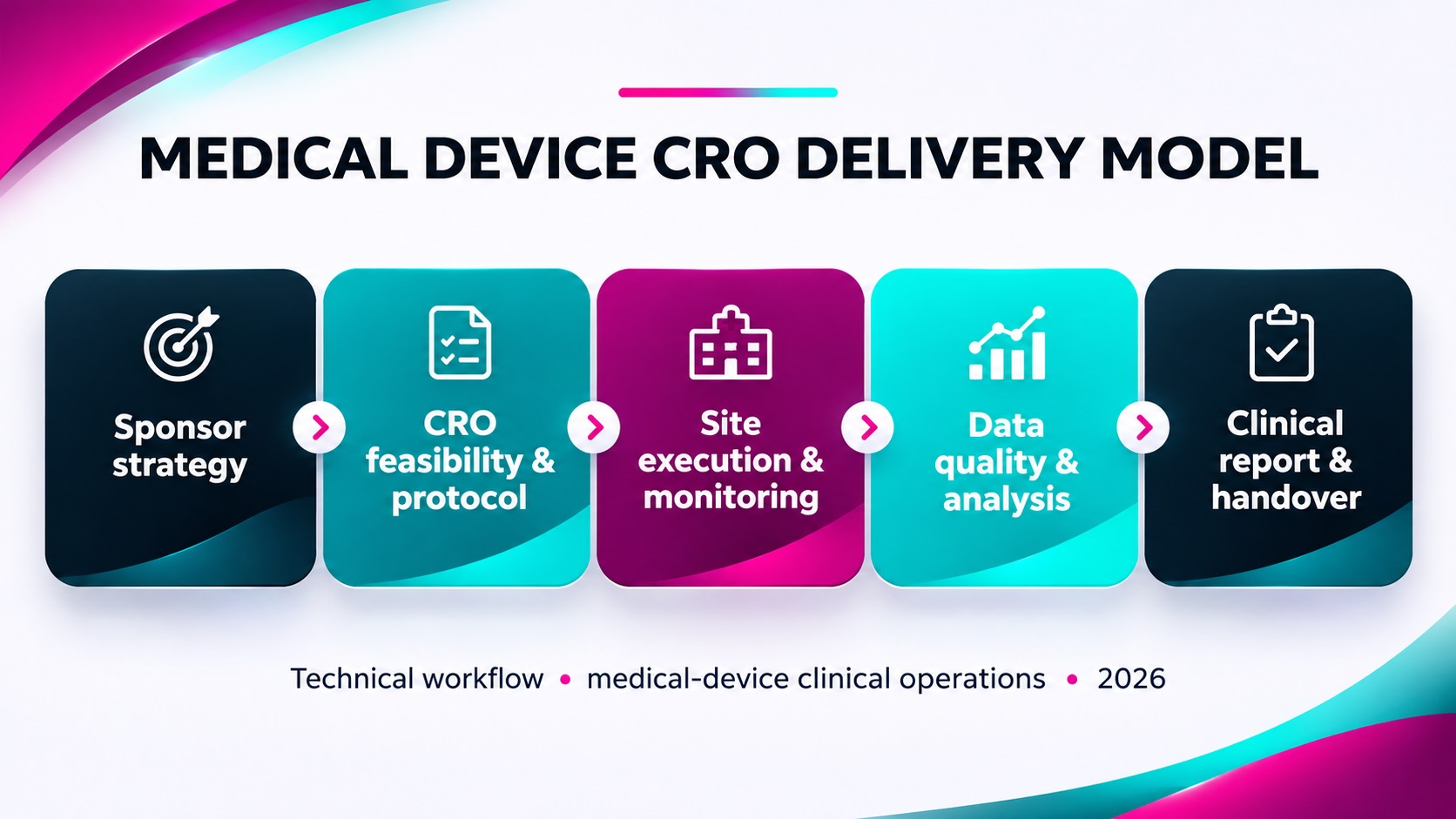
A medical device contract research organization provides delegated clinical research services, from protocol development and site feasibility to monitoring, data management, biostatistics, and clinical study reporting. The specific scope should be defined in a written responsibility matrix, with escalation paths for safety issues and protocol deviations.
CRO involvement does not remove the sponsor’s regulatory obligations. A capable provider understands device-specific endpoints, user training, technical complaints, investigational-device accountability, and post-market evidence needs. Procurement teams should distinguish genuine device-investigation experience from a vendor’s broader pharmaceutical-trial portfolio.
Medical Device Clinical Trials and Regulatory Pathways
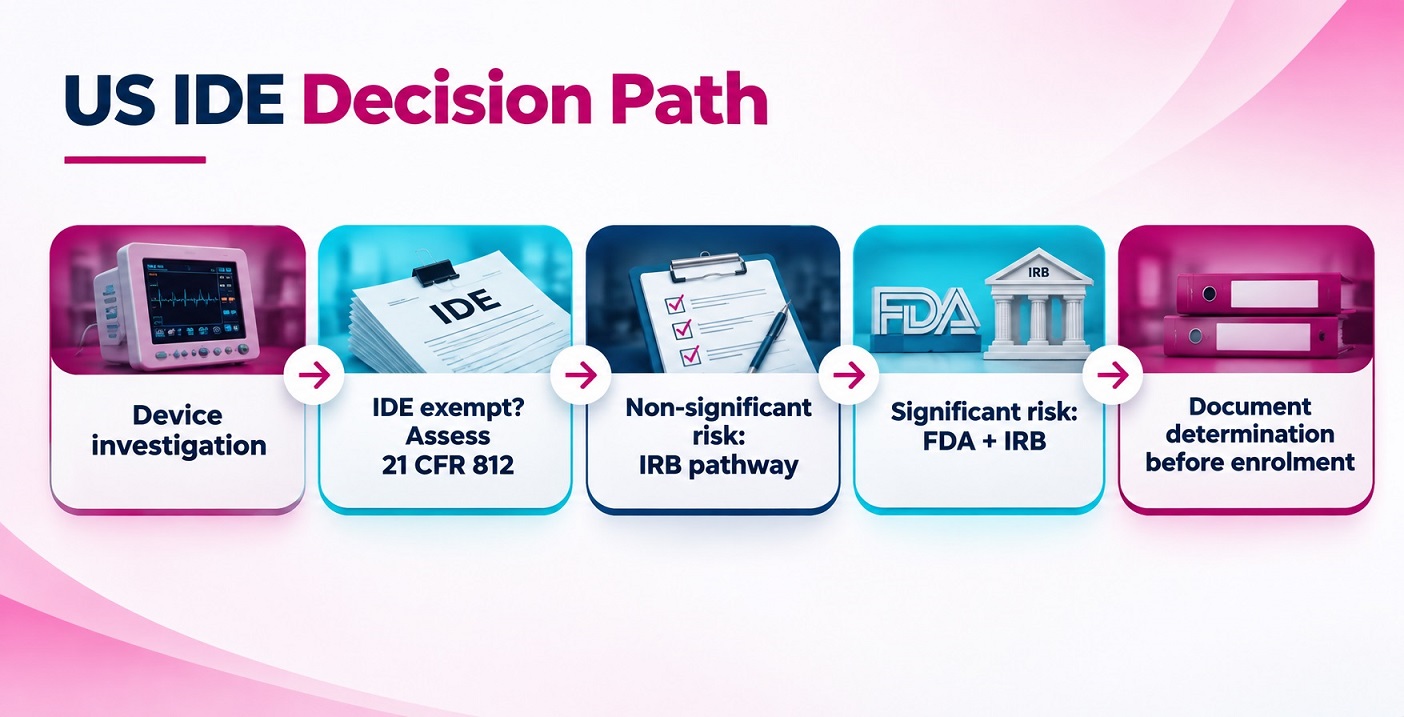
A medical device CRO should align the clinical investigation plan with the device’s intended purpose, risk classification, and target jurisdiction. In the United States, the investigational device exemption framework in 21 CFR Part 812 distinguishes significant-risk and nonsignificant-risk studies, as well as exempt investigations.
In the EU, Regulation (EU) 2017/745 sets requirements for clinical investigations, including Article 62 and Annex XV. Clinical evidence also supports the broader clinical evaluation process.
Key regulatory responsibilities:
EU MDR: Explain clinical investigation requirements and sponsor obligations, including Article 62 where applicable.
ISO 14155: Explain Good Clinical Practice for medical device clinical investigations.
FDA IDE: Distinguish significant-risk and nonsignificant-risk device investigations.
Sponsor versus CRO: Explain that outsourcing activities does not automatically eliminate the sponsor’s regulatory responsibilities.
Documentation: Cover the clinical investigation plan, informed consent, monitoring, safety reporting, and clinical investigation report.
FDA IDE and IRB Requirements for Device Studies
Significant-risk medical device investigations in the United States require FDA and IRB approval before initiation. An IDE application is generally considered approved 30 calendar days after FDA receipt unless FDA acts earlier or imposes restrictions. This does not guarantee approval or establish a trial-start deadline. Nonsignificant-risk studies generally follow abbreviated IDE requirements, while exempt studies have separate criteria.
The CRO should document:
Risk Determination: Classify study risks and justify decisions.
Regulatory Approvals: Maintain FDA and IRB documentation.
Informed Consent: Ensure proper participant consent procedures.
Compliance Records: Control investigational labeling and reporting responsibilities.
EU MDR, ISO 14155 and Clinical Evaluation
Under EU MDR Article 62, clinical investigations must demonstrate device safety, performance, and acceptable benefit-risk. ISO 14155:2026 establishes Good Clinical Practice requirements for medical device investigations. An experienced CRO transforms clinical evaluation gaps into reliable study designs and regulatory strategies.
Key CRO responsibilities include:
Clinical Endpoints: Define measurable safety and performance outcomes.
Follow-Up Duration: Establish appropriate patient monitoring periods.
Device Accountability: Track device use, handling, and traceability.
Investigator Qualification: Verify clinical expertise and training.
Regulatory Oversight: Confirm applicable EU MDR requirements for each investigation type.
Five Essential Medical Device CRO Selection Criteria
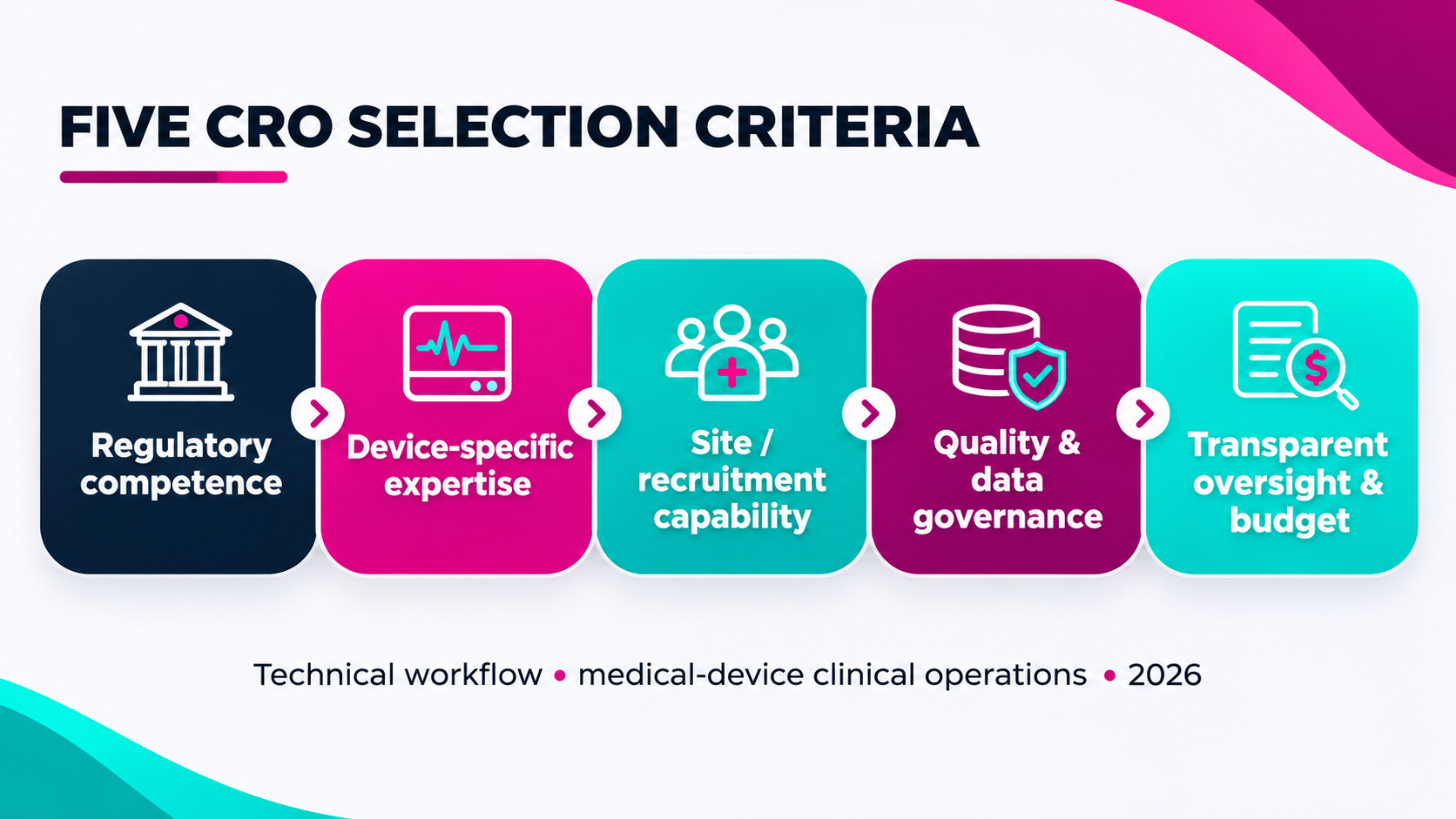
Selecting a medical device CRO requires measurable evidence, not marketing claims. Evaluate five key criteria to ensure regulatory compliance, operational efficiency, and patient safety.
Relevant Experience: Comparable device studies and regulatory expertise.
Audit Performance: Inspection history and CAPA effectiveness.
Operational KPIs: Enrollment rates, protocol deviations, and query resolution times.
Risk Management: Safety reporting, device deficiencies, and escalation procedures.
Sponsor Oversight: Clear responsibilities, communication, and record retention.
Score each criterion from 1–5, weighted by study risk and complexity. Document the final selection and maintain independent sponsor oversight.
Regulatory and ISO 14155 Competence
Check whether the CRO can explain the study’s IDE or MDR pathway and apply ISO 14155:2026 within a controlled quality system. Review training evidence, regulatory-submission samples, and procedures for ethics approvals, safety reporting, and protocol amendments. Require documented responsibility allocation and jurisdiction-specific escalation routes; a certification claim alone cannot demonstrate trial execution competence.
Device-Specific Technical Expertise
Look for monitors and investigators familiar with device use, operator variability, usability risks, technical malfunctions, and device accountability. A wound-care device and an implantable cardiac device can require markedly different site capabilities. Ask how the CRO standardizes training, evaluates learning curves, verifies device configuration, and traces product deficiencies to participant safety assessments.
Recruitment and Site Feasibility
Demand feasibility estimates supported by site-level evidence rather than unverified recruitment promises. Evaluate patient eligibility, competing trials, procedure capacity, investigator experience, and follow-up burden. The CRO should document assumptions for screen-failure rates and recruitment velocity, provide a recovery plan for slow sites, and update forecasts against actual enrollment performance.
Monitoring, Safety and Data Governance
Review risk-based monitoring methods, eCRF validation, query management, adverse-event escalation, access controls, and audit trails. Evidence should show who reviews critical data, when site visits are triggered, and how significant deviations are investigated. Sponsor dashboards should distinguish open queries, overdue actions, safety signals, and missing endpoint assessments instead of combining them into one opaque quality score.
Transparent Budget, Governance and Oversight
A defensible proposal separates fixed setup costs from per-site, per-patient, monitoring, statistics, and pass-through expenses. Define change-order triggers and deliverable acceptance criteria before contract signature. Include governance meetings, sponsor review rights, subcontractor controls, issue escalation, and termination or transfer arrangements, so oversight remains effective if enrollment or regulatory strategy changes.
Medical Device CRO Services: Deliverables and Accountability
The contract and quality agreement should translate every service into a named deliverable, owner, approval step, and quality check. Common outputs include the clinical investigation plan, investigator materials, monitoring plan, safety-management procedures, validated data workflows, statistical analysis plan, and clinical investigation report. Where subcontractors provide imaging, laboratories, or electronic systems, oversight must remain visible. The table illustrates a compact responsibility framework; actual assignments depend on the approved protocol and agreement. Sponsor accountability persists even when work is delegated.
Medical Device Marketing Channels: Audiences, Content, and KPIs
| Workstream | CRO output | Sponsor control | Quality gate |
|---|---|---|---|
|
Protocol |
CIP / amendments |
Clinical approval |
Version control |
|
Site operations |
Training / visits |
Oversight review |
Deviation trend |
|
Data & statistics |
eCRF / SAP / analysis |
Endpoint approval |
Audit trail |
|
Reporting |
Clinical study report |
Final sign-off |
Traceability |
Risk-Based Monitoring and Clinical Data Integrity
Risk-based monitoring should start with critical-to-quality factors, not simply reduce visit frequency. Identify eligibility, informed consent, primary endpoints, device accountability, serious adverse events, and clinically meaningful deviations as priority controls. Centralized checks can reveal missing visits, unusual data patterns, delayed safety reports, or inconsistent device measurements. The monitoring plan must specify thresholds, review cadence, ownership, and corrective responses.
Electronic data capture should preserve attributable, contemporaneous, accurate, and traceable records. Monitoring outputs become useful when the sponsor evaluates trends and verifies CAPA effectiveness.
Current Regulatory Issues for Medical Device CROs in 2026
Three developments deserve attention. First, ISO 14155:2026 is now the published fourth edition, replacing the 2020 edition. Second, the FDA QMSR took effect February 2, 2026 and incorporates ISO 13485:2016 by reference for applicable manufacturer quality-system requirements; it should not be misrepresented as a standalone CRO clinical-trial certification requirement. Third, FDA device inspections transitioned away from QSIT to the updated compliance program 7382.850.
CRO qualification should therefore connect investigation-specific controls with the manufacturer’s applicable quality-system and supplier-oversight processes.
Final words
A medical device CRO is valuable when it translates complex clinical and regulatory requirements into dependable execution, not merely when it supplies personnel. Select partners against documented device experience, ISO 14155 capability, appropriate FDA or EU pathways, transparent governance, and auditable data quality. Maintain written delegation, meaningful sponsor oversight, and risk-based metrics throughout the investigation. Before accepting timelines or budgets, verify approval assumptions and recruitment evidence.
A strong CRO relationship should produce reliable safety and performance evidence while preserving participant protection, traceability, and a clear regulatory rationale for every critical decision.
FAQs
A medical device CRO is a contract research organization supporting clinical investigation design and delivery for medical technologies, including site management, monitoring, safety reporting, statistics, and clinical documentation under sponsor oversight.
A CRO may prepare or coordinate an IDE submission, but regulatory responsibility must be allocated under the applicable framework. Significant-risk US device studies require FDA and IRB approval before beginning.
No. US rules distinguish significant-risk, nonsignificant-risk, and IDE-exempt investigations. The specific design, use, and risk classification determine the applicable oversight route.
References

Ershad Moradi, a Content Marketing Specialist at Zamann Pharma Support, brings 6 years of experience in the pharmaceutical industry. Specializing in pharmaceutical and medical technologies, Ershad is currently focused on expanding his knowledge in marketing and improving communication in the field. Outside of work, Ershad enjoys reading and attending industry related networks to stay up-to-date on the latest advancements. With a passion for continuous learning and growth, Ershad is always looking for new opportunities to enhance his skills and contribute to pharmaceutical industry. Connect with Ershad on Facebook for more information.
Medical Device CRO: Hidden Secrets of Successful Clinical Trials
Discover how a medical device CRO supports safer clinical trials, ensures ISO 14155, FDA IDE, and EU MDR compliance, strengthens monitoring and data quality, and helps you choose the right clinical research partner.

Medical Device Marketing: Powerful Strategies for Trusted Growth
Explore compliant medical device marketing, FDA and EU MDR advertising rules, evidence-based messaging, HCP targeting, and campaign KPIs.

Lean Six Sigma Training: Powerful Skills for Pharma Improvement
Explore Lean Six Sigma training for pharma, covering DMAIC, Green Belt skills, Cpk, CAPA, and practical GMP improvement projects with technical examples.
Lorem ipsum dolor sit amet, consectetur adipiscing elit. Ut elit tellus, luctus nec ullamcorper mattis, pulvinar dapibus leo.