


Medical device marketing connects clinical evidence, regulatory authorization, and commercial execution to bring suitable technologies to the right healthcare users. Unlike general consumer promotion, device messages must remain consistent with the intended purpose, labeling, and substantiated safety and performance claims. The FDA distinguishes 510(k) clearance from premarket approval, while EU MDR Article 7 prohibits misleading promotional claims.
Effective strategies pair professional education with measurable customer journeys and cross-functional review. The principles of pharma marketing strategies can inform channel selection, but device-specific evidence and local law determine what marketers may say. This guide presents five practical strategies, technical dashboards, and examples for responsible MedTech growth.
Table of Contents
What Is Medical Device Marketing?
Medical device marketing is the structured process of understanding clinical needs, differentiating a device using supported performance evidence, and communicating its appropriate use to professional or patient audiences. The audience may include clinicians, procurement teams, biomedical engineers, reimbursement stakeholders, and patients.
Effective programs connect clinical value to workflow, usability, service, and total cost rather than using vague innovation claims. The same product can require distinct messages for a surgeon and a hospital buyer, but those messages must remain within the authorized intended purpose and applicable national requirements.
Why Regulatory Alignment Shapes MedTech Marketing
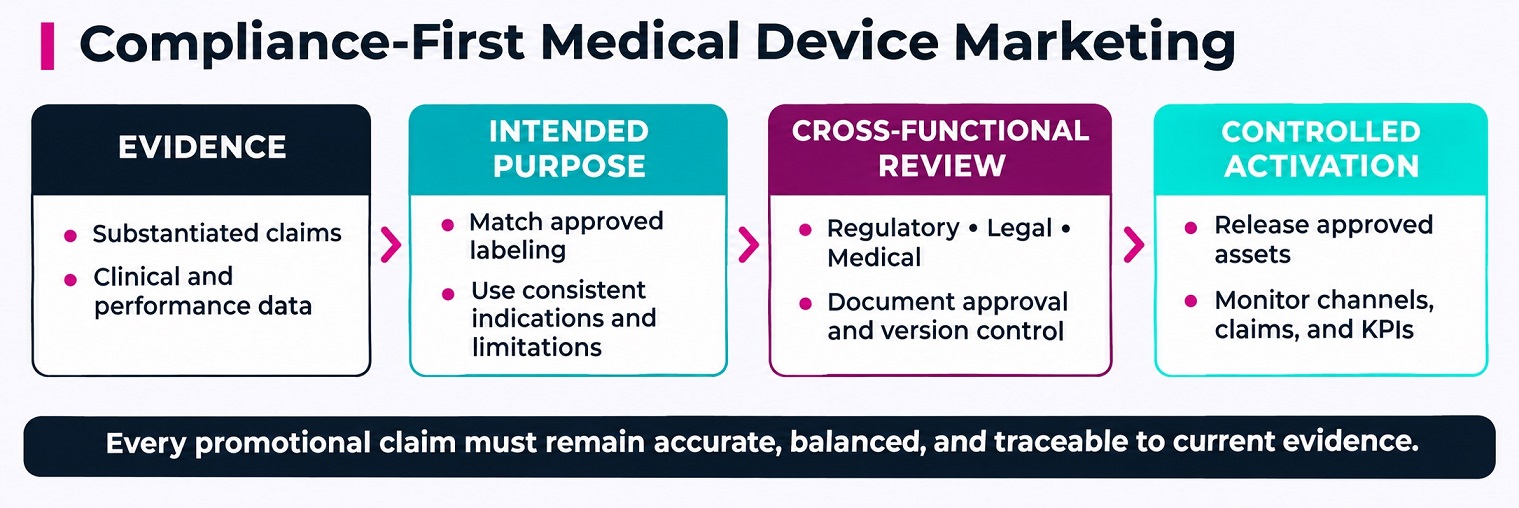
Regulatory status is a prerequisite for truthful positioning, not a marketing slogan. FDA pathways can include exempt status, 510(k), De Novo, or PMA, depending on the device and applicable requirements. A 510(k) substantially equivalent determination permits marketing but is not an FDA “approval.” In the EU, MDR Article 7 restricts claims about functions, diagnosis, safety, risks, and unassessed uses. Marketers should maintain a claims matrix and require review of advertising, websites, training slides, and distributor materials before release
Build a Medical Device Marketing Strategy Around Clinical Value
A practical strategy starts with a target patient pathway, the precise clinical problem, and a buyer map. Define differentiators only after comparing the device’s available evidence against clinical alternatives. Separate clinical outcomes from operational convenience and economic hypotheses. Identify a baseline metric, such as staff time per procedure, to quantify prospective value when credible data are available. Product management, regulatory affairs, and medical affairs should align on which statements are supported, which require qualification, and which must never appear in promotional content.
- Segment customers by specialty, care setting, and purchasing decision role.
- Document evidence source and approved claim wording before creative development.
- Choose success metrics linked to qualified demand, not impressions alone.
Essential Medical Device Marketing Strategies
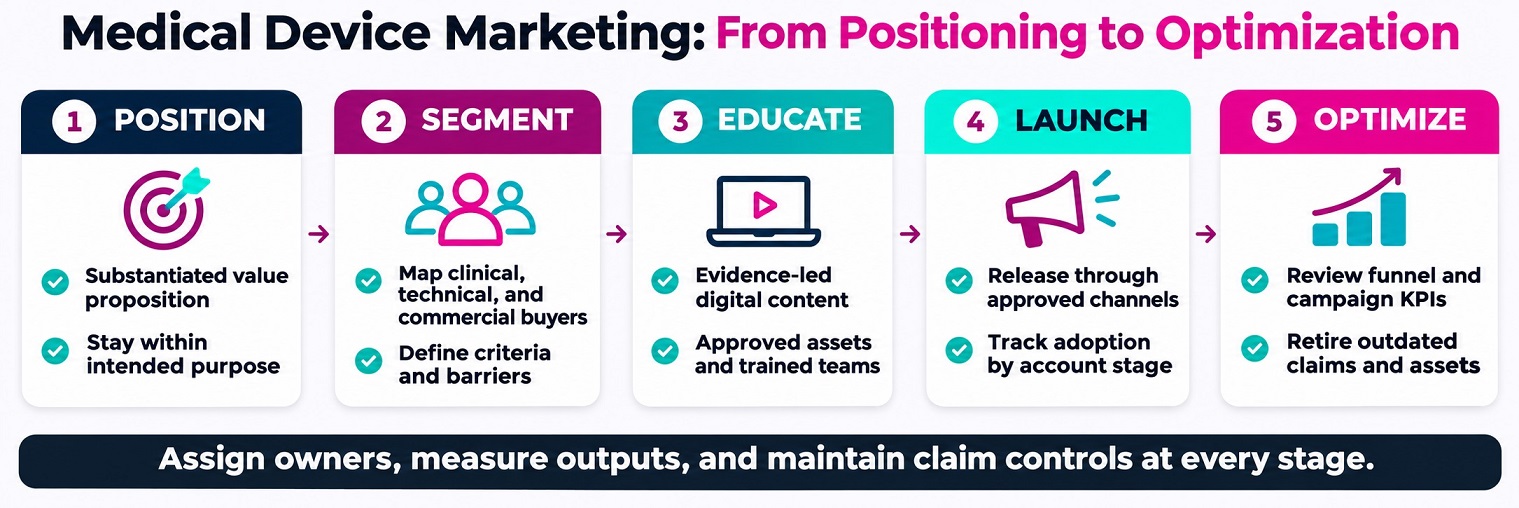
The following five strategies form an implementation sequence rather than five independent advertising tactics. They begin with a substantiated value proposition, translate that proposition into tailored clinical education, and build measurable digital engagement.
The final steps connect demand generation with hospital buying processes and ensure promotional change control throughout the product lifecycle. Each strategy should have an accountable owner, approval criteria, baseline, and review cadence.
Step 1: Create a Claims-Ready Value Proposition
Translate the intended purpose and supported evidence into a concise statement of user benefit. Link each claim to a precise source, version, jurisdiction, and disclaimer when required. Distinguish measured performance from proposed workflow benefits; avoid unsupported superiority or guaranteed outcomes.
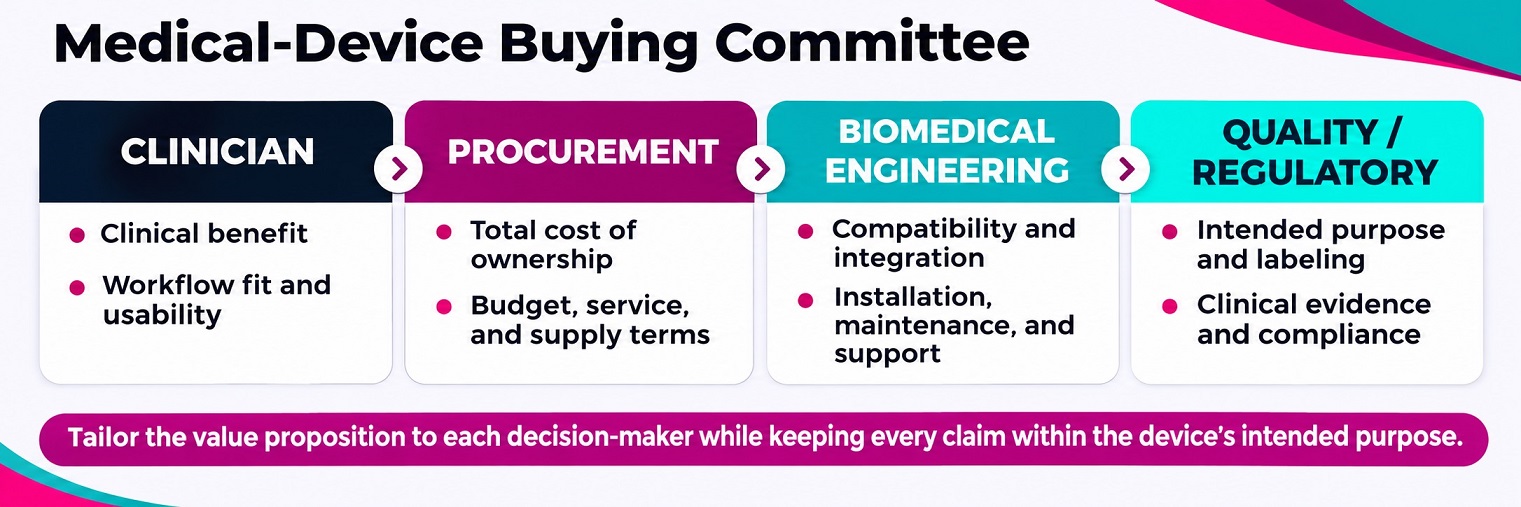
Step 2: Segment Healthcare Professionals and Buying Committees
Map each audience before planning campaigns. Match content to their needs and evidence.
- Define decision criteria and barriers for clinicians, nurses, engineers, supply-chain teams, and procurement leaders.
- Use substantiated case studies and train sales teams on approved messages and escalation triggers.
- Prioritize high-fit accounts over raw lead volume.
Step 3: Build Evidence-Led Digital Marketing Channels
Develop search pages around the device category, clinical workflow, and user questions. Pair technical explainers with accessible instructions, usability demonstrations, and transparent evidence summaries.
Ensure visuals and testimonials cannot imply unapproved intended uses. Measure engaged clinical audiences and qualified inquiries rather than interpreting page traffic as demand by itself.
Step 4: Coordinate Product Launch and Hospital Adoption
Plan market access, distributor readiness, demos, service capability, procurement documentation, and customer training as one launch process. Segment opportunities by regulatory availability and clinical readiness. Establish clear ownership for post-launch feedback, complaints, and corrections. A well-designed launch avoids promising features or patient outcomes that have not been demonstrated.
Step 5: Govern Promotions and Optimize the Funnel
Standardize and review every marketing asset. Keep content linked to current labeling and evidence.
- Use controlled templates, local-language review, approved assets, and periodic audits.
- Analyze funnel drop-offs; test compliant calls to action and navigation.
- Retire outdated assets promptly after labeling changes.
Medical Device Digital Marketing: Channel and KPI Selection
Match content to each decision stage. Define lead stages clearly. Use consistent attribution. Compare like with like.
- Use search pages and clinical explainers to build awareness.
- Use webinars and demos to support evaluation.
- Link clinical interest to procurement through account-based outreach.
- Calculate conversion rate: conversions ÷ eligible visits × 100.
- Compare equivalent periods and denominators; campaign growth is not clinical evidence.
Medical Device Marketing Channels: Audiences, Content, and KPIs
| Channel | Primary audience | Compliant content | Practical KPI |
|---|---|---|---|
|
SEO / website |
HCP researchers |
Evidence-linked explainers |
Qualified inquiries |
|
Webinar / education |
Clinicians |
Approved demonstrations |
Attendance to follow-up |
|
Account-based outreach |
Hospital committees |
Role-specific value materials |
Sales acceptance |
|
Distributor enablement |
Channel partners |
Controlled claim library |
Approved asset usage |
FDA and EU MDR Advertising: What Must Be Checked?
Before releasing a campaign, verify the jurisdiction, device classification, authorization, intended use, and currently controlled labeling. In the United States, FDA device labeling rules are addressed in 21 CFR Part 801, and promotional statements may raise misbranding concerns. In the EU, MDR Article 7 specifically prohibits misleading statements or omission of likely risks linked to intended use. Global campaigns therefore require country-specific review rather than literal translation of US copy. Clinical claims, comparisons, images, testimonials, and training videos all deserve the same evidence-based scrutiny.
How to Calculate Medical Device Marketing Performance
A practical scorecard separates marketing activity, commercial progression, and post-market feedback. The figures below are hypothetical examples.
- 80 qualified inquiries from 2,000 visits represent a 4.0% conversion rate.
- 20 sales-accepted opportunities from 80 inquiries represent a 25% progression rate.
- Segmentation, attribution windows, acquisition costs, and the qualification definition provide context.
These figures are not industry benchmarks. Consistent definitions support fair comparisons across device categories. Together, these measures offer a clearer view of campaign performance.
Integrating Risk, Quality, and Post-Market Learning
Medical device marketing does not end at purchase. Complaints, field feedback, usability observations, and labeling updates can change which messages remain valid. Establish a cross-functional governance process linking marketing to regulatory affairs, quality, clinical functions, and customer support.
Consistent post-market learning improves the quality of customer education without changing regulatory evidence requirements.
- Review complaint and field-feedback signals through approved quality processes.
- Refresh claim substantiation when labeling or evidence changes.
- Maintain training and publication records for distributor and agency assets.
Final words
Medical device marketing succeeds when useful clinical education, transparent evidence, regulatory discipline, and measurable commercial execution reinforce one another.
The strongest approach is not the loudest campaign; it is the one that explains a device’s authorized purpose accurately, answers the needs of multiple stakeholders, and can substantiate every important assertion. Start with an approved claims matrix, build content for a defined care pathway, and track qualified downstream engagement.
Coordinate launch activities with training and service teams, then incorporate quality-system feedback into future revisions. Over time, this process supports credible growth while protecting users from misleading expectations.
FAQs
Devices often require workflow demonstrations, usability training, technical service, and multi-stakeholder purchasing evaluation. Regulatory frameworks and claims must be assessed separately from pharmaceutical-drug rules.
No. FDA refers to a successful 510(k) substantial-equivalence determination as clearance; PMA uses an approval pathway. Marketers should use the correct term for their device. [1]
It prohibits misleading claims about intended purpose, safety, performance, diagnosis, and the omission of relevant risks in device advertising and other communications. [2]
References

Ershad Moradi, a Content Marketing Specialist at Zamann Pharma Support, brings 6 years of experience in the pharmaceutical industry. Specializing in pharmaceutical and medical technologies, Ershad is currently focused on expanding his knowledge in marketing and improving communication in the field. Outside of work, Ershad enjoys reading and attending industry related networks to stay up-to-date on the latest advancements. With a passion for continuous learning and growth, Ershad is always looking for new opportunities to enhance his skills and contribute to pharmaceutical industry. Connect with Ershad on Facebook for more information.

Medical Device Marketing: Powerful Strategies for Trusted Growth
Explore compliant medical device marketing, FDA and EU MDR advertising rules, evidence-based messaging, HCP targeting, and campaign KPIs.

Lean Six Sigma Training: Powerful Skills for Pharma Improvement
Explore Lean Six Sigma training for pharma, covering DMAIC, Green Belt skills, Cpk, CAPA, and practical GMP improvement projects with technical examples.

GMP Auditor Training: 5 Powerful Skills to Lead Audits with Clarity and Conviction
Build confident GMP audits with five essential auditor skills, practical risk-based techniques, and ready-to-use checklists. Learn how to assess regulatory expectations, uncover compliance gaps, and follow through on CAPAs to support stronger, more effective quality systems.
Lorem ipsum dolor sit amet, consectetur adipiscing elit. Ut elit tellus, luctus nec ullamcorper mattis, pulvinar dapibus leo.