


Lean Six Sigma training combines waste elimination with statistical control to improve pharmaceutical processes without compromising patient safety. It supports pharma quality management by connecting measurable critical-to-quality requirements, root cause analysis and sustained improvements. ASQ describes five DMAIC phases and the conventional Six Sigma benchmark of 3.4 defects per million opportunities, subject to its standard shift assumption.
Within regulated manufacturing, improvements must respect approved procedures, data integrity, validation and change control. ISO 13053-1 defines the five-phase DMAIC methodology, while ICH Q10 frames continual improvement within a pharmaceutical quality system . This guide translates those concepts into practical skills, verified equations, illustrative metrics and defensible GMP project decisions.
Table of Contents
Lean Six Sigma Training in Pharmaceutical Manufacturing
Lean Six Sigma training teaches teams to distinguish non-value-added activity from process variation and to solve both through a structured improvement cycle. Lean tools reveal delays, handoffs and excess work; Six Sigma methods quantify defect rates, causal relationships and capability. In pharmaceutical operations, the project charter should identify product and patient risks as well as cost or lead-time goals.
A faster batch record review is useful only when accuracy, contemporaneous documentation and approved release decisions remain intact. Training therefore combines applied statistics, process knowledge and quality-system governance .
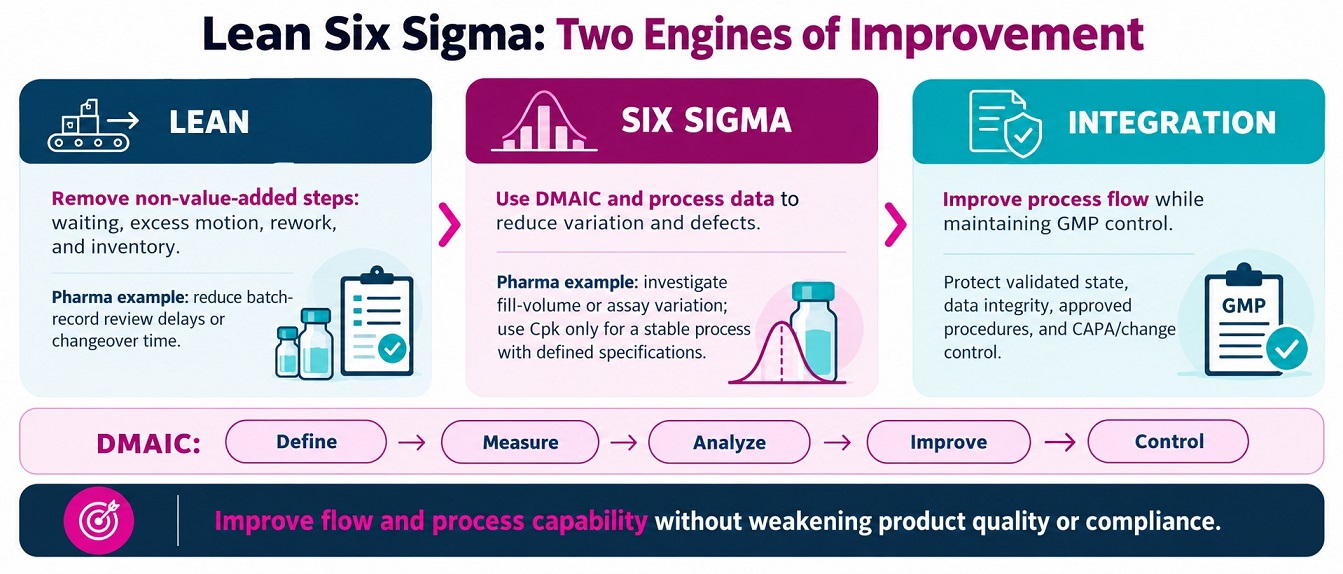
Lean vs Six Sigma: Waste, Variation and Flow
Lean improves flow; Six Sigma improves process consistency.
- Lean: Removes avoidable motion, waiting, rework, and excess inventory.
- Six Sigma: Reduces variation through measurement, analysis, and process control.
- Value-stream maps: Reveal handoff delays and workflow bottlenecks.
- Capability assessments: Test whether stable process outputs meet specifications.
Choose based on speed, reliability, or both; GMP controls still apply.
Which Pharma Professionals Benefit from Lean Six Sigma Certification?
Production supervisors, QA specialists, QC analysts, validation engineers, supply-chain teams and operational-excellence leaders can benefit from structured projects.
Yellow Belt learning introduces terminology and participation; Green Belt pathways emphasize project execution and core statistical tools; Black Belt pathways generally include deeper analysis and cross-functional leadership. Actual curriculum, examinations and experience requirements vary across providers, so a belt title alone does not prove practical competence.
For pharma hiring, documented work on deviation reduction, laboratory turnaround time or right-first-time records is stronger evidence than an unsupported savings claim.
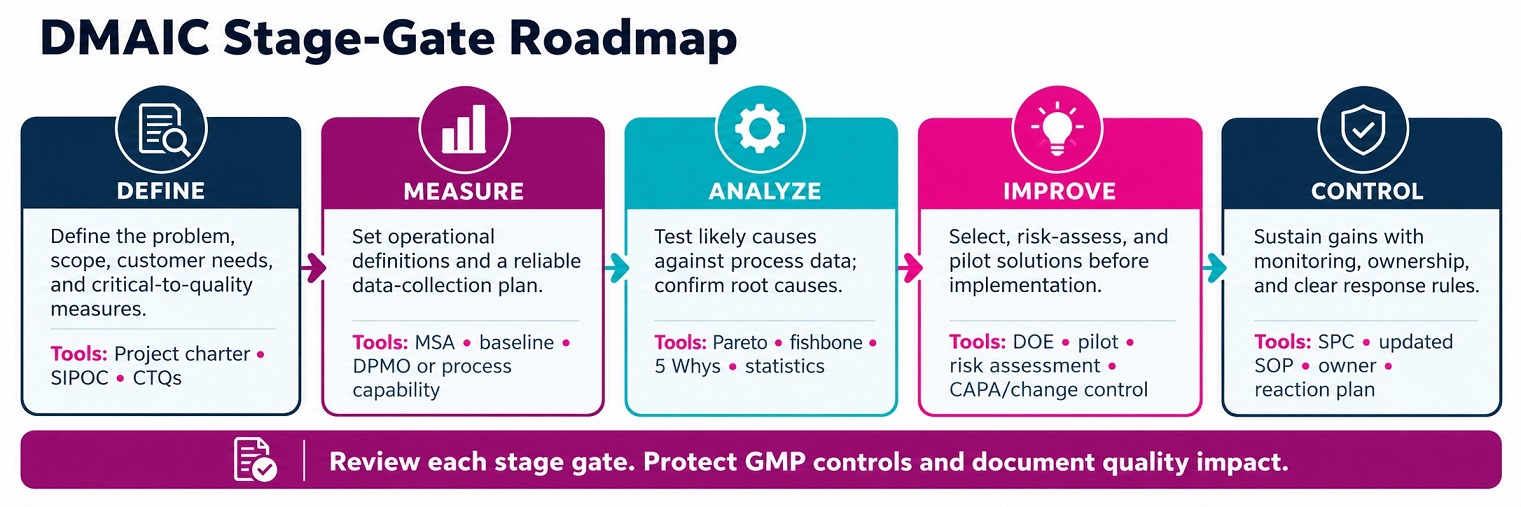
Essential Skills Covered in Lean Six Sigma Training
An effective program should test whether learners can move from an auditable problem definition to verified improvement and sustained ownership. The five competencies below map to DMAIC and ISO 13053-1. In a GMP environment, each step should preserve approved procedures and review gates. Teams should also document definitions and inclusion criteria before collecting data; otherwise, changes in reporting practice may be mistaken for genuine process improvement.
Number 1: Define: CTQs, SIPOC and Project Charters
Translate a business complaint into a bounded problem with a baseline, target, owner and patient-risk screen. Define critical-to-quality (CTQ) attributes separately from operational metrics. A SIPOC diagram identifies suppliers, inputs, process steps, outputs and customers. Record exclusions and escalation triggers before initiating work. Example: shorten QA review queues without modifying batch-disposition criteria or acceptance specifications.
Number 2: Measure: Data Integrity, MSA and Baseline Metrics
Define units, opportunities, and defects before calculating DPMO. Validate data before claiming improvement.
- Check sampling representativeness and analyst consistency.
- Confirm instrument calibration and electronic record integrity.
- Assess repeatability and reproducibility where applicable; document definitions, extraction logic, distributions, and trends.
Number 3: Analyze: Pareto, Fishbone and Statistical Evidence
Use Pareto analysis to prioritize frequently observed problems and fishbone diagrams to organize hypotheses, not to prove them. Verify suspected causes using time-sequenced records, stratification, regression, appropriate hypothesis testing or structured trials. Examine confounders such as shift, product mix and sampling frequency. Maintain a clear distinction between an investigative hypothesis and an evidence-supported root cause for CAPA decisions.
Number 4: Improve: DOE, Pilots and GMP Change Control
Use process mapping or DOE to compare corrective options. Assess failure modes and patient impact before testing. A pilot alone does not authorize permanent GMP implementation or commercial release.
- Map the process and evaluate options.
- Assess risks and patient impact.
- Obtain quality approval and required validation evidence
Number 5: Control: SPC, Standard Work and Sustainable Gains
Specify control-chart rules, metric ownership, review frequency and a written reaction plan. Update approved procedures, training and monitoring only through applicable governance. Transfer the project from its improvement team to the accountable process owner. Continue trending during routine production and escalate adverse signals through deviation, CAPA or management-review systems. The control phase requires evidence of sustained performance, not merely a successful launch.
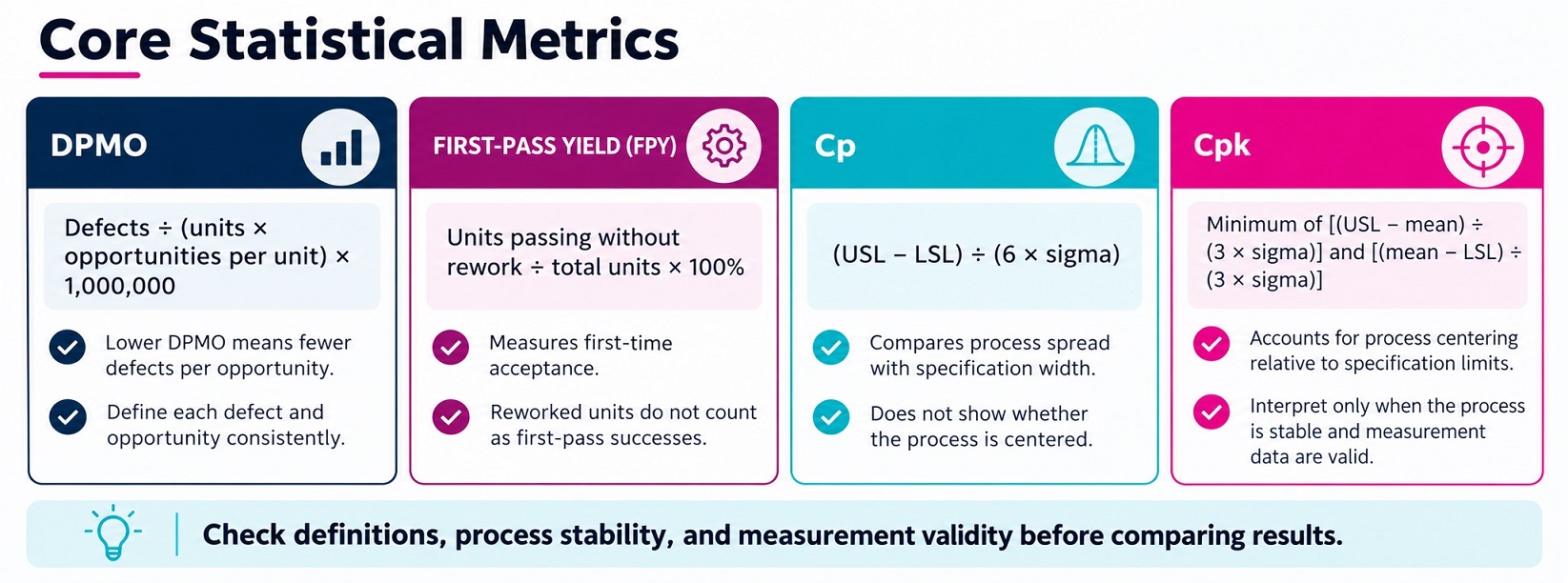
DMAIC Metrics: DPMO, Yield and Process Capability
Training should distinguish counting defects from counting defective units. DPMO equals defects divided by units multiplied by defined opportunities per unit, multiplied by one million. For a hypothetical 40 defects across 10,000 units with two defect opportunities each, DPMO is 2,000. First-pass yield captures units passing without rework, while Cp and Cpk assess the spread and centering of stable continuous data against specifications. Cpk must be interpreted using justified distributional and stability assumptions, not as a universal GMP release criterion .
Key Process Quality Metrics: Formulas, Examples, and Interpretation
| Metric | Formula / definition | Illustrative result | Use / caution |
|---|---|---|---|
|
DPMO |
40/(10,000 × 2) × 10⁶ |
2,000 |
Define opportunities consistently |
|
FPY |
9,600 / 10,000 × 100 |
96% |
No rework counted as first-pass |
|
Cp |
(110 − 90)/(6 × 2) |
1.67 |
Assumes sigma = 2; stable data |
|
Cpk |
min(110−102,102−90)/(3×2) |
1.33 |
Assumes mean = 102, sigma = 2 |
Choosing the Right Lean Six Sigma Green Belt or Black Belt Training
Choose a course based on role, statistical depth and coached project deliverables rather than belt color alone. A Green Belt learner should be able to create a charter, validate baseline definitions, use Pareto and capability methods, and close a control plan. Black Belt study typically expands into statistical inference, experimental design and leadership across functions. Assess whether the curriculum covers software use, real project review and regulator-aware decision making.
Common GMP Implementation Risks and Their Controls
Assess quality risk before starting a pilot. Revisit it when assumptions change. Align improvements with ICH Q10.
- Use traceable data for regulated decisions.
- Document approvals and required validation.
- Set monitoring thresholds and escalation steps.
Practical Case: Reducing Deviation Investigation Cycle Time
Consider a hypothetical site where median deviation closure time is 20 calendar days. A Lean Six Sigma team maps handoffs, stratifies investigations by complexity and finds extended queue times before QA assessment. It pilots standardized intake fields and escalation ownership without weakening investigation depth or approved CAPA requirements. The illustrative post-pilot median is 12 days, a calculated 40% decrease: (20 − 12) / 20 × 100. Verify the improvement with consistent case mix, dispersion, sustained trend data and independent quality review before claiming success.
Embedding Lean Six Sigma into ICH Q10 and Continued Process Verification
ICH Q10 expects systems for process-performance and product-quality monitoring, CAPA, change management and management review. Lean Six Sigma supplies analytical tools, but these PQS mechanisms remain the governance framework. FDA process-validation guidance identifies three lifecycle stages: process design, process qualification and continued process verification.
A DMAIC control plan can support Stage 3 monitoring by clarifying variables, trend rules and reactions, while any modification affecting process performance is evaluated through formal change control. Improvement should strengthen—not substitute for—the validated state.
Pharmuni’s Six Sigma White Belt Course
Pharmuni’s Six Sigma White Belt course introduces the fundamentals of Six Sigma, including variation, defects, yield, core metrics, and the DMAIC framework. It also introduces related approaches such as Lean and TQM. Designed for beginners and team members who support improvement projects, the course builds foundational knowledge; it does not replace advanced project training or GMP qualification.
Final words
Lean Six Sigma training is most valuable when statistical thinking becomes an auditable habit rather than a certificate on a résumé. Pharmaceutical teams should define patient-relevant CTQs, verify their measurement systems, test root causes and route implementation through the quality system.
ISO 13053-1 provides the DMAIC structure, while ICH Q10 and FDA process-validation principles explain the lifecycle setting in which improvement must operate. Start with a measurable, low-ambiguity project, publish a defensible baseline and keep a named process owner accountable for monitoring.
Strong training produces both better performance and stronger evidence that quality remains under control.
FAQs
No general GMP rule mandates a particular Lean Six Sigma belt. Firms must ensure personnel are appropriately qualified for their assigned duties; belt credentials are optional evidence of improvement-related competence, not a substitute for GMP training.
Green Belt learning usually targets structured improvement projects and core analysis, while Black Belt learning generally adds advanced statistics, complex project leadership and mentoring. Exact requirements differ by certification provider.
Divide the total defect count by the number of units multiplied by the predefined defect opportunities per unit; then multiply by 1,000,000. Ensure an opportunity has the same operational definition across baseline and follow-up.
References

Ershad Moradi, a Content Marketing Specialist at Zamann Pharma Support, brings 6 years of experience in the pharmaceutical industry. Specializing in pharmaceutical and medical technologies, Ershad is currently focused on expanding his knowledge in marketing and improving communication in the field. Outside of work, Ershad enjoys reading and attending industry related networks to stay up-to-date on the latest advancements. With a passion for continuous learning and growth, Ershad is always looking for new opportunities to enhance his skills and contribute to pharmaceutical industry. Connect with Ershad on Facebook for more information.

Lean Six Sigma Training: Powerful Skills for Pharma Improvement
Explore Lean Six Sigma training for pharma, covering DMAIC, Green Belt skills, Cpk, CAPA, and practical GMP improvement projects with technical examples.

GMP Auditor Training: 5 Powerful Skills to Lead Audits with Clarity and Conviction
Build confident GMP audits with five essential auditor skills, practical risk-based techniques, and ready-to-use checklists. Learn how to assess regulatory expectations, uncover compliance gaps, and follow through on CAPAs to support stronger, more effective quality systems.

CTD Module 3: A Technical Guide to Quality and CMC Dossier Preparation
CTD Module 3 contains the quality and CMC evidence regulators use to assess drug substance and drug product quality. This technical guide explains the section map, content expectations, and critical cross-checks.
Lorem ipsum dolor sit amet, consectetur adipiscing elit. Ut elit tellus, luctus nec ullamcorper mattis, pulvinar dapibus leo.