


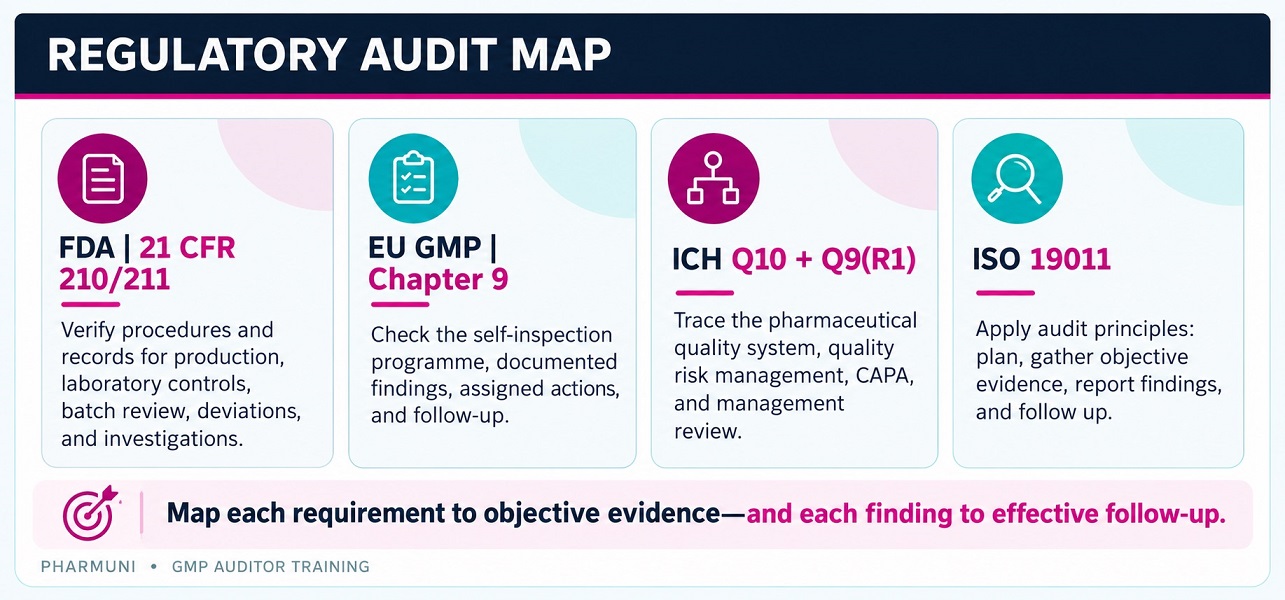
GMP auditor training equips pharmaceutical quality professionals to evaluate manufacturing controls, investigate evidence, and identify risks before they affect patients. Effective auditing starts with Good Manufacturing Practices (GMP), then connects FDA 21 CFR Parts 210–211, EU GMP self-inspection expectations, and ICH Q10 quality-system principles to practical audit decisions.
Training matters because a checklist alone cannot establish compliance. Auditors must interview personnel, review representative records, trace deviations, and communicate defensible findings. ISPE and CQI/IRCA programs emphasize auditor competence, audit execution, and follow-up, making these capabilities essential to sustained inspection readiness and patient protection.
Table of Contents
What Is GMP Auditor Training?
GMP auditor training is structured development of the knowledge, judgment, and practical skills needed to examine pharmaceutical operations against applicable requirements.
Programs cover audit objectives, impartiality, planning, evidence collection, reporting, and verification of corrective actions. Internal auditors assess their own organization’s systems; supplier auditors assess outsourced activities and material providers; lead auditors coordinate teams and complex audit programs. Competence should be evaluated using real or simulated audits rather than attendance alone.
Why Pharmaceutical GMP Auditor Training Matters
Manufacturing processes can produce acceptable-looking records while concealing weak controls, fragmented investigations, or unreliable data. A trained auditor distinguishes a documented procedure from evidence of actual execution and weighs the potential impact on product quality.
- EU GMP Chapter 9 establishes expectations for self-inspection.
- ICH Q10 supports continual improvement across the pharmaceutical quality system.
Targeted auditor development helps organizations identify systemic gaps early and use audit outcomes to improve oversight, management review, and CAPA effectiveness.
GMP Auditor Competency Requirements
Competence is a combination of regulatory literacy, process understanding, communication, analytical judgment, and professional independence. Before assignment, QA management should map each auditor to their intended scope and document the evidence supporting qualification. Relevant evidence can include observed interviews, test exercises, supervised audits, and reviewed reports. Specialized assignments need subject-matter expertise: aseptic processing auditors, for example, must understand contamination control and relevant Annex 1 principles. The same training certificate cannot demonstrate expertise in every manufacturing technology, dosage form, or risk category.
Five Essential Skills in GMP Auditor Training
A practical curriculum should teach five interconnected skills and require the trainee to demonstrate each through realistic scenarios. The sequence below moves from understanding audit criteria to validating the effectiveness of corrective action. Workshops should use controlled records, anonymized deviations, sample batch documentation, and mock interview exercises. Trainers should assess both technical accuracy and how clearly auditors connect an observation to its requirement and objective evidence.
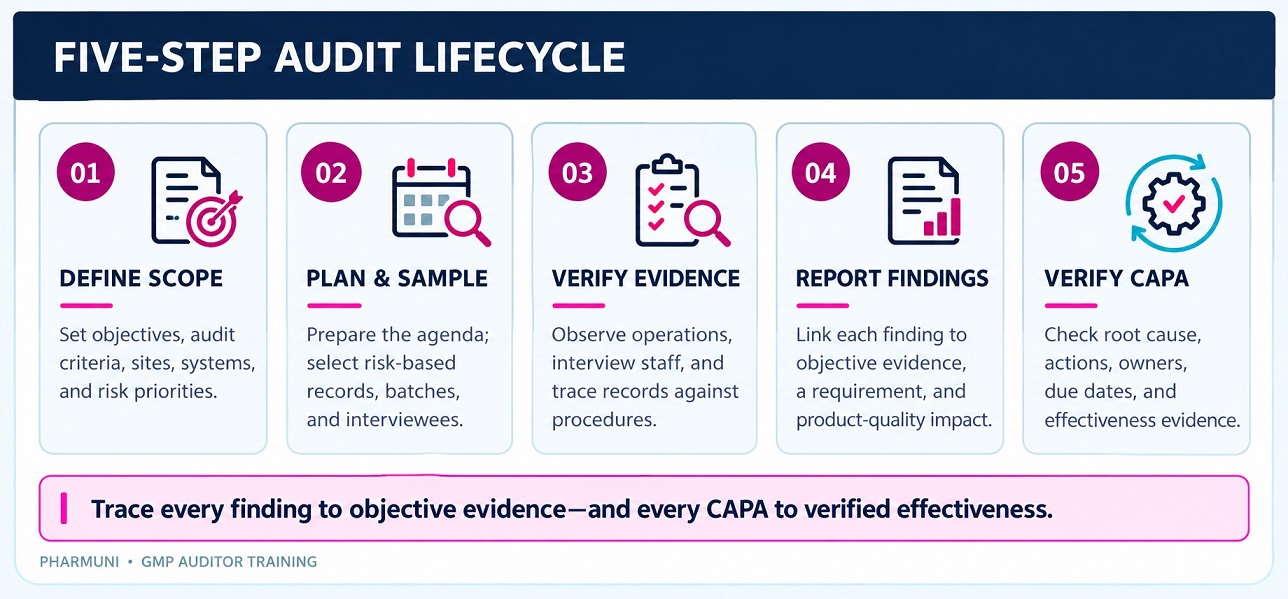
1. Regulatory Interpretation and Audit Criteria
Translate FDA 21 CFR 211, EU GMP chapters and annexes, and applicable ICH guidance into audit questions. Establish which requirements are legally applicable and distinguish binding regulations from supporting guidance. Test understanding with cases involving supplier oversight, batch documentation, change control, and qualification evidence.
2. Risk-Based Audit Planning
Define scope and audit objectives around product impact, process complexity, prior deviations, critical suppliers, and recent changes. Prepare a sampling rationale that targets important controls without overlooking baseline requirements. Assign time for interviews, shop-floor observations, documentation review, and emerging issues during the audit.
3. Interviewing and Objective Evidence Collection
GMP auditor assessing pharmaceutical operations and records:
- Asks open-ended questions.
- Observes actual practices.
- Compares records with approved procedures.
- Traces selected batches or deviations end to end.
- Documents dates, identifiers, observations, and requirements.
Relies on contemporaneous, attributable evidence rather than verbal reassurance.
4. Finding Classification and Audit Reporting
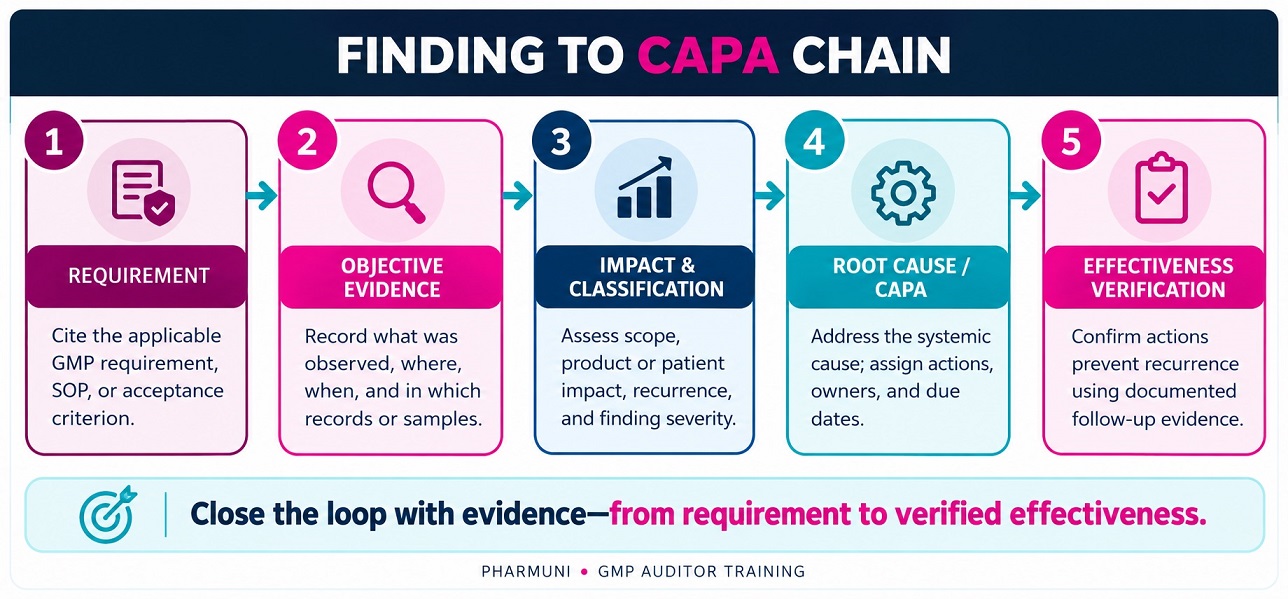
Write each observation as a clear chain: requirement, verified evidence, gap, and potential impact. Apply company-approved critical, major, or minor classification criteria consistently; classifications differ across regulators and audit programs. Avoid unsupported conclusions and confirm factual accuracy during the closing meeting.
5. CAPA Follow-Up and Effectiveness Verification
Evaluate root cause, containment, corrective and preventive actions, ownership, and due dates. Review evidence that actions were implemented and actually reduced recurrence risk. Effectiveness checks may involve trend analysis, targeted resampling, follow-up observation, and management escalation when actions fail.
Applying a Risk-Based GMP Audit Checklist
A GMP audit checklist should be built from the facility’s approved scope and applicable regulatory requirements. Use it as a memory aid—not a substitute for professional judgment. Sampling should cover high-risk processes and permit follow-up when unexpected evidence appears. For instance, a repeated deviation may justify tracing several batches, assessing investigation quality, and reviewing associated CAPA controls. Record the rationale for what was tested and what was excluded. ISPE cautions that checklist completion neither proves compliance nor replaces competent auditing.
GMP Audit Evidence: Red Flags and Follow-Up by Area
| Audit area | Example evidence | Red flag | Follow-up |
|---|---|---|---|
|
Production |
Batch record + line clearance |
Unexplained corrections |
Trace affected batches |
|
Laboratory |
Raw data + audit trail |
Missing / altered records |
Review access and controls |
|
PQS / CAPA |
Deviation + effectiveness check |
Recurring root cause |
Expand trend sample |
Data Integrity and ALCOA+ During Audits
Data integrity review requires more than checking whether a document is signed. Auditors should assess data creation, user permissions, audit trails, contemporaneous recording, backup, retention, and review processes. ALCOA+ provides useful characteristics for reliable records: attributable, legible, contemporaneous, original, accurate, complete, consistent, enduring, and available. Select representative transactions and compare instrument outputs, electronic records, paper forms, and final reports. Escalate unexplained discrepancies through approved procedures rather than assuming intentional misconduct. Audit depth should reflect the potential impact of records on patient safety and product quality.
GMP Audit Reporting, CAPA, and Follow-Up
Strong reporting helps decision-makers understand the nature and significance of a control failure. Each finding should identify the audit criterion, reliable evidence, observed gap, and potential product or patient impact. The auditee develops appropriate containment, root-cause analysis, and CAPA, while QA confirms disposition and tracks completion. Auditors should examine whether action addresses the systemic cause rather than merely fixing an isolated record. Closure should be supported by documented implementation and a proportionate effectiveness check, especially for recurring or high-risk deficiencies.
GMP Auditor Certification and Training Pathways
Professional development can progress from a GMP foundation module to internal-auditor training, supervised audits, and advanced lead-auditor education. CQI/IRCA publishes pharmaceutical internal-auditor and lead-auditor programs; its listed lead-auditor course has an indicative duration of 40 hours and focuses on ICH Q10 and ISO 19011 methods. An external course certificate does not automatically authorize every internal audit assignment. Organizations should define their own qualification criteria, verify practical competence, document authorization, and provide refresher training when regulations, processes, or technologies change.
How to Measure GMP Auditor Training Effectiveness
Measure auditor competence with performance data, not course completion alone:
- Knowledge: Test score on requirements and rationale.
- Observed practice: Mock interview and evidence-trace score.
- Report quality: Share of findings with clear, traceable evidence and accurate classification.
- Consistency: Agreement between auditors on finding classifications.
- Follow-up: CAPA effectiveness rate and repeat-deviation trend.
Compare results before and after training. Use trends to target coaching, while accounting for organizational factors.
Final words
GMP auditor training should produce more than a certificate or a completed checklist. The real measure of success is whether auditors can identify meaningful risks, trace objective evidence, communicate justified findings, and confirm sustained improvements. Build the curriculum around relevant FDA and EU GMP requirements, ICH Q10 quality-system principles, and risk-based audit practices. Combine classroom learning with supervised field experience, witnessed competency assessments, and periodic calibration.
When organizations invest in role-specific qualification and robust CAPA follow-up, auditing becomes a practical mechanism for preventing quality failures, reinforcing data integrity, and protecting patients across the product lifecycle.
FAQs
Becoming a qualified GMP auditor requires knowledge of applicable GMP regulations, pharmaceutical manufacturing processes, risk-based auditing, and quality systems. A typical pathway includes formal training, practical exercises, supervised audits, and documented competency assessment. Organizations should authorize auditors based on demonstrated competence and their assigned audit scope.
A specific external GMP auditor certification is not universally required by FDA or EU GMP regulations. However, organizations must ensure personnel performing audits are appropriately qualified and trained. Professional certifications can support career development, but practical auditing experience, technical expertise, and documented competency remain essential.
A GMP internal auditor evaluates compliance within an organization’s pharmaceutical quality system, while a lead auditor coordinates audit planning, team responsibilities, evidence evaluation, reporting, and audit conclusions. Lead auditors generally require additional competence in audit management, communication, and complex regulatory assessments.
References

Ershad Moradi, a Content Marketing Specialist at Zamann Pharma Support, brings 6 years of experience in the pharmaceutical industry. Specializing in pharmaceutical and medical technologies, Ershad is currently focused on expanding his knowledge in marketing and improving communication in the field. Outside of work, Ershad enjoys reading and attending industry related networks to stay up-to-date on the latest advancements. With a passion for continuous learning and growth, Ershad is always looking for new opportunities to enhance his skills and contribute to pharmaceutical industry. Connect with Ershad on Facebook for more information.

GMP Auditor Training: 5 Powerful Skills to Lead Audits with Clarity and Conviction
Build confident GMP audits with five essential auditor skills, practical risk-based techniques, and ready-to-use checklists. Learn how to assess regulatory expectations, uncover compliance gaps, and follow through on CAPAs to support stronger, more effective quality systems.

CTD Module 3: A Technical Guide to Quality and CMC Dossier Preparation
CTD Module 3 contains the quality and CMC evidence regulators use to assess drug substance and drug product quality. This technical guide explains the section map, content expectations, and critical cross-checks.

Revalidation in Pharma: When Is It Required? A GMP Guide
Revalidation in pharma helps confirm that processes, equipment, and systems remain fit for intended use. Learn key GMP triggers, risk-based decisions, and records needed to maintain a validated state.
Lorem ipsum dolor sit amet, consectetur adipiscing elit. Ut elit tellus, luctus nec ullamcorper mattis, pulvinar dapibus leo.