


One quality dossier, two narratives—drug substance in 3.2.S and drug product in 3.2.P—must tell a consistent story. In pharma regulation, CTD Module 3 links composition and manufacturing to controls, validation, packaging, and shelf life. Follow ICH M4Q(R1); use ICH Q8(R2), ICH Q9(R1), and ICH Q10 to frame development knowledge, risk decisions, and lifecycle control. Reviewers need traceable evidence across specifications, analytical methods, batch data, stability, and the Module 2 Quality Overall Summary. This guide maps each section, regional details, eCTD updates, and post-approval change control. Together, ICH guidance supports a coherent quality argument through every lifecycle stage.
Table of Contents
What Is CTD Module 3 in a Pharmaceutical Submission?
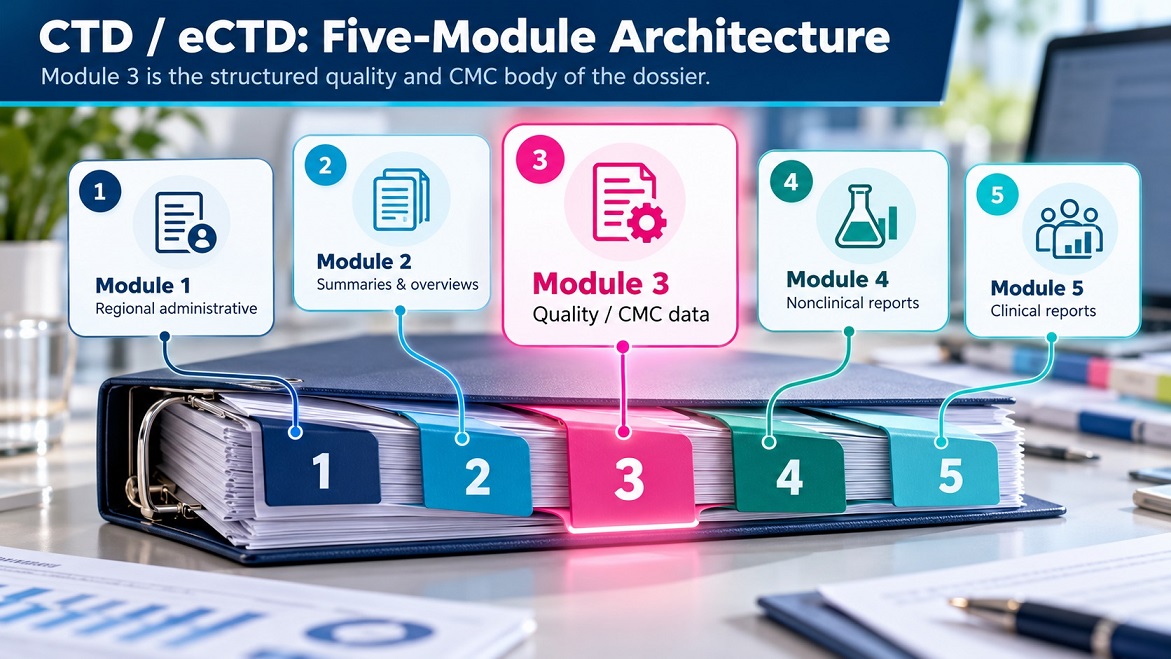
Module 3 is the structured location for quality data in the CTD. It presents manufacturing and control information for the active substance and finished product, plus supporting appendices, region-specific content, and literature references. In an eCTD submission, those documents are organized as lifecycle-managed leaf documents within the applicable sequence and regional implementation.
- Module 3 provides the detailed quality evidence; Module 2.3 summarizes it as the QOS.
- Module 3 content should be product-specific, internally consistent, and traceable to source records.
- ICH harmonizes structure, but local laws, guidelines, dosage form, and product type can add requirements.
CTD Module 3 vs. Quality Overall Summary (Module 2.3)
The QOS is not a substitute for Module 3. It follows the same broad quality logic and highlights critical information, rationale, and conclusions. Every summary statement should be supportable from the detailed section it references. Differences in manufacturer names, batch formula, acceptance criteria, or stability conclusions between 2.3 and 3.2 create avoidable review questions.
CTD Quality Module Structure at a Glance
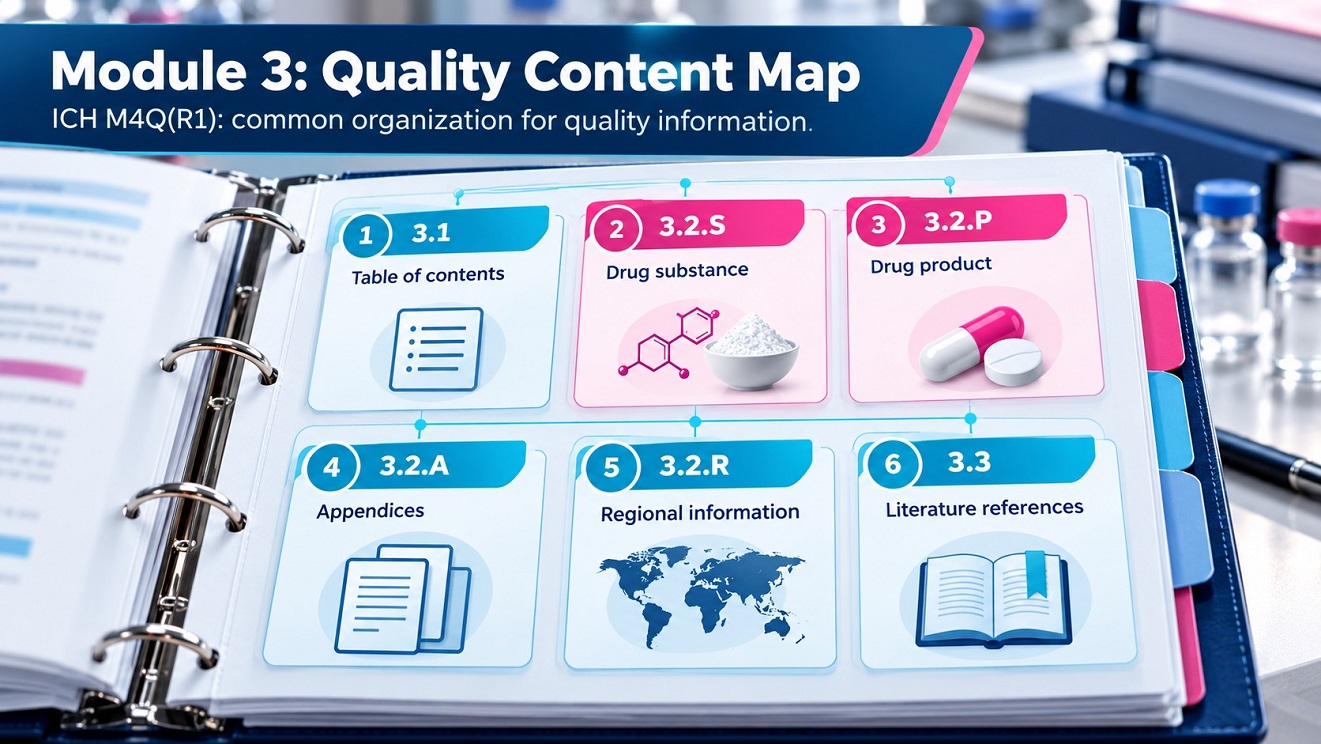
ICH M4Q(R1) defines the quality organization as 3.1 Table of Contents, 3.2 Body of Data, and 3.3 Literature References. Within 3.2, the core common technical sections cover the drug substance and drug product; regional information is included where applicable.
CTD Module 3 section 3.2.S Drug Substance: CTD API Documentation
The 3.2.S section is generally prepared for each drug substance and, where required, each relevant manufacturer or source. It should connect the substance’s identity and properties to the synthetic or biological process, impurity profile, control strategy, reference standards, packaging, and stability. For biologics, the specific applicable guidance and terminology must be followed; the chemically synthesized API structure should not be copied mechanically.
Section 3.2.S.1 General Information
S.1.1 Nomenclature provides established names and identifiers; S.1.2 Structure addresses structural information appropriate to the substance; S.1.3 General Properties describes relevant physical, chemical, and biological properties. Include values and methods that matter to manufacture, control, handling, or performance, and keep nomenclature consistent across the dossier.
Section 3.2.S.2 Manufacture
S.2.1 identifies manufacturers and sites with the activities performed. S.2.2 describes the manufacturing process and process controls, including a flow diagram and narrative with materials, intermediates, reagents, solvents, and reprocessing where applicable. S.2.3 controls materials; S.2.4 controls critical steps and intermediates; S.2.5 addresses process validation and/or evaluation when applicable; S.2.6 summarizes process development and rationale for the commercial process.
- Distinguish the proposed commercial process from development or clinical processes.
- Identify critical steps, in-process controls, hold times, and acceptance criteria with rationale.
- Align site names, responsibilities, batch scale, and process descriptions with GMP and regional sections.
Section 3.2.S.3 Characterisation and Impurities
S.3.1 presents evidence supporting structure and other characteristics. S.3.2 discusses impurities, including process-related and degradation impurities, with their origin, fate, control, and qualification or justification as relevant. Link impurity discussion to the process, analytical procedures, specifications, and applicable ICH guidance rather than treating the impurity table as a standalone list.
Section 3.2.S.4 Control of Drug Substance
S.4.1 contains the specification; S.4.2 the analytical procedures; S.4.3 validation of those procedures; S.4.4 batch analyses; S.4.5 justification of specification. Present test, method, acceptance criterion, and units unambiguously. Batch analysis data should be representative and traceable, with batch identity, scale, site, and intended use clear.
Sections 3.2.S.5 to 3.2.S.7: Standards, Packaging, Stability
S.5 describes reference standards or materials, including qualification and traceability. S.6 describes the container closure system. S.7 provides stability summary and conclusions, postapproval stability protocol/commitment where applicable, and supporting data. The proposed retest period or shelf life must be supported by the submitted data and a scientifically justified extrapolation, where used.
3.2.P Drug Product: CTD Finished Product Sections
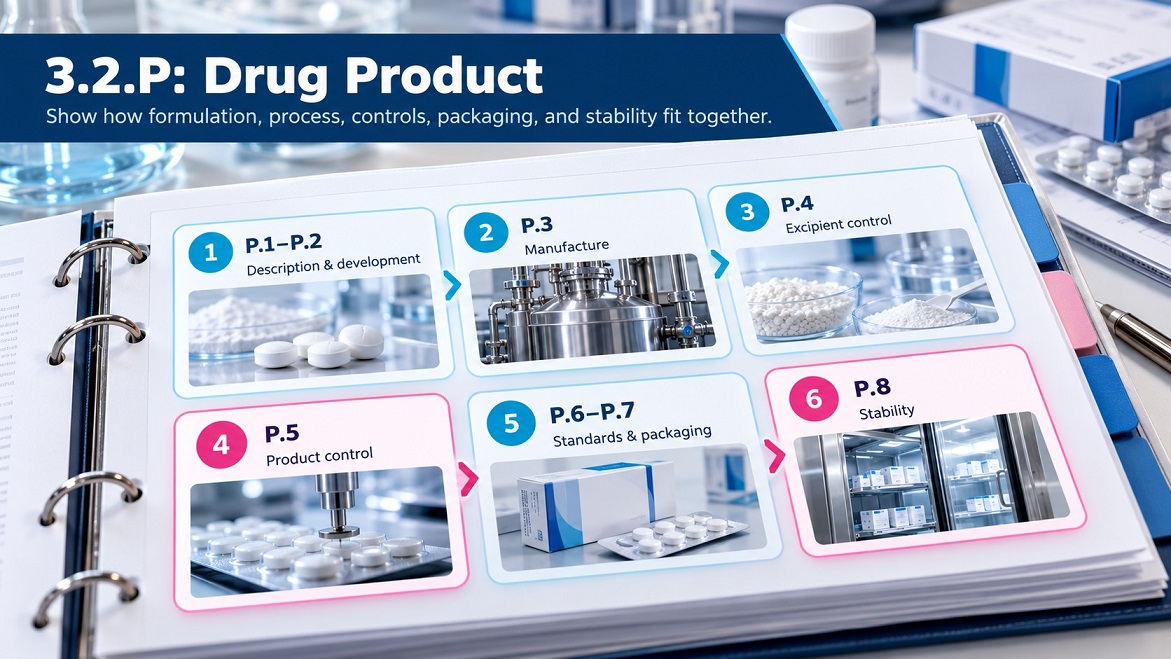
The 3.2.P dossier explains the finished dosage form, formulation rationale, manufacturing process, control of excipients and product, packaging, and stability. For each strength or pharmaceutical form, the applicant should follow applicable ICH and regional rules on whether separate sections or cross-references are appropriate. Avoid duplicating documents without explaining which data apply to which presentation.
3.2.P.1 to 3.2.P.2: Composition and Pharmaceutical Development
P.1 states the description and composition, including all components and their quantities or functions as applicable. P.2.1 addresses components; P.2.2 the drug product; P.2.3 manufacturing process development; P.2.4 the container closure system; P.2.5 microbiological attributes; and P.2.6 compatibility. Discuss relevant development batches, formulation changes, comparative in vitro or in vivo data where appropriate, and how the selected formulation and process support the proposed product.
3.2.P.3 Manufacture and Process Validation
P.3.1 identifies manufacturers and sites; P.3.2 provides the batch formula; P.3.3 describes the manufacturing process and controls; P.3.4 controls critical steps and intermediates; P.3.5 addresses process validation and/or evaluation. The process description should be executable and consistent with the master batch record: sequence, equipment principle, operating ranges, in-process controls, hold times, and reprocessing are described as applicable.
3.2.A, 3.2.R, and 3.3: Appendices and Regional Information
3.2.A contains appendices as applicable, including facilities information (A.1), adventitious agents safety evaluation (A.2), and novel excipients (A.3). 3.2.R is reserved for regional information. 3.3 lists literature references. Their exact use and content depend on product type and regional implementation; check current authority-specific guidance before assuming a section is required or omitting it.
Module 3 Supporting Sections
| Section | Purpose | Check |
|---|---|---|
|
3.2.A |
Quality appendices |
Applicability |
|
3.2.R |
Regional content |
Local guidance |
|
3.3 |
Literature references |
Cited sources |
How to Build a Reviewer-Ready CTD Module 3
A technically complete dossier makes the quality argument easy to follow. Review across sections, not only within each authoring stream. The essential question is whether the proposed control strategy is supported by development knowledge, manufacturing evidence, analytical capability, batch results, and stability data.
Cross-Reference and Consistency Checks
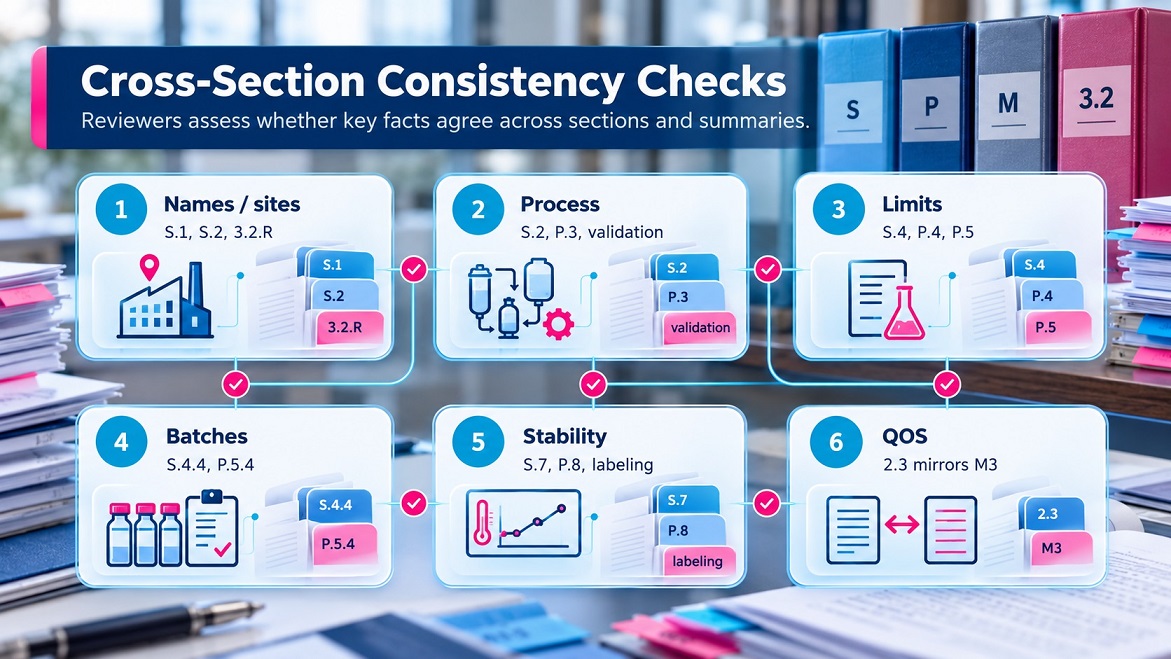
Use a structured consistency matrix before submission. Confirm that the same product name, strength, dosage form, manufacturing site, batch scale, process sequence, specification version, method number, and stability conclusion appear consistently wherever relevant. Ensure that Module 2.3 summaries accurately reflect Module 3 data and that every cross-reference points to a current, accessible document.
eCTD Document Granularity and Lifecycle Control
In eCTD, technical validity includes more than PDF readability. Use the current regional eCTD specification and validation criteria for document granularity, leaf titles, bookmarks, hyperlinks, metadata, lifecycle operators, and sequence organization. When replacing or updating an existing document, apply the correct lifecycle operation and preserve a clear relationship to prior versions. Do not assume one global technical rule covers every authority or application type.
Common CTD Module 3 Deficiencies to Prevent
- Unexplained differences between QOS and detailed Module 3 content.
- Manufacturing flow diagrams that omit controls, intermediates, or site steps present in the narrative.
- Specifications without adequate method references, units, acceptance-criteria rationale, or batch-data support.
- Stability conclusions that do not align with data, proposed storage statement, or commitments.
- Ambiguous site / manufacturer roles, batch scales, or source-specific applicability.
- Cross-references to missing, obsolete, or incorrectly placed documents.
Final words
CTD Module 3 is the detailed quality case behind a marketing application. Its strength depends on a logical, traceable relationship among drug-substance and drug-product development, manufacturing, controls, analytical procedures, validation, batch analyses, packaging, and stability. ICH M4Q(R1) supplies the harmonized structure; applicable regional rules and product-specific guidance determine the precise content and filing expectations.
For experienced CMC teams, dossier readiness means more than filling every heading. It means ensuring that each claim is supported, each control is justified, each result is interpretable, and each summary matches the source data. A reviewer-ready Module 3 should let the authority follow the quality argument from material attributes through the commercial process to the proposed control strategy and postapproval commitments.
FAQs
3.2.S covers the drug substance; 3.2.P covers the finished drug product. They have parallel control and stability concepts but distinct technical content.
The QOS is in Module 2.3. Module 3 contains the detailed supporting quality data.
No. Applicability depends on the product, manufacturing process, dosage form, and regional requirements. Explain justified omissions and follow current authority guidance.
References

Ershad Moradi, a Content Marketing Specialist at Zamann Pharma Support, brings 6 years of experience in the pharmaceutical industry. Specializing in pharmaceutical and medical technologies, Ershad is currently focused on expanding his knowledge in marketing and improving communication in the field. Outside of work, Ershad enjoys reading and attending industry related networks to stay up-to-date on the latest advancements. With a passion for continuous learning and growth, Ershad is always looking for new opportunities to enhance his skills and contribute to pharmaceutical industry. Connect with Ershad on Facebook for more information.

CTD Module 3: A Technical Guide to Quality and CMC Dossier Preparation
CTD Module 3 contains the quality and CMC evidence regulators use to assess drug substance and drug product quality. This technical guide explains the section map, content expectations, and critical cross-checks.

Revalidation in Pharma: When Is It Required? A GMP Guide
Revalidation in pharma helps confirm that processes, equipment, and systems remain fit for intended use. Learn key GMP triggers, risk-based decisions, and records needed to maintain a validated state.

Pharma Management Review: Turning Quality Data into Critical Decisions
Learn how pharma management reviews turn quality data into critical decisions on deviations, complaints, CAPA effectiveness, resources, and continual improvement.
Lorem ipsum dolor sit amet, consectetur adipiscing elit. Ut elit tellus, luctus nec ullamcorper mattis, pulvinar dapibus leo.