


Revalidation in pharma helps confirm that a manufacturing process, piece of equipment, cleaning procedure, analytical method, or computerized system remains capable of performing as intended. EU GMP Annex 15, FDA’s process-validation lifecycle guidance, and WHO validation guidance place this work within a broader system of documented, science-based control. The decision matters because process drift or poorly assessed change can affect product quality and patient safety. Revalidation is not simply a calendar exercise: its scope should reflect process knowledge, performance data, and risk.
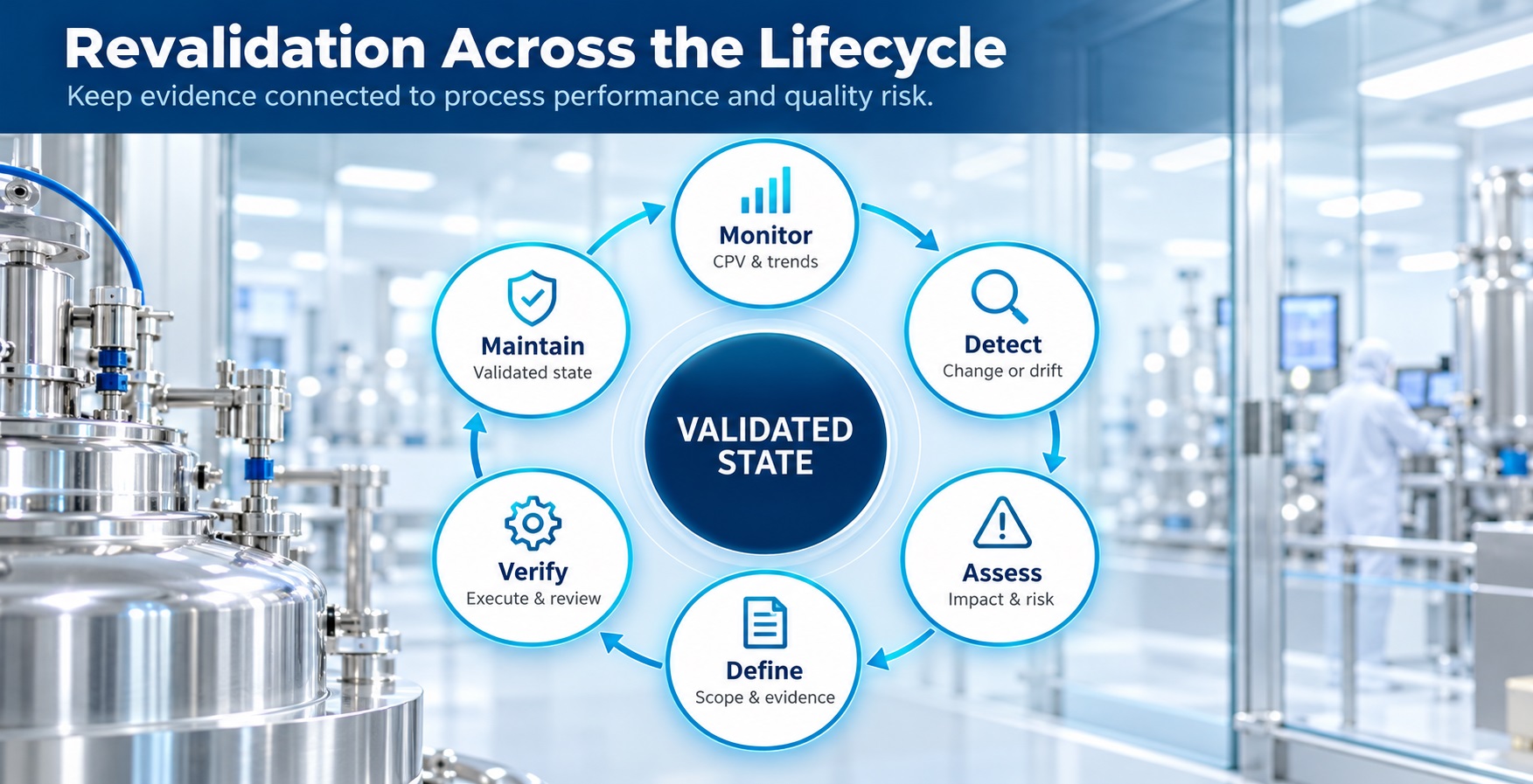
A robust Pharma Validation program connects revalidation decisions with change control, quality risk management, and ongoing process monitoring. FDA describes continued process verification as ongoing assurance that a process remains in a state of control, while WHO recommends basing revalidation on identified need and risk. This guide explains what revalidation means, when it may be warranted, how to define its scope, and what documentation supports a defensible conclusion.
Table of Contents
What Is Revalidation in Pharma?
Revalidation is documented reassessment or repeat verification used to confirm that a previously validated process, method, procedure, system, or item of equipment continues to meet its intended requirements after relevant changes, emerging signals, or a justified review. The extent may range from a documented review to targeted testing or a broader repeat study.
- The decision is linked to impact on critical quality attributes (CQAs), process performance, and patient risk.
- The required evidence is defined in an approved protocol or review plan with acceptance criteria.
- The conclusion is documented, reviewed by the quality unit, and connected to the validated state.
Why Revalidation Matters to GMP Compliance
A successful initial validation provides evidence at a defined point in time. Commercial processes continue to encounter material variability, equipment wear, personnel changes, maintenance, supplier changes, and accumulated process knowledge. Ongoing review helps detect whether the control strategy still works and whether additional proof is needed.
Revalidation, Requalification, and CPV
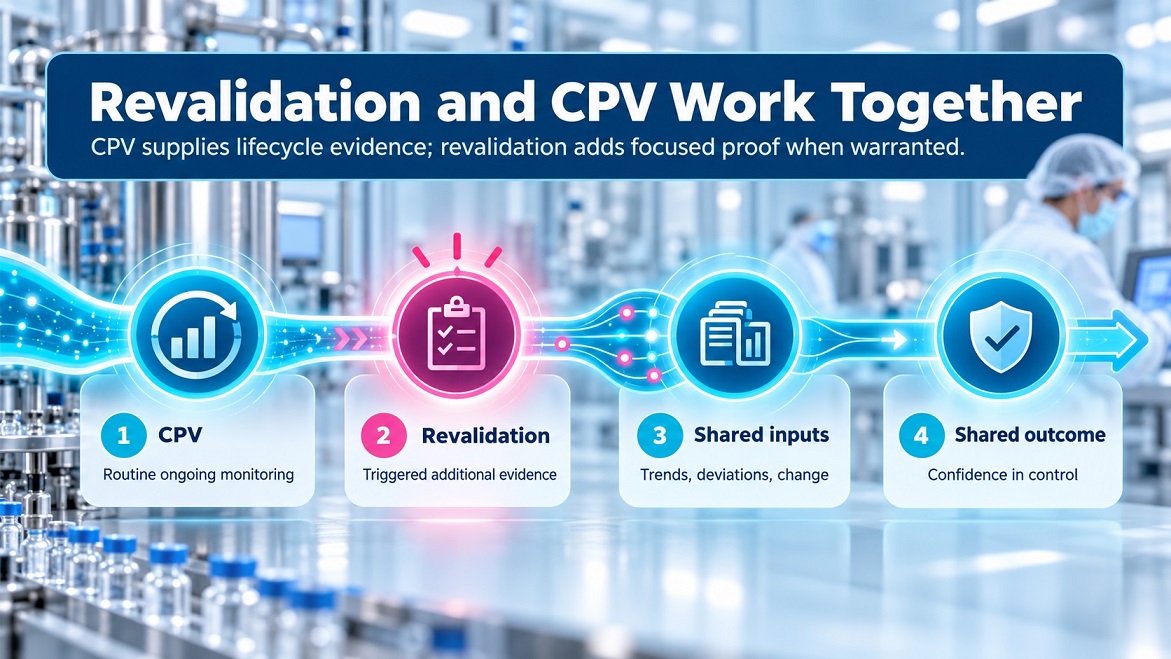
Revalidation generally addresses a process or procedure; requalification addresses whether equipment, utilities, or facilities continue to meet their qualified requirements. Continued process verification (CPV) monitors process performance routinely. The activities can inform each other, but they are not interchangeable: a trend signal may prompt revalidation assessment, while routine CPV does not automatically replace required qualification activities.
Six Common Revalidation Cases
The following cases are examples for assessment, not automatic mandates. Each decision should be documented against the applicable product, process, and regulatory context.
Number 1 Process or formulation change
A change to critical process parameters, sequence, formulation, scale, or hold time can alter variability and product quality. Map the change to CQAs and identify whether existing development knowledge and controls cover the new operating condition. Scope may include targeted verification or a broader PPQ strategy where uncertainty or impact is high.
- Compare approved and proposed ranges.
- Assess cumulative changes and prior trends.
- Define post-change monitoring.
Number 2 Equipment replacement or modification
A like-for-like replacement may still require documented qualification checks; a different design, capacity, control logic, or product-contact surface can create a larger impact. Evaluate installation, operating ranges, alarms, calibration, cleaning, and data interfaces. Requalification and process revalidation may both be relevant, but their scope should be justified separately.
Number 3 Site transfer or technology transfer
A transfer changes the manufacturing context even when the recipe is unchanged. Compare equipment trains, utilities, environmental conditions, methods, materials, operator practices, and local controls. A transfer protocol should establish comparability and define the evidence needed at the receiving site. Risk, process knowledge, and regulatory commitments determine the study design.
- Compare sending and receiving sites.
- Review scale and equipment differences.
- Set transfer acceptance criteria.
Number 4 Critical material or supplier change
A source change can affect material attributes such as particle size, viscosity, moisture, or impurity profile. Determine which attributes influence processability or CQAs, then examine supplier qualification, incoming controls, historical variability, and any bridging data. Additional process verification is appropriate when the existing control strategy cannot adequately cover the change.
- Identify material attributes linked to CQAs.
- Review supplier and lot history.
Number 5 Adverse trend, deviation, or failure
Repeated deviations, atypical trends, OOS/OOT results, complaints, or process capability deterioration may indicate that the validated state is weakened. Investigate root cause and product impact before choosing a response. Revalidation cannot substitute for an adequate investigation or CAPA; its role is to generate evidence that revised controls or conditions perform as intended.
- Trend data across batches and time.
- Assess product impact and root cause.
- Verify CAPA effectiveness.
Number 6 Periodic review or extended inactivity
A scheduled review can reveal whether evidence remains current, particularly after prolonged inactivity, aging equipment, or major personnel and maintenance changes. Periodic review does not mean automatic repetition at a fixed interval. For example, ICH Q7 says systems and processes should be periodically evaluated and explains that revalidation is normally unnecessary when there are no significant changes and quality review confirms consistent performance.
Revalidation Protocol, Execution, and Report
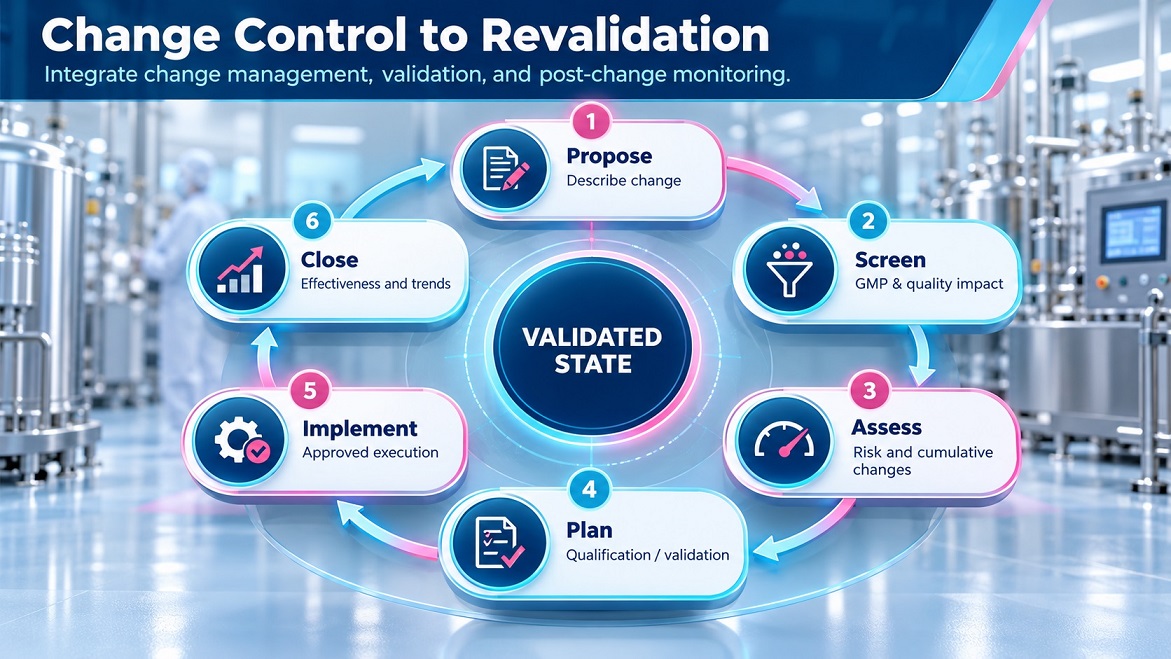
A revalidation plan should state the objective, boundaries, responsibilities, prerequisites, sampling approach, acceptance criteria, statistical methods where appropriate, deviation handling, and approval requirements. Use traceability from each identified risk to a test or other evidence source.
Protocol and Acceptance Criteria
Define in advance what will be tested and what constitutes success. Criteria should relate to product and process requirements, not be selected after results are known. Identify data sources, instruments, calibration status, sampling locations, worst-case conditions, and any prerequisites such as approved procedures and trained personnel.
Deviation Handling and Final Report
Document protocol deviations, unexpected observations, invalid runs, and out-of-acceptance results. Assess their impact on the study and on batches manufactured since the last demonstrated state of control. The final report should summarize results, unresolved issues, CAPA, limitations, and a clear conclusion approved by Quality.
Key Study Records: Required Content and Approval
| Record | Minimum content | Approval |
|---|---|---|
|
Protocol |
Scope, criteria |
QA before work |
|
Execution |
Data, deviations |
Study owner |
|
Report |
Conclusion, CAPA |
Quality unit |
Revalidation Across Different Validation Areas
The same decision principles apply across validation domains, but the technical evidence differs. Identify the applicable regulations, product-specific risks, and commitments before adapting this general framework.
Process and Cleaning Revalidation
Process revalidation draws on process parameters, in-process controls, CQAs, and CPV. Cleaning revalidation considers residues, worst-case products, equipment trains, cleaning agents, sampling recovery, and acceptance limits. For cleaning, reassess when product mix, equipment, cleaning procedure, analytical method, or toxicological basis changes.
Analytical Methods and Computerized Systems
Analytical procedure changes should be assessed against intended use, performance characteristics, and applicable ICH Q2(R2)/Q14 principles. Computerized systems should be periodically evaluated for continued GMP compliance and fit-for-use; upgrades, configuration changes, security issues, and data integrity signals may affect validation status.
Revalidation Checklist
- Describe the trigger and link it to change control or a quality signal.
- Identify affected products, CQAs, parameters, equipment, methods, and systems.
- Review cumulative changes, CPV trends, deviations, CAPA, and product quality review.
- Complete and approve a documented quality risk assessment.
- Justify whether review, enhanced monitoring, targeted, partial, or full revalidation is appropriate.
- Approve protocol, responsibilities, sampling, acceptance criteria, and data analysis before execution.
- Investigate deviations and assess impact on the study and relevant batches.
- Issue a report with a clear conclusion, actions, and QA approval.
- Define post-change monitoring and effectiveness checks.
Final words
Revalidation in pharma is a lifecycle decision that protects confidence in process performance and product quality. EU GMP Annex 15, FDA process-validation guidance, WHO validation guidance, and ICH Q9(R1) support evidence-based oversight, risk assessment, and documented decisions. The right response may be a review, focused verification, enhanced monitoring, or a broader study; it depends on impact, uncertainty, and the strength of existing controls.
A reliable program connects change control, deviations, CAPA, CPV, maintenance, and product quality review. It explains why revalidation is or is not needed, defines acceptance criteria before work begins, and records a clear conclusion. Avoid relying on a fixed calendar or batch count without a scientific rationale. The practical goal is to maintain a demonstrable validated state and act promptly when data show that control may be weakening.
FAQs
It is a documented reassessment or repeat verification that confirms a previously validated process, method, procedure, or system remains suitable after relevant changes or signals.
No universal interval applies to every process. Follow explicit requirements for the relevant activity and establish justified periodic reviews based on risk, history, and applicable guidance.
Revalidation usually addresses a process or procedure; requalification checks whether equipment, utilities, or facilities continue to meet qualified requirements.
References

Ershad Moradi, a Content Marketing Specialist at Zamann Pharma Support, brings 6 years of experience in the pharmaceutical industry. Specializing in pharmaceutical and medical technologies, Ershad is currently focused on expanding his knowledge in marketing and improving communication in the field. Outside of work, Ershad enjoys reading and attending industry related networks to stay up-to-date on the latest advancements. With a passion for continuous learning and growth, Ershad is always looking for new opportunities to enhance his skills and contribute to pharmaceutical industry. Connect with Ershad on Facebook for more information.

Revalidation in Pharma: When Is It Required? A GMP Guide
Revalidation in pharma helps confirm that processes, equipment, and systems remain fit for intended use. Learn key GMP triggers, risk-based decisions, and records needed to maintain a validated state.

Pharma Management Review: Turning Quality Data into Critical Decisions
Learn how pharma management reviews turn quality data into critical decisions on deviations, complaints, CAPA effectiveness, resources, and continual improvement.

Internal Audit in Pharma Industry: 5 Most Critical GMP Controls for 2026
Learn how to plan risk-based GMP self-inspections, collect reliable audit evidence, write clear findings, and verify CAPA effectiveness. This practical guide includes pharma audit examples, useful metrics, and eight technical visuals.
Lorem ipsum dolor sit amet, consectetur adipiscing elit. Ut elit tellus, luctus nec ullamcorper mattis, pulvinar dapibus leo.