


Management review in pharma industry is a formal senior-management assessment of pharmaceutical quality system (PQS) suitability, performance and effectiveness. ICH Q10 identifies two complementary review activities: oversight of process performance and product quality in section 3.2.4, and periodic review of the wider PQS in section 4.1. Six input streams—product trends, deviations, CAPA, changes, audits and previous actions—help reveal emerging risk before individual metrics appear unacceptable.
The practical outcome is not a signed slide deck: leadership must fund controls, assign ownership and verify improvement. ICH Q10 sections 4.1–4.3 call for performance indicators, consideration of internal and external factors, and documented communication of decisions. For effective pharma quality management, those decisions should be traceable to batch-level evidence, critical quality attributes, regulatory commitments and follow-up records.
Table of Contents
What Is Management Review in Pharma Industry?
Management review is the governance mechanism through which accountable leaders evaluate whether the PQS can protect patients and meet quality objectives.
Leaders should review:
- Site-level process performance and quality-system effectiveness.
- Weak trends, cross-functional dependencies, and resource constraints.
The review should drive system-level improvement—not simply endorse the QA presentation.
Which Records Must Leadership Review?
For each dataset, require a defined reporting period, system-of-record location, approved extraction method, accountable process owner and data-quality assessment. Highlight missing or late observations rather than treating incomplete datasets as reassuring. Correlate associated signals—for example, increased deviations after a supplier change—with release and stability outcomes before recommending action.
Review evidence must be sufficiently current, attributable and comparable. Trend rates against meaningful exposure: complaints per million distributed units, repeat deviations per eligible batch, or investigation delays by risk class. Keep raw-data links so an auditor can reconstruct a chart.
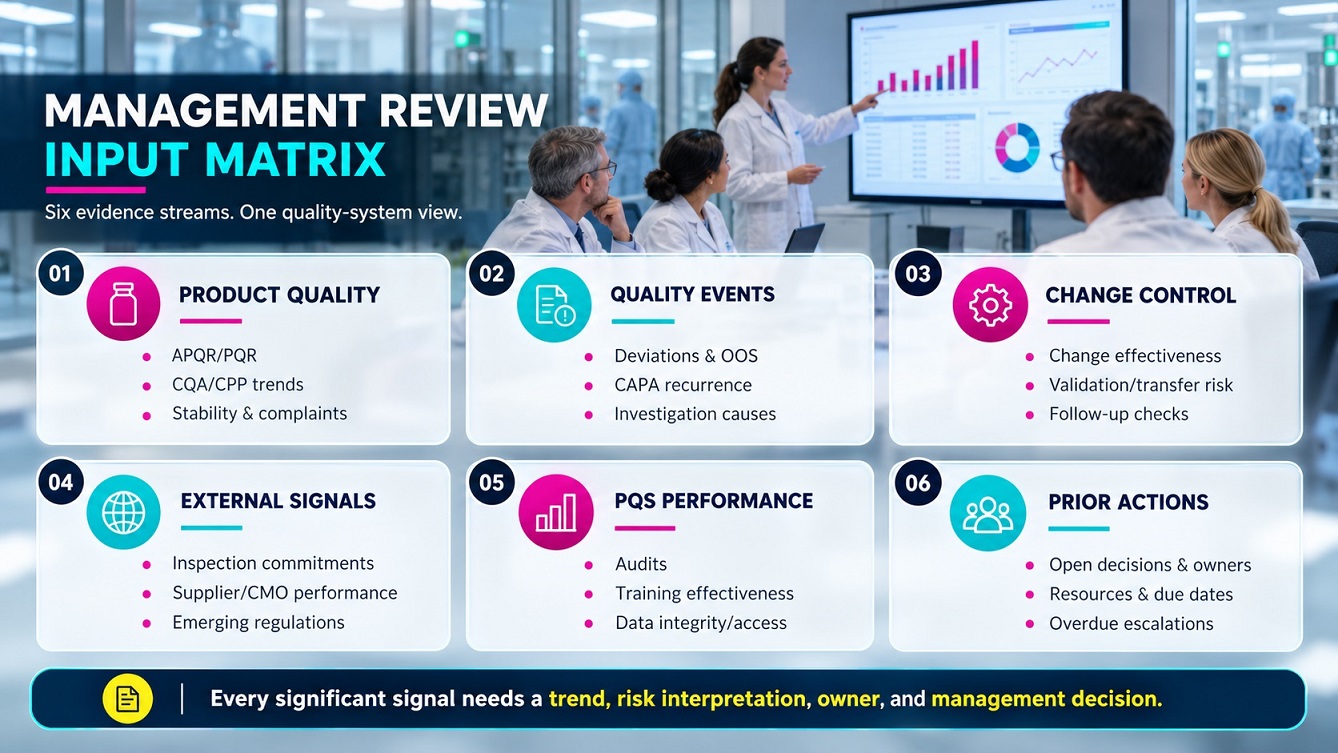
Five Critical Inputs for an Effective Pharma Management Review
Use these five core domains as a minimum planning framework, tailoring the depth of review to product complexity and risk. They organize evidence; they are not an externally mandated five-item checklist. For each domain, compare at least 3 review periods—for example, the current quarter and the previous 2 quarters—to identify adverse trends and recurring signals. Track each resulting action with a named owner, a due date, and a documented effectiveness check.
1. Product Quality Trends
Compare annual product quality review conclusions, critical process parameters, stability signals and rejected-batch patterns. Stratify by product, line and period so pooled averages do not conceal high-risk subgroups. Flag drift before registered specifications are exceeded.
- Normalize rates by exposure
- Escalate persistent adverse trends
2. Deviations and CAPA
Review recurring investigations, root-cause confidence and CAPA effectiveness independently of closure dates. A high on-time closure percentage can coexist with repeated failure mechanisms. Select examples where corrective actions changed process controls and demonstrate that recurrence risk declined.
3. Change and Validation
Examine post-implementation change verification, validation lifecycle signals, equipment interventions and transfers. Leadership should identify underfunded controls and unintended quality effects, especially where changes influence control strategies, process capability or data integrity.
- Check affected product families
- Verify approved change outcomes
4. Audit and Supplier Signals
Integrate internal audit observations, regulatory commitments, customer concerns and outsourced-activity monitoring. Compare repeated systemic findings and overdue high-risk supplier actions. Confirm contractual responsibilities are reflected in technical oversight and remediation plans.
5. Previous Review Actions
Track each prior management decision against its owner, deadline, verification criterion and residual risk. Open items are not merely project delays: unresolved high-severity issues may require management escalation or additional product-protection measures.
How Should a Risk-Based Review Operate?
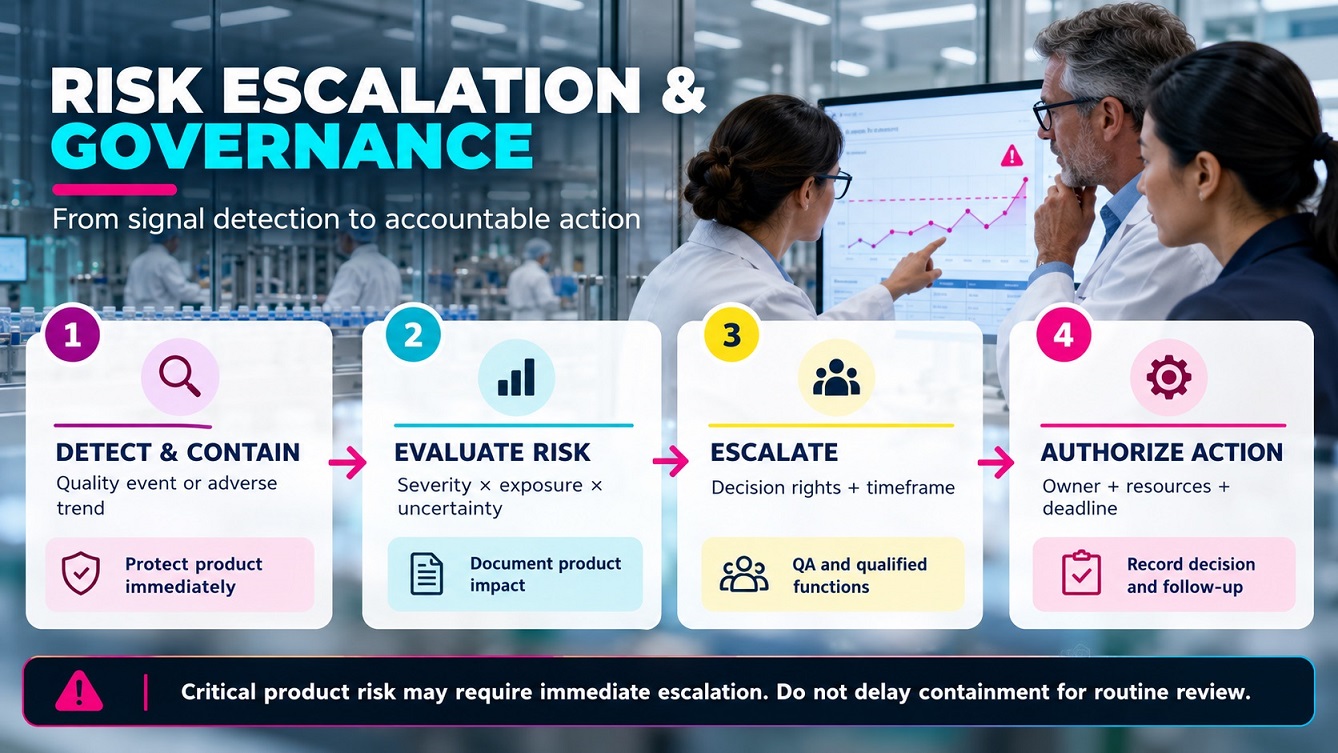
A productive meeting distinguishes approval authority from technical subject-matter advice. QA can challenge risk interpretation while manufacturing, engineering and regulatory experts provide implementation constraints. Minutes should explicitly capture alternatives rejected and why. Define the trigger for off-cycle review, particularly a potential patient-safety impact, a serious data-integrity concern or an emerging cross-product defect.
Define scope, frequency, attendees, escalation pathways and decision authority in an approved procedure. Management review can occur at site, product or enterprise levels; ICH Q10 allows a series of reviews across management levels when escalation remains timely. Critical signals cannot wait for the next routine meeting.
Management Review Governance Gates: Evidence, Accountability, and Escalation
| Review gate | Minimum documented evidence | Responsible role |
|---|---|---|
|
Pre-read |
Qualified trend datasets and risk commentary |
Process owners |
|
Meeting |
Challenges, rationale, dispositions |
Senior management |
|
Action approval |
Resources, owner, due date |
Governance chair |
|
Verification |
Post-action comparison and QA review |
Action owner + QA |
Management Review KPIs: Interpret the Numbers
Avoid a single traffic-light score blending fundamentally different risks. An improving closure percentage may simply indicate that teams closed easy items while severe deviations remain open. Present counts beside percentages, show run charts where suitable and separate leading indicators such as overdue risk assessments from lagging indicators such as repeat complaints.
KPIs should reveal control, not reward administration. The following fictional dataset illustrates how ratios and denominators change conclusions; it is not a benchmark or regulatory target. A metric without period, exposure, definition and decision threshold cannot reliably direct action.
How Is Management Review Different from APQR?
APQR generally examines a defined product across batches and time, while senior management may need to see shared failure mechanisms spanning several products, sites or contractors. Link a recurring quality defect discovered in multiple APQRs to the enterprise-level decision log. Preserve both product-specific disposition and wider PQS governance conclusions without duplicating ownership.
FDA 21 CFR 211.180(e) calls for written records supporting evaluation of quality standards of each drug product at least annually. This product-specific evaluation is not a universal rule that senior management must conduct the entire PQS governance review exactly once a year. APQR findings should, however, feed strategic management review when they disclose systemic issues.
How Do Decisions Become Effective CAPA?
For high-risk actions, combine process evidence with outcome evidence: verify that equipment interlocks actually prevent the erroneous step, and then review comparable production exposure for recurrence. Where volume is small, extend monitoring using justified risk-based criteria rather than claiming success from the absence of a few events. Escalate failed checks promptly.
Common Inspection-Readiness Gaps
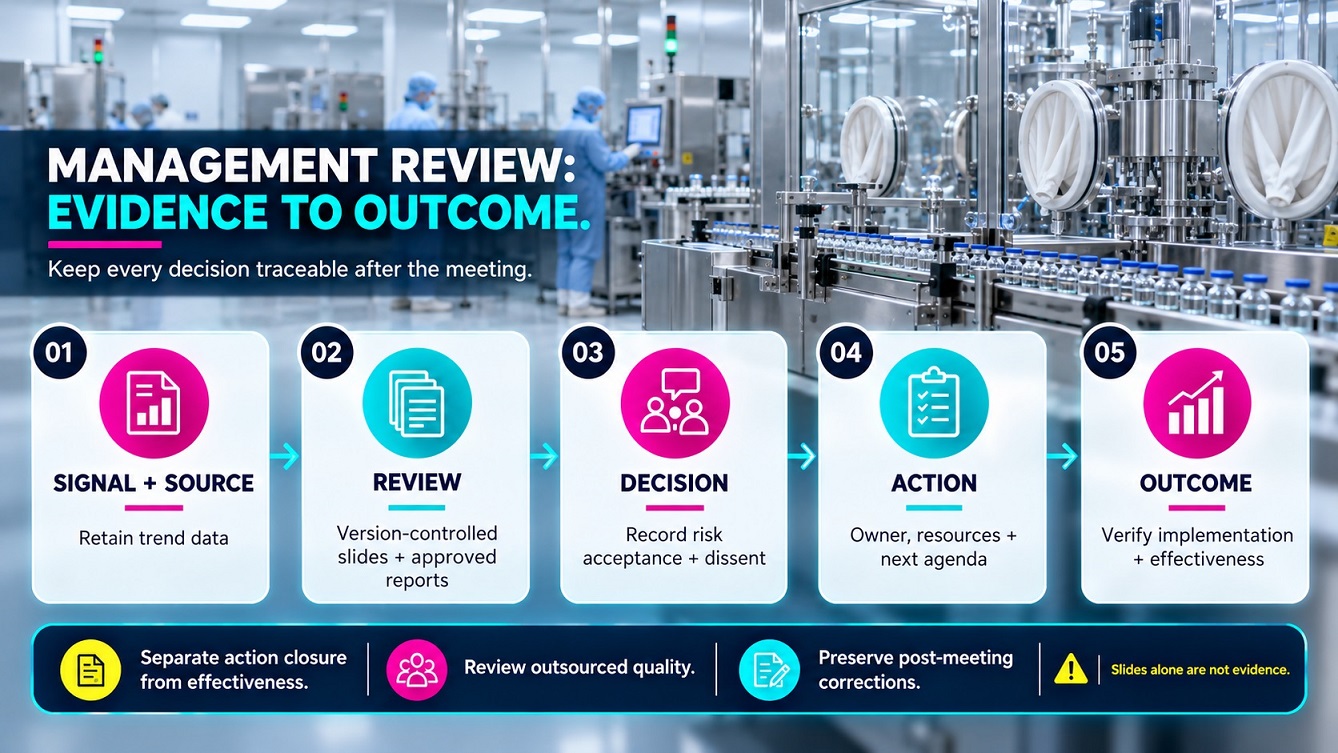
Preparedness improves when reviewers can reopen the complete evidence chain without relying on a particular presenter. Use version-controlled slides linked to approved source reports; document any corrections after the meeting. Record which management body accepts residual risks and how unresolved high-risk actions enter the next agenda. Secure electronic signatures alone do not establish sound decisions.
Typical weaknesses include slide-only minutes, averaged data hiding critical trends, absent resource decisions, closed actions without effectiveness evidence and unresolved repeat findings. Inspectors should be able to trace a patient-relevant signal through escalation, decision, implementation and verified outcome; maintain approved minutes and documented follow-up.
- Document dissenting risk assessments
- Retain trend calculation sources
- Separate closure from effectiveness
- Review outsourced quality performance
Final words
Management review in pharma industry creates value when leaders translate quality signals into sustained control. In the illustrative dashboard, 3/24 critical CAPAs remain overdue (12.5%): this requires risk-based review, not a declaration that the site meets an invented industry limit. ICH Q10 sections 2.6 and 4.1–4.3 emphasize senior-management accountability, process indicators, resourcing and documented communication. Combine meaningful denominators, independent QA challenge and verified action outcomes to keep patient protection ahead of presentation metrics.
FAQs
It enables senior leaders to assess whether the Pharmaceutical Quality System (PQS) remains suitable, effective, and capable of meeting quality objectives and protecting patients. The review should result in documented decisions, assigned owners, appropriate resources, and follow-up—not just approval of a presentation.
An APQR/PQR focuses on the quality and consistency of a specific product over a defined period. Management review looks across the wider PQS, including systemic trends that may affect multiple products, sites, suppliers, or processes. Product-specific findings should feed into management review when they reveal broader risks.
Key inputs include product quality trends, deviations and OOS results, CAPA performance, change controls and validation, audit and supplier findings, and the status of actions from previous reviews. Data should have a clear reporting period, source, calculation method, and accountable owner.
References

Ershad Moradi, a Content Marketing Specialist at Zamann Pharma Support, brings 6 years of experience in the pharmaceutical industry. Specializing in pharmaceutical and medical technologies, Ershad is currently focused on expanding his knowledge in marketing and improving communication in the field. Outside of work, Ershad enjoys reading and attending industry related networks to stay up-to-date on the latest advancements. With a passion for continuous learning and growth, Ershad is always looking for new opportunities to enhance his skills and contribute to pharmaceutical industry. Connect with Ershad on Facebook for more information.

Pharma Management Review: Turning Quality Data into Critical Decisions
Learn how pharma management reviews turn quality data into critical decisions on deviations, complaints, CAPA effectiveness, resources, and continual improvement.

Internal Audit in Pharma Industry: 5 Most Critical GMP Controls for 2026
Learn how to plan risk-based GMP self-inspections, collect reliable audit evidence, write clear findings, and verify CAPA effectiveness. This practical guide includes pharma audit examples, useful metrics, and eight technical visuals.

Fishbone Diagram Root Cause Analysis: 6 Powerful GMP Steps for 2026
Build 6M Ishikawa diagrams to explore potential causes across Man, Machine, Method, Material, Measurement, and Mother Nature (Environment). Test each cause against documented GMP evidence, investigate deviations systematically, and distinguish confirmed root causes from assumptions. Then define CAPA that addresses the cause and verify its effectiveness to help prevent recurrence.