


Internal Audit in Pharma Industry: 5 Most Critical GMP Controls for 2026

Internal audit in pharma industry operations provides a systematic check of whether approved controls work beyond their written procedures. EU GMP Chapter 9 specifies three core expectations: a pre-arranged self-inspection programme, independent competent reviewers, and recorded observations with subsequent actions. A useful audit therefore measures implementation and risk exposure, not merely the number of SOPs reviewed or employees trained. For high-impact sterile and laboratory processes, a small evidence gap can undermine batch disposition confidence.

These requirements imply that audit scope, auditor independence, objective evidence and corrective-action follow-up must operate as one system. ICH Q10 links audit results with management review and continuous improvement; FDA 21 CFR 211.180(e) separately requires at least annual product-quality evaluation, not universally annual internal audits. A risk-based programme connects findings to pharma quality management by testing process controls, supporting defensible CAPA and escalating unresolved quality risks.


Table of Contents

What Is Internal Audit in Pharma Industry?

An internal GMP audit, also called self-inspection in EU GMP Chapter 9, independently assesses whether the pharmaceutical quality system (PQS) is implemented and effective. The auditor tests actual operations against approved procedures, regulatory expectations and quality commitments. Scope may span manufacturing, QC, engineering, warehousing, outsourced activities and electronic systems. An inspection by a regulator is different: it is an external authority assessment rather than a company-run internal audit.

What Evidence Makes an Audit Defensible?

A defensible conclusion links the requirement, sample, original evidence, and potential quality impact.

  • Define the applicable requirement.
  • Explain why the sample was selected.
  • Compare original records with audit-trail entries.
  • Assess potential impact on batch decisions.
  • Consider variation across products and shifts.

For example, reviewing 12 batch records against audit trails may reveal six late entries. These are illustrative training figures, not industry rates.

Five Audit Controls That Matter Most

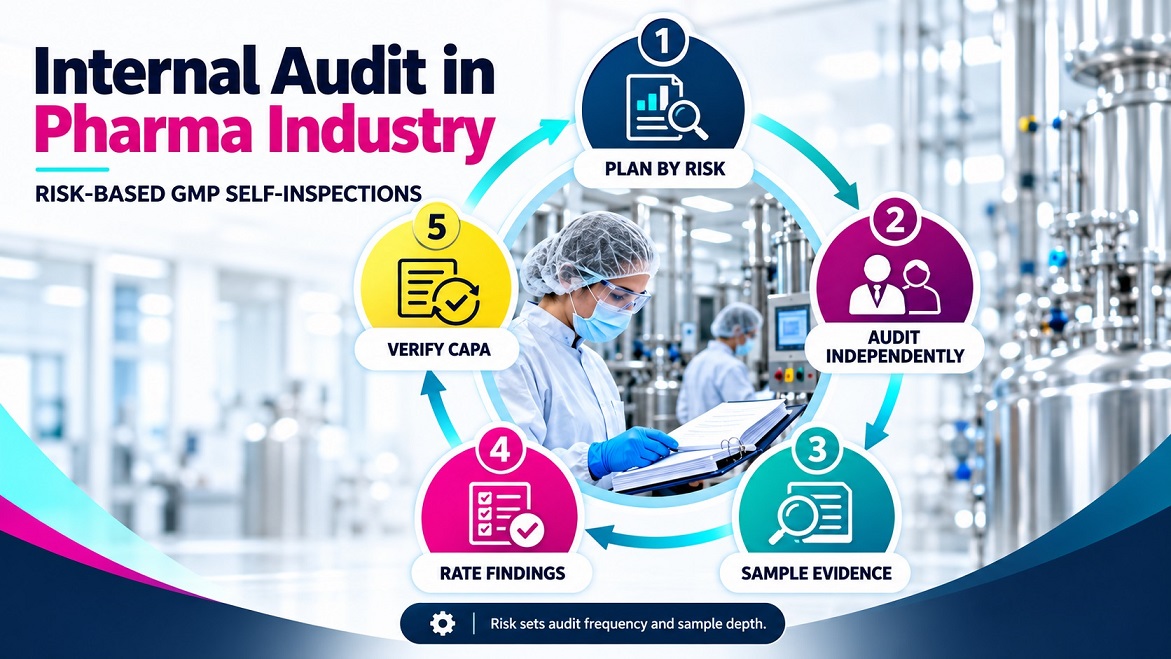
A strong GMP self-inspection programme uses five controls: risk-based planning, qualified independent auditors, traceable sampling, justified finding classification, and verified CAPA effectiveness. Audit scope should reflect patient risk, process criticality, prior findings, changes, and quality trends; EU GMP Chapter 9 sets no universal annual frequency. Document sample populations, shifts, timestamps, evidence provenance, impact ratings, and outcome measures to assess recurrence and confirm that corrective actions work.

1. Risk-Based Audit Planning

Audit frequency should consider patient risk, process criticality, prior observations, significant changes and quality trends. No universal one-year frequency is imposed by EU GMP Chapter 9. Document why an aseptic process needs closer review than a stable, low-risk support function.

  • Prioritize sterile controls
  • Reassess after changes

2. Auditor Competence and Independence

Assign technically qualified auditors without operational ownership of the activity examined. Record discipline expertise, audit-method training, independence declarations and escalation responsibilities. EU GMP Chapter 9 specifically expects independent, detailed self-inspections conducted by competent designated personnel.

  • Avoid self-auditing
  • Document auditor qualifications

3. Traceable Evidence Sampling

Use process maps to select representative batches, operators, shifts and electronic data. Verify timestamps and record provenance before treating interviews as evidence. Sample counts are context-specific; document the population, selection rationale and any exclusions.

4. Risk-Based Finding Classification

Define critical, major and minor findings in approved site procedures using patient impact, GMP system failure, detectability and recurrence. These labels are commonly used but specific thresholds vary across organizations. Do not automatically equate a numerical finding count with quality-system maturity.

  • Justify impact rating
  • Escalate critical gaps

5. CAPA Effectiveness Verification

Link each finding to a documented investigation, owner, deadline and preventive system control. An auditor should check evidence that the causal pathway changed. Retraining completion or CAPA closure alone does not establish long-term effectiveness.

  • Define outcome measures
  • Trend repeat findings

How to Build a Risk-Based GMP Audit Programme

Start with an auditable universe: products, process families, supporting utilities, laboratories, computerized systems and suppliers. Set the annual planning horizon internally if useful, but refresh priorities after serious deviations, recalls, system changes or regulatory findings. The audit schedule should preserve adequate independence and allow unannounced targeted sampling when appropriate.

  • Map quality systems
  • Rank product impact
  • Assign independent auditors
  • Predefine sampling logic
Risk-based GMP self-inspection cycle

What Should Auditors Verify in Manufacturing and QC?

Walk the process in both directions: from a released batch to its critical process evidence and from raw data to the approved report. Cross-check batch manufacturing records, equipment status, calibration, analytical sequences, laboratory investigations, deviations, change controls and training qualification. Interview different shifts to reveal handover weaknesses.

Audit Domain / Objective Evidence / Failure Signal

Audit Domain Objective Evidence Failure Signal
Manufacturing
Executed BMR, IPC trends
Unexplained overrides
QC & Data
Raw records, audit trail
Unattributed edits
Equipment
Calibration, maintenance
Overdue critical service
Supplier
Quality agreement, deviations
Unresolved material trends

Example: Aseptic Processing Audit

In a fictional aseptic line, auditors review 20 interventions and discover three missing intervention annotations. The illustrative 15% sample finding rate requires investigation of data integrity, operator practice, system design and potentially affected batches; it does not itself prove contamination or justify a site-wide prevalence estimate.

Aseptic GMP audit_ investigate findings
Risk-based GMP self-inspection cycle

How Should Findings Link to CAPA?

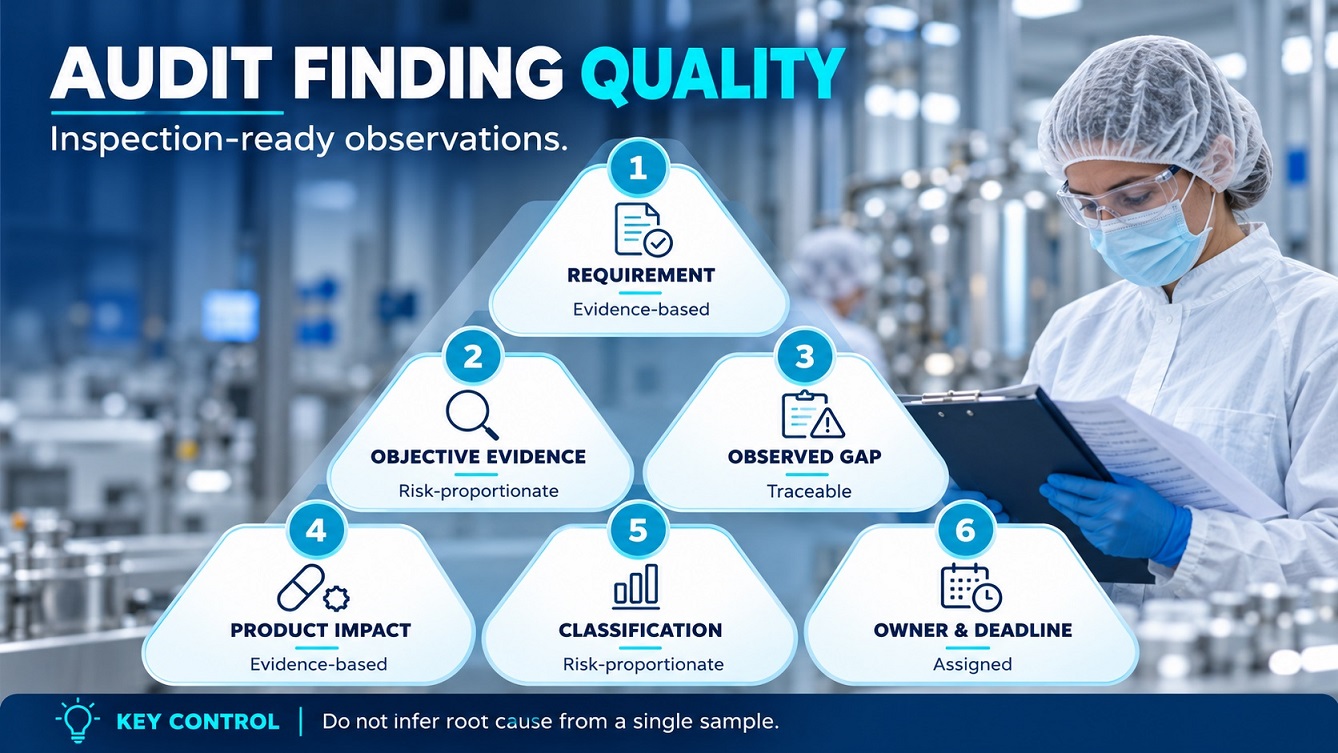
A strong finding states the requirement, what was sampled, the verifiable discrepancy and why it matters. QA assigns classification with justification. Root-cause work tests procedure usability, access rights and supervisory review—not just operator error. CAPA should identify systemic controls and an independently verified effectiveness endpoint.

How Does Electronic Data Integrity Change Audit Sampling?

Electronic records require reviewers to consider user permissions, audit-trail configuration, time synchronization, backup and restoration controls, and whether critical GMP changes can be reconstructed. During a QC audit, an approved result alone is insufficient where deleted injections, reintegration events or unreviewed audit-trail entries could change its meaning. Link each sampled exception to the original data, an authorized explanation and a documented quality decision. A risk-based reviewer should also distinguish between routine technical system events and changes with potential product-quality impact.

  • Trace critical data
  • Review privileged access
  • Test record retrieval

How Is Audit Closure Different from Effectiveness?

Audit closure confirms that planned actions have been completed and adequately recorded. Effectiveness verification tests whether those actions sustainably reduced the relevant failure pathway. For example, correcting an overdue calibration entry resolves one record, whereas a revised scheduling control must be tested against subsequent planned calibrations. Specify the baseline, monitoring population and acceptance criteria before implementation. Repeat findings should trigger reconsideration of root-cause assumptions, action strength and audit frequency.

Pharmaceutical GMP Audit Finding Quality
Risk-based GMP self-inspection cycle

Final words

Internal audit in pharma industry should produce verifiable improvement, not ceremonial checklists. EU GMP Chapter 9 expects an independent, recorded self-inspection programme; ICH Q10 expects quality-system feedback, escalation and management review. A sample showing 3 gaps in 20 reviewed interventions is an investigation trigger, not an industry benchmark. The lasting measure is whether audit evidence drives risk-based scope changes, tested CAPA and fewer repeat failures without compromising product or patient protection.

FAQs

1️⃣ What is an internal audit in the pharmaceutical industry?

It is an independent, documented review of whether GMP processes and quality-system controls are implemented and effective.

2️⃣ Does EU GMP require an internal audit every year?

EU GMP Chapter 9 requires a pre-arranged inspection programme but sets no universal annual interval. The annual evaluation in 21 CFR 211.180(e) applies to product quality, not internal audit frequency.

3️⃣ What evidence should auditors review?

Review original records, approved procedures, audit trails, batch documentation, and relevant interviews. Document the sample population, selection rationale, and any exclusions.

References

Picture of Ershad Moradi
Ershad Moradi

Ershad Moradi, a Content Marketing Specialist at Zamann Pharma Support, brings 6 years of experience in the pharmaceutical industry. Specializing in pharmaceutical and medical technologies, Ershad is currently focused on expanding his knowledge in marketing and improving communication in the field. Outside of work, Ershad enjoys reading and attending industry related networks to stay up-to-date on the latest advancements. With a passion for continuous learning and growth, Ershad is always looking for new opportunities to enhance his skills and contribute to pharmaceutical industry. Connect with Ershad on Facebook for more information.

Fishbone Diagram Root Cause Analysis: 6 Powerful GMP Steps for 2026

Build 6M Ishikawa diagrams to explore potential causes across Man, Machine, Method, Material, Measurement, and Mother Nature (Environment). Test each cause against documented GMP evidence, investigate deviations systematically, and distinguish confirmed root causes from assumptions. Then define CAPA that addresses the cause and verify its effectiveness to help prevent recurrence.

Read More »

Share