

FDA Accelerated Approval Pathway in 2026: Requirements and Inspection Readiness

In 2025, the FDA granted accelerated approval to 11 of 46 novel drugs (24%), highlighting the growing importance of faster access to treatments. However, the accelerated approval pathway does not reduce the need for strong clinical evidence or GMP compliance. Under US pharma regulation, manufacturers must address confirmatory clinical trials, postmarketing requirements, and inspection readiness. Therefore, understanding FDA expectations in 2026 is essential to prevent compliance gaps, approval delays, and potential market withdrawal.

Table of Contents

What Is the FDA Accelerated Approval Pathway?

The FDA accelerated approval pathway allows earlier approval of drugs for serious conditions with unmet medical needs. Unlike traditional approval, it may rely on surrogate endpoints likely to predict clinical benefit. However, manufacturers must meet safety, efficacy, and postmarketing requirements, including confirmatory trials to verify clinical benefit.

This infographic shows how FDA accelerated approval progresses from clinical evidence to confirmed benefit.

Why Regulatory Evidence and GMP Readiness Matter?

Strong clinical evidence alone does not guarantee FDA approval. Manufacturers must also demonstrate GMP compliance, data integrity, process validation, and manufacturing readiness. Therefore, unresolved FDA inspection findings can delay approval, making early quality assessments and complete regulatory documentation essential.

4 Critical Checks for Accelerated Approval

The FDA accelerated approval process requires more than promising clinical results. Pharmaceutical manufacturers must meet regulatory expectations for clinical evidence, product quality, manufacturing controls, and postmarketing obligations. However, gaps in these areas can delay approval or trigger further FDA scrutiny. Therefore, identifying compliance risks early helps manufacturers strengthen inspection readiness and support timely regulatory decisions.

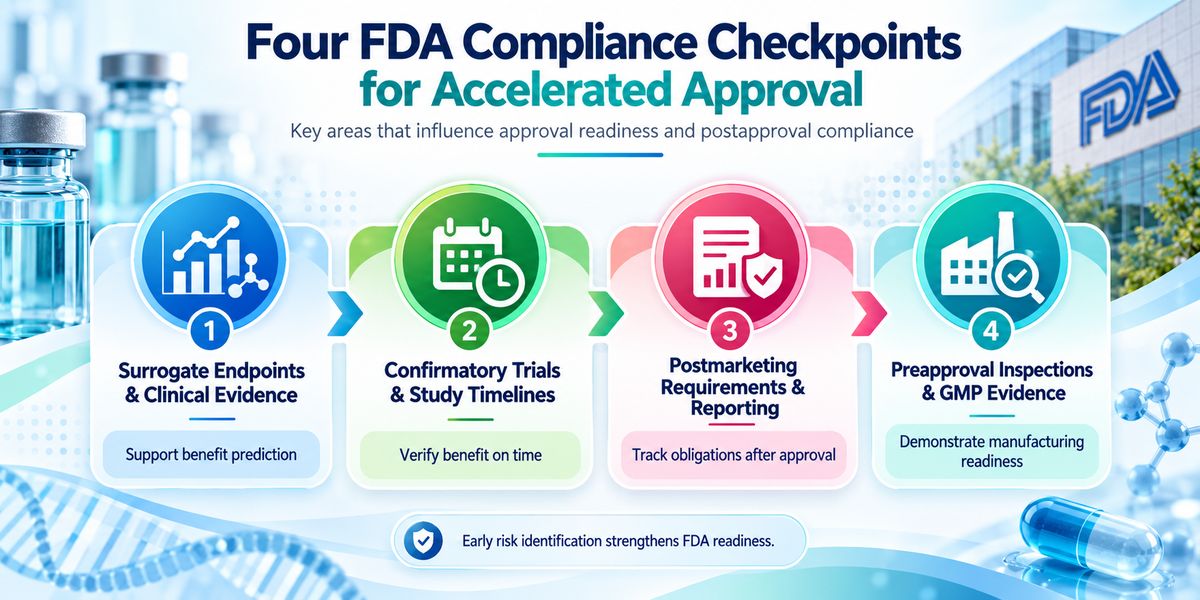
The following four critical checkpoints highlight where pharmaceutical companies should focus their compliance efforts before and after FDA approval.

  • Surrogate Endpoints and Clinical Evidence (Available PDF)
  • Confirmatory Trials and Study Timelines (Available PDF)
  • Postmarketing Requirements and Reporting (Available PDF)
  • Preapproval Inspections and GMP Evidence (Available PDF)


This infographic highlights four essential FDA compliance checkpoints, helping manufacturers identify regulatory risks, prepare for inspections, and meet approval requirements.

Four essential checkpoints in the FDA accelerated approval process, covering clinical evidence, GMP inspection readiness, manufacturing quality, and postmarketing requirements

Surrogate Endpoints and Clinical Evidence (Available PDF)

The accelerated approval process may use surrogate endpoints to predict clinical benefit. However, manufacturers must provide sufficient evidence to support their validity.

Download FDA Clinical Trial Endpoints Guidance Here

Confirmatory Trials and Study Timelines (Available PDF)

Confirmatory clinical trials must verify the expected clinical benefits of accelerated approval drugs. Therefore, sponsors should establish realistic study timelines, enrollment plans, and completion milestones with the FDA.

Download FDA Confirmatory Trial Guidance Here

Postmarketing Requirements and Reporting (Available PDF)

Manufacturers must meet postmarketing requirements and report study progress after FDA accelerated approval. Therefore, timely reporting helps identify delays in confirming clinical benefit.

Download FDA Postmarketing Requirements Guidance Here

Preapproval Inspections and GMP Evidence (Available PDF)

FDA preapproval inspections assess GMP compliance, manufacturing readiness, and data integrity. Therefore, unresolved quality or validation deficiencies may delay regulatory approval.

Download Preapproval Inspections — FDA Compliance Program 7346.832 Here

How Does Accelerated Approval Compare With Other FDA Pathways?

The FDA offers several approval pathways and expedited programs to help patients access safe and effective medicines. However, each approach serves a different purpose, from accelerating clinical development to shortening regulatory review timelines. The FDA accelerated approval program allows earlier approval based on endpoints reasonably likely to predict clinical benefit, while other programs focus on development support or faster application reviews. Therefore, understanding these differences helps pharmaceutical manufacturers plan clinical studies, meet regulatory requirements, and maintain GMP inspection readiness.

The following table compares five FDA approval approaches, highlighting their eligibility criteria, evidence requirements, review timelines, and postapproval obligations.

FDA Pathway or Program Main Purpose Evidence Requirements Review Timeline Key Regulatory Considerations
Traditional Approval
Approve drugs with established evidence of clinical benefit.
Substantial evidence of effectiveness, supported by clinical outcomes or validated surrogate endpoints.
Standard review generally targets 10 months after application filing.
Requires adequate safety, efficacy, manufacturing quality, and GMP compliance.
Accelerated Approval
Allow earlier approval for serious conditions with unmet medical needs
Surrogate or intermediate clinical endpoints reasonably likely to predict clinical benefit.
No separate fixed review timeline; standard or priority review may apply
Generally requires confirmatory trials and postmarketing obligations to verify clinical benefit.
Fast Track
Speed development and review of drugs addressing unmet medical needs.
No automatic reduction in review time
Weak study design, incomplete data, or unsuitable analysis can require clarification or additional evidence.
Offers more frequent FDA communication and potential rolling review.

What Happens When Clinical Benefit Is Not Confirmed?

If confirmatory clinical trials fail to verify clinical benefit, the FDA may withdraw accelerated approval. Additionally, missed study deadlines or unresolved safety concerns can trigger regulatory action. Therefore, manufacturers must monitor trial progress, meet postmarketing requirements, and maintain regulatory compliance.

Final Word

In 2025, the FDA issued more than 125 warning letters to drug manufacturers, highlighting continued regulatory scrutiny of pharmaceutical quality and GMP compliance. As inspection oversight evolves, manufacturers must strengthen data integrity, manufacturing controls, and clinical evidence management.

Therefore, success under the accelerated approval pathway requires more than faster market access; it demands sustained inspection readiness, timely confirmatory trials, and ongoing regulatory compliance.

FAQs

1️⃣ Can the FDA reject accelerated approval because of GMP inspection findings?


Yes. Significant GMP deficiencies, data integrity issues, or inadequate manufacturing controls can delay or prevent FDA approval until resolved.

2️⃣ What happens if confirmatory clinical trials fail after FDA accelerated approval?


The FDA may withdraw accelerated approval if confirmatory trials fail to verify clinical benefit or sponsors fail to meet required study obligations.

3️⃣ What documentation is required for FDA preapproval inspections under accelerated approval?


Manufacturers should prepare process validation records, batch records, stability data, CAPA reports, change controls, and data integrity evidence to demonstrate GMP compliance.

Picture of Mahtab Shardi

Mahtab Shardi

Mahtab is a pharmaceutical professional with a Master’s degree in Physical Chemistry and over five years of experience in laboratory and QC roles. Mahtab contributes reliable, well-structured pharmaceutical content to Pharmuni, helping turn complex scientific topics into clear, practical insights for industry professionals and students.

Share