


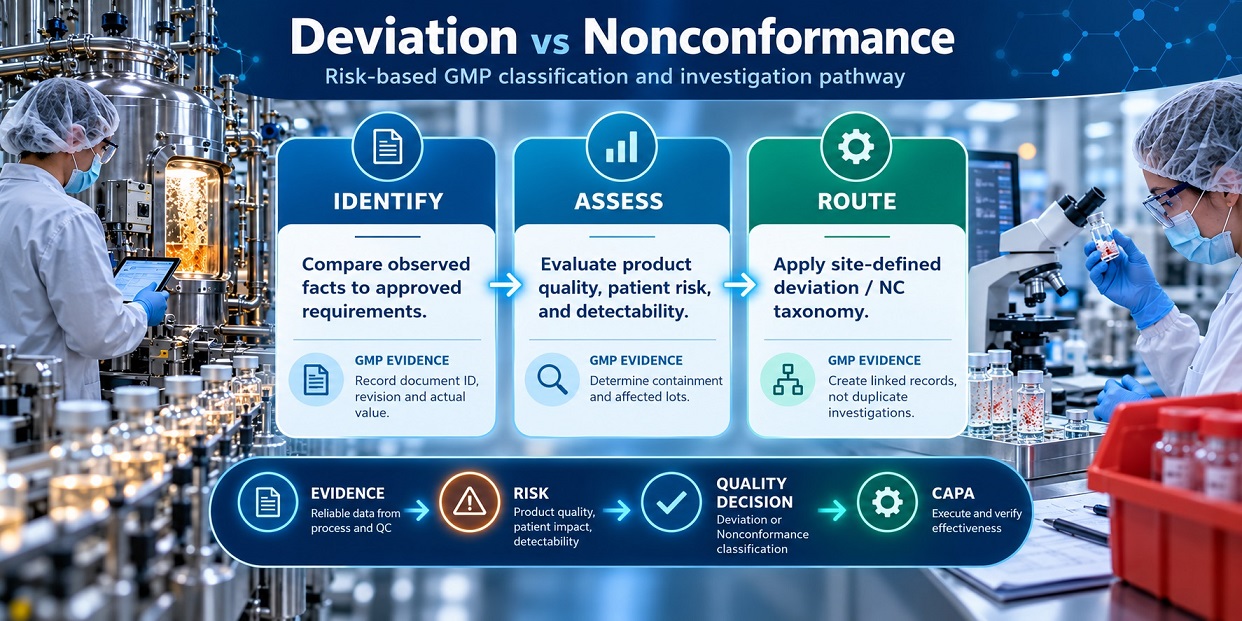
Deviation vs nonconformance is a critical distinction in pharmaceutical quality systems: a deviation describes a departure from an approved instruction or expected process, while a nonconformance identifies an unmet requirement. Neither label alone determines batch disposition. FDA 21 CFR 211.192 requires thorough investigation of unexplained discrepancies and specification failures, including assessment of potentially associated batches. The event must first be defined using traceable, contemporaneous evidence.
Effective pharma quality management aligns terminology with risk assessment, independent quality-unit oversight and CAPA. EU GMP Chapter 1 requires deviations to be documented and explained; significant quality-related deviations demand investigation. ICH Q10 connects deviation management, corrective actions and continual improvement.
Table of Contents
Deviation vs Nonconformance: GMP Definitions
A deviation is an unexpected or unauthorized departure from approved instructions, established process parameters or validated expectations. A nonconformance is the nonfulfillment of a requirement such as a specification, procedure or quality-system obligation. Site procedures must define nomenclature and pathways because regulations do not prescribe one universal electronic event taxonomy.
Where Do They Overlap?
A granulation-time excursion may be a deviation without a demonstrated product specification failure. An incoming material that fails identity testing is a nonconformance and may trigger a deviation or investigation record under local procedures. An unauthorized process change with a resulting failed assay belongs in both conceptual categories: a procedural departure and unmet product requirement.
Five Event Types QA Must Distinguish
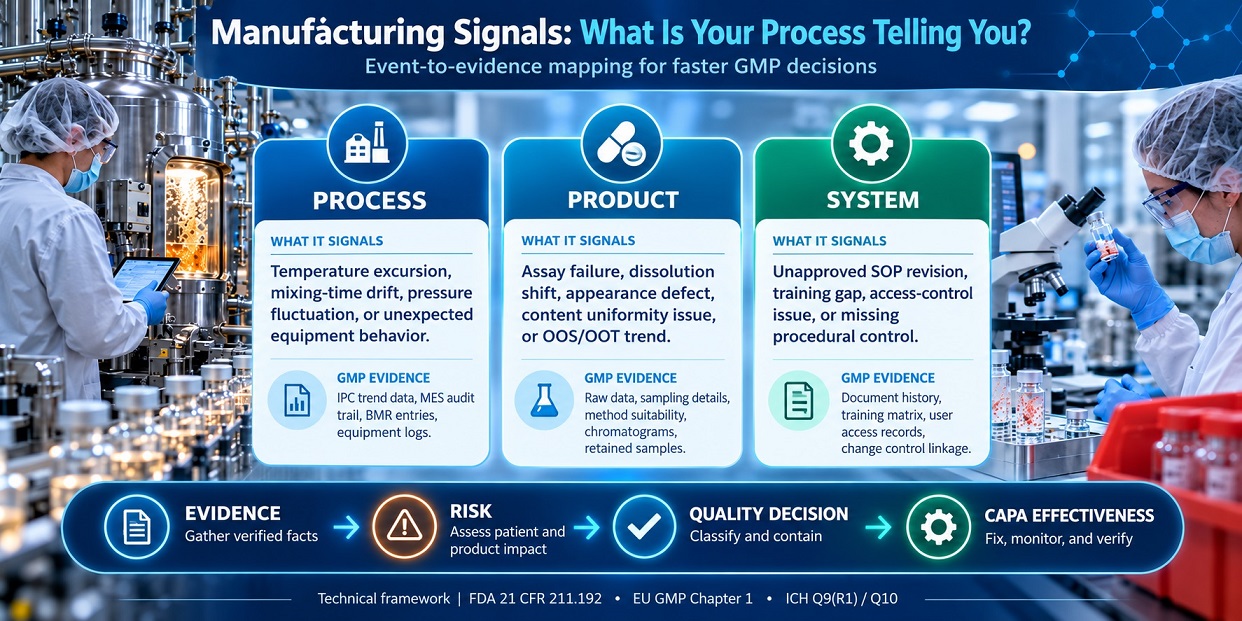
Classification should consider objective observations and controlled requirements, rather than the department reporting the event. The five patterns below explain why one event may require several linked workflows without duplicating the scientific investigation.
- Event Type 1 :Parameter excursion
- Event Type 2 : Specification failure
- Event Type 3 : Utility breakdown
- Event Type 4 : Documentation gap
- Event Type 5 : Supplier defect
Event Type 1 :Parameter excursion
A mixing duration or temperature exceeds a validated boundary. Evaluate the magnitude, exposure and control strategy, then identify affected intermediates and batches. The event is typically a process deviation; if a registered requirement also fails, nonconformance classification may additionally apply.
Event Type 2 : Specification failure
A finished-product assay or impurity test fails its approved acceptance criterion. This is a product nonconformance requiring scientific investigation, not an automatic retest-and-release decision. Apply 21 CFR 211.192 and the site OOS procedure; evaluate laboratory validity and manufacturing causes.
Event Type 3 : Utility breakdown
Conductivity alerts, HVAC interruptions, or equipment alarms may affect multiple operations. Check whether critical operating conditions were lost. Assess product and environmental risks. Classify events based on GMP requirements and risk.
-
Conductivity excursions
-
HVAC interruptions
-
Equipment alarms
-
Operating condition failures
-
Product and environmental impact
Event Type 4 : Documentation gap
Use of an obsolete SOP, incomplete batch record or missing contemporaneous entry can represent a procedural deviation and quality-system nonconformance. Investigate data integrity, access controls and execution chronology. Corrected paperwork does not establish that the underlying operation met approved conditions.
Event Type 5 : Supplier defect
A component failing approved specifications is a material nonconformance. Quarantine affected stock. Review previously used lots and supplier history. Open a linked deviation if internal controls also failed.
-
Specification failure
-
Material quarantine
-
Previous lot assessment
-
Supplier history review
-
Linked deviation investigation
GMP Deviation Investigation Key Steps
| Event | Requirement | Initial evidence | Likely route |
|---|---|---|---|
|
Blending time exceeded |
Approved process instruction |
BMR, MES history |
Deviation |
|
Assay below limit |
Registered specification |
Raw data, lab review |
Nonconformance / OOS |
|
Obsolete SOP used |
Document control |
Revision log, training |
Both may apply |
|
Incoming material failed IDA |
Material specification |
CoA, verified ID test |
Nonconformance |
How Should QA Classify and Escalate Events?
Start with the approved GMP requirement. Compare actual and expected conditions. Document containment and affected operations. Assess product quality and patient safety risks. Apply site-defined severity categories.
-
SOP and batch instructions
-
Specifications and validated limits
-
Actual vs. expected conditions
-
Containment and risk assessment
-
Minor, major, or critical classification
Deviation vs Nonconformance: Investigation Workflow
Preserve original GMP records and audit trails. Identify potentially affected batches. Investigate shared equipment, materials, and processes. Link related quality events. Ensure QA approves evidence-based conclusions and batch disposition.
GMP Investigation Workflow
Evidence Collection → Batch Traceability → Impact Assessment → Root Cause Investigation → QA Decision
Key Investigation Steps:
-
Preserve raw data and audit trails
-
Review MES, SCADA, and batch records
-
Identify affected lots and equipment
-
Link overlapping investigations
-
Document QA approval and disposition
When Is Root Cause Analysis Required?
Investigation depth must be justified by severity, detectability, extent and recurrence. For a significant quality deviation, structured root cause analysis should distinguish observable failure from underlying system weaknesses. Five Whys, fishbone mapping and event chronology may generate hypotheses, but the investigation must verify or exclude them with records and scientific testing.
CAPA Effectiveness Check Methods
| Investigation gate | Minimum evidence | Approval |
|---|---|---|
|
Triage |
Requirement / observed facts / containment |
Site QA |
|
Impact |
Batch and product traceability |
Quality unit |
|
Root cause |
Tested hypotheses / original data |
QA + SMEs |
|
CAPA |
Owner / due date / effectiveness |
Quality unit |
When Does the Event Require CAPA?
Correction addresses the immediate discrepancy; corrective action removes an identified cause; preventive action targets analogous vulnerabilities. CAPA is risk-based, not an automatic training assignment for every issue. Actions may include recipe interlocks, revised sampling controls, supplier remediation or procedural redesign. Establish owner, approval, due date and predefined effectiveness criteria.
Final Word
The distinction between deviation and nonconformance improves record quality only when it directs an appropriate decision. A deviation may exist without failed product specifications; a nonconformance may arise from product, material or system requirements; and a single incident may involve both.
A defensible pharmaceutical quality system connects observed facts, requirements, risk, scope, causal evidence and CAPA verification without allowing terminology to obscure patient protection.
FAQs
A GMP deviation is a departure from an approved procedure, established process parameter, or validated operating condition. A nonconformance is the failure to meet a defined requirement, such as a material specification, product acceptance criterion, or quality-system obligation. A deviation does not necessarily indicate a product specification failure. However, both classifications can overlap when an event breaches procedural and product requirements.
Yes. A single pharmaceutical manufacturing event can involve both classifications. For example, an unauthorized change in mixing time may constitute a process deviation. If the resulting batch also fails an approved assay specification, a product nonconformance exists. The pharmaceutical quality system should maintain appropriate linked records while avoiding duplicate investigations and ensuring traceable quality-unit decisions.
QA should classify GMP deviations using a documented, risk-based evaluation of potential patient harm, product quality impact, process control, event extent, and recurrence. A minor event generally presents limited quality risk, while major or critical events may involve significant control failures or potential patient safety consequences. These severity categories are typically defined within the site’s pharmaceutical quality system; FDA and EU GMP do not establish one universal numerical classification threshold.

Ershad Moradi
Ershad Moradi, a Content Marketing Specialist at Zamann Pharma Support, brings 6 years of experience in the pharmaceutical industry. Specializing in pharmaceutical and medical technologies, Ershad is currently focused on expanding his knowledge in marketing and improving communication in the field. Outside of work, Ershad enjoys reading and attending industry related networks to stay up-to-date on the latest advancements. With a passion for continuous learning and growth, Ershad is always looking for new opportunities to enhance his skills and contribute to pharmaceutical industry. Connect with Ershad on Facebook for more information.

Deviation vs Nonconformance 2026: 5 Critical GMP Mistakes to Avoid
Explore 5 critical differences between deviation and nonconformance in pharma, including GMP investigations, OOS, risk assessment, and CAPA.

Root Cause Analysis in Pharmaceutical Industry: 6 Powerful Methods in 2026
Explore 6 powerful root cause analysis methods in pharma to investigate deviations, strengthen CAPA, ensure GMP compliance, and protect patient safety.

Quality Culture in Pharma Industry 2026: Proven Ways to Build Trust
Explore how to build a strong quality culture in the pharmaceutical industry in 2026 through leadership commitment, ICH Q10 principles, meaningful GMP metrics, effective CAPA, and continuous improvement.