


Quality culture in pharma industry determines whether employees escalate risks, protect data integrity, and prioritize patients under pressure. ICH Q10 defines four pharmaceutical quality system elements: process performance and product quality monitoring, CAPA, change management, and management review. Strong culture makes these controls effective through accountable leadership, transparent reporting, and scientifically justified investigations.
The FDA’s Quality Management Maturity initiative also highlights quality culture beyond baseline CGMP compliance. Evaluate progress using five signals: recurring deviations, CAPA effectiveness, near-miss reporting, demonstrated competency, and escalation time. Explore Pharmuni’s pharma quality management resources to connect these principles with practice.
Table of Contents
What Is Quality Culture in Pharma Industry?
Quality culture in the pharmaceutical industry goes beyond GMP compliance. It reflects how employees and leadership make decisions, report risks, and protect product quality under operational pressure. According to ICH Q10, an effective Pharmaceutical Quality System (PQS) requires management commitment, continuous improvement, and evidence-based decision-making. The FDA’s Quality Management Maturity (QMM) initiative further emphasizes the importance of building a sustainable quality culture that supports reliable medicine supply.
Leadership Accountability
Transparent Reporting
Continuous Improvement
Why Does Quality Culture in Pharma Industry Matter for GMP?
A technically compliant site can still tolerate shortcuts, incomplete handovers or delayed escalation. A mature culture encourages early reporting, patient-focused decisions and learning before repeat events affect batches or supply. FDA notes that quality metrics and continuous improvement contribute to sustainable compliance; a completion rate alone cannot demonstrate culture. Leaders must ask what employees actually do when a critical alarm occurs, when an operator challenges an instruction, or when the production schedule conflicts with a QA hold.
How Can You Build a Strong Pharmaceutical Quality Culture?
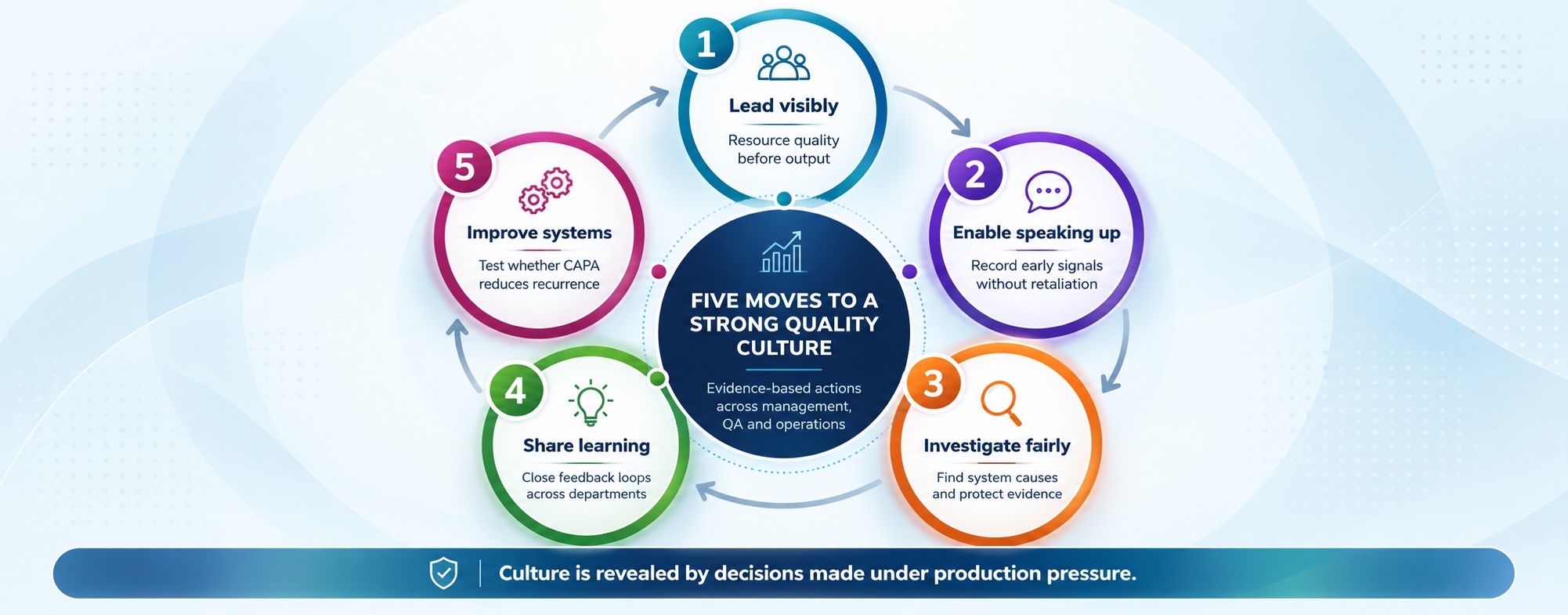
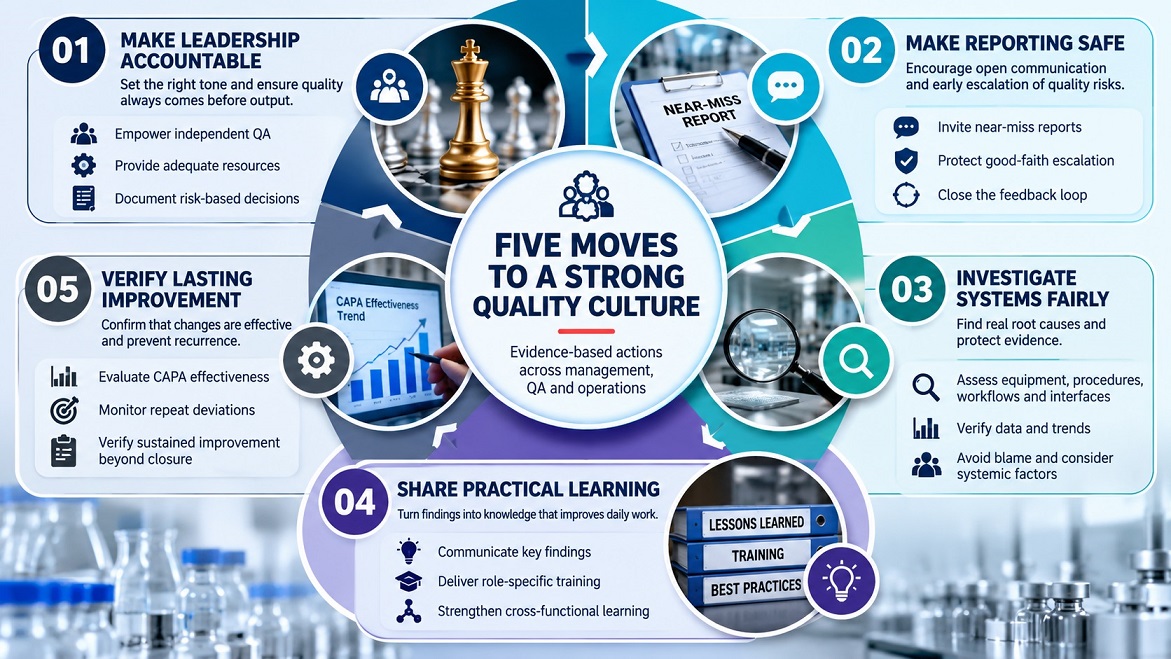
Treat quality culture as a cross-functional operating system, not a QA campaign. The following five-step roadmap translates management commitment into observable GMP behaviors. Each step needs named owners, transparent escalation and evidence that the intended behavior occurs during routine work. Adapt methods to site size, product risks and local regulations; the sequence is an operational example, not a mandated regulatory template.
Step 1: Make Leadership Accountable
Step 2: Make Reporting Safe
Step 3: Investigate Systems Fairly
Step 4: Share Practical Learning
Step 5: Verify Lasting Improvement
Step 1: Make Leadership Accountable
Strong pharmaceutical quality culture begins with leadership commitment and clear accountability. Management must ensure that patient safety and GMP compliance take priority over production pressures.
Empower QA: Ensure independent authority over critical quality decisions.
Allocate Resources: Provide adequate personnel, training, and investigation tools.
Document Decisions: Record risk assessments when production targets conflict with quality requirements.
Step 2: Make Reporting Safe
A transparent reporting environment enables employees to identify quality risks before they escalate into serious deviations. Organizations should encourage open communication without fear of unfair punishment.
Encourage Transparency: Promote early reporting of deviations and near-miss events.
Prevent Retaliation: Protect employees who raise legitimate quality concerns.
Close Feedback Loops: Communicate investigation outcomes and corrective actions to reporting teams.
Step 3: Investigate Systems Fairly
Effective deviation investigations focus on identifying scientifically supported root causes rather than assigning blame. Teams should evaluate equipment performance, procedural weaknesses, and operational conditions before concluding human error.
Step 4: Share Practical Learning
Quality investigations create value when their findings improve daily manufacturing practices across departments. Sharing lessons from deviations, complaints, and CAPA activities strengthens organizational knowledge and prevents repeated failures.
Communicate Findings: Share relevant deviation and complaint investigation outcomes.
Deliver Targeted Training: Convert investigation lessons into role-specific competency development.
Strengthen Collaboration: Transfer knowledge across QA, QC, Production, and Engineering.
Step 5: Verify Lasting Improvement
Closing a CAPA does not automatically demonstrate that the underlying quality issue has been permanently resolved. Organizations must verify corrective action effectiveness through documented monitoring, performance trends, and observable operational improvements.
Which Behaviors Reveal Strong or Weak Quality Culture?
Look for evidence in daily records and conversations. A healthy culture produces complete contemporaneous data, sensible challenges to assumptions, and open communication between QA, production, engineering and QC. Warning signs include repeated “operator error” conclusions, silence around known deviations, missing audit-trail reviews and training with no competency checks. Interview employees across shifts, then compare their answers with actual decisions and sampled quality records; do not rely on a survey alone.
Strong or Weak Quality Culture
| Area | Positive evidence | Warning sign | Audit probe |
|---|---|---|---|
|
Leadership |
Quality hold honored |
Schedule overrides risk |
Review escalation decision |
|
Production |
Real-time entries |
Backfilled logbooks |
Trace one batch event |
|
QA/CAPA |
Systemic root causes |
Training-only CAPA |
Verify repeat-event trend |
|
QC / DI |
Original data review |
Unofficial worksheets |
Sample audit trails |
How Do You Measure Quality Culture in Pharma Industry?
Use a balanced scorecard instead of ranking sites by one number. Repeat-deviation frequency, CAPA effectiveness, practical competency and timely escalation are useful when adjusted for manufacturing volume and risk. A rise in near-miss reports may signal improved trust rather than deteriorating control. Review trends with process owners, confirm denominators, and investigate outliers. FDA describes quality metrics as aids to monitoring and continuous improvement; these illustrative indicators are not universal regulatory targets.
Quality Culture: 5 Metrics That Matter
| Key Metric | Calculation | Quality Insight |
|---|---|---|
|
Repeat Deviation Rate |
Recurring events ÷ total deviations |
Compare by product and process |
|
CAPA Effectiveness |
Failed checks ÷ completed checks |
Evaluate corrective action durability |
|
Near-Miss Reporting |
Reports per 100 employees |
Higher reporting may indicate trust |
|
Practical Competency |
Successful observations ÷ total observations |
Measure actual task performance |
|
Escalation Time |
Detection-to-QA notification time |
Assess against event severity |
Connecting Quality Culture with Deviations and CAPA
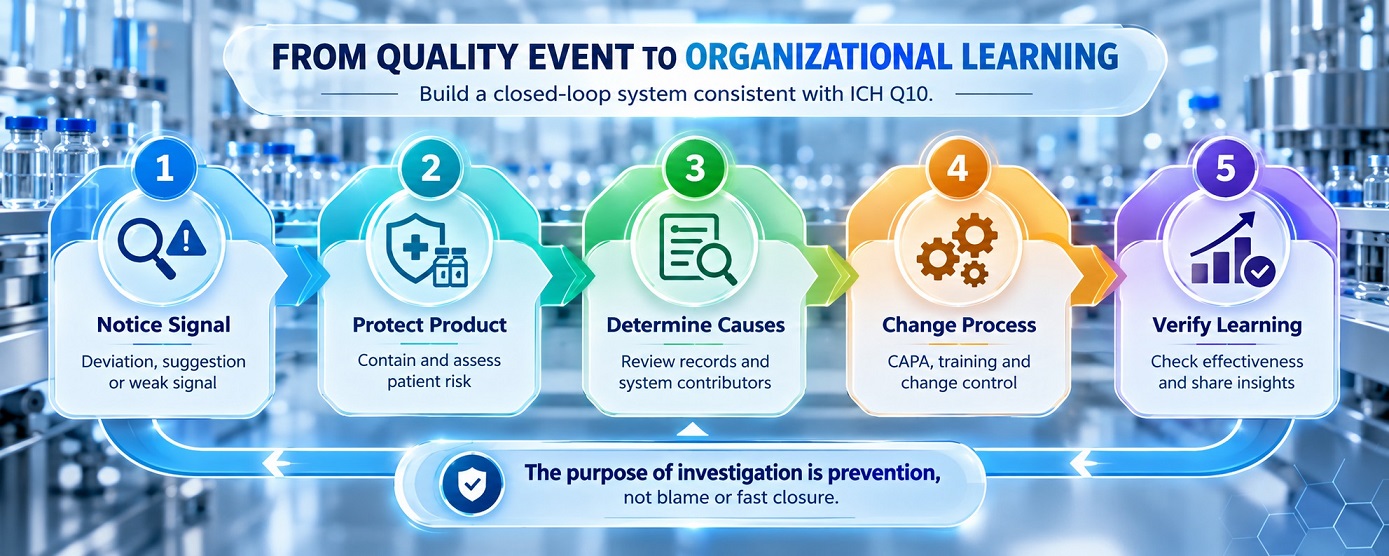
A strong quality culture transforms deviations into opportunities for continuous improvement through evidence-based investigations and effective CAPA. Teams must protect affected products, preserve original data, and identify scientifically justified root causes rather than assigning blame.
Root Cause Investigation: Evaluate systemic failures, process weaknesses, and contributing factors.
CAPA Effectiveness: Implement sustainable corrective actions and verify prevention of recurrence.
Effective quality management also requires timely feedback to employees, risk-based effectiveness monitoring, and sharing lessons across departments.
How Can Training Gaps Become Effective CAPA Instead of Repeat Retraining?
A deviation attributed to “human error” should trigger analysis of confusing displays, workload, equipment, SOP usability, supervision, and knowledge. If a genuine skill gap exists, define what performance must change and test it in operation. Where the root cause lies in process design, a revised job aid or technical control may outperform another slide deck. QA should check that the action corrected the root cause and monitor recurrence across comparable tasks.
Final Word
Five actions—lead, listen, investigate, learn, and verify—transform pharmaceutical quality culture into measurable improvements. ICH Q10 establishes 4 essential PQS elements: process performance monitoring, CAPA, change management, and management review. Meanwhile, the FDA’s Quality Management Maturity (QMM) assessment framework evaluates 5 practice areas, including leadership commitment, technical excellence, and employee engagement.
A mature quality culture goes beyond basic CGMP compliance. Rather than treating zero deviations as proof of excellence, organizations should prioritize timely risk detection, reliable data, scientifically justified investigations, and verified CAPA effectiveness.
FAQs
It is the behavior and management choices that consistently prioritize patient safety, reliable data, learning and product quality.
It is not one standalone universal regulation; related expectations appear across GMP requirements and guidance such as ICH Q10.
Compliance is meeting applicable requirements; culture helps sustain sound decisions and continuous improvement.

Ershad Moradi
Ershad Moradi, a Content Marketing Specialist at Zamann Pharma Support, brings 6 years of experience in the pharmaceutical industry. Specializing in pharmaceutical and medical technologies, Ershad is currently focused on expanding his knowledge in marketing and improving communication in the field. Outside of work, Ershad enjoys reading and attending industry related networks to stay up-to-date on the latest advancements. With a passion for continuous learning and growth, Ershad is always looking for new opportunities to enhance his skills and contribute to pharmaceutical industry. Connect with Ershad on Facebook for more information.

Quality Culture in Pharma Industry 2026: Proven Ways to Build Trust
Explore how to build a strong quality culture in the pharmaceutical industry in 2026 through leadership commitment, ICH Q10 principles, meaningful GMP metrics, effective CAPA, and continuous improvement.

GMP Training Effectiveness 2026: Proven Ways to Build Real Competence
GMP training effectiveness goes beyond attendance records and quiz scores. Learn how role-based assessments, on-the-job observation, and meaningful KPIs help verify employee competence, strengthen training records, and address recurring performance gaps across pharmaceutical operations.

GMP Audit Checklist 2026: The Essential Guide for Risk-Based Audits
Master your GMP Audit Checklist with a practical, risk-based approach to pharmaceutical self-inspections. Explore five essential audit steps, FDA’s six-system model, GMP documentation and evidence sampling, audit findings, CAPA tracking, and effectiveness verification to strengthen compliance and inspection readiness.