


A GMP audit checklist is a risk-based tool for evaluating compliance with Good Manufacturing Practices (GMP) across pharmaceutical manufacturing, quality control, documentation, and quality systems. Its importance is reinforced by recent regulatory data: according to the FDA Office of Compliance FY2025 Annual Report, the agency issued 314 warning letters, including more than 120 letters to drug manufacturing facilities, primarily involving significant CGMP deviations. Under EU GMP Chapter 9, manufacturers are expected to conduct planned, independent, documented self-inspections and record corrective actions.
In 2026, an effective checklist goes beyond procedural verification by integrating risk-based evidence sampling, data integrity assessments, deviation trending, and CAPA effectiveness checks to identify systemic weaknesses before they compromise product quality or patient safety.
Table of Contents
What is GMP Training Effectiveness ?
GMP training effectiveness measures whether employees can reliably apply required knowledge and skills to the work they perform—not merely whether they attended a session. Under 21 CFR 211.25, role-relevant CGMP training must continue with enough frequency to maintain familiarity. EU GMP Chapter 2 also addresses initial and continuing training and assessment of practical effectiveness. The business question is concrete: can the person perform an assigned operation correctly, consistently, and with trustworthy records?
GMP Training Effectiveness Requirements
A defensible GMP training program connects job duties with current SOPs and demonstrated competence. No universal passing score or mandatory 30/60/90-day review cycle applies; risk-based criteria should be defined in approved site procedures.
Align training with assigned tasks and SOP versions.
Verify practical skills before independent work.
Define retraining and reassessment triggers.
Assign qualified trainers and retain assessment records.
For critical tasks, prioritize evidence of correct execution over quiz scores alone.
Key Step in GMP Training Effectiveness Assessment
The following five-step model is a proposed operational framework, not a verbatim regulatory sequence. It starts with the regulated task and ends with a verification that the learning has changed performance. Each stage needs an accountable owner, relevant evidence, and a defined decision about whether the employee may perform the task independently.
Step 1: Define Role-Based Learning Outcomes
Step 2: Assess Knowledge with Relevant Scenarios
Step 3: Observe Performance on the Job
Step 4: Verify Competence and Grant Authorization
Step 5: Trend Results and Improve Training
Step 1: Define Role-Based Learning Outcomes
Translate each critical SOP into observable actions, including what correct performance looks like, required records, and unacceptable errors. Document which roles require qualification.
Step 2: Assess Knowledge with Relevant Scenarios
Use brief case questions, oral checks, or simulated decisions to uncover misunderstandings. A pass mark should reflect the risk and assessment design, not an arbitrary universal percentage.
Case-Based Questions: Test understanding through realistic scenarios.
Oral & Simulation Checks: Identify misunderstandings through verbal questions and simulated decisions.
Risk-Based Pass Criteria: Define passing thresholds based on task criticality and assessment design.
Step 3: Observe Performance on the Job
A qualified observer watches the actual task, records objective results, and identifies procedural workarounds. For sterile operations, use approved qualification methods suited to the activity.
Step 4: Verify Competence and Grant Authorization
Supervision or QA, according to site procedure, confirms readiness before independent work. Failed observations require coaching, reassessment, and controlled task access.
Readiness Verification: Supervision or QA confirms competency before independent work.
Corrective Coaching: Failed observations trigger targeted coaching and corrective actions.
Reassessment & Task Access: Reassess competency and restrict independent tasks until qualification is confirmed.
Step 5: Trend Results and Improve Training
Compare repeat observations, deviation investigations, audit findings, and changes in SOPs. A sustained signal may require process redesign rather than additional classroom training.
Performance Monitoring: Track recurring observations and deviations to identify competency gaps.
Audit & SOP Review: Evaluate audit findings and procedural changes for potential training needs.
Process Improvement: Address persistent issues through process redesign rather than repeated classroom training.
GMP Training Effectiveness Methods by Pharma Role
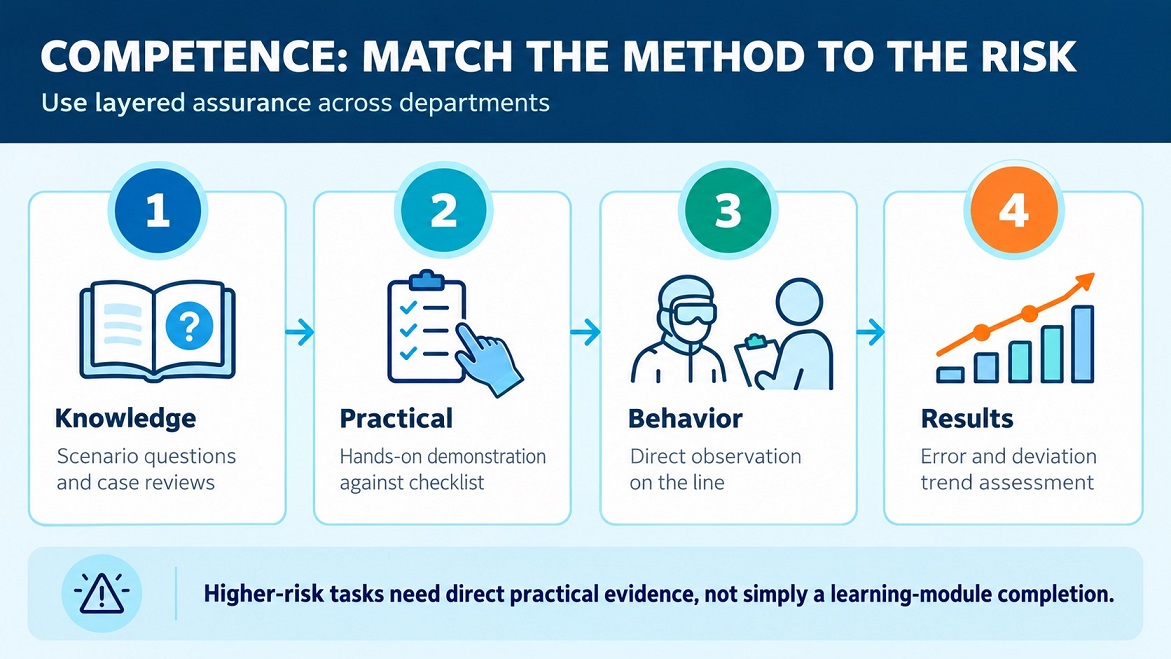
The best test depends on the operation. A microbiologist, maintenance technician, and batch-record reviewer do not demonstrate competence in the same way. Use direct observation for critical manual tasks, case-based reasoning for judgment-heavy work, and record reviews for documentation practices. Triangulate multiple evidence sources when a single assessment could conceal performance gaps. This is particularly important after deviations, changes, or extended absence from a complex task.
Role-Based GMP Training Effectiveness Assessment
| Role / task | Assessment method | Objective evidence | Escalation trigger |
|---|---|---|---|
|
Production / line clearance |
Observed setup challenge |
Signed task assessment |
Missed mix-up control |
|
QC / OOS assessment |
Case-based record review |
Decision rationale + review |
Unsupported invalidation |
|
QA / deviation |
Investigation simulation |
RCA and impact logic |
Repeat weak investigations |
|
Engineering / calibration |
Hands-on demonstration |
Equipment test record |
Incorrect as-found action |
Which GMP Training Effectiveness KPIs Are Useful?
Avoid equating training completion rate with actual competence. A risk-based GMP dashboard should track measurable performance indicators:
Qualification pass rate
Repeat assessment failures
Overdue high-risk qualifications
Training-linked recurring deviations
Performance by role and task criticality
Segment findings by function, equipment, and trainer. Fewer deviations do not necessarily prove training effectiveness, as production volume, reporting practices, and process changes may influence results. Investigate root causes before claiming improvement.
Beyond Training Completion: 3 Critical GMP Competence Risk Indicators
| GMP Indicator | Assessment Evidence | Risk Signal |
|---|---|---|
|
Qualification Pass |
Passed checks / attempts |
Competence gaps |
|
High-Risk Overdue |
Late qualifications / required |
Authorization exposure |
|
Repeat Skill Gaps |
Repeated task failures |
Weak skill transfer |
LMS & GMP Training Records: Inspection Readiness
An inspection-ready LMS should link 6 critical training elements to demonstrate GMP compliance and personnel competence. Under 21 CFR 211.25, personnel require appropriate training, while 21 CFR Part 11 establishes applicable controls for electronic records and signatures.
- Personnel Records
- Training Curricula
- SOP Revisions
- Assessment Results
- Trainer Qualifications
- Task Authorizations
Ensure audit trails, access controls, and retrievable evidence where applicable.
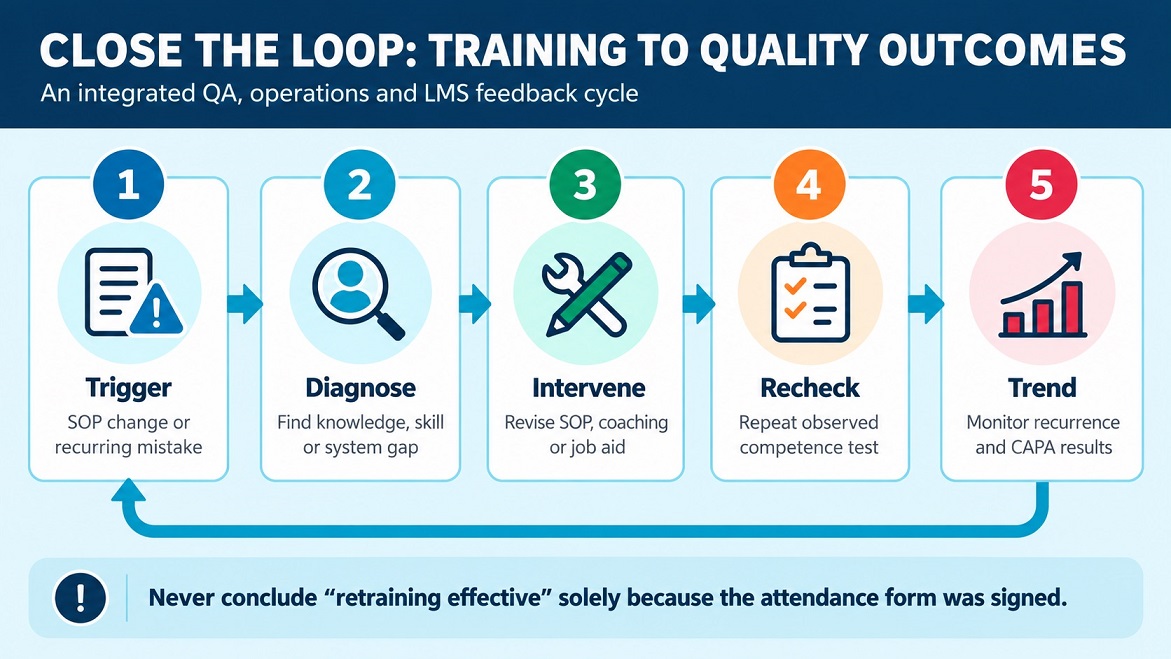
How Can Training Gaps Become Effective CAPA Instead of Repeat Retraining?
A deviation attributed to “human error” should trigger analysis of confusing displays, workload, equipment, SOP usability, supervision, and knowledge. If a genuine skill gap exists, define what performance must change and test it in operation. Where the root cause lies in process design, a revised job aid or technical control may outperform another slide deck. QA should check that the action corrected the root cause and monitor recurrence across comparable tasks.
Final Word
The central regulatory principle is simple: qualified people must perform assigned GMP work competently. Under 21 CFR 211.25 and EU GMP Chapter 2, training needs to be relevant and ongoing; meaningful practical verification makes those obligations operational. A case such as repeated documentation corrections may call for observation, clearer interfaces, and better procedures—not just another signed attendance sheet. Use the five-step cycle to connect every significant qualification decision to evidence and patient-protection outcomes.
FAQs
Completion documents participation; effectiveness verifies usable competence.
No universal percentage is specified in 21 CFR 211.25; set justified site criteria.
After significant changes, performance gaps, and at justified risk-based intervals.

Ershad Moradi
Ershad Moradi, a Content Marketing Specialist at Zamann Pharma Support, brings 6 years of experience in the pharmaceutical industry. Specializing in pharmaceutical and medical technologies, Ershad is currently focused on expanding his knowledge in marketing and improving communication in the field. Outside of work, Ershad enjoys reading and attending industry related networks to stay up-to-date on the latest advancements. With a passion for continuous learning and growth, Ershad is always looking for new opportunities to enhance his skills and contribute to pharmaceutical industry. Connect with Ershad on Facebook for more information.

GMP Training Effectiveness 2026: Proven Ways to Build Real Competence
GMP training effectiveness goes beyond attendance records and quiz scores. Learn how role-based assessments, on-the-job observation, and meaningful KPIs help verify employee competence, strengthen training records, and address recurring performance gaps across pharmaceutical operations.

GMP Audit Checklist 2026: The Essential Guide for Risk-Based Audits
Master your GMP Audit Checklist with a practical, risk-based approach to pharmaceutical self-inspections. Explore five essential audit steps, FDA’s six-system model, GMP documentation and evidence sampling, audit findings, CAPA tracking, and effectiveness verification to strengthen compliance and inspection readiness.
Orphan Drug Designation in 2026: FDA and EMA Eligibility Criteria
Discover how orphan drug designation works in 2026. Compare FDA and EMA eligibility criteria, rare disease prevalence thresholds, scientific evidence requirements, and regulatory incentives. Learn what pharmaceutical sponsors need to prepare for successful regulatory submissions