


A GMP audit checklist is a risk-based tool for evaluating compliance with Good Manufacturing Practices (GMP) across pharmaceutical manufacturing, quality control, documentation, and quality systems. Its importance is reinforced by recent regulatory data: according to the FDA Office of Compliance FY2025 Annual Report, the agency issued 314 warning letters, including more than 120 letters to drug manufacturing facilities, primarily involving significant CGMP deviations. Under EU GMP Chapter 9, manufacturers are expected to conduct planned, independent, documented self-inspections and record corrective actions.
In 2026, an effective checklist goes beyond procedural verification by integrating risk-based evidence sampling, data integrity assessments, deviation trending, and CAPA effectiveness checks to identify systemic weaknesses before they compromise product quality or patient safety.
Table of Contents
What is GMP Audit Checklist ?
A GMP audit checklist translates requirements into testable questions for pharmaceutical manufacturing, QC laboratories, warehouses and quality systems. Under EU GMP Chapter 9, companies conduct planned self-inspections and document findings and follow-up actions.
Three critical priorities for effective GMP audits include:
Risk-Based Assessment: Prioritize high-risk processes, critical quality attributes, and recurring deviations in accordance with ICH Q9(R1).
Data Integrity & Documentation: Verify ALCOA+ principles, contemporaneous records, audit trails, and compliance with 21 CFR Part 211.
CAPA Effectiveness: Evaluate root cause investigations, corrective action implementation, and recurrence trends in line with ICH Q10.
How Should a Pharmaceutical GMP Audit Checklist Be Structured?
Organize the GMP audit checklist by process and risk, then connect its questions with applicable regulations and internal SOPs. The FDA drug-manufacturing inspection program groups operations into six systems, while EU GMP Part I covers personnel, premises, documentation, production, quality control, outsourced activities, complaints and self-inspection. Translate those frameworks into a site-specific plan with process owners, selected batches, sampling rationale, objective evidence and follow-up. Auditors should distinguish a requirement, an observation and the conclusion drawn from that observation.
What Are the Five Steps in a Risk-Based GMP Audit Checklist?
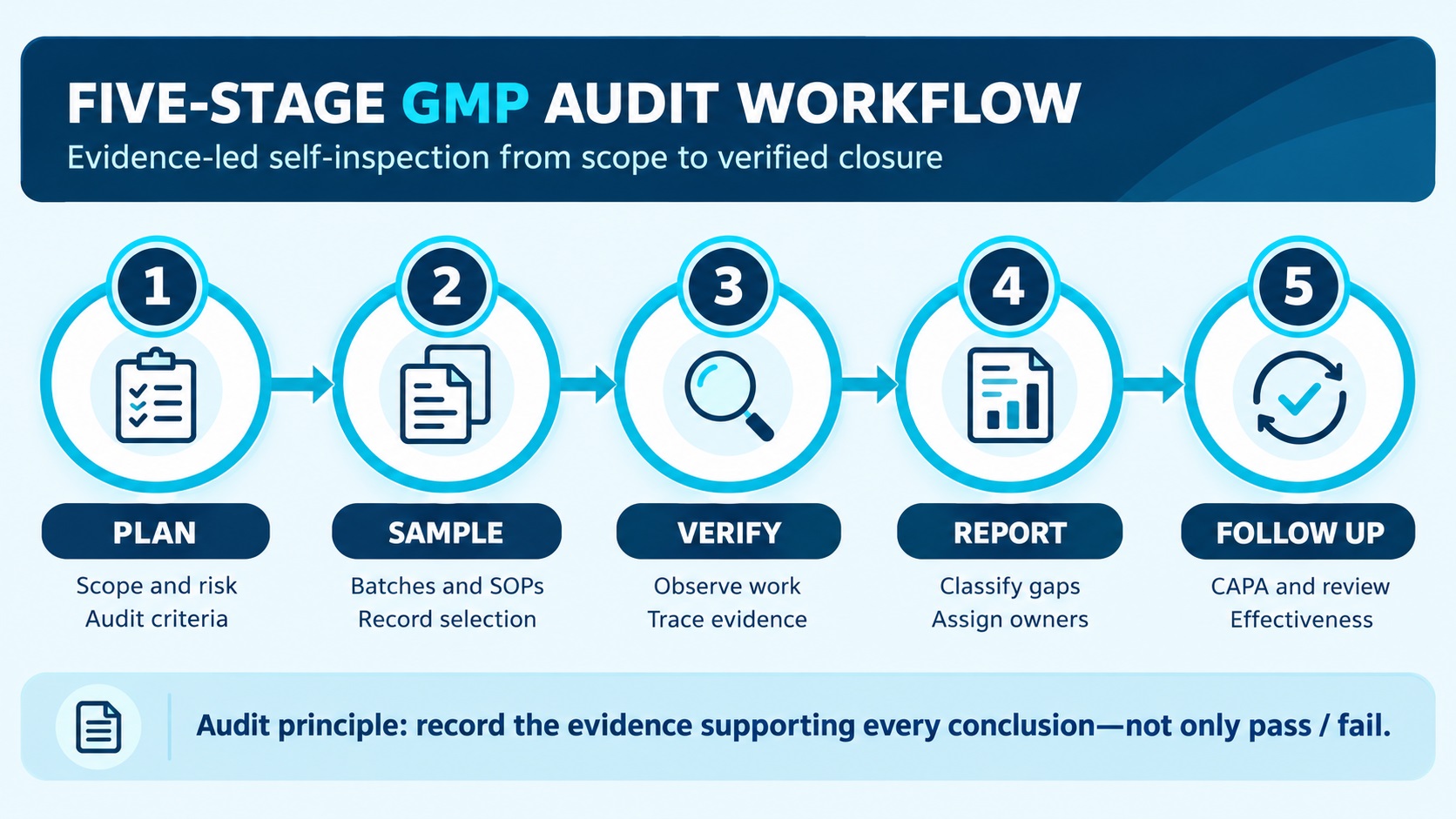
A five-step audit model gives staff a repeatable method without implying an official prescribed sequence. Define the audit scope before sampling; test how work is actually performed rather than relying on an SOP alone. Document discrepancies with traceable evidence and review the risk of broader impact. Finally, follow findings through CAPA and effectiveness checks so recurring signals reach quality management.
Step 1: Plan GMP Audit Scope and Criteria
Step 2: Sample Representative GMP Records
Step 3: Verify Compliance at the Point of Work
Step 4: Record Findings and Agree CAPA Ownership
Step 5: Verify Effectiveness and Trend Repeat Events
Step 1: Plan GMP Audit Scope and Criteria
Define audit scope based on manufacturing processes, product risks, regulatory requirements, and previous inspection findings. Apply ICH Q9(R1) quality risk management principles to prioritize high-risk operations, critical utilities, recent process changes, and recurring quality deviations. Establish audit objectives, responsible personnel, sampling criteria, and applicable GMP references before execution.
Key Audit Activities:
Risk Prioritization
Regulatory Mapping
Audit Planning
Step 2: Sample Representative GMP Records
Select representative and traceable samples of executed batch manufacturing records, equipment logbooks, deviations, calibration reports, training records, and qualification documentation. Sampling should cover different production periods, shifts, and product categories to identify inconsistencies that routine document reviews may overlook.
Step 3: Verify Compliance at the Point of Work
Evaluate whether actual manufacturing and laboratory practices match approved SOPs, validated processes, and documented GMP requirements. Combine direct observation, operator interviews, record reconciliation, and equipment status verification to detect gaps between documented procedures and operational execution.
Key Audit Activities:
Shop-Floor Verification
Personnel Competency
Process Compliance
Step 4: Record Findings and Agree CAPA Ownership
Document each audit finding using objective evidence, applicable GMP requirements, potential product-quality impact, and the extent of noncompliance. Classify observations according to the company’s approved severity criteria and evaluate whether deficiencies indicate isolated events or broader pharmaceutical quality system weaknesses.
Step 5: Verify Effectiveness and Trend Repeat Events
Confirm that implemented CAPAs address verified root causes rather than merely correcting individual observations. Evaluate subsequent manufacturing records, repeat deviations, audit trends, and process performance indicators to determine whether corrective and preventive controls remain effective over time.
Key Audit Activities:
Effectiveness Verification:
Performance Monitoring
Management Review
Which Areas Belong in a GMP Audit Checklist for Pharmaceutical Manufacturing?
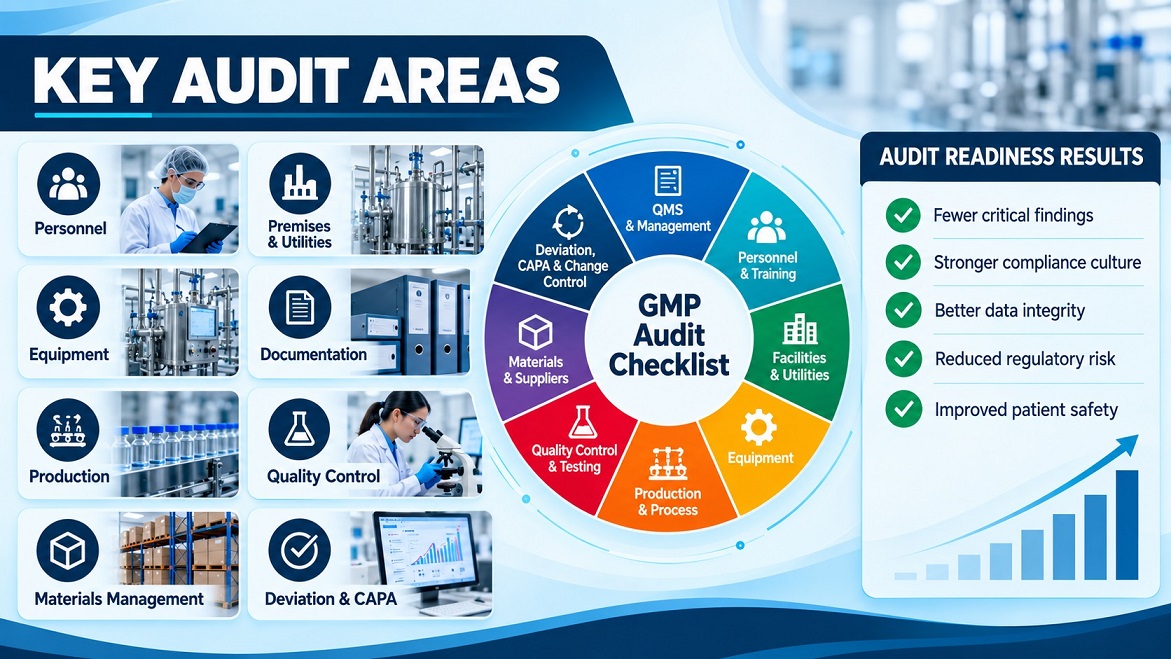
Every audit must reflect local operations. Include pharmaceutical quality system, personnel and training, premises and equipment, documentation and data integrity, production, QC, materials, suppliers and complaints. Sterile sites also need contamination-control and aseptic-processing coverage. For each area, auditors should ask whether requirements are implemented, whether records are trustworthy and whether the system detects its own failures. The suggested matrix below is a practical example—not an exhaustive legal checklist.
GMP Audit Checklist: Core Areas and Evidence
| Audit area | Audit question | Objective evidence | Follow-up owner |
|---|---|---|---|
|
Personnel |
Are operators competent for assigned critical tasks? |
Role matrix; observed task; current training |
Department / QA |
|
Documents |
Are records complete and contemporaneous? |
Executed BMR; logbooks; audit trails |
Document control |
|
Production |
Are process steps and line clearance controlled? |
In-process checks; reconciliation; deviations |
Production / QA |
|
QC laboratory |
Are OOS results thoroughly investigated? |
Raw data; OOS files; method status |
QC / QA |
|
Equipment |
Is equipment qualified, calibrated and maintained? |
Calibration trends; maintenance; IQ/OQ/PQ |
Engineering |
How Does the FDA Six-System Model Improve a GMP Audit Checklist?
FDA Compliance Program 7356.002 describes a systems-based inspection approach covering six critical pharmaceutical manufacturing systems: Quality, Facilities and Equipment, Materials, Production, Packaging and Labeling, and Laboratory Control. This framework helps auditors identify cross-functional compliance gaps and evaluate interconnected GMP risks.
Three essential areas for cross-system GMP audit verification include:
Quality & Manufacturing Controls
Materials & Packaging Compliance
Laboratory & Equipment Integrity
Auditors should use these system groupings to improve inspection coverage rather than substitute FDA guidance for binding requirements under 21 CFR Parts 210 and 211.
FDA Six-System Checklist Crosswalk
| FDA system | Technical GMP Audit Checks | Objective Evidence & Critical Risk Signals |
|---|---|---|
|
Quality + Production |
Verify deviation investigations, CAPA effectiveness, process validation status, batch release decisions and critical process parameter (CPP) controls. |
Evidence: BMRs, deviation reports, CAPA records, PPQ data, CPV trends. Risks: Repeated root causes, unexplained process variability, unjustified batch release. |
|
Facilities & Equipment + Materials |
Assess equipment qualification (IQ/OQ/PQ), calibration, preventive maintenance, critical utilities, supplier qualification and material status controls. |
Evidence: Qualification protocols, calibration logs, utility monitoring, supplier audits, CoAs. Risks: Unqualified equipment, unexplained excursions, material mix-ups, unapproved suppliers. |
|
Packaging & Labeling + Laboratory Control |
Evaluate line clearance, label reconciliation, packaging controls, analytical method validation, OOS investigations and electronic data integrity. |
Evidence: Packaging BMRs, reconciliation records, chromatograms, audit trails, OOS files. Risks: Label mix-ups, unsupported data exclusions, invalid analytical results, batch disposition errors. |
How Should GMP Audit Checklist Findings Be Classified and Closed?
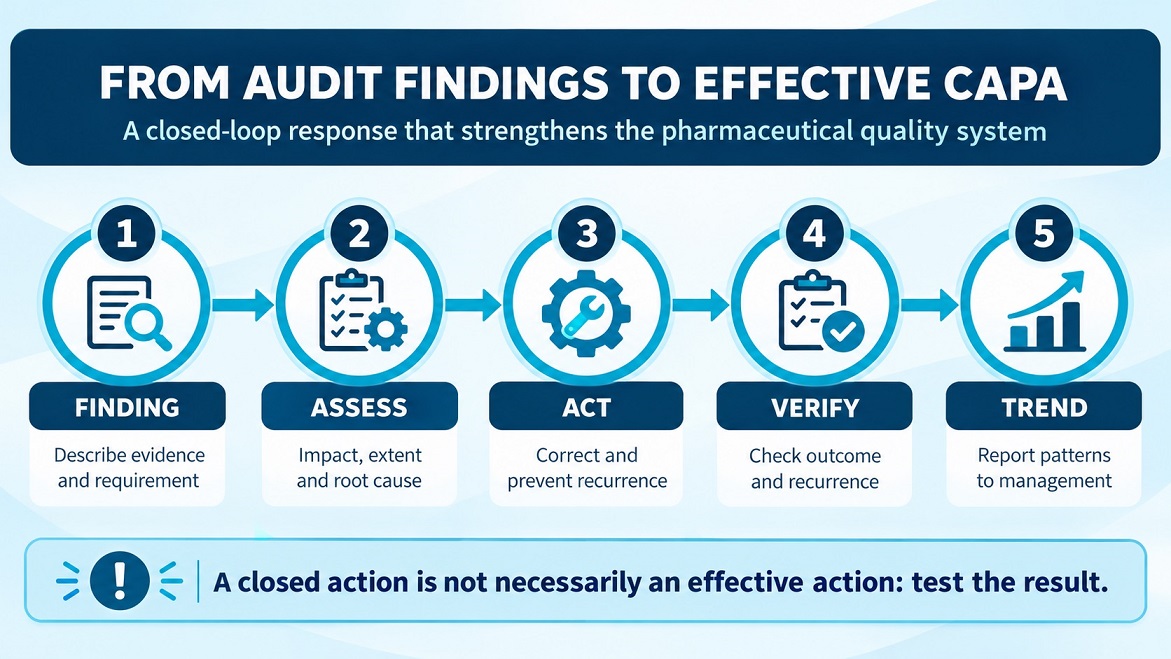
A defensible audit finding identifies the requirement, evidence, extent and quality risk. Severity categories such as critical, major and minor should follow the applicable authority’s approach or the company’s approved procedure, not an invented universal threshold. The audit report should separate a verified nonconformity from a suggested improvement. Assign CAPA owners and dates, retain objective closure evidence and plan effectiveness checks proportionate to impact. Fast closure without evidence can hide the original problem.
Common GMP Audit Checklist Mistakes
One frequent error is treating 100% checklist completion as proof of compliance. A completed form may coexist with missing audit-trail review, repeated deviations or unqualified temporary personnel. Another is sampling only recent clean records or allowing the auditee to choose every example. Build independence into the audit team, sample across shifts and products, and distinguish procedural compliance from proven process performance. Managers should review trends and verify whether previous findings have truly stayed closed.
Four Critical GMP Audit Mistakes to Avoid:
Insufficient Data Integrity Verification
Weak CAPA Effectiveness Assessment
Lack of Cross-System Traceability
- Inadequate Risk-Based Sampling
How Can Digital GMP Audit Checklists Improve Evidence and Follow-Up?
A well-configured electronic audit tool can capture versions, observations, attachments, owners and CAPA links, but cannot replace auditor judgment. Define role permissions, data retention, access and validation needs before deployment. A simple controlled spreadsheet may be sufficient for limited workflows; a multi-site eQMS can improve trending where audit volume is high.
Training on GMP fundamentals also matters: the Good Manufacturing Practices (GMP) learning resources provide context for the underlying controls.
Final Word
Regulatory compliance alone does not guarantee sustainable pharmaceutical quality. According to the FDA FY2024 Report on the State of Pharmaceutical Quality, 165 manufacturing sites were associated with 260 recall events, a 15% increase over FY2023. Contamination-related recalls included microbial contamination (31%), sterility assurance failures (28%), and particulate contamination (20%). These findings demonstrate why GMP audits must assess manufacturing reliability, contamination prevention, and emerging quality risks.
Looking ahead, the FDA’s Quality Metrics Program emphasizes three performance indicators: Lot Acceptance Rate (LAR), Product Quality Complaint Rate (PQCR), and Invalidated OOS Rate (IOOSR). Integrating these metrics into GMP audit reviews can transform traditional compliance assessments into measurable evaluations of process capability, laboratory reliability, and long-term quality performance.
.
FAQs
No universal template is prescribed across all authorities; the checklist must reflect applicable GMP rules and site risks.
Use a justified planned program based on risk, process history and applicable procedures rather than claiming one universal interval.
Competent auditors with sufficient independence from the operations being assessed.

Ershad Moradi
Ershad Moradi, a Content Marketing Specialist at Zamann Pharma Support, brings 6 years of experience in the pharmaceutical industry. Specializing in pharmaceutical and medical technologies, Ershad is currently focused on expanding his knowledge in marketing and improving communication in the field. Outside of work, Ershad enjoys reading and attending industry related networks to stay up-to-date on the latest advancements. With a passion for continuous learning and growth, Ershad is always looking for new opportunities to enhance his skills and contribute to pharmaceutical industry. Connect with Ershad on Facebook for more information.

GMP Audit Checklist 2026: The Essential Guide for Risk-Based Audits
Master your GMP Audit Checklist with a practical, risk-based approach to pharmaceutical self-inspections. Explore five essential audit steps, FDA’s six-system model, GMP documentation and evidence sampling, audit findings, CAPA tracking, and effectiveness verification to strengthen compliance and inspection readiness.
Orphan Drug Designation in 2026: FDA and EMA Eligibility Criteria
Discover how orphan drug designation works in 2026. Compare FDA and EMA eligibility criteria, rare disease prevalence thresholds, scientific evidence requirements, and regulatory incentives. Learn what pharmaceutical sponsors need to prepare for successful regulatory submissions

CEP certificate in pharma: What QA Must Verify in 2026
Learn how QA teams verify EDQM certificates, assess API suppliers, and prepare for GMP inspections. This guide explains CEP 2.0 updates, impurity controls, and essential records that help maintain regulatory compliance and inspection readiness across pharmaceutical manufacturing operations.