


CEP certificate in pharma: What QA Must Verify in 2026

In 2025, EDQM conducted 37 on-site inspections, up from 30 in 2024. Yet a CEP certificate in pharma does not replace evidence of GMP compliance. So, what should QA teams verify to meet pharma regulation requirements? This guide explains how to check EDQM validity, understand CEP 2.0, and review essential API supplier records to support inspection readiness.

Table of Contents

What Is CEP Certificate in Pharma?

CEP stands for Certification of Suitability to the Monographs of the European Pharmacopoeia. It confirms that a pharmaceutical substance’s quality can be adequately controlled using relevant European Pharmacopoeia standards. The European Directorate for the Quality of Medicines & HealthCare (EDQM) issues this certificate after reviewing the manufacturer’s quality dossier. Therefore, CEP supports regulatory assessments of active pharmaceutical ingredient (API) quality. However, it does not replace GMP compliance or API supplier qualification.

Why Does a CEP Matter During GMP Inspections?

During GMP inspections, inspectors check whether actual manufacturing practices match the approved CEP dossier. They review production processes, quality controls, and supporting records to confirm compliance with GMP requirements. Therefore, API manufacturers must maintain accurate documentation and evidence of consistent quality. However, holding a CEP does not automatically prove GMP compliance. Manufacturers must also provide inspection records, quality system documentation, and evidence of effective GMP control.

4 Critical Checks for CEP Inspection Readiness

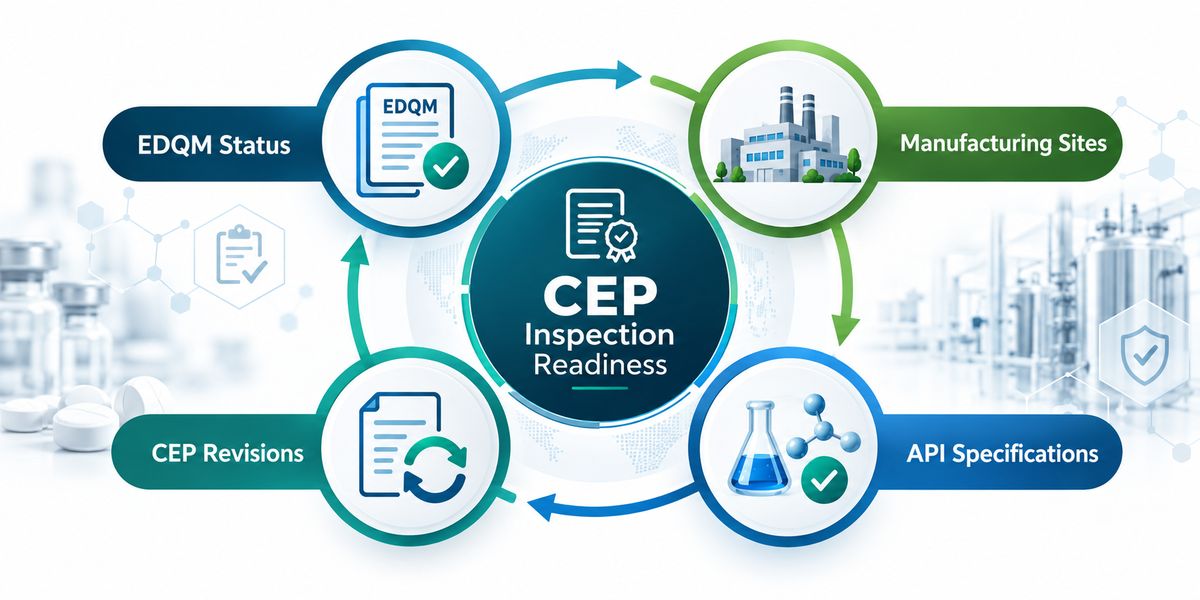
CEP inspection readiness requires more than holding a valid certificate. Inspectors assess whether manufacturing practices match the approved CEP dossier and GMP requirements. Therefore, QA teams must maintain accurate supplier records, API quality specifications, and change control documentation. Moreover, missing or outdated records can raise concerns about compliance and product quality.

The following four checks help QA teams verify CEP compliance, identify documentation gaps, and prepare for GMP inspections.

  • Verify the Certificate and Its EDQM Status (Available PDF)
  • Confirm Manufacturing Sites and Supplier Records (Available PDF)
  • Review of API Specifications and Impurity Controls (Available PDF)
  • Assess Changes and CEP Revision Requirements (Available PDF)


The infographic highlights four essential CEP verification checks that help QA teams maintain regulatory compliance and prepare for GMP inspections.

Four critical checks for CEP inspection readiness, covering EDQM status, manufacturing sites, API specifications, and certificate revisions.

Verify the Certificate and Its EDQM Status (Available PDF)

Verify the CEP number, holder details, and validity in the EDQM database. Also, confirm it matches the API and remains active.

Download How to read a CEP Here

Confirm Manufacturing Sites and Supplier Records (Available PDF)

Verify that API manufacturing sites match the approved CEP dossier. Also, review supplier records, GMP compliance, and manufacturing documents for inspection readiness.

Download the CEP Dossier Guide Here

Review of API Specifications and Impurity Controls (Available PDF)

Compare API specifications and impurity limits with CEP and European Pharmacopoeia standards. Also, assess residual solvents, elemental impurities, and nitrosamine risks.

Download Module 8 – Control of impurities: CEP approach Here

Assess Changes and CEP Revision Requirements (Available PDF)

Assess manufacturing, site, and quality changes for CEP revision or EDQM notification. Maintain updated change control records to ensure regulatory compliance.

Download the CEP Revision Guide Here (PDF)

What Changed with CEP 2.0 for QA Teams?

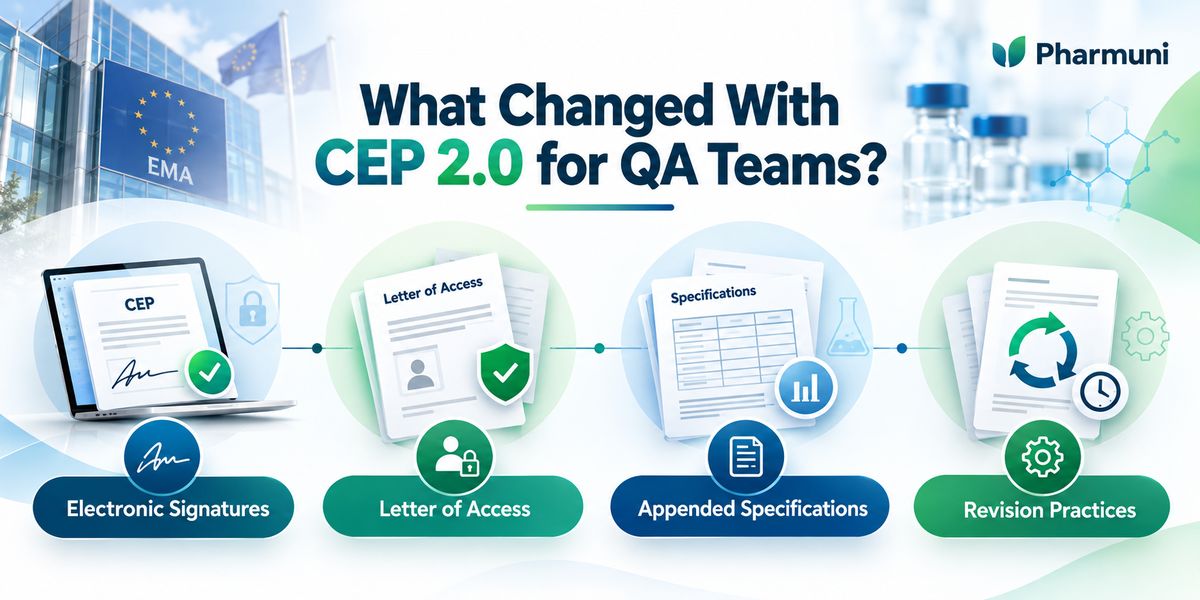
CEP 2.0 introduced digitally signed certificates, separate letters of access, and appended API specifications. As a result, QA teams must verify electronic signatures, access documents, and approved quality requirements. Moreover, EDQM now issues revised certificates only when their content changes. Therefore, QA teams should track approved revisions and maintain updated supplier records to support GMP compliance.

This infographic compares traditional CEP certificates with CEP 2.0, highlighting key changes that help QA teams improve document verification and regulatory compliance.

each validation element should connect from protocol planning to final report conclusion.

Comparison infographic showing traditional CEP and CEP 2.0 differences in electronic signatures, access letters, API specifications, and certificate revisions.
CEP 2.0 introduces digital signatures, separate letters of access, appended API specifications, and updated revision practices.

Which Records Should QA Prepare for an Inspection?

A valid CEP certificate alone cannot prove GMP compliance. During inspections, QA teams must provide supplier documents, API quality records, and evidence of regulatory compliance. Moreover, inspectors check whether manufacturing activities match the approved CEP dossier. Therefore, maintaining accurate and updated records helps identify compliance gaps and improve inspection readiness.

The following table highlights the essential CEP-related records and what QA teams should verify before an inspection.

Record Category Documents to Prepare What QA Should Verify
CEP Certificate
Current CEP and applicable annexes
Confirm EDQM validity, revision, and certificate status
Supplier Qualification
Supplier audits, GMP evidence, and quality agreements
Verify approved manufacturing sites and supplier compliance
API Quality Records
API specifications, CoAs, and impurity assessments
Confirm compliance with European Pharmacopoeia standards
Change Control
Change assessments, CEP revisions, and regulatory notifications
Verify that changes were assessed, documented, and reported when required

Final Word

In 2025, EDQM conducted 96 desktop assessments, up from 79 in 2024. This increase highlights the growing importance of document-based GMP oversight. Therefore, a CEP certificate in pharma must be supported by accurate supplier records, updated API specifications, and effective change control. Ultimately, inspection readiness depends on documented evidence, not just holding a certificate.

FAQs

1️⃣ How can I check if a CEP certificate is valid?


Search the official EDQM Certification Database using the CEP number or API name. Then, confirm the certificate’s validity status and latest version. Suspended, withdrawn, or expired certificates are not valid.

2️⃣ Does a CEP certificate replace GMP certification for API suppliers?


No. A CEP confirms compliance with relevant European Pharmacopoeia quality standards but does not prove GMP compliance. Therefore, pharmaceutical companies must still verify supplier qualification and GMP evidence.

3️⃣ When is a CEP revision required after manufacturing changes?


CEP holders must report manufacturing changes to EDQM according to applicable revision requirements. Under CEP 2.0, EDQM issues a revised certificate when approved changes affect its content.

Picture of Mahtab Shardi

Mahtab Shardi

Mahtab is a pharmaceutical professional with a Master’s degree in Physical Chemistry and over five years of experience in laboratory and QC roles. Mahtab contributes reliable, well-structured pharmaceutical content to Pharmuni, helping turn complex scientific topics into clear, practical insights for industry professionals and students.

Quality assurance specialist reviewing a Certificate of Suitability with digital verification icons in a pharmaceutical manufacturing facility

CEP certificate in pharma: What QA Must Verify in 2026

Learn how QA teams verify EDQM certificates, assess API suppliers, and prepare for GMP inspections. This guide explains CEP 2.0 updates, impurity controls, and essential records that help maintain regulatory compliance and inspection readiness across pharmaceutical manufacturing operations.

Read More »
CAPA and Deviation Review in Pharma

GMP Inspection Readiness : A Proven Audit Guide in 2026

GMP inspection readiness means showing that your pharmaceutical quality systems work every day. This practical guide walks QA, QC and site leaders through a five-step, risk-based preparation framework, with priority evidence to review, mock inspection tips, CAPA guidance and answers to common inspection questions.

Read More »

Share