


In 2026, GMP inspection readiness means proving that pharmaceutical quality systems work every day, not preparing documents when an inspector arrives. The FDA’s drug-manufacturing inspection framework covers six systems, while EU GMP Volume 4 links personnel, production, quality control and documentation. A practical readiness program connects those requirements to actual batches, data, equipment, people and corrective decisions. This guide provides a five-step workflow, evidence matrices and realistic inspection questions.
For deeper foundations, review Pharmuni’s Good Manufacturing Practices (GMP) learning resources.
Table of Contents
What is GMP Inspection Readiness ?
What is GMP Inspection Readiness? It means a pharmaceutical site can show that its quality systems work every day through current records, trained staff, controlled processes, and reliable data. A risk-based program links product risks to evidence, owners, and corrective actions.
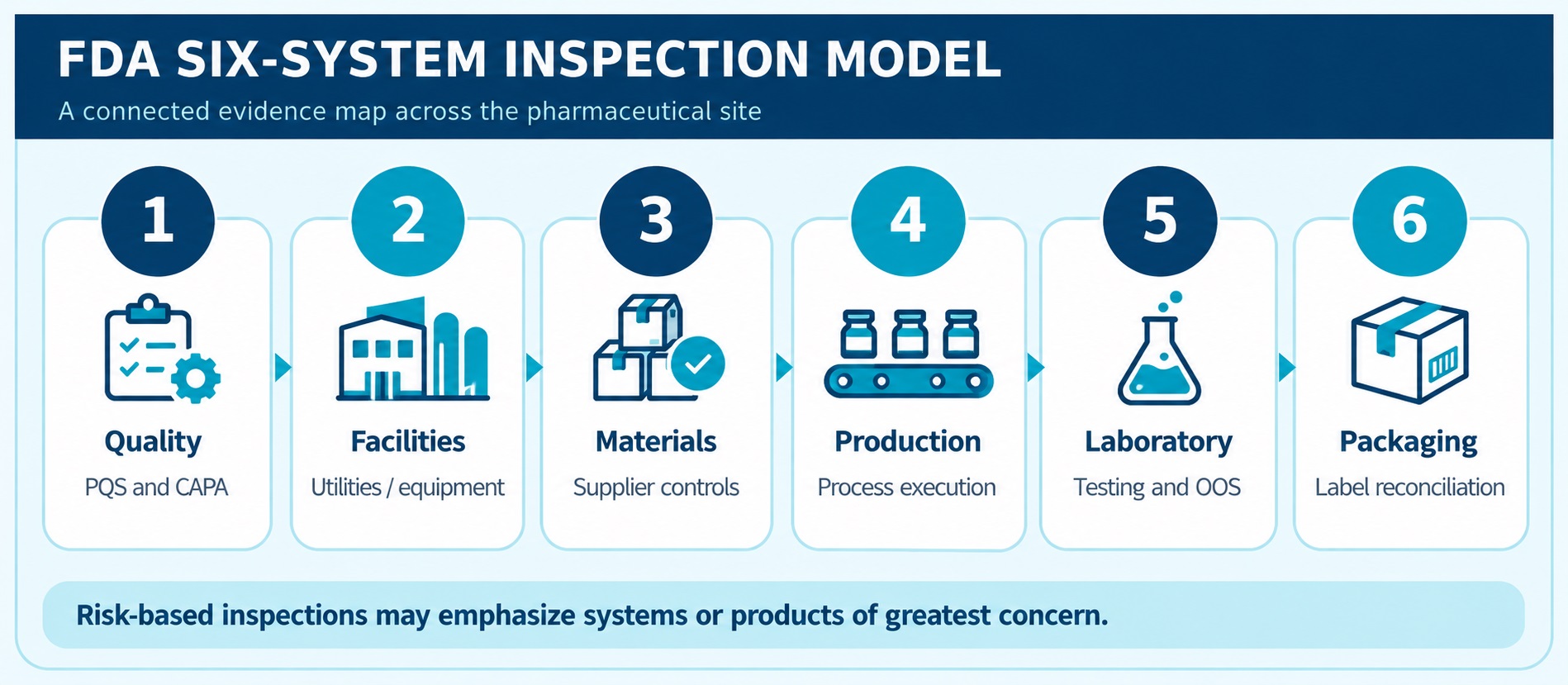
FDA Compliance Program 7356.002 describes six inspection systems: quality, facilities and equipment, materials, production, packaging and labeling, and laboratory controls. Use that model to prioritize batch records, deviations, CAPA effectiveness, data integrity, and staff interviews. A mock GMP inspection can test document retrieval, reveal gaps, and help teams verify remediation before an FDA inspection.
Which FDA, EU GMP and PIC/S Expectations Matter Most?
FDA, EU GMP and PIC/S provide key inspection references:
- FDA: Six systems cover quality, facilities and equipment, materials, production, packaging and labeling, and laboratory control.
- EU GMP: Chapters 1, 4 and 9 address the quality system, documentation and self-inspection.
- PIC/S: PI 041-1 clarifies data integrity expectations.
Map these requirements to your licenses, products and local rules. No single checklist applies to every site.
How Can a Pharma Site Prepare for an Inspection in Five Steps?
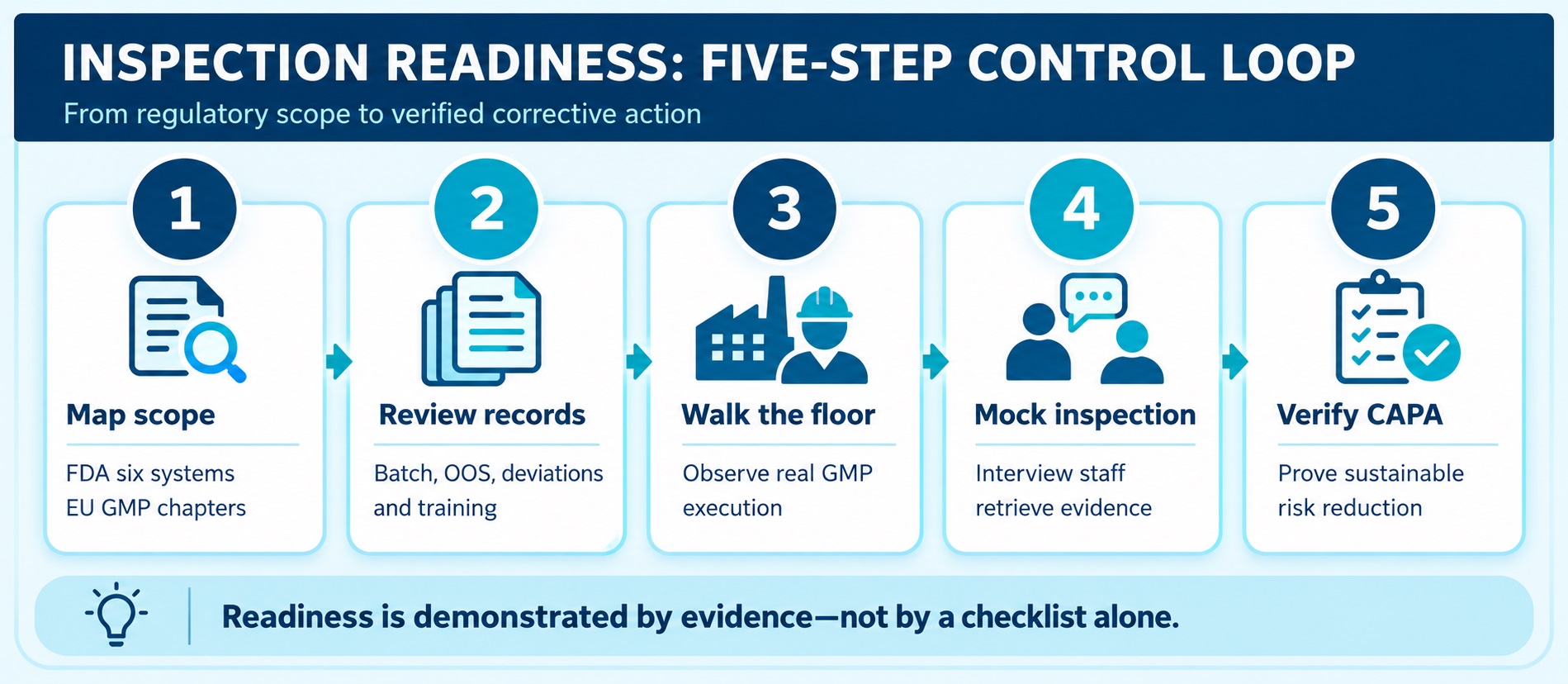
The following five steps are a proposed operational method, not an official FDA timetable. Assign owners in QA, QC, production, engineering and IT. Use previous findings, product risk and recent changes to prioritize evidence. The objective is an inspection response that reflects actual control of medicines and manufacturing operations.
Step 1: Define the Inspection Scope and Critical Products
Step 2: Review GMP Records and Quality System Trends
Step 3: Verify Shop-Floor Practices and Data Integrity
Step 4: Rehearse Interviews and Document Retrieval
Step 5: Close Gaps and Verify CAPA Effectiveness
Step 1: Define the Inspection Scope and Critical Products
Confirm approved activities, product families, recent regulatory commitments and outsourced steps. Prioritize sterile processes, complex products and previous recurring risks. Link each scope item to an accountable subject-matter expert.
Step 2: Review GMP Records and Quality System Trends
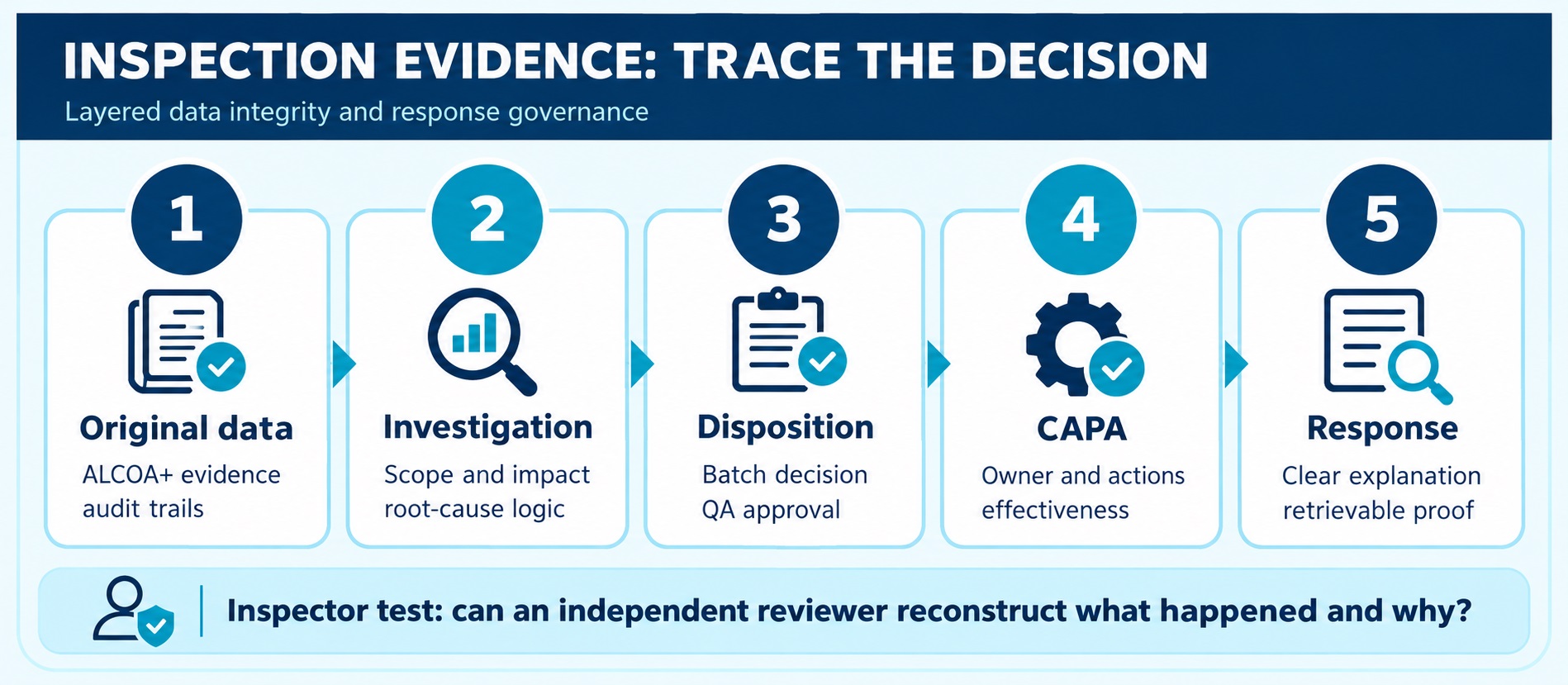
Sample batch records, deviations, OOS investigations, change controls and annual product quality reviews. Check traceability from original result to QA disposition. Trend repeated issues instead of presenting only closed records.
Step 3: Verify Shop-Floor Practices and Data Integrity
Observe line clearance, material status, cleaning, calibration and operator behavior. Reconcile actual practice with SOPs. Verify audit-trail review and ALCOA+ principles wherever electronic GMP data are generated.
Step 4: Rehearse Interviews and Document Retrieval
Run a timed mock inspection. Ask employees to explain their own tasks and retrieve original evidence promptly. Train staff to answer factually, escalate uncertainty and avoid speculative responses.
Step 5: Close Gaps and Verify CAPA Effectiveness
Assign risk-ranked actions with due dates and evidence. Confirm that corrections are implemented and test whether preventive controls work. Maintain transparent records of unresolved items rather than hiding them.
What Should Each Inspection-Readiness Step Produce?
A useful output package comprises a signed scope map, sampled record reviews, shop-floor observation notes, a mock-inspection log and a CAPA verification register. Evidence ownership matters as much as completeness: each finding should have one accountable person and an escalation path. Avoid invented “100% readiness” scores without a justified method.
Five-step deliverables
| Step | Deliverable | Quality owner |
|---|---|---|
|
Scope |
Product and regulatory risk map |
QA + Regulatory |
|
Review |
Controlled records and trend register |
QA + QC |
|
Verify |
Gemba observations / DI review |
Production + IT |
|
Rehearse |
Interview and retrieval log |
Site QA |
|
Improve |
CAPA effectiveness record |
Process owner + QA |
Which GMP Inspection Documents and Systems Need Priority Review?
A strong inspection file shows what the site actually controls. Use the FDA systems model to locate records quickly while retaining alignment with EU GMP documentation requirements. The table gives an illustrative evidence index, not a regulator-endorsed mandatory file list. Ensure current approved versions, contemporaneous data and decision rationales are accessible.
FDA system evidence
| FDA system | Evidence examples | Risk question |
|---|---|---|
|
Quality |
PQR/APR, CAPA, complaint trending |
Were systemic issues escalated? |
|
Facilities |
Calibration, HVAC, maintenance |
Are critical utilities controlled? |
|
Materials |
Supplier status, sampling, receipt |
Is material traceability intact? |
|
Production |
BMR, IPC, cleaning, validation |
Was the process followed? |
How Do Mock Inspections and CAPA Improve Audit Readiness?
A mock inspection becomes valuable when inspectors follow a single batch from incoming material to disposition, interviewing the people who performed the work. Record observations by severity, potential patient impact, root-cause hypothesis, owner and status. Quality leaders should evaluate whether CAPA addresses failure mechanisms, not merely whether the action box is marked complete
What Are the Most Common GMP Inspection Findings?
Frequent vulnerability themes include incomplete investigations, delayed CAPA, weak data governance, training disconnected from actual tasks and ineffective supplier or equipment oversight. The precise observation varies by product and site. Repeat events are particularly concerning because they challenge the adequacy of prior root-cause work. During response preparation, separate confirmed facts from assumptions and document who approved the scientific rationale.
A Realistic Inspection Challenge: The Missing Link
Consider an illustrative composite scenario: a site passes its document review, yet operators cannot explain a revised cleaning step and the training record shows only an electronic acknowledgment. A strong response investigates the mismatch, assesses affected batches, coaches operators, qualifies the task and measures ongoing effectiveness. The lesson from industrial practice is that training completion does not automatically prove capability.
- Verify operators can explain and perform the revised step.
- Assess potential impact on affected batches.
- Confirm training and CAPA effectiveness over time.
Final Word
In 2026, credible GMP inspection readiness is measurable through complete evidence, controlled operations and sustained CAPA effectiveness. The FDA’s six-system model and EU GMP Chapters 1–9 offer complementary ways to test site control; neither promises a perfect audit score. The strongest sites can reconstruct a single batch decision, explain its risks and demonstrate action when something fails. Invest in routine self-inspection instead of a last-minute document campaign.
FAQs
Not universally as a named exercise; routine self-inspection is an EU GMP expectation.
Scope varies; FDA may use the six-system, risk-based inspection approach.
No. Inspectors evaluate investigation quality, product impact and control of recurrence.

Ershad Moradi
Ershad Moradi, a Content Marketing Specialist at Zamann Pharma Support, brings 6 years of experience in the pharmaceutical industry. Specializing in pharmaceutical and medical technologies, Ershad is currently focused on expanding his knowledge in marketing and improving communication in the field. Outside of work, Ershad enjoys reading and attending industry related networks to stay up-to-date on the latest advancements. With a passion for continuous learning and growth, Ershad is always looking for new opportunities to enhance his skills and contribute to pharmaceutical industry. Connect with Ershad on Facebook for more information.

GMP Inspection Readiness : A Proven Audit Guide in 2026
GMP inspection readiness means showing that your pharmaceutical quality systems work every day. This practical guide walks QA, QC and site leaders through a five-step, risk-based preparation framework, with priority evidence to review, mock inspection tips, CAPA guidance and answers to common inspection questions.

GMP Training Matrix in 2026: How to Build an Audit-Ready, Role-Based Training System
Learn how to build a GMP training matrix that links pharma team roles to SOPs, records competency evidence, tracks retraining, and supports inspection readiness.

Universities vs Pharmuni in 2026: Faster Pharma Career Readiness
Universities provide formal degrees, research depth and academic credibility. Pharmuni adds faster pharma-specific upskilling, assessments, Career Paths, CV tools and job-readiness support. Here is how the two models differ—and when using both makes sense.