


A GMP Training Matrix connects pharma team roles with SOPs, competency evidence, and retraining requirements. Even 98% training completion can leave critical tasks exposed if the remaining 2% involves unqualified personnel. Tracking attendance alone cannot demonstrate readiness for independent work.
Good Manufacturing Practices (GMP) requires training appropriate to assigned responsibilities. FDA 21 CFR 211.25 and EU GMP Chapter 2 emphasize continuing training and practical effectiveness. This guide explains how to map requirements, assess competence, control SOP revisions, and maintain inspection readiness through documented qualification, targeted retraining, and accessible training records.
Table of Contents
What Is a GMP Training Matrix in Pharmaceutical Manufacturing?
A Good Manufacturing Practices (GMP) training matrix helps map required learning to regulated tasks and verify competence.
A GMP training matrix maps job roles and individual employees to the quality-system topics, approved procedures, competencies and refresh requirements relevant to their work. It links training plans with documented evidence and qualification decisions. A useful matrix is not simply a green list of completed courses: it must show whether people are qualified for assigned activities, including work involving production, QC laboratories, engineering, warehouses and contractors who influence product quality. Requirements differ with operational risk.
Why Do FDA and EU GMP Expect Structured Personnel Training?
Under 21 CFR 211.25, pharmaceutical staff need suitable education, training or experience, and continuing CGMP training with sufficient frequency for their functions. EU GMP Chapter 2 describes initial and continuing training, records and periodic assessment of practical effectiveness.
Neither source prescribes one universal spreadsheet template. The matrix is an implementation tool: it helps a manufacturer demonstrate that training assignments match tasks and that personnel competence is controlled, reviewed and maintained.
Some important questions must be answered
Number 1. Which Roles and SOPs Belong in a GMP Training Matrix?
Number 2. How Should a Risk-Based GMP Training Matrix Be Designed?
Number 3. How Do You Track Initial Training, Retraining and SOP Revisions?
Which Roles and SOPs Belong in a GMP Training Matrix?
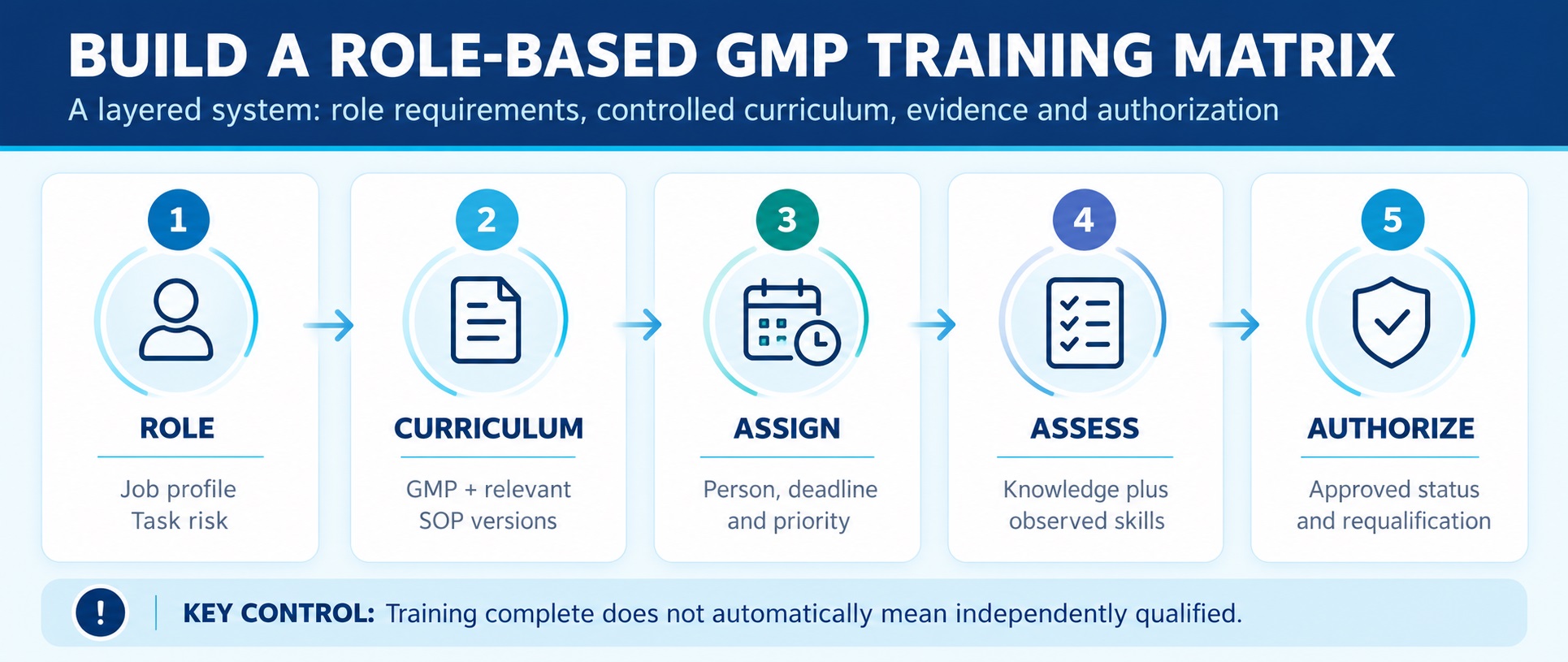
Start with approved job descriptions and real tasks, not an alphabetical list of every SOP. Production operators require batch records, line clearance, hygiene and equipment-specific instructions; QC analysts need methods, OOS and data integrity; QA staff need deviations, CAPA and release-related processes. Engineering, cleaners, contract staff and warehouse teams must also be included where their activities affect product quality. Include employee, role, document identifier, version, training method, criticality, status and qualification evidence.
GMP Training Matrix by Department and Role
| Department / role | Core training topics | Practical qualification evidence |
|---|---|---|
|
Production operator |
GMP, BMR, line clearance, hygiene |
Observed execution / sign-off |
|
QC analyst |
Methods, OOS, ALCOA+, lab SOPs |
Method demonstration |
|
QA officer |
Deviation, CAPA, change control |
Case-file assessment |
|
Engineering |
Equipment, calibration, change control |
Task observation |
How Should a Risk-Based GMP Training Matrix Be Designed?
Organize requirements into sitewide GMP fundamentals, department procedures, job-specific SOPs and critical practical competencies. Apply higher oversight to aseptic interventions, material status changes, critical calculations and batch disposition. Use role-to-training mappings that are approved and version-controlled. A risk ranking may set retraining priorities, but the company must justify it: there is no single mandated “annual retraining for every SOP” rule. The critical distinction is between completion, understanding and authorized performance.
How Do You Track Initial Training, Retraining and SOP Revisions?
For each assignment, capture a due date, controlled procedure revision, completed date, assessor and applicable refresher trigger. New hires need induction before unsupervised critical work. Change control should flag revised SOPs and identify who must be retrained before new instructions take effect. Role transfers, prolonged absence, a failed skills check or relevant deviations can also prompt reassessment. Overdue training should be evaluated against job permissions; a red dashboard indicator alone cannot prevent an unqualified person from performing a critical activity.
How Can GMP Training Effectiveness Be Verified Beyond Attendance?
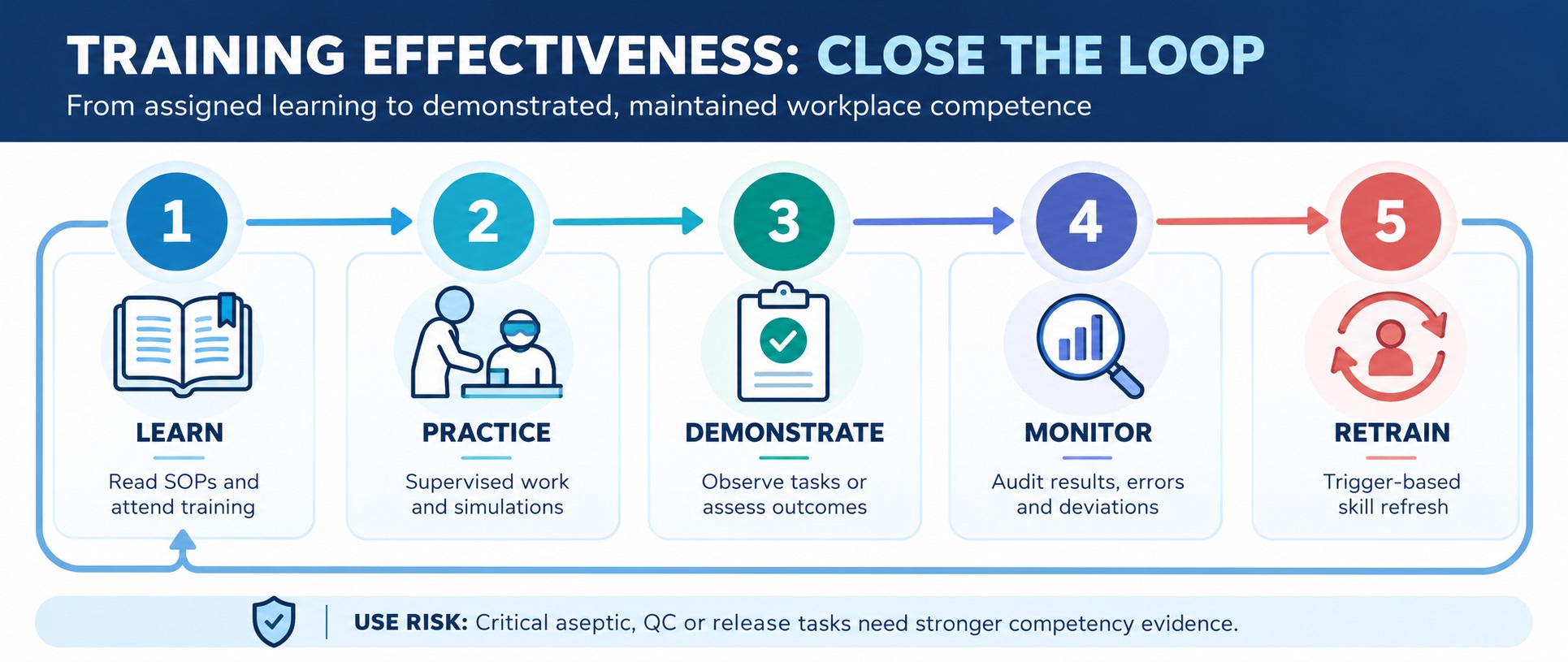
A signature or course completion certificate proves exposure, not competence. Choose evidence according to risk: brief knowledge checks for GMP fundamentals, direct observation for line clearance, practical demonstrations for gowning or sampling, and supervised performance for high-risk tasks.
Define pass criteria and reassessment rules in advance. EU GMP personnel requirements emphasize checking training effectiveness; the objective is reliable task performance, not perfect attendance statistics.
Training Effectiveness and Compliance Tracking
| Training / competency control | Suggested record | Risk-based follow-up |
|---|---|---|
|
Initial SOP instruction |
Version, date, trainer, learner |
Before assigned GMP task |
|
Critical task qualification |
Assessment + approver |
Before independent work |
|
SOP revision |
Change impact + retraining |
Before revised task execution |
|
Failed assessment |
Gap, coaching, retest |
Restrict task pending approval |
What Should GMP Training Matrix Software and an LMS Control?
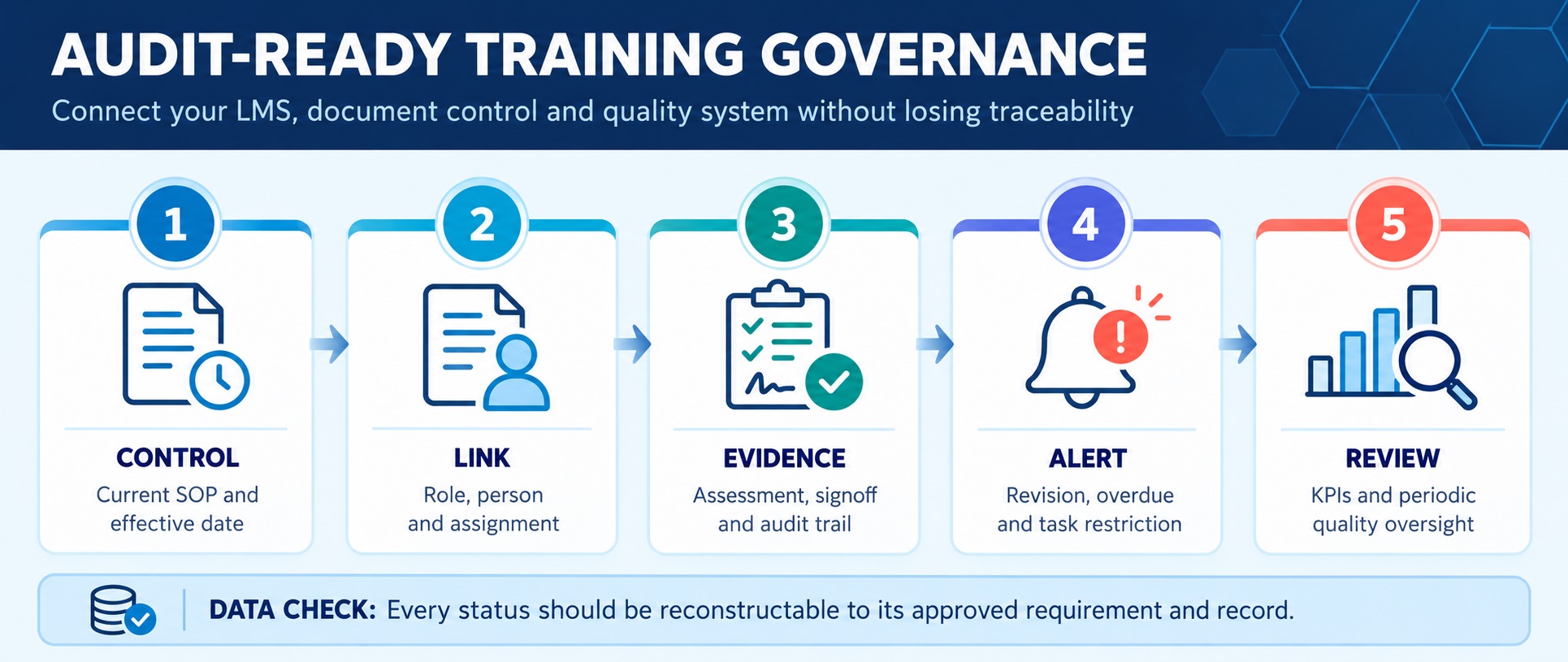
An electronic learning management system (LMS) can automate assignments, due dates, escalation and reporting. The higher-value integration is linking the LMS with document control, changes and job-role authorizations, so a new effective SOP can trigger relevant training. Validate computerized systems for their intended GMP use, define access rights, protect records and test electronic signatures where applicable. A platform should let reviewers reconstruct who was assigned which requirement, which version was trained and who authorized independent work.
Which Training Records Should Be Available During a GMP Inspection?
An inspector may follow a particular batch activity back to the operator, the applicable SOP revision and evidence of qualification on the execution date. Keep approved curricula, training attendance or completion, objective assessments, trainer qualifications, effectiveness checks and retraining history accessible. Investigate discrepancies between the matrix and actual shop-floor practice.
The best inspection test is reconstruction: could QA show the employee’s permitted tasks and current competence without relying on an unverified spreadsheet snapshot?
GMP Training Matrix KPIs
Useful measures include critical-role training coverage, overdue requirements affecting active assignments, practical assessment failures, retraining after revisions and repeat deviations related to human performance. Segment results by role, process and risk level. Avoid celebrating a sitewide “98% complete” result if the missing 2% includes critical interventions. Trend training outcomes alongside deviations, audit findings and procedural changes. Training effectiveness is a quality-system outcome; a high number of completed modules may coexist with poor operational control.
How Can a Pharma Site Implement a GMP Training Matrix in 60 Days?
Days 1–15: inventory roles, critical tasks, SOPs and training evidence; identify gaps.
Days 16–30: approve curricula, definitions of competence and retraining triggers.
Days 31–45: pilot one production or laboratory group, connect document revisions and assess skills.
Days 46–60: audit records, train supervisors, correct ambiguities and release a controlled process. These timeframes are an illustrative rollout, not a regulatory deadline.
Start with high-risk tasks and ensure task authorization remains separate from simple completion status.
Practical Checklist: Is Your GMP Training Matrix Audit-Ready?
✓ Every quality-impacting role and contractor is considered
✓ Approved SOP versions and training assignments are linked
✓ High-risk practical competencies have objective assessment evidence
✓ Overdue or failed training can trigger task restriction
✓ SOP revisions and job changes initiate reassessment
✓ QA can reconstruct training status at the time of batch execution
Final Word
A GMP Training Matrix should connect every role, SOP revision, and critical task with documented competence. Even 100% course completion cannot prove that personnel can perform correctly. Prioritize practical assessments, traceable records, and task authorization before independent work.
FDA 21 CFR 211.25, WHO GMP guidance, and EU GMP Chapter 2 support structured training and qualified personnel. Monitor 3 indicators: overdue critical training, assessment failures, and recurring performance deviations. Use these data to trigger targeted retraining, verify effectiveness, and keep qualification evidence accessible throughout routine operations and inspections for every employee.
FAQs
Training completion confirms that an employee received instruction. Demonstrated competency requires evidence that the employee can perform the assigned task against predefined acceptance criteria. Record completion, assessment results, and authorization for independent work separately.
Consider the task’s potential impact on patient safety, product quality, and data integrity. Higher-risk activities require stronger practical evidence and closer oversight. Define acceptance criteria around critical task steps, allowable errors, and the employee’s ability to recognize and respond to abnormal conditions.
Use direct observation, supervised execution, practical demonstrations, and relevant simulations. For example, assess line clearance against an approved checklist or observe sampling technique. Record the procedure version, assessor, results, and qualification decision; a knowledge quiz alone may be insufficient.
References

Ershad Moradi
Ershad Moradi, a Content Marketing Specialist at Zamann Pharma Support, brings 6 years of experience in the pharmaceutical industry. Specializing in pharmaceutical and medical technologies, Ershad is currently focused on expanding his knowledge in marketing and improving communication in the field. Outside of work, Ershad enjoys reading and attending industry related networks to stay up-to-date on the latest advancements. With a passion for continuous learning and growth, Ershad is always looking for new opportunities to enhance his skills and contribute to pharmaceutical industry. Connect with Ershad on Facebook for more information.

GMP Training Matrix in 2026: How to Build an Audit-Ready, Role-Based Training System
Learn how to build a GMP training matrix that links pharma team roles to SOPs, records competency evidence, tracks retraining, and supports inspection readiness.

Universities vs Pharmuni in 2026: Faster Pharma Career Readiness
Universities provide formal degrees, research depth and academic credibility. Pharmuni adds faster pharma-specific upskilling, assessments, Career Paths, CV tools and job-readiness support. Here is how the two models differ—and when using both makes sense.

Innopharma Education vs Pharmuni in 2026: The Ultimate Career Game-Changer?
Innopharma Education offers structured, accredited life-science programmes with formal academic pathways and career support. Pharmuni is a lighter, self-paced pharma career ecosystem combining courses, assessments, Career Paths, CV tools, and job matching. This guide compares where each model fits best.