


A university degree and Pharmuni should not be treated as interchangeable products. Universities can provide formal academic qualifications, research training, laboratories, faculty supervision, campus networks, and—in regulated professions such as pharmacy—accredited routes toward professional practice. A current UCL Pharmacy MPharm example runs for four academic years and is fully accredited by the General Pharmaceutical Council, while many pharma-related MSc programmes are one year full-time.
Pharmuni is built for a different job: faster, role-focused pharmaceutical upskilling and career execution. Its public offer currently includes 50+ life-sciences courses, 7 guided Career Paths, role assessments, Smart CV tools, a Professional Profile, competency benchmarking and 1,000+ life-science job opportunities.
Table of Contents
Universities vs Pharmuni: How Is the Learning Structure Different?
University education is curriculum-led. Students move through modules, examinations, laboratory work, research projects and broader scientific or professional foundations over a defined academic calendar. That structure is valuable because it builds depth, discipline and transferable knowledge beyond a single job title. Pharmuni is role-led. Instead of starting with a degree syllabus, a learner can start with a target role, assess current gaps and follow a shorter sequence of industry-focused courses. The structural difference is academic formation versus targeted career acceleration.
Learning Architecture: Academic Formation vs Role-Focused Progression
| Learning Dimension | University Route | Pharmuni Route |
|---|---|---|
|
Starting point |
Degree/programme curriculum and entry requirements |
Target pharma role or skill gap |
|
Learning sequence |
Semester/module structure with academic progression |
Career Paths and selected standalone courses |
|
Practice model |
Labs, projects, placements and research vary by programme |
Short technical courses, quizzes, assessments and role-linked practice |
|
End point |
Academic award; sometimes professional eligibility |
Course/path certificates plus career-readiness outputs |
Degree Depth vs Job-Specific Pharma Skills: What Are You Actually Building?
Universities are strongest when scientific depth matters. Pharmacy, pharmacology, pharmaceutical sciences and drug-development programmes can cover mechanisms of action, formulation, statistics, research methods, clinical development and laboratory science in a way that short courses cannot replicate. UCL’s current Drug Discovery and Pharma Management MSc, for example, is a one-year programme combining scientific and commercial drug-development expertise. Pharmuni focuses more directly on workplace-facing topics such as GMP, QA, validation, regulatory affairs, pharmacovigilance, production planning and documentation. That makes it useful when a learner already has academic knowledge but needs clearer alignment with industry processes, terminology and role expectations.
Knowledge Build: Scientific Depth vs Workplace Readiness
| Capability Layer | Typical University Strength | Typical Pharmuni Strength |
|---|---|---|
|
Scientific foundations |
Deep theory, research methods, laboratory science |
Applied technical context around regulated pharma work |
|
Role specificity |
Depends on degree and electives |
High: Career Paths are organized around pharma roles |
|
GMP/quality workflow |
May be covered, but varies widely by programme |
Central in many QA, validation and manufacturing courses |
|
Speed to targeted skill |
Usually tied to semester/programme timing |
Shorter self-paced learning and single-course purchase |
Cost and Time: What Does the Investment Look Like?
The financial gap can be substantial, although university pricing varies enormously by country, degree and residency status. As a representative 2026/27 example, UCL lists its four-year Pharmacy MPharm at £9,790 per year for UK students and £35,400 per year for international students. Its one-year Drug Discovery and Pharma Management MSc lists £21,500 for UK students and £42,700 for overseas students. Pharmuni operates at a very different price level: Starter is £0, Plus is currently £23.81/month when billed yearly, and selected standalone pharma courses are publicly listed at £17.99 one-time. These are different purchases, not equivalent credentials.
Investment Snapshot: Long-Form Education vs Modular Upskilling
| Buying Scenario | University Example | Pharmuni Reference |
|---|---|---|
|
Entry-level academic route |
4-year MPharm example; tuition charged annually |
Starter plan £0; 3 introductory courses on current Plans page |
|
Postgraduate specialization |
1-year MSc examples; £18,400–£42,700 in reviewed UCL programmes |
Plus: £23.81/month annual-billing equivalent |
|
One narrow technical topic |
Usually embedded inside a module/programme |
Standalone course examples at £17.99 |
|
Career support layer |
Often bundled into student services |
CV, profile, assessments, jobs and coaching integrated by plan |
Credentials: When Does a University Degree Matter More?
This is the section where the comparison must stay precise. A university degree can be an academic qualification, and in some fields it may be part of a regulated professional pathway. UCL’s four-year MPharm, for example, is fully accredited by the GPhC and forms part of the route toward pharmacist registration. Pharmuni explicitly states that its certificates are evidence of course completion and are not academic degrees, state-recognized qualifications, professional licenses or regulatory approvals. That does not make them irrelevant; it means they solve a different problem. Pharmuni certificates can document focused continuing development, while a university degree can satisfy academic or professional requirements that short-course certificates cannot replace.
Career Support: Universities Are Stronger Than a “Degree Only” Stereotype
It would be inaccurate to claim that universities stop at teaching. Strong institutions can provide career fairs, CV reviews, placements, employer events, interview preparation and large vacancy systems. UCL reports 11,000 vacancies posted on myUCLCareers in 2024/25 and 264 employer events, while its School of Pharmacy describes CV/application feedback, summer-placement support and practice interviews. The difference is specialization. Pharmuni’s career layer is narrower but explicitly pharmaceutical: Professional Profile, Smart CV analysis, Career Competency Radar, market benchmarking and Job Radar Matching. University career services are broad and institution-based; Pharmuni’s tools are pharma-specific and product-integrated.
Career Infrastructure: Broad University Services vs Pharma-Specific Tools
| Career Mechanism | University Example | Pharmuni Workflow |
|---|---|---|
|
CV/application support |
Career advisers, workshops and reviews |
AI CV review + resume/cover-letter builder |
|
Opportunity discovery |
1,000+ life-science job opportunities |
Hours to days per course; multi-course paths completed at learner pace |
|
Readiness visibility |
Adviser feedback, grades, placements and experience |
Career Competency Radar + market benchmarks |
Career Paths: Where Pharmuni Can Complement a Degree
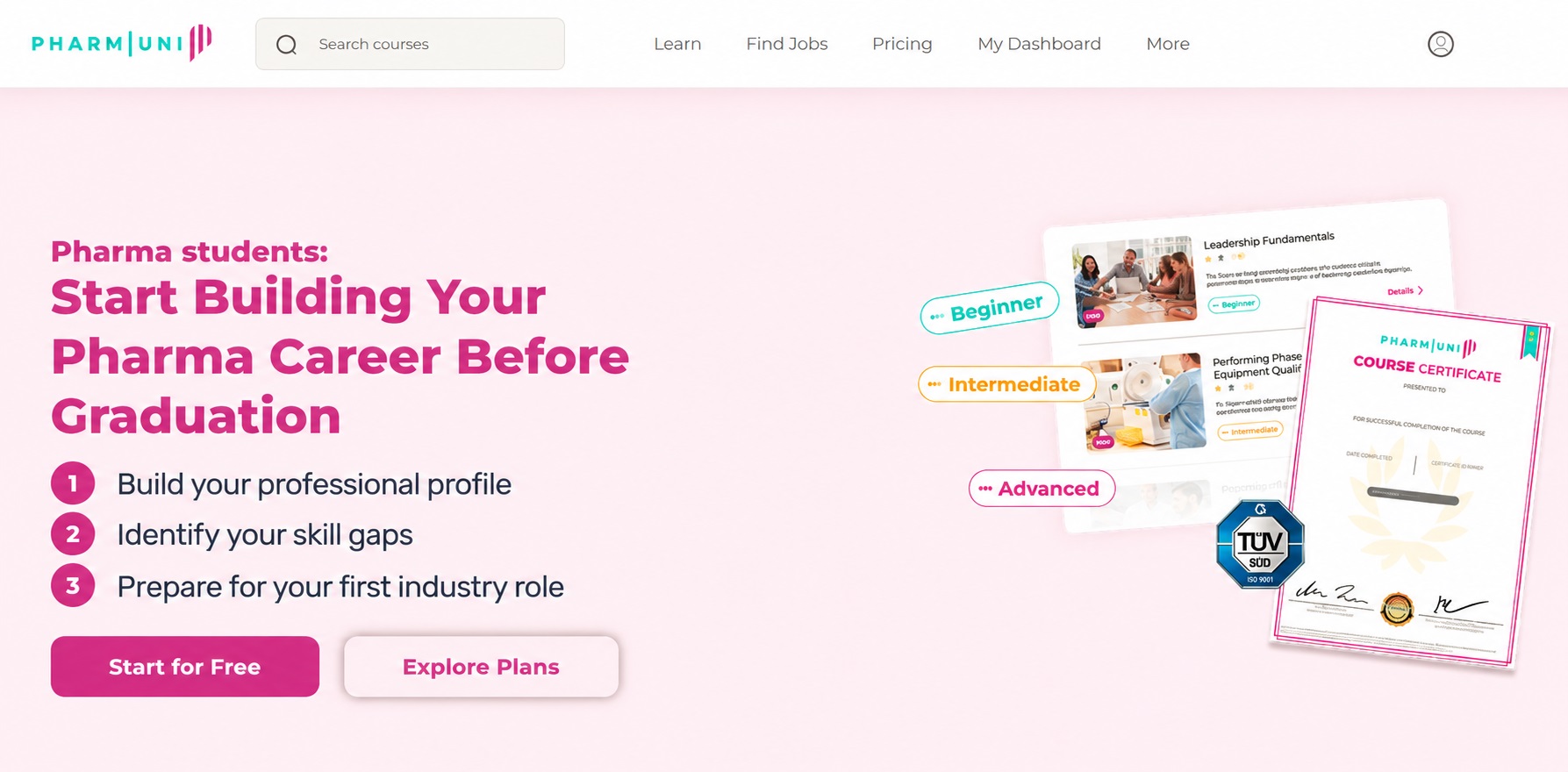
A university programme gives students a formal curriculum, but graduates can still struggle with the practical question of which industry role to target first. Pharmuni’s Career Paths are designed to answer that narrower question. Current examples include GMP Basics (6 courses), Quality Assurance Specialist (7), Pharmacovigilance Specialist (5), Pharma Production Planner (7) and Equipment Qualification Specialist (4). Each path groups learning around a defined role or capability area rather than an academic discipline. This is why Pharmuni makes more sense as a career-translation layer after or alongside university, not as a substitute for a degree where a degree is required.
CV, Professional Profile, and Job Matching: What Happens After Learning?
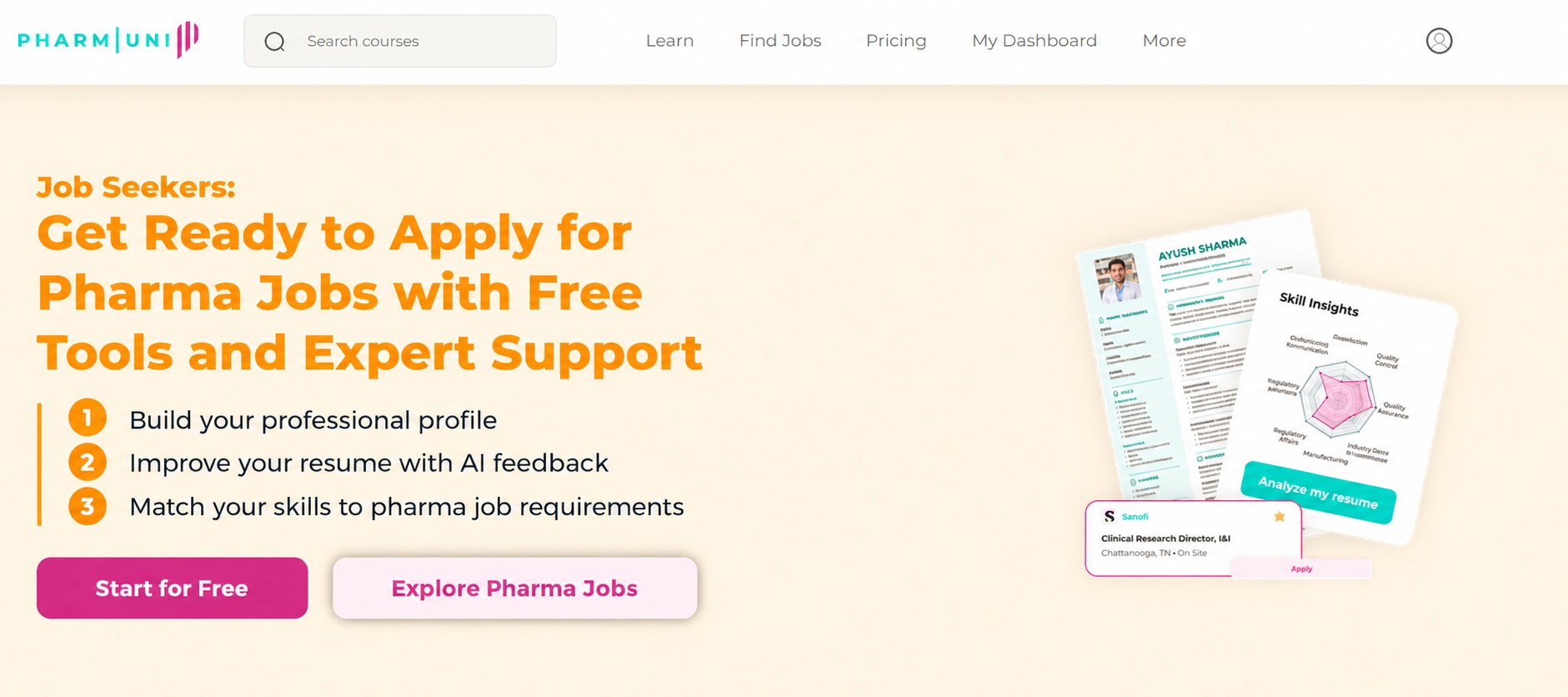
A degree strengthens a CV, but it does not automatically convert academic experience into an industry-ready profile. Universities can help through advisers and career centres, while Pharmuni tries to operationalize that step inside the platform. Its Job Seeker page promotes a free resume builder, AI-supported Professional Profile, first AI resume review, competency comparison and job applications. Plus adds unlimited Smart CV analysis and a full resume/cover-letter builder. The distinctive value is continuity: the learner can move from assessment to learning, then to profile building and job matching without leaving the same pharma-focused system.
Who Should Choose a University, Pharmuni, or Both?
Choose a university when you need a formal degree, research training, scientific depth, regulated professional eligibility, campus-based learning or access to academic supervision and laboratory infrastructure. Choose Pharmuni when you already have a degree—or do not need one—and want faster pharma-specific upskilling, role assessments, Career Paths, CV positioning and job-readiness tools. For many students and graduates, the strongest strategy may be both: use university education for the academic foundation and Pharmuni to translate that foundation into current industry language, targeted role skills and a more focused application strategy.
Final Word
Universities and Pharmuni serve different development needs. A university provides academic depth, formal qualifications and, where applicable, an accredited route to professional registration. Pharmuni adds role-focused pharma learning, assessments and career tools. Its certificates document course completion; they do not replace a degree, license or regulated qualification.
Choose the route by checking the role’s entry requirements and your current skill gaps. If the role requires an accredited degree, university study is essential. If you already meet the academic requirements, targeted training can help you connect your knowledge to GMP, QA, validation, regulatory affairs or other pharma functions. For many learners, combining both routes offers the clearest path from academic preparation to focused job applications.
FAQs
Yes. The Student journey is designed around profile building, assessments, skill-gap visibility and preparation for a first pharma opportunity.
Yes. Pharmuni’s Terms allow one-time individual course purchases, and several current course pages list £17.99 one-time access including quiz and certificate eligibility.
Pharmuni can be more direct because its courses, assessments and Career Paths are organized around those industry functions.

Ershad Moradi
Ershad Moradi, a Content Marketing Specialist at Zamann Pharma Support, brings 6 years of experience in the pharmaceutical industry. Specializing in pharmaceutical and medical technologies, Ershad is currently focused on expanding his knowledge in marketing and improving communication in the field. Outside of work, Ershad enjoys reading and attending industry related networks to stay up-to-date on the latest advancements. With a passion for continuous learning and growth, Ershad is always looking for new opportunities to enhance his skills and contribute to pharmaceutical industry. Connect with Ershad on Facebook for more information.

Universities vs Pharmuni in 2026: Faster Pharma Career Readiness
Universities provide formal degrees, research depth and academic credibility. Pharmuni adds faster pharma-specific upskilling, assessments, Career Paths, CV tools and job-readiness support. Here is how the two models differ—and when using both makes sense.

Innopharma Education vs Pharmuni in 2026: The Ultimate Career Game-Changer?
Innopharma Education offers structured, accredited life-science programmes with formal academic pathways and career support. Pharmuni is a lighter, self-paced pharma career ecosystem combining courses, assessments, Career Paths, CV tools, and job matching. This guide compares where each model fits best.

ISPE Training vs Pharmuni in 2026: Deep Technical Training or a Full Pharma Career System?
ISPE offers deep specialist pharmaceutical training and respected technical certificate programs. Pharmuni combines 50+ pharma courses with free assessments, Career Paths, CV tools, competency benchmarking, and job matching. Here is where each platform fits best.