


CRF vs eCRF choices directly affect clinical trial data quality and traceability. Clinical trials depend on structured, accurate, and reviewable participant information. ClinicalTrials.gov recently listed more than 604,000 studies across 226 countries and territories. That scale makes consistent data capture increasingly important for research teams.
A case report form records protocol-required information for each study participant. An electronic case report form captures similar information through an electronic system. However, an eCRF is not simply a digital paper form. It can support validation checks, controlled access, audit trails, and centralized review. Modern clinical data management therefore requires careful system design and governance.
ICH E6(R3) strengthens expectations around data governance and computerized system controls. FDA guidance also addresses trustworthy electronic records, signatures, and clinical systems. This article explains both formats, their workflows, benefits, limitations, and compliance considerations.
Table of Contents
What Is a CRF in Clinical Research?
A case report form organizes study data required by the clinical protocol. It creates a consistent structure across participants, visits, sites, and investigators’ may exist on paper or inside validated electronic data capture systems.
The form should collect necessary data without creating avoidable transcription burdens. Good design also supports completeness, consistency, review, and later statistical analysis. CDISC CDASH provides standards for consistent clinical trial data collection. These standards also improve traceability from collection into standardized submission datasets.
Paper CRF (pCRF) and Traditional Data Collection
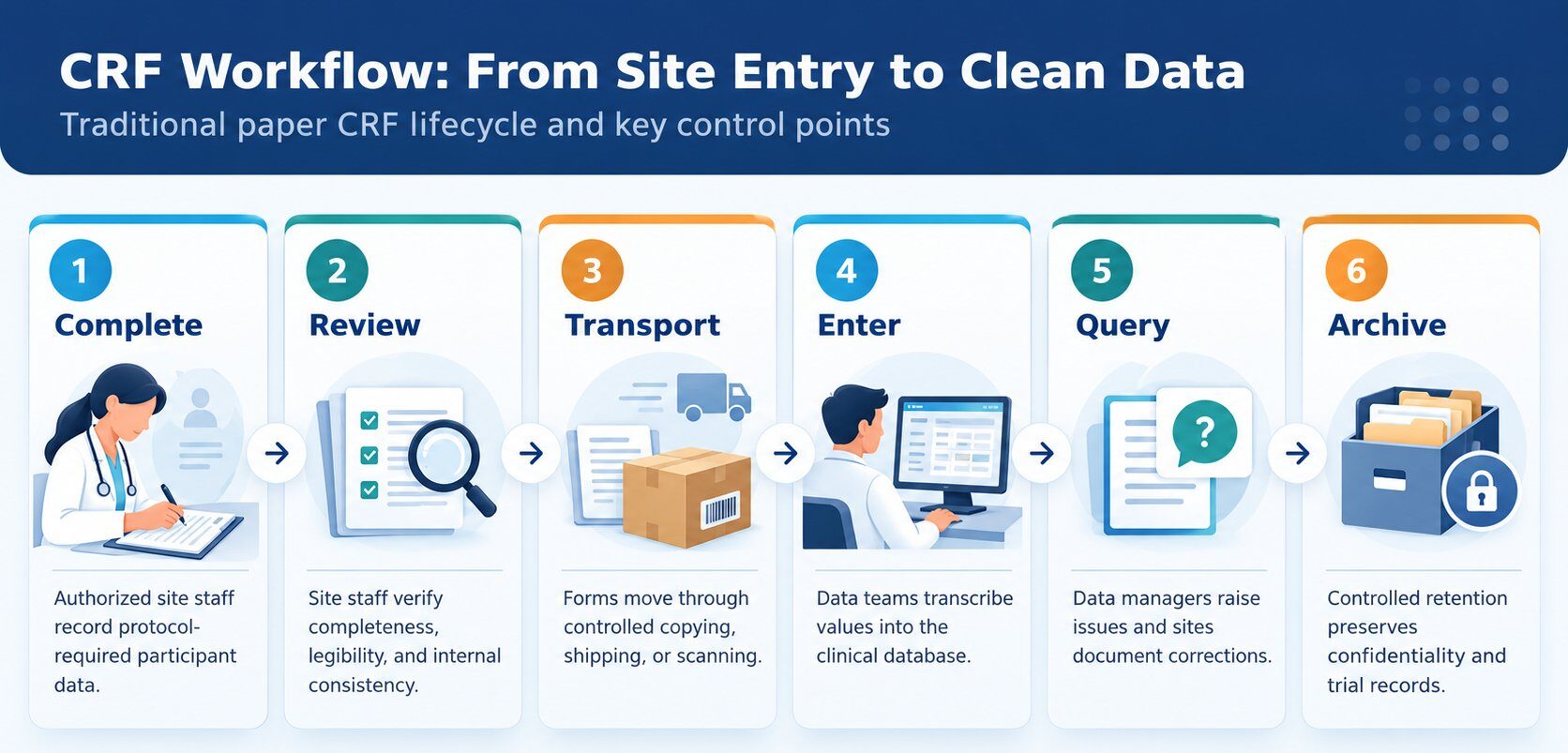
Paper CRFs use printed forms completed by authorized study-site personnel. Sites usually review entries before sending copies for sponsor or CRO review. Data managers may then transcribe entries into a centralized clinical database.
Double data entry can reduce transcription risk, but it increases workload. Reviewers often raise queries after identifying missing, inconsistent, or unclear information. Sites document corrections according to controlled procedures and study requirements.
How paper CRFs are completed, reviewed, transported
| Stage | Paper CRF Workflow | Main Control |
|---|---|---|
|
Completion |
Site staff record protocol-required data on paper. |
Legible entries and completion instructions |
|
Review |
Site staff review forms before external review. |
Completeness and consistency checks |
|
Transport |
Copies or originals move under controlled processes. |
Tracking and confidentiality |
|
Database Entry |
Data staff transcribe CRF values into databases. |
Verification or double entry |
Core Data Elements Commonly Captured in a CRF
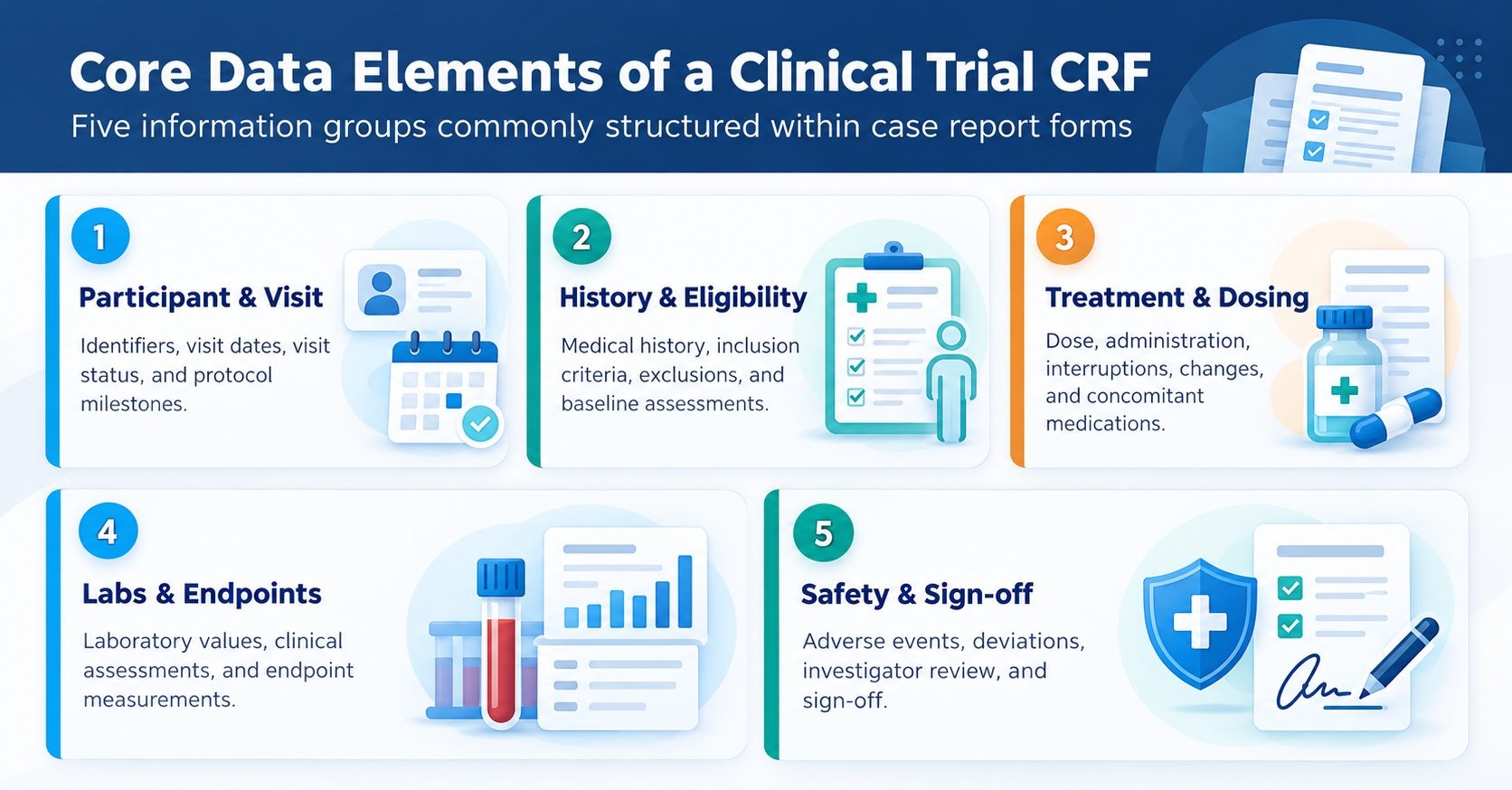
CRF content depends on the protocol, endpoints, population, and safety requirements. Each field should serve a defined scientific, operational, or regulatory purpose.
Element 1: Participant and Visit Information
Element 2: Medical History, Eligibility, and Baseline Data
Element 3: Treatment, Dosing, and Concomitant Medications
Element 4: Laboratory Results, Assessments, and Endpoints
Element 5: Adverse Events, Deviations, and Investigator Sign-off
Element 1: Participant and Visit Information
CRFs capture participant identifiers, visit dates, visit status, and protocol milestones. These fields help teams confirm visit sequencing and expected assessment timing.
Element 2: Medical History, Eligibility, and Baseline Data
Baseline sections record relevant history, eligibility criteria, and pretreatment assessments. Clear fields help investigators document whether participants satisfy protocol requirements.
Element 3: Treatment, Dosing, and Concomitant Medications
Treatment pages record dosing, administration details, interruptions, and treatment changes. Medication pages document therapies that may influence safety or efficacy interpretation.
Element 4: Laboratory Results, Assessments, and Endpoints
CRFs capture required laboratory values, clinical assessments, and endpoint measurements. Structured fields improve consistency when teams review data across different sites.
Element 5: Adverse Events, Deviations, and Investigator Sign-off
Safety pages capture adverse events, seriousness, causality, outcomes, and relevant actions. Deviation records support protocol oversight and follow-up where required. Investigator sign-off confirms review of study data under applicable procedures.
What Is an eCRF and How Does It Work?
An eCRF is a digital CRF within an electronic data capture system. Authorized users enter or review study information through controlled system access. Programmed edit checks can flag missing values or inconsistent entries quickly. Queries can move between data managers and study sites within one platform. Audit trails can document initial entries, changes, deletions, users, dates, and reasons.
ICH E6(R3) specifically addresses audit trails, metadata, corrections, security, and validation. FDA guidance also emphasizes reliable electronic systems and traceable electronic source data. Therefore, eCRFs combine structured capture with workflow and governance controls.
- Controlled user accounts and role-based permissions.
- Programmed edit checks for selected data quality risks.
- Electronic queries with documented status and resolution.
- Audit trails covering important data and workflow changes.
- Centralized review for sponsors, CROs, and authorized monitors.
CRF vs eCRF: Key Differences
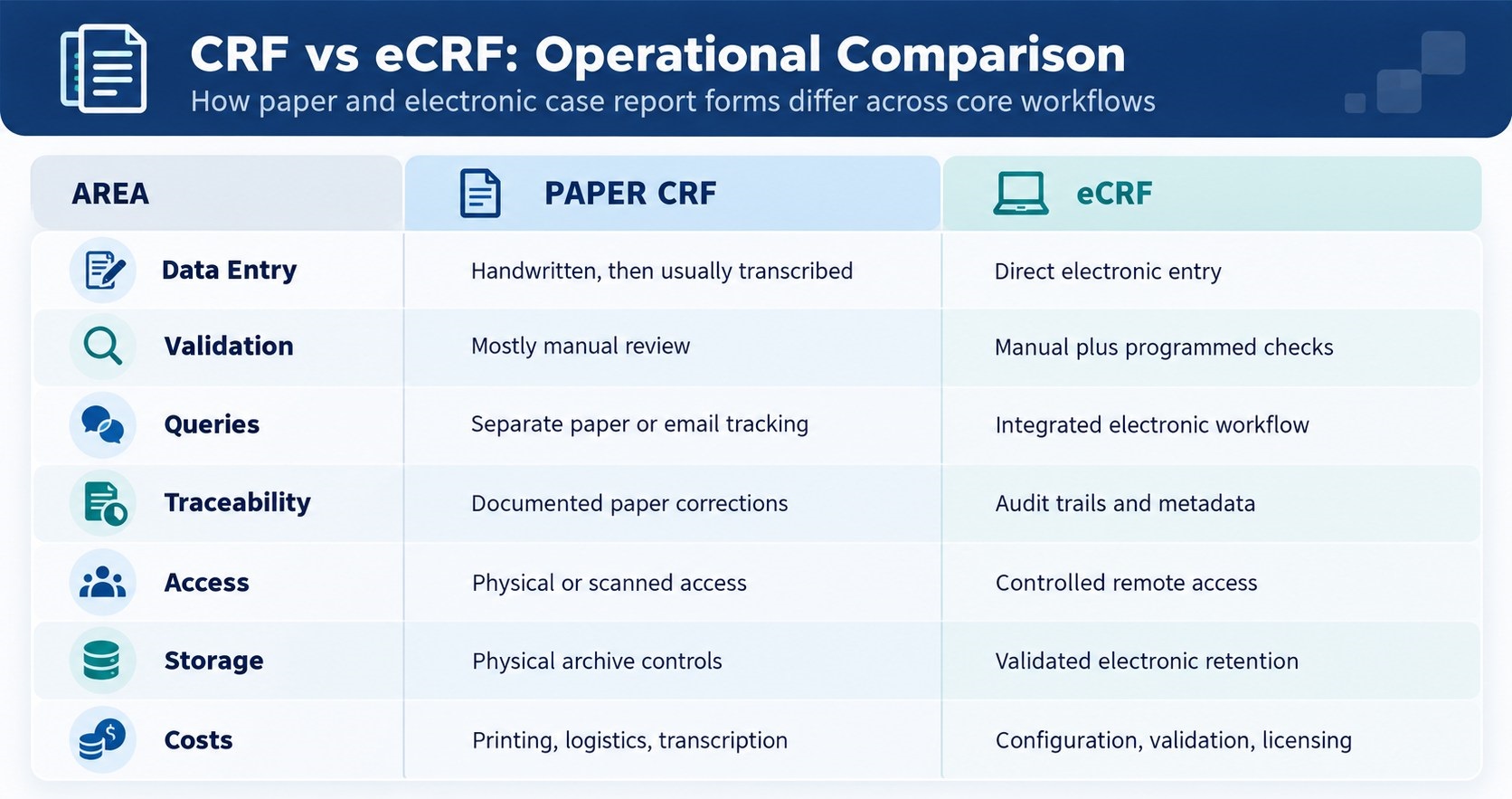
CRF vs eCRF differences extend beyond paper compared with computer screens. They affect data movement, review speed, traceability, security, oversight, and operating costs. Electronic systems can reduce repeated transcription between source records and trial databases. However, eCRFs require validated systems, user controls, training, and technical support. Paper forms require physical storage, controlled handling, and later database transcription. Study complexity, geography, infrastructure, and risk should guide the final approach.
Data Entry, Validation, and Query Management
Paper CRFs often rely on manual review before database entry. Data teams may identify issues after forms reach a central location. That delay can extend the time between data creation and correction.
eCRFs can apply edit checks during or shortly after data entry. These checks may identify missing fields, range issues, or conflicting values. Data managers can then issue and track queries within the EDC system. Still, excessive automated checks can create unnecessary site workload. Teams should design checks around meaningful data quality risks.
Speed, Security, Traceability, Cost, and Regulatory Compliance
eCRFs support near-real-time access for authorized study teams. This visibility can accelerate review, monitoring, and data cleaning activities. Role-based permissions help restrict access according to assigned responsibilities. Electronic audit trails can preserve traceability across changes and workflow actions.
Part 11 considerations may apply to regulated electronic records and signatures. FDA’s 2024 guidance explains expectations for reliable clinical electronic systems. Paper CRFs avoid some software costs but create printing and storage expenses.
Benefits and Limitations of CRF and eCRF
Both approaches can support reliable trials when teams control their processes. Paper CRFs remain practical for some small, remote, or infrastructure-limited studies. They also provide a familiar workflow for sites with limited digital resources.
eCRFs can improve timeliness, consistency, remote oversight, and change traceability. They can also support standardized fields aligned with CDISC collection principles. However, poor configuration can create confusing screens and excessive data queries. System downtime or weak training can also disrupt site workflows. Technology does not replace protocol clarity or sound data management practices.
- Paper CRF strength: simple deployment without complex system configuration.
- Paper CRF limitation: slower review and greater transcription dependency.
- eCRF strength: faster access, validation, and centralized oversight.
- eCRF limitation: system setup, validation, training, and support requirements.
Final Word
CRFs and eCRFs both structure clinical trial data for review and analysis. Paper CRFs can remain suitable where study conditions justify traditional workflows. However, eCRFs support faster review, centralized oversight, and stronger electronic traceability.
Modern regulations also emphasize data governance across computerized clinical systems. Teams should match technology with protocol needs, risks, sites, and infrastructure. A well-designed eCRF can strengthen clinical data management without unnecessary complexity. Ultimately, reliable data depends on controlled processes, trained users, and clear responsibilities.
FAQs
No. An eCRF is the electronic form used for study data capture. The EDC system hosts eCRFs and manages related workflows. It may also manage queries, permissions, audit trails, and exports.
Part 11 applicability depends on the regulated record and system use. Teams should assess applicable FDA requirements and intended electronic records. Documented procedures should address security, signatures, controls, and record integrity.
Yes, some eCRF fields can receive direct electronic source data. FDA guidance discusses manual and electronic source-data capture into eCRFs. The study should define source origins, responsibilities, and traceability clearly.

Ershad Moradi
Ershad Moradi, a Content Marketing Specialist at Zamann Pharma Support, brings 6 years of experience in the pharmaceutical industry. Specializing in pharmaceutical and medical technologies, Ershad is currently focused on expanding his knowledge in marketing and improving communication in the field. Outside of work, Ershad enjoys reading and attending industry related networks to stay up-to-date on the latest advancements. With a passion for continuous learning and growth, Ershad is always looking for new opportunities to enhance his skills and contribute to pharmaceutical industry. Connect with Ershad on Facebook for more information.

Deviation vs Nonconformance 2026: 5 Critical GMP Mistakes to Avoid
Explore 5 critical differences between deviation and nonconformance in pharma, including GMP investigations, OOS, risk assessment, and CAPA.

Root Cause Analysis in Pharmaceutical Industry: 6 Powerful Methods in 2026
Explore 6 powerful root cause analysis methods in pharma to investigate deviations, strengthen CAPA, ensure GMP compliance, and protect patient safety.

Quality Culture in Pharma Industry 2026: Proven Ways to Build Trust
Explore how to build a strong quality culture in the pharmaceutical industry in 2026 through leadership commitment, ICH Q10 principles, meaningful GMP metrics, effective CAPA, and continuous improvement.