


CAPA vs deviation describes two connected decisions within pharma quality management. A deviation records an observed departure and its potential impact. CAPA addresses causes through corrective or preventive actions, then checks results. Confusing these records can hide product risks or create unnecessary action plans. EU GMP Chapter 1 expects significant deviations to receive documented investigation. It also connects root cause analysis with suitable corrective and preventive action. Meanwhile, United States rules require investigations for specified unexplained discrepancies. This guide explains the distinction, escalation, practical workflow, and evidence for closure.
No universal numerical threshold automatically triggers standalone CAPA. Site procedures and quality risk management govern that decision. First, protect patients and establish event facts. Then justify action depth against severity, recurrence, and scope.
Table of Contents
What Is the Difference Between a Deviation and CAPA?
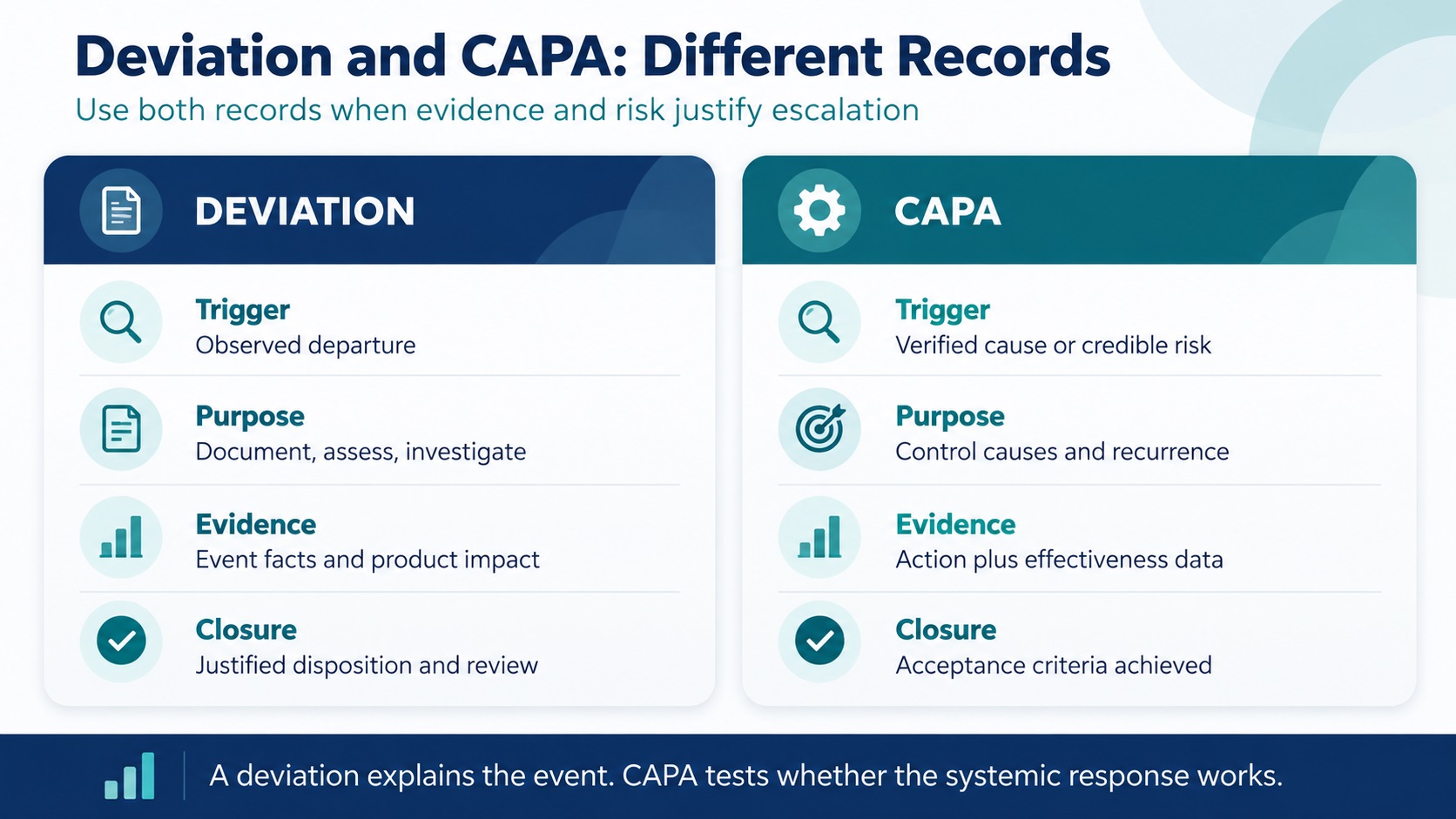
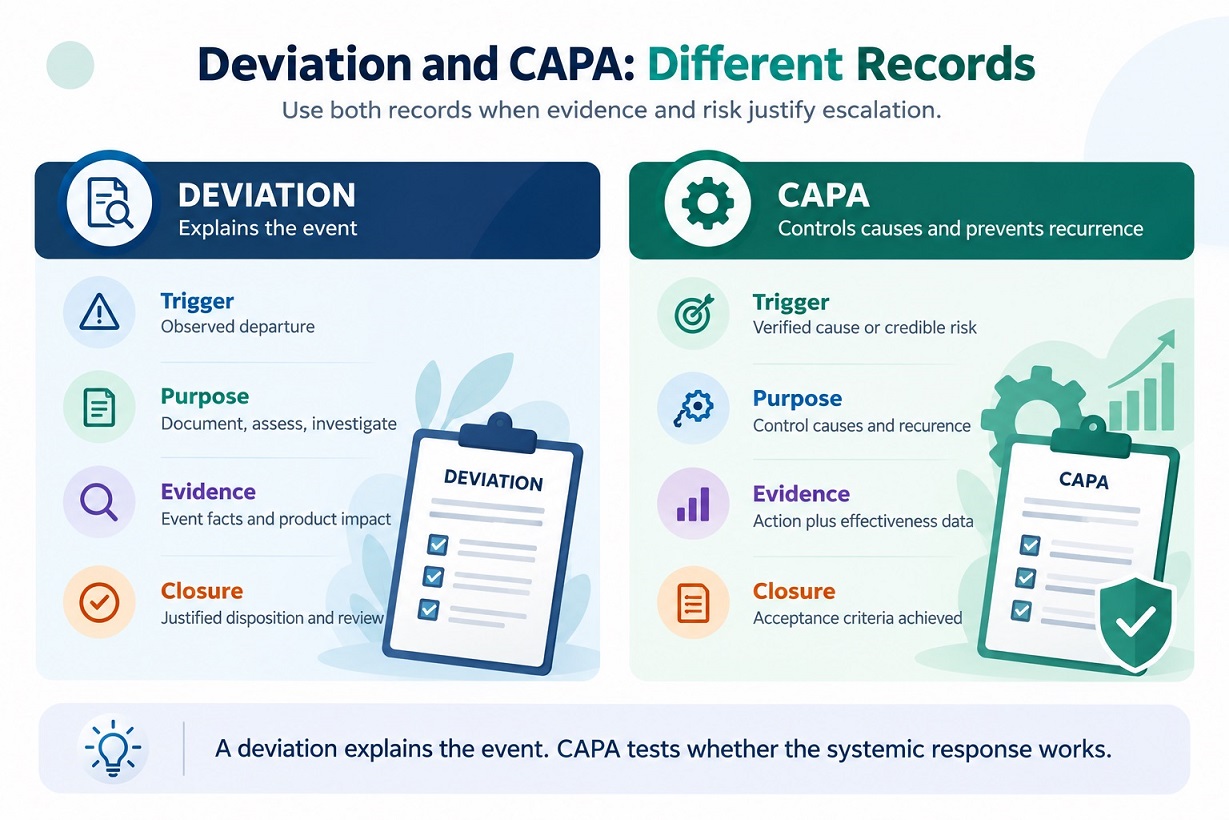
A deviation starts when actual work departs from an approved requirement or expected condition. The deviation file describes occurrence, containment, investigation, scope, and disposition. CAPA starts when evidence supports a systemic action or credible preventive control. Its file tracks owners, changes, implementation proof, and effectiveness. A deviation can prompt CAPA, but the records answer different questions. One asks what happened and whether product remains acceptable. The other asks how the organization will control a demonstrated or anticipated cause.
What Is 5 Whys Root Cause Analysis?
The method creates a cause-and-effect chain through repeated questioning. Teams begin with a precise problem statement. They then ask why the event happened. Each supported answer becomes the basis for another question.
The final answer should explain system failure, not personal blame. For example, “operator error” rarely provides enough depth. Investigators should examine procedures, interfaces, training design, workload, equipment, and oversight.
The tool works best for focused events with a reasonably linear pathway. Complex failures often contain several interacting paths. In those cases, teams should combine 5 Whys with broader tools.
Deviation and CAPA Comparison
| Comparison | Deviation | CAPA |
|---|---|---|
|
Trigger |
Observed departure |
Verified cause or credible risk |
|
Immediate purpose |
Assess event and product impact |
Control cause and future occurrence |
|
Primary evidence |
Facts, chronology, investigation |
Action proof and monitoring |
|
Typical closure |
Approved assessment and disposition |
Acceptance criteria met |
What Counts as a GMP Deviation?
Examples include an unapproved process change, missing contemporaneous entry, and temperature excursion. However, every unusual observation needs classification against approved requirements.
Teams should document when and where it occurred before interpreting significance. They should preserve original records and evaluate affected lots promptly.
For example, a temperature excursion can threaten stability without causing visible product changes. Product impact assessment therefore cannot depend on appearance alone.
What Does a CAPA Record Address?
A CAPA record connects an identified problem or potential failure with controlled actions. It should state the cause hypothesis, supporting evidence, action, owner, and deadline.
It should also define a measurable effectiveness criterion before implementation. For example, alarm redesign may require testing and subsequent excursion trending.
Closing an action because a procedure changed leaves recurrence control untested. Training may support implementation, but training alone rarely addresses faulty system design.
Types of Actions in Deviation Management
Teams should distinguish immediate containment from durable changes. These four action types answer different operational questions:
- Type 1 — Correction: Restore control and document product disposition; investigate the underlying cause separately.
- Type 2 — Corrective Action: Remove a verified cause and reduce recurrence of the observed failure.
- Type 3 — Preventive Action: Control a plausible failure identified before its first occurrence.
- Type 4 — Effectiveness Check: Confirm the action controls the specified failure during monitoring.
Evidence for cause verification
| Evidence source | What it can confirm | Typical record |
|---|---|---|
|
Process data |
Timing and parameter relationships |
Historian or batch trend |
|
Equipment records |
Failure, maintenance, or calibration status |
CMMS and calibration log |
|
Laboratory data |
Analytical sequence and validity |
Raw data and audit trail |
|
Interviews |
Work sequence and decision context |
Signed interview notes |
Type 1 — Correction
Correction addresses the condition in front of the team. Staff may quarantine materials, repeat an authorized step, or repair equipment. They must follow approved instructions and preserve relevant original data. Moreover, they must document product impact independently of the correction. A repaired alarm cannot retroactively prove earlier stock remained within specifications.
Type 2 — Corrective Action
Corrective action targets a demonstrated cause of an event that already occurred. Investigators should test competing causes using batch records, maintenance data, and process trends. Then, the team selects controls that change the causal mechanism. For example, revised alarm limits require approved change control and functional testing. Repetition after implementation signals incomplete root cause analysis or ineffective control.
Type 3 — Preventive Action
Preventive action targets a credible risk before the same event appears locally. Trend analysis may reveal increasing near misses across comparable equipment. Similarly, risk reviews can identify vulnerabilities in related processes. Teams should explain why action scope extends beyond the initial deviation. They should avoid describing every future-facing corrective action as a separate preventive action.
Type 4 — Effectiveness Check
The CAPA effectiveness check measures whether the intended control works over time. Before implementation, define the metric, sample, observation period, and failure threshold. A completed training record proves delivery, but cannot prove stable performance. Instead, monitor relevant deviations, alarms, audit observations, or process measurements. Failed checks should reopen the analysis and trigger proportionate follow-up.
When Does a Deviation Require CAPA?
Escalate when evidence indicates a repeatable cause, broad scope, or significant patient risk. Recurring minor events can reveal a systemic process weakness. Conversely, an isolated low-risk event may justify correction and documented closure. The quality unit should record its rationale under site procedures. Investigators must still perform any required product assessment and investigation. Thus, no separate CAPA does not mean no investigation.
Use an escalation screen that tests multiple dimensions:
- Severity: Evaluate patient exposure, product quality, and regulatory commitments.
- Frequency: Review repeat events, near misses, and related trends.
- Scope: Check other batches, lines, equipment, products, and sites.
- Evidence: Confirm the causal mechanism and limits of the investigation.
- Controls: Determine whether immediate measures reliably contain the risk.
How Deviation Investigation and CAPA Work Together
The deviation investigation builds an evidence chain before action selection. CAPA then uses that chain to justify durable changes and monitor performance. ICH Q10 describes CAPA as a core pharmaceutical quality system element. Its inputs include deviations, complaints, audits, process monitoring, and product trends. Consequently, teams should link records without treating every input as identical. The following stages help protect traceability and prevent premature closure.
Deviation Investigation & CAPA Alignment
| Stage | Key evidence | Decision output |
|---|---|---|
|
Record and contain |
Event facts, batches, immediate controls |
Defined scope and preliminary risk |
|
Investigate |
Chronology, data review, cause testing |
Root cause or justified uncertainty |
|
Decide and act |
Risk rationale, owner, change control |
CAPA or justified alternative |
|
Verify and close |
Implementation proof, effectiveness trend |
Approved, documented closure |
Step 1: Record the Event and Assess Product Impact
First, record the original observation with its time, location, and source. Identify the affected equipment, materials, batches, and released product. Next, apply proportionate containment without changing underlying records. Compare actual process conditions against validated limits and specifications.
Consider distributed product when the issue spans earlier manufacturing periods. Quality staff should record uncertainties and update impact assessments when new evidence arrives.
Step 2: Investigate Root Cause and Define Actions
Investigators should separate observed facts from assumptions. They can map event chronology, compare similar batches, and test plausible mechanisms. Avoid stopping at “human error” without examining instructions, interfaces, workloads, and controls.
Then, evaluate whether other processes share the failure pathway. A cause statement should connect evidence with a controllable mechanism. This allows actions to address the system, rather than only its latest symptom.
Step 3: Implement Actions and Verify Effectiveness
Assign each action an owner, deadline, implementation deliverable, and measurable success criterion. Route equipment changes, documents, and validation work through appropriate controls. Then, verify execution using objective records, not signatures alone. Schedule effectiveness after enough operational exposure can reveal recurrence. For example, review several relevant production cycles or a defined monitoring window. If the criterion fails, reassess both the cause and action design.
A robust handoff should document these checkpoints:
- Investigation approval precedes root-cause-dependent CAPA selection.
- Product disposition remains traceable to supporting quality evidence.
- Change control and validation links identify modified process controls.
- Effectiveness review uses predefined measures and an accountable owner.
Practical Examples of Deviation vs CAPA
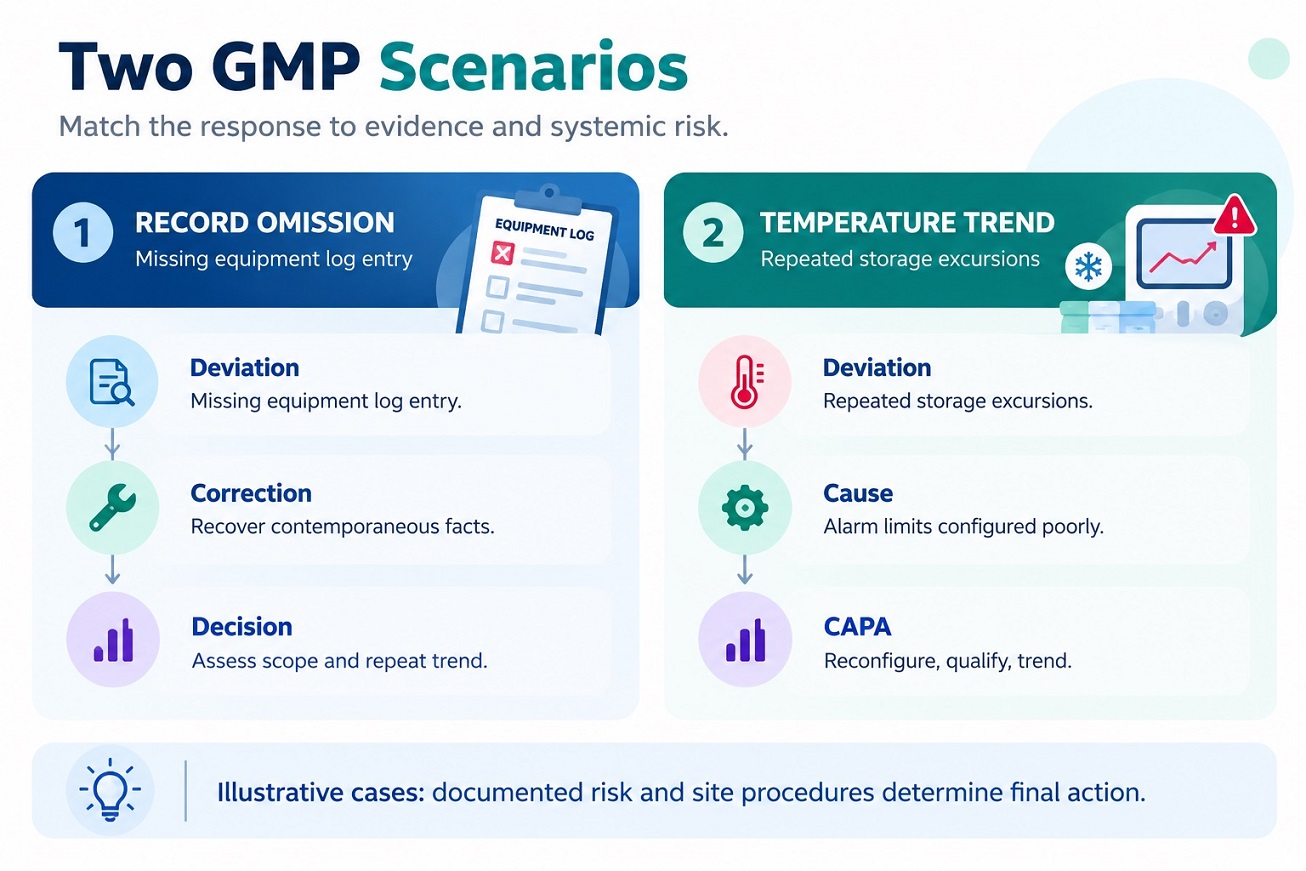
Consider a missing equipment log entry discovered during batch review. Staff preserve the original gap and investigate whether operation occurred as required. They check contemporaneous electronic data, nearby records, and previous omissions. If evidence supports limited impact, the deviation may close with justified correction. However, repeating gaps could reveal a faulty form or weak workflow. That trend would support systemic corrective action.
Now consider repeated storage temperature excursions across several weekends. The deviation investigation identifies affected stock and evaluates stability impact. Trend review links events to alarm limits configured outside approved response expectations. The team updates alarm settings through change control and tests notification performance. Next, it monitors excursions across an agreed operating period. A sustained reduction supports effectiveness; another excursion triggers further investigation.
Classification depends on evidence and product context. Even one high-risk event may warrant broad investigation. Meanwhile, low-severity repetition can justify formal CAPA. QA should maintain an auditable decision record.
Final Word
CAPA vs deviation becomes practical when teams keep event assessment separate from systemic action. First, establish what happened and protect the affected product. Next, test causes and document the escalation decision. Then, implement actions and measure whether they work.
Useful technical metrics include: Deviation recurrence rate: target <5% , CAPA effectiveness checks: 100% completed and Overdue CAPAs: target <10% Sound decisions support compliance, product quality, and patient safety. For QA professionals, these skills also strengthen investigation judgment and cross-functional leadership.
FAQs
No. A deviation requires appropriate documentation and assessment. Its investigation may identify no systemic action need. However, significance, recurrence, and site procedures can justify CAPA escalation. Record the reason for either decision.
Yes. Trend monitoring, audits, complaints, and risk assessments can identify needed actions. ICH Q10 describes several potential CAPA inputs. The organization should record the originating signal and action rationale clearly.
Close CAPA after implementation and effectiveness meet predefined criteria. The assessment needs enough relevant operational exposure. Document monitoring results and explain any remaining limitations. A signed action plan alone does not show sustained control.

Ershad Moradi
Ershad Moradi, a Content Marketing Specialist at Zamann Pharma Support, brings 6 years of experience in the pharmaceutical industry. Specializing in pharmaceutical and medical technologies, Ershad is currently focused on expanding his knowledge in marketing and improving communication in the field. Outside of work, Ershad enjoys reading and attending industry related networks to stay up-to-date on the latest advancements. With a passion for continuous learning and growth, Ershad is always looking for new opportunities to enhance his skills and contribute to pharmaceutical industry. Connect with Ershad on Facebook for more information.

Deviation vs Nonconformance 2026: 5 Critical GMP Mistakes to Avoid
Explore 5 critical differences between deviation and nonconformance in pharma, including GMP investigations, OOS, risk assessment, and CAPA.

Root Cause Analysis in Pharmaceutical Industry: 6 Powerful Methods in 2026
Explore 6 powerful root cause analysis methods in pharma to investigate deviations, strengthen CAPA, ensure GMP compliance, and protect patient safety.

Quality Culture in Pharma Industry 2026: Proven Ways to Build Trust
Explore how to build a strong quality culture in the pharmaceutical industry in 2026 through leadership commitment, ICH Q10 principles, meaningful GMP metrics, effective CAPA, and continuous improvement.