


Clinical data management converts complex trial information into analysis-ready evidence. ClinicalTrials.gov now lists more than 604,000 studies across 226 countries and territories, showing the scale of modern research. Teams reconcile eCRFs, laboratory data, safety systems, ePRO, and external vendors before database lock. ICH E6(R3), finalized in 2025, requires risk-based review of data, metadata, transfers, and audit trails.
FDA expectations also require electronic changes to preserve who changed data, when, and why. Strong governance reduces discrepancies and protects endpoint reliability across increasingly decentralized trial environments.
Table of Contents
What Is Clinical Data Management in a Clinical Trial?
Clinical data management covers planning, collection, validation, cleaning, reconciliation, and controlled delivery. Its objective is a complete and credible dataset for statistical analysis. The function works with investigators, clinical operations, safety, programming, and statisticians. Responsibilities differ across sponsors and contract research organizations. Nonetheless, each team needs clear ownership for critical data and decisions. CDM does not replace medical judgment or source-data verification at sites.
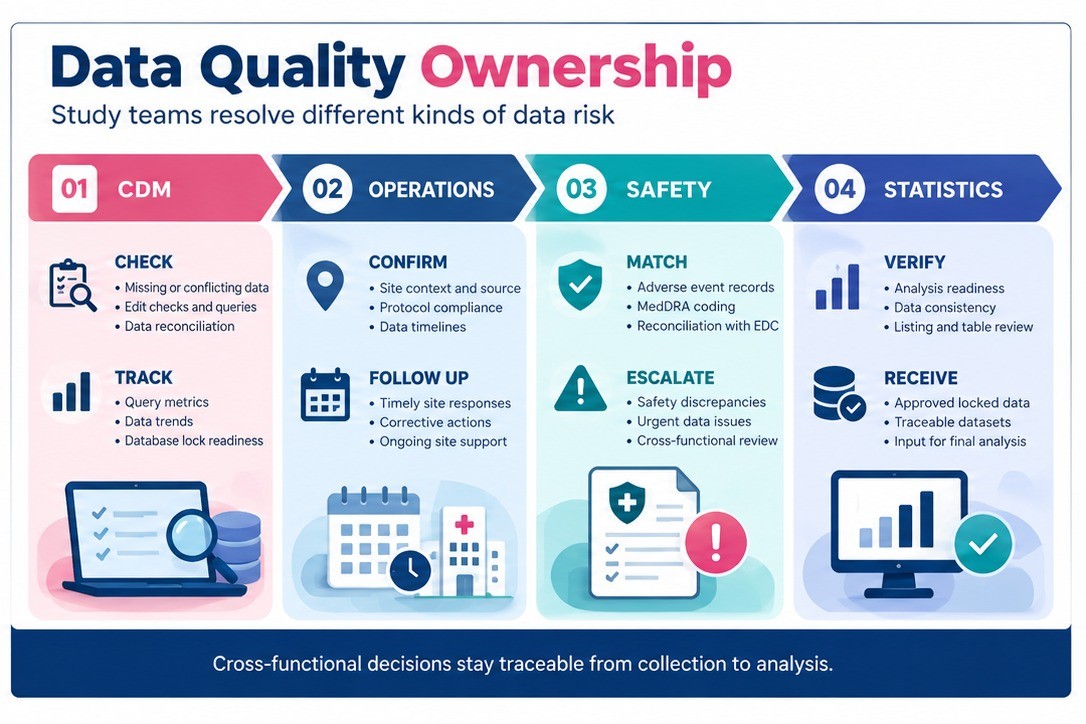
Clinical Data Management Roles and Handoffs
| Function | Primary responsibility | Key handoff |
|---|---|---|
|
Clinical data management |
Review, reconcile, and lock data |
Approved analysis dataset |
|
Clinical operations |
Oversee sites and trial conduct |
Site follow-up and context |
|
Biostatistics |
Define analyses and interpret results |
Analysis requirements |
|
Clinical programming |
Create transformations and outputs |
Traceable programmed datasets |
What Data Does a Clinical Data Manager Handle?
Site staff enter visits and observations into electronic case report forms. Laboratories send results, while imaging vendors provide measurements and interpretations. Participants may report outcomes through ePRO applications. Safety teams maintain adverse event information in separate systems. Devices can generate additional time-stamped observations. The manager must understand each source, transfer schedule, and identifier. Source records and transformed datasets serve different purposes and require traceability.
- eCRF data includes demographics, visits, endpoints, and protocol deviations.
- External feeds include laboratory, imaging, device, and participant-reported results.
- Coding dictionaries standardize reported events and concomitant medications.
- Safety reconciliation identifies mismatches between clinical and safety records
What Does a Clinical Data Management System Do?
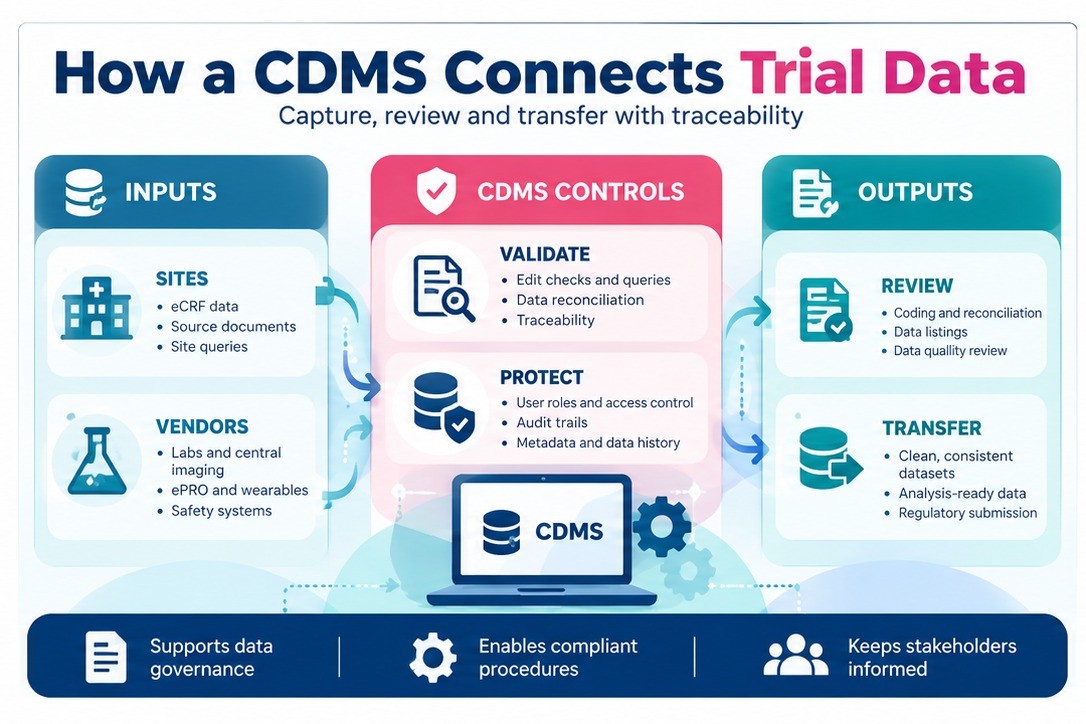
A clinical data management system supports controlled study data collection and review. Many teams use electronic data capture within a broader CDMS environment. Configuration should follow approved specifications, testing, and access management. System features alone cannot repair weak protocol definitions or unclear ownership. Instead, people and procedures must govern how every feature operates.
Function 1 Data Capture and eCRF Design
Designers translate protocol assessments into structured eCRF fields and visit schedules. They define mandatory fields, allowed values, and branching logic. Clear completion instructions reduce ambiguity at sites. Before launch, users test representative cases through user acceptance testing. A well-designed form collects necessary data without burdening participants or investigators.
Function 2 Edit Checks and Query Management
Edit checks flag missing, inconsistent, or implausible data. For example, a visit date may precede consent. Data managers review the flag before requesting site clarification. The site responds using the controlled query workflow. Then, teams verify resolution without rewriting original evidence. Automated checks should complement clinical and medical review, not replace them.
Function 3 External Data Integration and Reconciliation
Vendor data arrives through agreed formats, identifiers, and transfer schedules. Teams test mappings, version changes, and completeness before routine imports. Reconciliation compares matching records across systems. For example, laboratory sample identifiers must align with participant visits. Safety events need separate comparison against pharmacovigilance records. Every unresolved mismatch requires an owner and documented resolution.
Function 4 Audit Trails, Access Controls and Data Security
Audit trails show who changed records, when, and sometimes why. Role-based permissions limit access to authorized study personnel. Periodic reviews should identify inappropriate privileges and unusual changes. Teams must preserve confidentiality while enabling inspection of relevant records. Likewise, backup and recovery arrangements protect data availability during system failures.
Function 5 Exports, Standards and Database Lock
Teams export reviewed data for downstream programming and analysis. CDISC CDASH supports consistent collection design; SDTM supports standardized tabulation. The CDMS alone does not create compliant submissions automatically. Before database lock, teams resolve critical queries and document remaining exceptions. Authorized personnel approve the lock under study procedures. Subsequent changes require controlled unlock, justification, and renewed review.
How Does the Clinical Data Management Process Work?
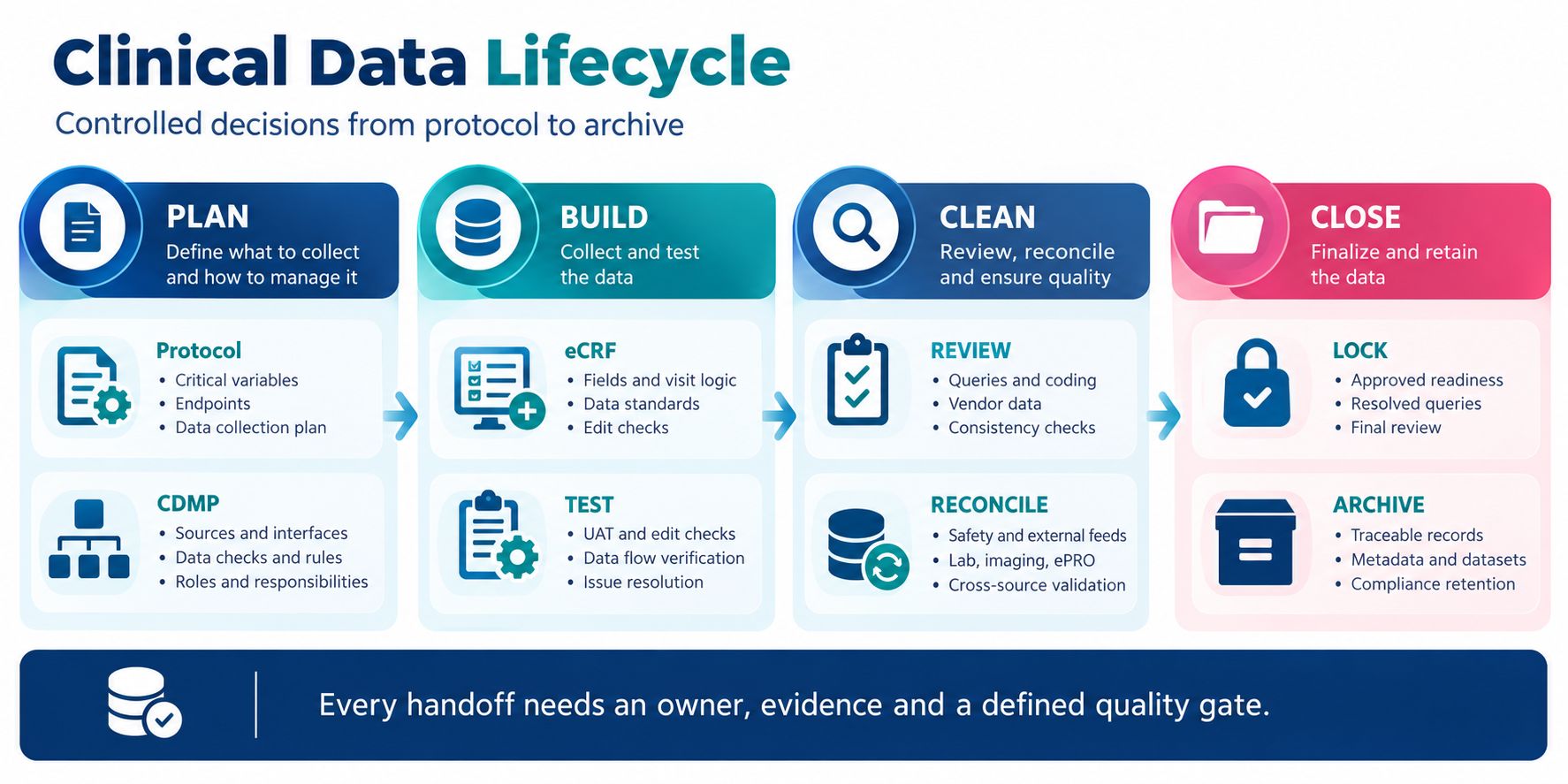
The workflow begins before the first participant enters the study. The protocol drives the data collection design and critical-variable list. Teams then build and test systems before routine site entry. Throughout conduct, they clean records and reconcile vendor data. Finally, approved readiness checks support lock, transfer, and archive. Each handoff needs evidence showing what changed and who approved it.
Clinical Data Management Process Phases
| Phase | Evidence | Quality gate |
|---|---|---|
|
Plan |
Protocol, CDMP, data flow map |
Critical data approved |
|
Build and test |
eCRF, edit checks, UAT |
Release authorized |
|
Collect and clean |
Entries, queries, coding logs |
Discrepancies resolved |
|
Reconcile and lock |
Vendor and safety comparisons |
Lock checklist approved |
How Do Teams Maintain Clinical Trial Data Quality?
Quality depends on critical-data selection, documented review, and timely correction. ICH GCP encourages proportionate controls around trial risks. EMA guidance also details computerised system and electronic-data oversight. Therefore, quality teams should assess both data content and system behavior. Metrics should reveal meaningful problems, rather than reward query volume alone.
Plan Critical Data and Define Quality Checks
Identify primary endpoints, eligibility, consent, and safety variables early. Specify the source, expected timing, permissible values, and accountable reviewer. Then write checks for missingness, chronology, and cross-form consistency. Include manual medical review for clinically unusual patterns. Testing should challenge both expected and unexpected cases. Document why each critical check supports a study decision.
Clean Data and Reconcile External Sources
During collection, prioritize discrepancies by potential effect on safety or analysis. Sites should answer queries using supporting source information. Meanwhile, vendor reconciliations need stable keys and agreed cutoff dates. Track aging queries, missing feeds, and unresolved coding decisions. Escalate systemic issues when repeats suggest design or transfer defects. Continuous review reduces late surprises before lock.
- Check missing or late critical visits against the expected schedule.
- Reconcile laboratory, imaging, safety, and ePRO transfers by participant.
- Review audit trails for unexplained corrections to critical variables.
- Trend recurring queries and correct the underlying collection problem.
Final Word
Clinical data management turns diverse trial observations into a reviewed, traceable analysis resource. Strong data management plans define critical data, edit checks, reconciliation steps, roles, and database-lock criteria. Controlled systems should preserve audit trails, user access, timestamps, and change history in line with GCP and electronic-record expectations. Data from eCRFs, laboratories, imaging, ePRO, and safety systems must be reconciled before final analysis. CDISC standards such as SDTM support structured regulatory datasets. Cross-functional review reduces unresolved discrepancies before lock. For career growth, combine EDC knowledge, query management, coding, reconciliation, data standards, clinical judgment, and clear communication.
FAQs
Employers commonly seek clinical research knowledge and careful data handling. Experience with EDC systems, spreadsheets, and trial terminology helps. Entry roles may include data coordinator or associate positions. Build evidence through supervised projects and clear documentation examples.
No. EDC usually describes electronic site data capture. A CDMS may include capture, review, coding, reconciliation, and exports. Vendors group these features differently. Check each study architecture before assuming one platform handles every source.
Teams resolve critical queries, complete coding, reconcile external sources, and document reviews. They check outstanding exceptions against the study plan. Authorized staff then approve a specific dataset version. A later change needs controlled unlocking and renewed approval.

Ershad Moradi
Ershad Moradi, a Content Marketing Specialist at Zamann Pharma Support, brings 6 years of experience in the pharmaceutical industry. Specializing in pharmaceutical and medical technologies, Ershad is currently focused on expanding his knowledge in marketing and improving communication in the field. Outside of work, Ershad enjoys reading and attending industry related networks to stay up-to-date on the latest advancements. With a passion for continuous learning and growth, Ershad is always looking for new opportunities to enhance his skills and contribute to pharmaceutical industry. Connect with Ershad on Facebook for more information.

GMP Training Effectiveness 2026: Proven Ways to Build Real Competence
GMP training effectiveness goes beyond attendance records and quiz scores. Learn how role-based assessments, on-the-job observation, and meaningful KPIs help verify employee competence, strengthen training records, and address recurring performance gaps across pharmaceutical operations.

GMP Audit Checklist 2026: The Essential Guide for Risk-Based Audits
Master your GMP Audit Checklist with a practical, risk-based approach to pharmaceutical self-inspections. Explore five essential audit steps, FDA’s six-system model, GMP documentation and evidence sampling, audit findings, CAPA tracking, and effectiveness verification to strengthen compliance and inspection readiness.
Orphan Drug Designation in 2026: FDA and EMA Eligibility Criteria
Discover how orphan drug designation works in 2026. Compare FDA and EMA eligibility criteria, rare disease prevalence thresholds, scientific evidence requirements, and regulatory incentives. Learn what pharmaceutical sponsors need to prepare for successful regulatory submissions