


Verification vs Validation in Pharma in 2026: GMP Differences and Inspection Evidence

More than 62% of FDA drug quality assurance inspections in FY2024 occurred at foreign sites, an all-time high. Therefore, teams managing post approval changes in pharma need robust risk assessment, documented change control, and GMP compliance. In the United States, 21 CFR 314.70 is a key pharma regulation that sets requirements for reporting changes to approved drug applications. Moreover, ICH Q12 supports a structured lifecycle approach to managing CMC changes. Strong governance helps protect product quality, regulatory compliance, and supply continuity after approval.

Table of Contents

What is verification vs validation in pharma?

In pharmaceutical operations, understanding verification vs validation in pharma helps teams choose the right GMP evidence. Validation provides documented evidence that a process, method, system, or procedure can consistently achieve its intended result. Verification, however, confirms that defined requirements or expected results have been met in a specific situation. Therefore, validation builds confidence in consistent performance, while verification confirms that performance remains acceptable. Both support product quality, data integrity, and regulatory compliance.

Why This Difference Matters During GMP Inspections?

During GMP inspections, regulators expect evidence to match the claim a company makes. Therefore, confusing verification with validation can weaken protocols, acceptance criteria, and final conclusions. A verification check may confirm one result, but it may not prove consistent process performance. Likewise, poorly designed validation can leave gaps in sampling, risk assessment, or lifecycle control. As a result, clear GMP validation logic helps teams defend decisions, demonstrate control, and reduce inspection risk.

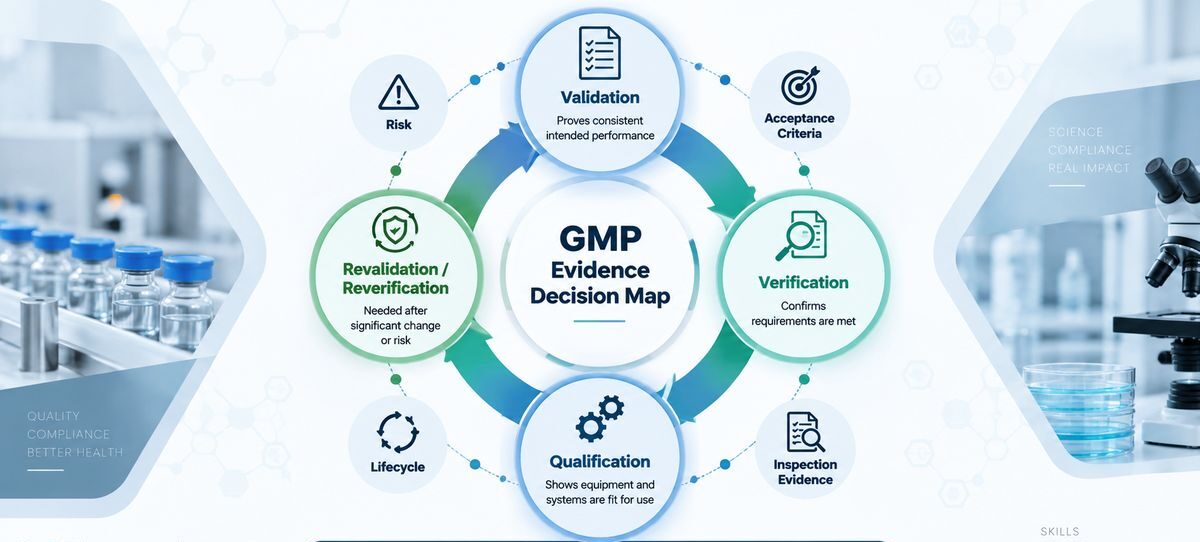
The Verification vs Validation: GMP Evidence Decision Map shows which type of evidence fits each lifecycle decision and helps teams avoid weak or unsupported conclusions.

GMP evidence decision map comparing verification, validation, acceptance criteria, and lifecycle control.
Verification vs validation decision map for selecting the right GMP validation evidence.

4 Evidence Decisions That Change the Required GMP Approach

The right GMP approach depends on the purpose, risk, and evidence required. Validation, qualification, or verification should be selected based on what must be proven and the intended regulatory outcome.

The following four evidence decisions show how regulatory expectations change across process validation, qualification, analytical validation, and method verification:

  • How Does Process Validation Build Lifecycle Assurance? (Available PDF)
  • How Does EU GMP Connect Qualification With Validation? (Available PDF)
  • When Does an Analytical Procedure Require Validation? (Available PDF)
  • When Is Method Verification Enough? (Available PDF)

How Does Process Validation Build Lifecycle Assurance? (Available PDF)

Process validation shows that a manufacturing process can consistently produce products that meet predefined quality requirements. It supports lifecycle assurance through process design, qualification, and continued process verification.

Download Guidance for Industry: Process Validation: General Principles and Practices Here

How Does EU GMP Connect Qualification With Validation? (Available PDF)

EU GMP Annex 15 links qualification and validation through a documented, risk-based lifecycle approach. It requires companies to confirm that facilities, equipment, utilities, systems, and processes remain suitable for their intended use.

Download EudraLex Volume 4 – EU Guidelines for Good Manufacturing Practice for Medicinal Products for Human and Veterinary Use – Annex 15: Qualification and Validation Here

When Does an Analytical Procedure Require Validation? (Available PDF)

Analytical procedure validation demonstrates that a method is suitable for its intended analytical purpose. The required validation characteristics depend on the procedure type, measured attribute, technology, and expected performance.

Download Validation of Analytical Procedures Q2(R2) Here

When Is Method Verification Enough? (Available PDF)

Method verification confirms that a previously validated or pharmacopoeial procedure performs acceptably under actual laboratory conditions. Therefore, full validation may not be necessary when the method is already established and only its suitability for local use must be demonstrated.

Download Annex 3: Good Manufacturing Practices: Guidelines on Validation Here

Where Verification Fits Across the Validation Lifecycle

Verification supports validation by confirming that processes, equipment, controls, and results continue to meet predefined requirements. However, it does not replace the broader validation evidence needed to establish process capability. During commercial manufacture, verification becomes especially important because teams monitor trends and detect unwanted variability. Therefore, combining validation with ongoing verification helps maintain a documented state of control throughout the product lifecycle.

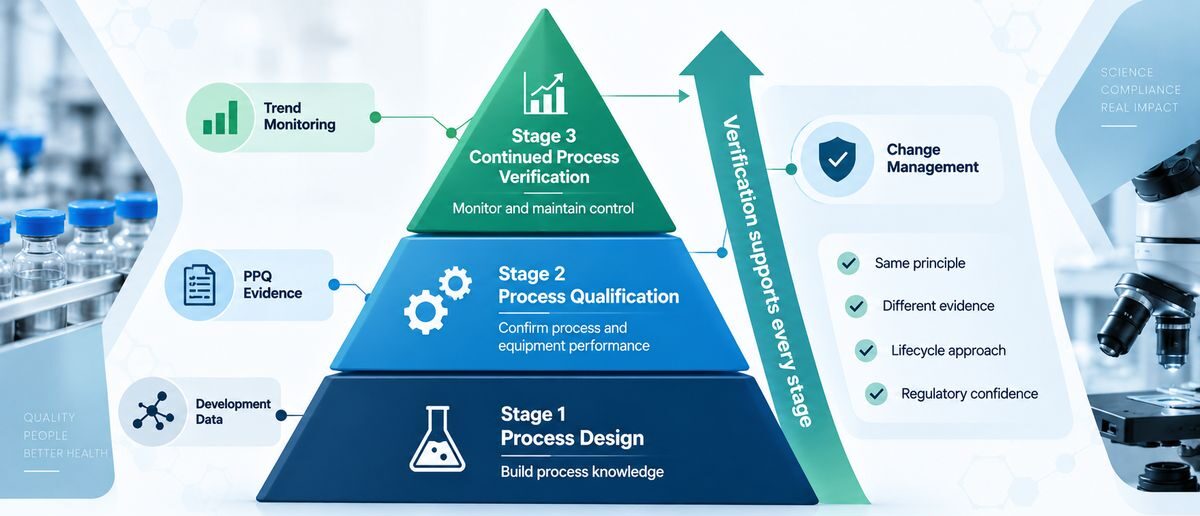
The table shows how verification supports each lifecycle stage and what evidence GMP teams should maintain.

Lifecycle Point Main Validation Purpose How Verification Fits Typical GMP Evidence
Stage 1: Process Design
Build process knowledge and define the commercial process.
Verification checks whether development data and assumptions meet predefined requirements.
Development studies, risk assessments, CQAs, process parameters
Stage 2: Process Qualification
Confirm that equipment, utilities, and the commercial process perform as intended.
Verification confirms qualification results and PPQ acceptance criteria.
IQ/OQ/PQ records, PPQ data, calibration records, acceptance criteria
Stage 3: Continued Process Verification
Maintain assurance that the process remains in a state of control.
Ongoing monitoring verifies process performance and product quality over time.
CPP/CQA trends, statistical analysis, deviations, capability data
Change Management
Protect the validated state after process, equipment, or material changes.
Verification confirms that changes achieve their intended result without unacceptable impact.
Change controls, risk assessments, comparability data, effectiveness checks


This infographic shows how verification supports all three validation lifecycle stages and helps maintain process control during commercial manufacture.

The three-stage validation lifecycle showing how verification supports process design, process qualification, and continued process verification

Practical Examples Across Pharmaceutical Operations

The correct GMP approach depends on what changed, the associated quality risk, and the evidence already available. For example, a new manufacturing process normally requires validation, while an established process needs continued verification during routine production. However, significant changes can trigger revalidation when previous evidence no longer supports the validated state. In laboratories, verification may be sufficient for an established pharmacopoeial method, whereas meaningful analytical changes can require revalidation.

Final Word

Strong GMP evidence depends on proving that processes and methods remain suitable for their intended use. Therefore, understanding verification vs validation in pharma helps teams choose the right evidence, maintain lifecycle control, and defend decisions during inspections. The issue remains current: FDA’s FY2025 drug inspection data recorded 121 observations linked to 21 CFR 211.160(b), which covers scientifically sound laboratory controls. This trend reinforces the need for clear acceptance criteria, justified methods, and documented evidence throughout routine operations.

FAQs

1️⃣ What is the difference between validation and verification in GMP?


Validation demonstrates that a process can consistently achieve its intended result. Verification confirms that defined requirements continue to be met through specific checks, testing, or ongoing monitoring.

2️⃣ When is revalidation required after a pharmaceutical process change?


Revalidation is needed when a change may affect product quality, process performance, or the validated state. Its scope should be based on a documented risk assessment.

3️⃣ Does a pharmacopoeial analytical method need validation or verification?


A recognised pharmacopoeial method generally requires verification to demonstrate suitability under the laboratory’s actual conditions. However, a non-pharmacopoeial or significantly modified analytical procedure normally requires appropriate validation.

Picture of Mahtab Shardi

Mahtab Shardi

Mahtab is a pharmaceutical professional with a Master’s degree in Physical Chemistry and over five years of experience in laboratory and QC roles. Mahtab contributes reliable, well-structured pharmaceutical content to Pharmuni, helping turn complex scientific topics into clear, practical insights for industry professionals and students.

FMEA in Pharma

FMEA in Pharma in 2026: A Practical Guide to Risk Assessment and Control

This practical guide explains FMEA in pharma, from defining scope through residual-risk review. Learn severity, occurrence, detection, RPN calculation, pharmaceutical applications, and control planning. Follow a worked tablet-compression example, compare related tools, and build clearer, science-based quality risk assessments with confidence during operations.

Read More »
5 Whys Root Cause Analysis in Pharma: Key Steps and Guide in 2026

5 Whys Root Cause Analysis in Pharma: Key Steps and Guide in 2026

Learn how pharmaceutical teams apply 5 Whys root cause analysis to deviations, OOS results, complaints, and CAPA investigations. Follow a verified workflow, review a tablet weight example, compare leading RCA tools, avoid common mistakes, and strengthen lasting quality improvements across operations confidently today.

Read More »

Share