


FMEA in pharma identifies potential failures before they harm products or patients. The method examines failure modes, effects, causes, and current controls. It then helps teams prioritize focused risk reduction. This structure supports better pharmaceutical quality management across the product lifecycle. However, FMEA does not produce certainty. It organizes available knowledge and exposes important uncertainty. Therefore, teams should use current process data and qualified expertise.
ICH Q9(R1) describes pharma quality management as a systematic process. The revision also emphasizes formality, subjectivity control, and knowledge management. Many teams incorrectly treat RPN as the final decision. Instead, scientific judgment must evaluate severity, uncertainty, and control strength. This guide explains scoring, documentation, risk controls, and residual-risk review. It also provides a practical tablet-compression example.
Table of Contents
What Is FMEA in Pharma?
Failure Mode and Effects Analysis provides a structured, prospective risk assessment. A cross-functional team studies each process step before assigning scores. The team identifies how each step could fail. Next, it describes every credible effect and likely cause. Existing prevention and detection controls also require clear documentation. This work creates a traceable connection between hazards and control actions. FMEA can support development, technology transfer, manufacturing, validation, and change control. It can also strengthen deviation investigations and CAPA planning.
FMEA vs FMECA, HACCP and Fault Tree Analysis
Several risk tools answer different questions. FMEA starts with process steps and potential failures. FMECA adds an explicit criticality assessment to FMEA. HACCP focuses on hazards and critical control points. Fault Tree Analysis starts with an undesired event. It then works backward through contributing causes. Therefore, teams should select tools according to the decision. Complex problems may require more than one method.
FMEA vs FMECA, HACCP and Fault Tree Analysis
| Tool | Primary Focus | Best Use |
|---|---|---|
|
FMEA |
Potential failure modes |
Process, product, equipment, or system risks |
|
FMECA |
Failure modes plus criticality |
Safety-critical or highly ranked risks |
|
HACCP |
Hazards and critical controls |
Contamination and process-control hazards |
|
Fault Tree Analysis |
Single undesired event |
Complex causal pathways |
How FMEA Aligns with ICH Q9(R1)
ICH Q9(R1) links risk assessment with risk control, communication, and review. FMEA supports that cycle through transparent, evidence-based documentation. The selected formality should match uncertainty, importance, and problem complexity. Therefore, a minor issue may need a simple assessment. A complex sterile process may require deeper analysis and broader expertise. Teams should also manage subjectivity deliberately. Defined scales, facilitation, evidence, and peer challenge improve scoring consistency. The assessment must identify assumptions and knowledge gaps. Otherwise, precise numbers may hide weak information.
- Severity estimates potential harm to patients, products, compliance, or supply.
- Occurrence estimates failure likelihood using data and process knowledge.
- Detection evaluates how reliably current controls reveal the failure.
- RPN multiplies severity, occurrence, and detection scores.
- Residual risk reflects remaining exposure after approved controls.
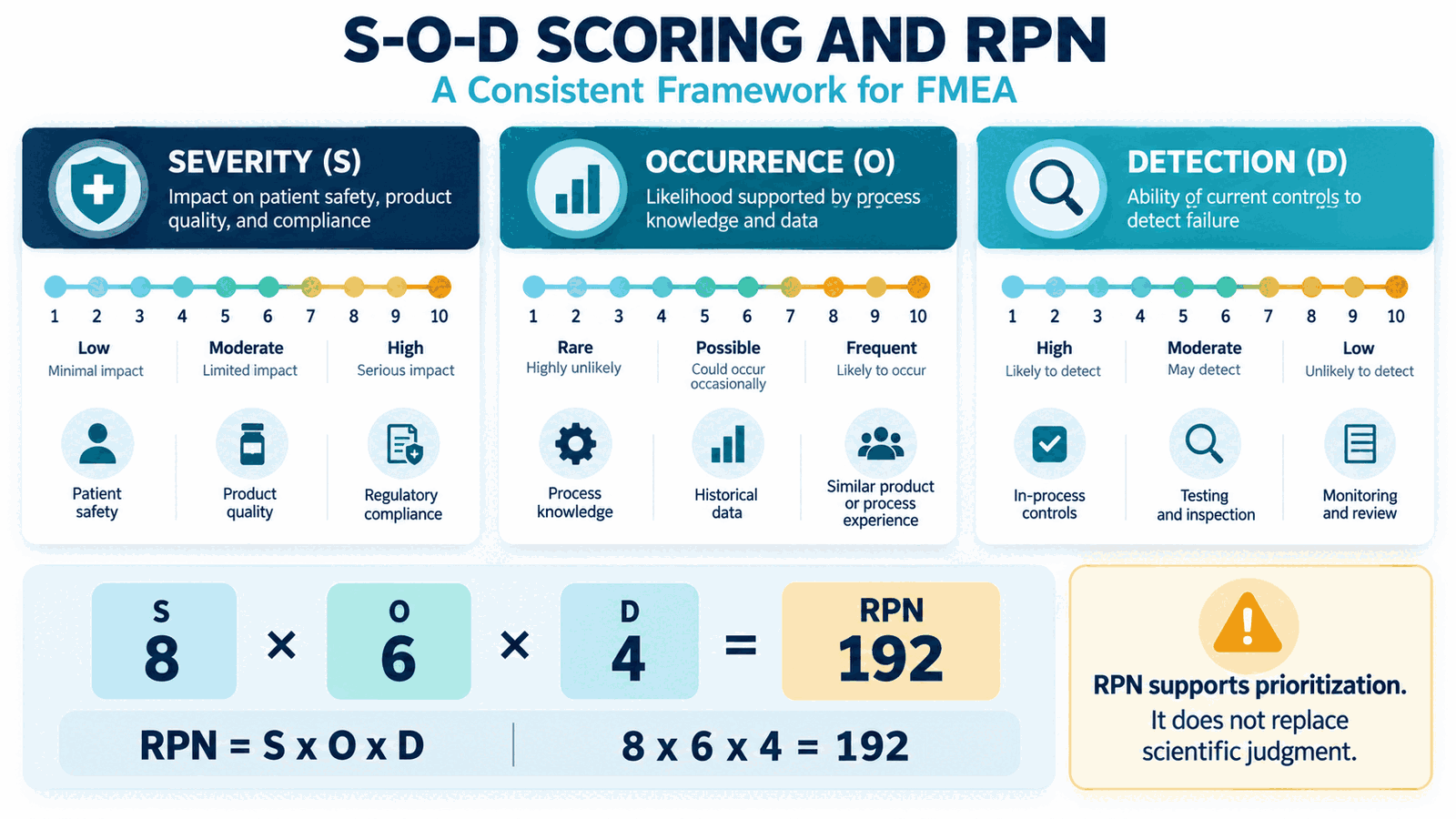
Item 1 Severity (S): impact on patient safety, product quality and compliance
Measures the consequence of a potential failure. It considers patient safety, product quality, and compliance. Higher severity means greater potential harm.
Item 2 Occurrence (O): likelihood based on process knowledge and data
Estimates how likely the failure is to happen. Ratings should use process knowledge and historical data. Higher occurrence means greater failure probability.
Item 3 Detection (D): ability of current controls to detect the failure
Evaluates how effectively current controls can detect a failure. Strong controls improve early identification. Higher detection scores usually indicate lower detectability.
Item 4 Risk Priority Number
RPN combines severity, occurrence, and detection ratings. It is calculated as RPN = S × O × D. Higher values can indicate greater need for risk reduction.
Item 5 Risk acceptability, action thresholds and residual risk
Defined thresholds determine whether risk is acceptable. Unacceptable risks require appropriate mitigation actions. Residual risk should be reassessed after controls are implemented.
How to Perform FMEA in Pharma in 7 Steps
A disciplined sequence makes FMEA repeatable and reviewable. Before scoring, approve definitions for every rating level. Also define escalation rules for high-severity risks. Never rely only on one RPN threshold. Different score combinations can produce identical RPN values. Yet, their patient implications may differ substantially.
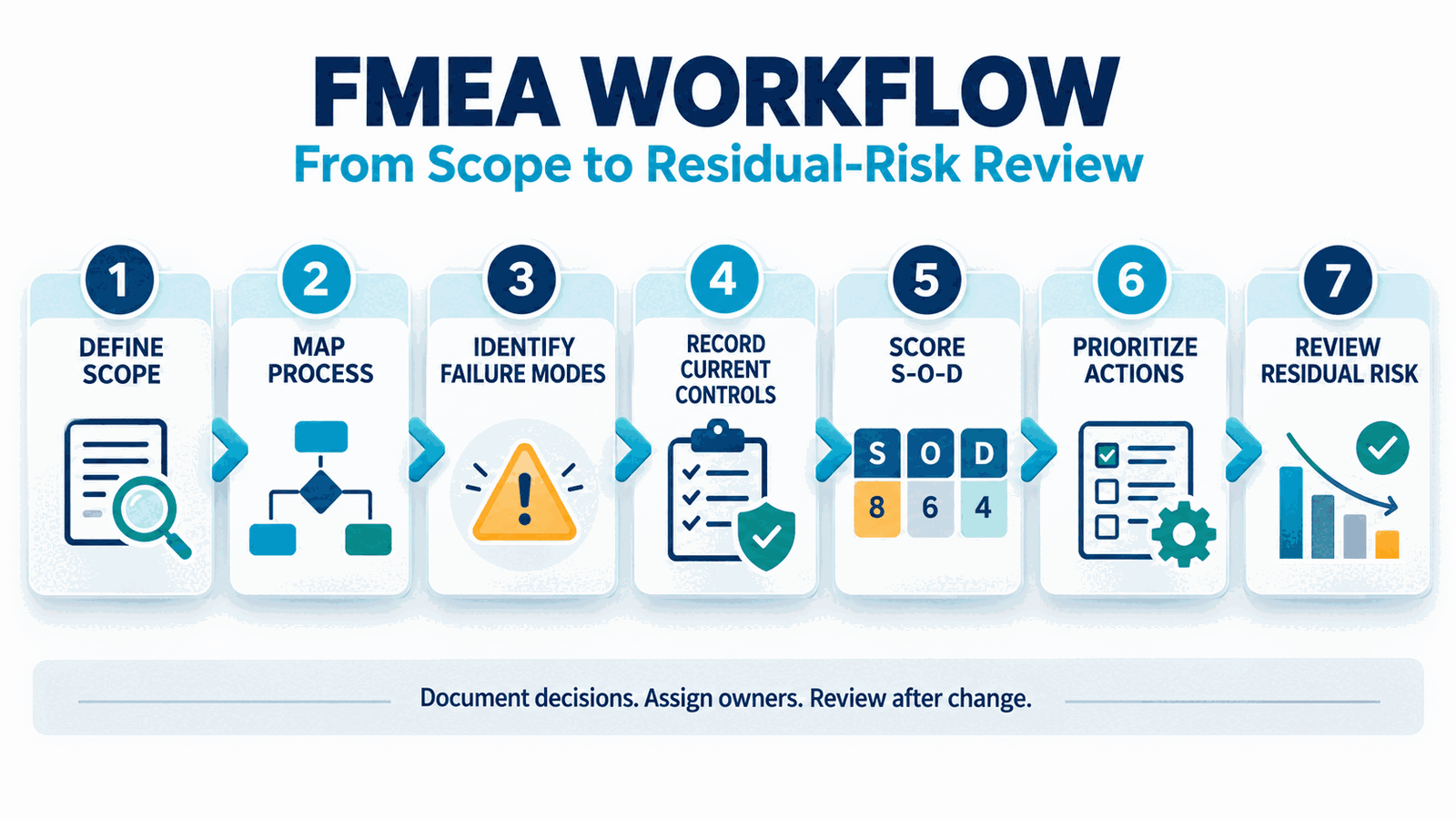
- Step 1 — Define scope, objectives, boundaries, assumptions, and required decisions.
- Step 2 — Form a cross-functional team with relevant process knowledge.
- Step 3 — Map process steps, inputs, outputs, interfaces, and dependencies.
- Step 4 — Identify failure modes, effects, causes, and existing controls.
- Step 5 — Score severity, occurrence, and detection using approved criteria.
- Step 6 — Prioritize actions, owners, deadlines, evidence, and effectiveness checks.
- Step 7 — Reassess scores, approve residual risk, and schedule reviews.
Causal levels in an investigation
Worked Pharmaceutical FMEA Example
Consider tablet weight variation during compression. Unstable powder feeding can disturb die filling. Tablets may then contain inconsistent mass and dose. The team assigns severity eight because dose inconsistency affects product quality. Historical process performance supports occurrence six. Current sampling provides detection four. Therefore, the initial RPN equals 192. This number indicates prioritization within the approved company matrix. It does not prove absolute risk acceptability.
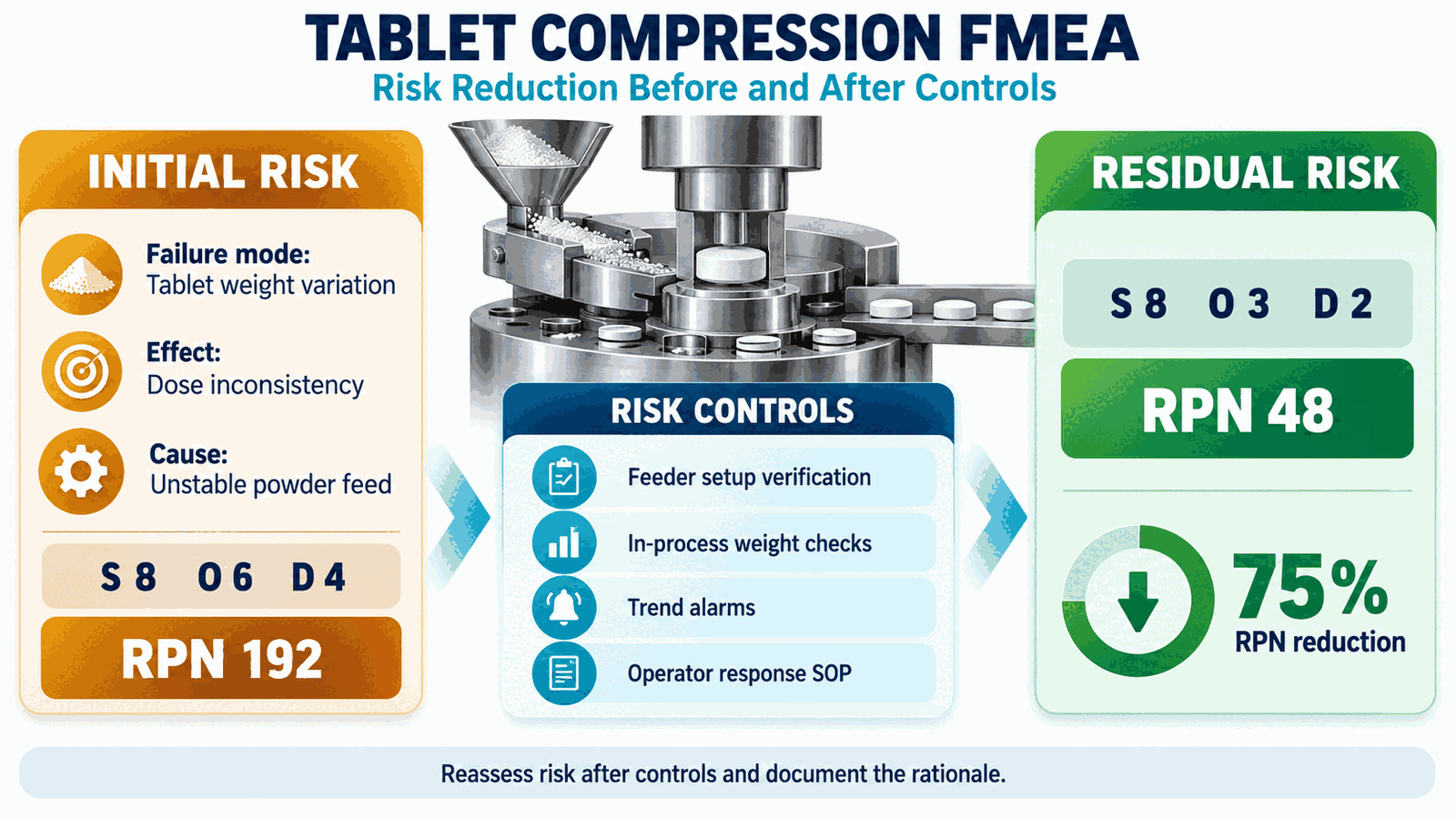
Example: Tablet Compression — Weight Variation and Content-Uniformity Risk
The team evaluates feeder setup, powder flow, and in-process monitoring. It introduces verified feeder settings and tighter weight-check frequencies. Trend alarms help operators detect drift sooner.
A response SOP defines adjustment limits and escalation requirements. After implementation, occurrence falls from six to three. Detection falls from four to two. Severity remains eight because the potential effect remains serious. Consequently, the residual RPN becomes 48. Quality leaders then compare residual risk against approved acceptance criteria.
Example Scoring, Actions, Ownership and Post-Control RPN
Every action requires an owner, due date, and effectiveness measure. Evidence may include capability data, alarm challenges, or deviation trends. The team should avoid lowering scores before verifying implementation. Likewise, detection scores should reflect actual control reliability. They should not reflect planned controls. Residual-risk approval must identify the accountable decision-maker. Periodic product review can then confirm sustained control performance.
Where FMEA Is Used Across the Pharmaceutical Lifecycle
FMEA can connect development knowledge with commercial control strategies. The tool remains useful when products, processes, equipment, or regulations change. Teams should update assessments after significant deviations or emerging trends. However, routine reviews should also confirm continued relevance. Archived assessments quickly lose value when controls change silently.
- Development teams rank critical material attributes and process variables.
- Technology-transfer teams evaluate knowledge gaps, scale effects, and site differences.
- Manufacturing teams assess equipment, utilities, process steps, and human interactions.
- Validation teams define challenge conditions and monitoring priorities
Final Word
Effective FMEA in pharma turns process knowledge into defendable quality decisions. Strong assessments use clear scopes, reliable evidence, and consistent rating criteria. They also protect patient safety through proportional risk controls. RPN helps organize priorities, but judgment remains essential. Therefore, teams should challenge assumptions and document uncertainty.
They should verify control effectiveness before reducing scores. Finally, lifecycle reviews keep assessments aligned with current operations. This discipline strengthens compliance, product quality, and business continuity.
FAQs
FMEA means Failure Mode and Effects Analysis. It identifies potential failures, their effects, causes, and controls. Pharmaceutical teams use it to prioritize risk reduction before problems reach patients.
No universal regulation mandates one RPN formula. Companies define suitable scoring methods within their quality systems. The method should remain documented, consistent, science-based, and proportionate.
Review timing should match lifecycle risk and process change. Significant deviations, changes, complaints, or trends can trigger review. Periodic reviews confirm assumptions and control performance.

Ershad Moradi
Ershad Moradi, a Content Marketing Specialist at Zamann Pharma Support, brings 6 years of experience in the pharmaceutical industry. Specializing in pharmaceutical and medical technologies, Ershad is currently focused on expanding his knowledge in marketing and improving communication in the field. Outside of work, Ershad enjoys reading and attending industry related networks to stay up-to-date on the latest advancements. With a passion for continuous learning and growth, Ershad is always looking for new opportunities to enhance his skills and contribute to pharmaceutical industry. Connect with Ershad on Facebook for more information.

GMP Inspection Readiness : A Proven Audit Guide in 2026
GMP inspection readiness means showing that your pharmaceutical quality systems work every day. This practical guide walks QA, QC and site leaders through a five-step, risk-based preparation framework, with priority evidence to review, mock inspection tips, CAPA guidance and answers to common inspection questions.

GMP Training Matrix in 2026: How to Build an Audit-Ready, Role-Based Training System
Learn how to build a GMP training matrix that links pharma team roles to SOPs, records competency evidence, tracks retraining, and supports inspection readiness.

Universities vs Pharmuni in 2026: Faster Pharma Career Readiness
Universities provide formal degrees, research depth and academic credibility. Pharmuni adds faster pharma-specific upskilling, assessments, Career Paths, CV tools and job-readiness support. Here is how the two models differ—and when using both makes sense.