


5 whys root cause analysis examines why a quality event occurred. It moves teams beyond visible symptoms. Each answer creates the next focused question. However, every answer requires objective evidence. This discipline matters across pharmaceutical manufacturing. Weak investigations allow deviations, complaints, and OOS results to recur. Consequently, recurring failures threaten product quality, compliance, supply continuity, and patient safety.
FDA warning letters still identify inadequate root cause determinations. A July 2025 letter criticized unsupported conclusions and limited investigation scope. Moreover, 2026 letters continued requesting stronger investigations and CAPA effectiveness systems.
This guide explains the method, evidence requirements, limitations, and documentation. It also links investigation practice with pharma quality management and ICH Q10 principles. Explore pharma quality management for broader system context.
Table of Contents
What Is 5 Whys Root Cause Analysis?
The method creates a cause-and-effect chain through repeated questioning. Teams begin with a precise problem statement. They then ask why the event happened. Each supported answer becomes the basis for another question.
The final answer should explain system failure, not personal blame. For example, “operator error” rarely provides enough depth. Investigators should examine procedures, interfaces, training design, workload, equipment, and oversight.
The tool works best for focused events with a reasonably linear pathway. Complex failures often contain several interacting paths. In those cases, teams should combine 5 Whys with broader tools.
What Is 5 Whys Root Cause Analysis?
The method creates a cause-and-effect chain through repeated questioning. Teams begin with a precise problem statement. They then ask why the event happened. Each supported answer becomes the basis for another question.
The final answer should explain system failure, not personal blame. For example, “operator error” rarely provides enough depth. Investigators should examine procedures, interfaces, training design, workload, equipment, and oversight.
The tool works best for focused events with a reasonably linear pathway. Complex failures often contain several interacting paths. In those cases, teams should combine 5 Whys with broader tools.
Use 5 Whys when the investigation includes these conditions
The event has a clear and specific problem statement. Available records can verify each causal connection. The suspected pathway remains relatively linear.
The team includes relevant technical process knowledge. The event risk supports this method’s depth and formality. The analysis can expand when multiple pathways appear.
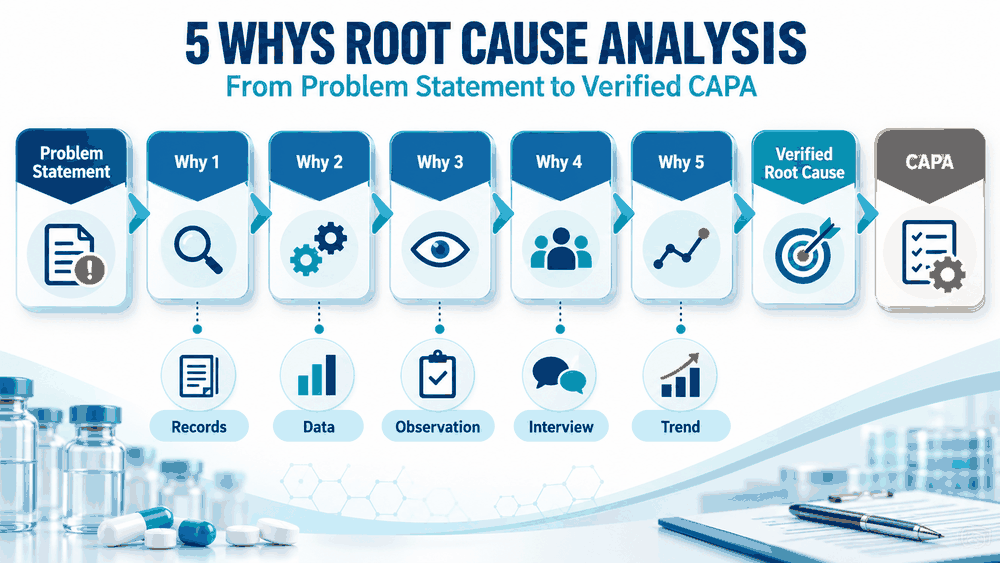
How 5 Whys Supports Pharmaceutical Investigations
ICH Q10 expects a structured investigation approach that determines root causes. It also expects CAPA effectiveness evaluation. Therefore, 5 Whys can support the pharmaceutical quality system when applied rigorously.
FDA OOS guidance also requires scientifically sound investigations. Passing retests cannot erase an unexplained failing result. Instead, investigators must evaluate laboratory and manufacturing causes using documented evidence.
A strong analysis separates four causal levels. The symptom describes what became visible. The direct cause explains the immediate mechanism. Contributing factors increased likelihood. The root cause identifies the underlying controllable system weakness.
Causal levels in an investigation
| Level | Purpose | Example |
|---|---|---|
|
Symptom |
Visible quality signal |
Tablet weights exceed limits |
|
Direct cause |
Immediate failure mechanism |
Die filling becomes inconsistent |
|
Contributing factor |
Condition increasing likelihood |
Granule moisture varies |
|
Root cause |
Controllable systemic weakness |
Calibration control lacks risk basis |
How to Conduct a 5 Whys Root Cause Analysis Step by Step
A disciplined sequence prevents assumption-driven conclusions. First, define what happened, where, when, and how often. Next, establish the affected products, batches, systems, and time periods.
Then, assemble QA, operations, engineering, laboratory, and subject experts. The team should preserve evidence before changing conditions. Afterwards, ask each why without suggesting a preferred answer.
Verify every answer using batch records, audit trails, logs, interviews, trends, and observations. Reject answers that lack support. Finally, test whether removing the proposed cause prevents recurrence.
Investigation workflow
Step 1 — Define the event using measurable facts.
Step 2 — Establish scope, impact, and immediate controls.
Step 3 — Map each why to supporting evidence.
Step 4 — Explore alternative and parallel causal paths.
Step 5 — Verify systemic and contributing causes.
Step 6 — Assign CAPA and effectiveness measures.
Evidence for cause verification
| Evidence source | What it can confirm | Typical record |
|---|---|---|
|
Process data |
Timing and parameter relationships |
Historian or batch trend |
|
Equipment records |
Failure, maintenance, or calibration status |
CMMS and calibration log |
|
Laboratory data |
Analytical sequence and validity |
Raw data and audit trail |
|
Interviews |
Work sequence and decision context |
Signed interview notes |
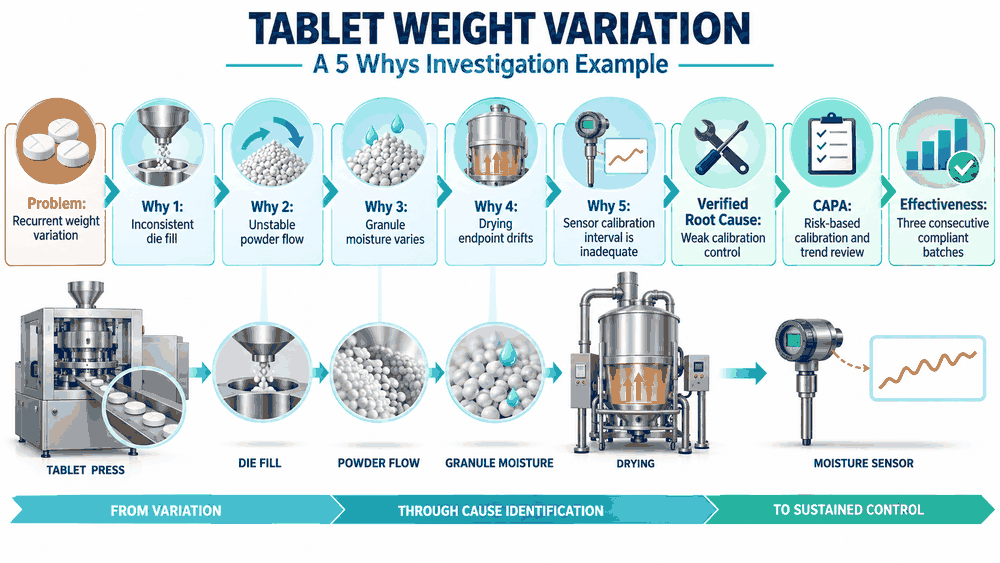
Pharmaceutical 5 Whys Example Recurrent Tablet Weight Variation
A tablet line shows recurrent weight variation during extended runs. The investigation confirms inconsistent die filling. Powder flow becomes unstable after several production hours.
Granule moisture varies between dryer discharge locations. The drying endpoint depends on one moisture sensor. Calibration records show an interval unsupported by process risk.
The verified root cause involves weak calibration control. However, granulation variability remains a contributing factor. The team revises calibration frequency and introduces sensor trend review.
Common 5 Whys Mistakes in Pharma and How to Avoid Them
Poor investigations often follow a preferred narrative. Teams may stop at training gaps or operator mistakes. Yet those conclusions rarely explain why controls failed.
Another mistake involves asking leading questions. This practice creates confirmation bias. Instead, teams should test several plausible causes against the same evidence.
Investigators also confuse correlation with causation. A maintenance activity may precede failure without causing it. Therefore, teams should confirm mechanisms through records, experiments, or reproducible observations.
Mistake 1 Stopping at human error or inadequate training
“Human error” describes what happened, but rarely explains why it happened. Check whether the procedure, equipment, workload, or work environment made the error more likely. Retraining alone may leave the underlying cause in place.
Mistake 2 Using assumptions instead of objective evidence
Build each conclusion from records, observations, interviews, or test results. Separate confirmed facts from hypotheses and document any gaps in the evidence. An unsupported assumption can send the investigation toward the wrong cause.
Mistake 3 Following only one causal path in a multi-factor event
A deviation can result from several conditions acting together. Examine the full process and test plausible contributing factors, even after finding one likely cause. This helps prevent a narrow CAPA that addresses only part of the problem.
Mistake 4 Writing vague problem statements
A statement such as “the process failed” gives investigators too little to examine. Specify what happened, where and when it occurred, and how the result differed from the requirement. A precise problem statement makes the investigation easier to focus and verify.
Mistake 5 Choosing CAPA before verifying the root cause
Do not select an action simply because it is quick or familiar. First, compare the proposed root cause with the available evidence and check whether it explains the event. Then choose actions that address the verified cause and define how their effectiveness will be measured.
Mistake 6 Failing to assess product impact and investigation scope
Determine which batches, materials, equipment, and time periods may be affected. Assess the potential effect on product quality using the available evidence. Document why the investigation includes or excludes each potentially affected area.
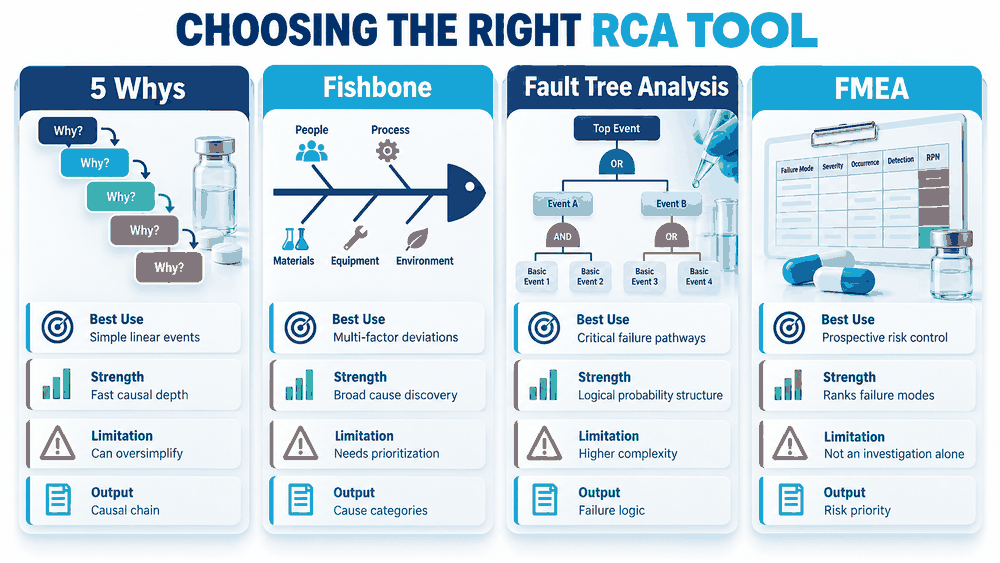
5 Whys vs Fishbone, Fault Tree Analysis, and FMEA
No single RCA tool suits every quality event. 5 Whys provides speed and understandable causal depth. Fishbone analysis broadens discovery across people, process, equipment, materials, methods, and environment.
Fault tree analysis models logical failure combinations. It supports high-risk technical events with branching pathways. Meanwhile, FMEA ranks prospective failure modes. FMEA does not replace retrospective investigation.
Teams can begin complex events with a fishbone diagram. They can then apply 5 Whys to priority branches. This combination balances broad exploration with focused causal depth.
Statistical tools can also test suspected relationships. Control charts reveal shifts, cycles, and special causes. Designed experiments can separate interacting process variables. Therefore, tool selection should follow uncertainty and risk.
Final Word
5 Whys offers a simple framework for disciplined causal thinking. However, simplicity never removes the need for evidence. Strong teams verify every link, review 100% of relevant records, and test alternative explanations using risk-based analysis.
Within pharmaceutical quality systems, rigorous RCA supports effective CAPA. It also protects product quality, compliance, supply reliability, and patient safety. Therefore, investigators should treat 5 Whys as a structured method, not paperwork. FDA and EU GMP expectations emphasize documented root cause evaluation, with CAPA effectiveness checks confirming that issues are prevented from recurring.
FAQs
No. Five provides a practical reminder, not a mandatory endpoint. Stop after verifying a systemic cause. Continue when evidence shows deeper control weaknesses.
Yes, but investigators must follow applicable OOS procedures. They should evaluate laboratory and manufacturing causes. Unsupported retesting cannot replace scientific root cause analysis.
Usually not by itself. Investigators should examine procedure design, training effectiveness, interfaces, workload, supervision, and error-proofing. These factors often reveal controllable weaknesses.

Ershad Moradi
Ershad Moradi, a Content Marketing Specialist at Zamann Pharma Support, brings 6 years of experience in the pharmaceutical industry. Specializing in pharmaceutical and medical technologies, Ershad is currently focused on expanding his knowledge in marketing and improving communication in the field. Outside of work, Ershad enjoys reading and attending industry related networks to stay up-to-date on the latest advancements. With a passion for continuous learning and growth, Ershad is always looking for new opportunities to enhance his skills and contribute to pharmaceutical industry. Connect with Ershad on Facebook for more information.

GMP Training Effectiveness 2026: Proven Ways to Build Real Competence
GMP training effectiveness goes beyond attendance records and quiz scores. Learn how role-based assessments, on-the-job observation, and meaningful KPIs help verify employee competence, strengthen training records, and address recurring performance gaps across pharmaceutical operations.

GMP Audit Checklist 2026: The Essential Guide for Risk-Based Audits
Master your GMP Audit Checklist with a practical, risk-based approach to pharmaceutical self-inspections. Explore five essential audit steps, FDA’s six-system model, GMP documentation and evidence sampling, audit findings, CAPA tracking, and effectiveness verification to strengthen compliance and inspection readiness.
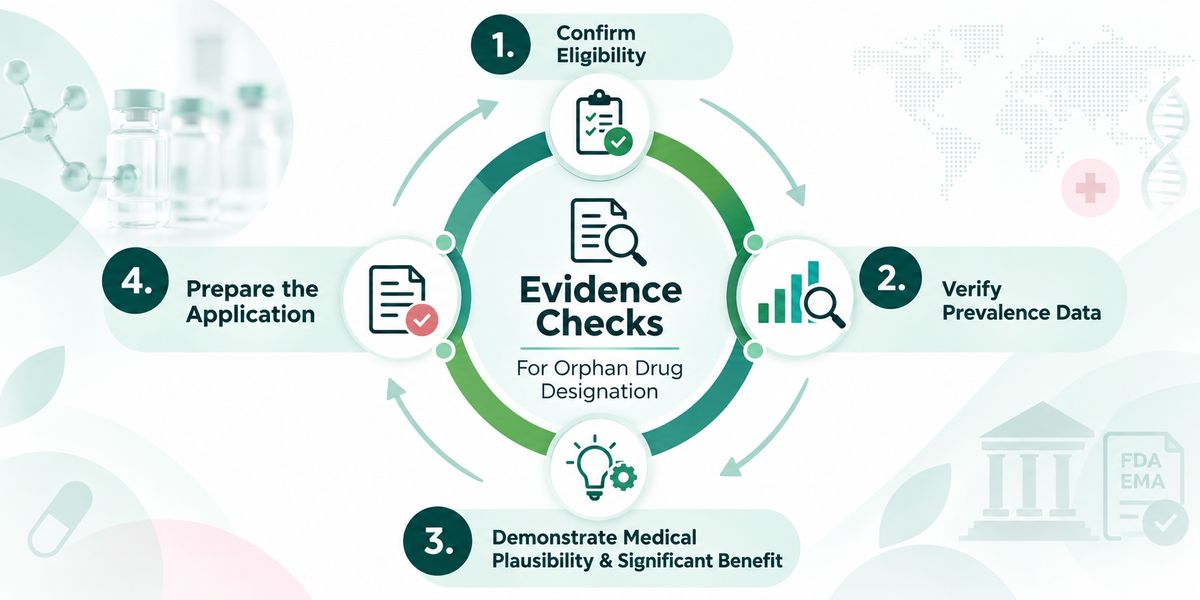
Orphan Drug Designation in 2026: FDA and EMA Eligibility Criteria
Discover how orphan drug designation works in 2026. Compare FDA and EMA eligibility criteria, rare disease prevalence thresholds, scientific evidence requirements, and regulatory incentives. Learn what pharmaceutical sponsors need to prepare for successful regulatory submissions