


Regulatory intelligence in pharma turns external change into practical regulatory action. Pharmaceutical companies face continuous updates across markets, products, and lifecycle stages. EMA recommended 104 human medicines for authorization during 2025. It also reviewed 1,201 potential safety signals during that year. Meanwhile, FDA published new 2026 guidance agendas across major centers. ICH also completed the E6(R3) Good Clinical Practice revision in 2026. These examples show why passive monitoring creates avoidable regulatory risk.
A revised EU reference-sample annex becomes applicable on 24 September 2026. Teams need structured pharma regulation monitoring before such changes take effect. This guide explains sources, workflows, tools, AI, and impact assessment. Regulatory information is not intelligence until teams judge relevance and impact.
Table of Contents
What Is Regulatory Intelligence in Pharma?
Regulatory intelligence is a structured process for finding and interpreting regulatory change. It combines monitoring, analysis, communication, and documented follow-up. Teams use pharmaceutical regulatory intelligence to understand new expectations early. They also compare requirements across countries, products, and development stages. The goal is not collecting more documents. The goal is identifying information that can change decisions. Strong intelligence connects external requirements with internal owners, systems, and timelines. Therefore, it supports regulatory strategy before deadlines create operational pressure. Effective programs also distinguish confirmed requirements from emerging expectations.
Regulatory Intelligence vs. Regulatory Affairs
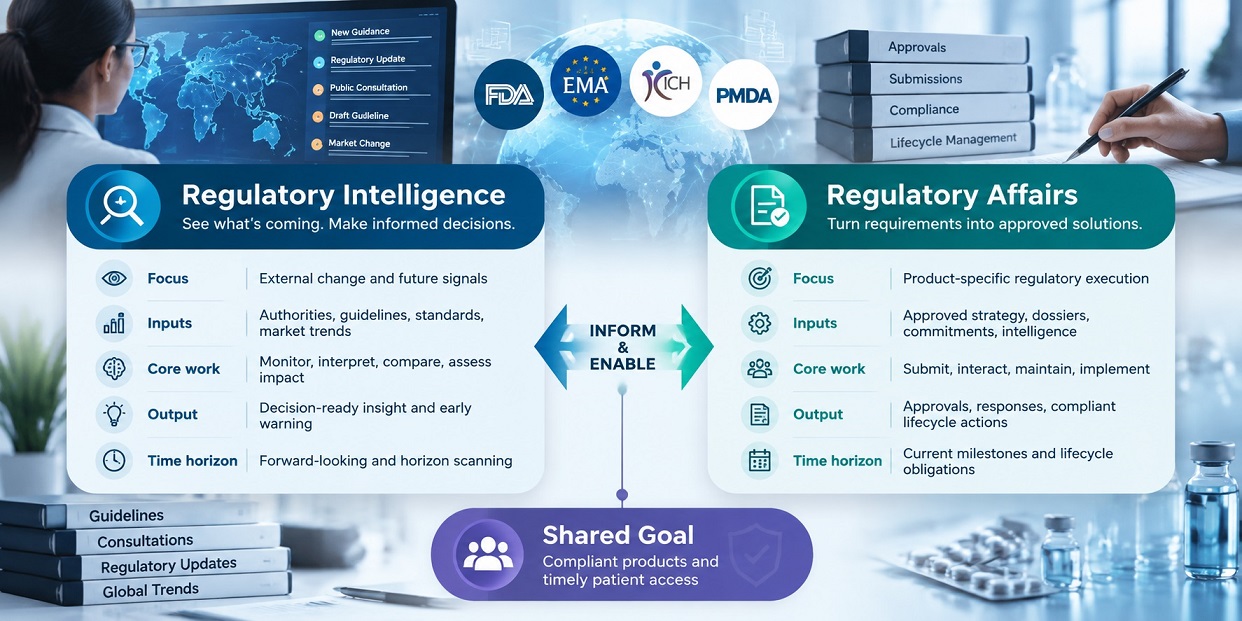
Regulatory intelligence and regulatory affairs support the same compliance objective. However, their daily focus differs. Intelligence teams scan external environments and interpret emerging regulatory signals. Regulatory affairs teams apply requirements to submissions, approvals, and authority interactions. Intelligence therefore looks outward and forward.
Regulatory affairs converts those insights into product-specific regulatory execution. Mature organizations connect both functions through shared evidence and governance. Regulatory intelligence may identify a future submission risk months earlier. Regulatory affairs then decides how that risk affects authority engagement. This handoff works best with agreed roles and controlled records.
Strategic Value of Regulatory Intelligence in Pharma
Regulatory intelligence creates value when teams connect signals with business decisions. It strengthens planning across development, registration, manufacturing, and post-authorization activities. Moreover, it helps functions prepare evidence before regulators request changes. The strongest programs focus on relevance, timing, ownership, and traceability.
Strategic Value 1 — Faster Regulatory Decision-Making
Teams make faster decisions when verified intelligence reaches the correct owner quickly. A concise impact summary reduces repeated searching and interpretation. Therefore, leaders can compare options using the same regulatory evidence.
Strategic Value 2 — Earlier Identification of Regulatory Change
Horizon scanning reveals draft guidance, consultations, standards, and enforcement trends early. Early signals provide time for scenario planning and stakeholder discussion. They also reduce rushed responses near implementation dates.
Strategic Value 3 — Better Submission and Lifecycle Planning
Regulatory updates can affect development plans, dossiers, commitments, and post-approval changes. Intelligence helps teams adjust sequencing before submissions reach critical milestones. Consequently, lifecycle planning becomes more resilient across markets.
Strategic Value 4 — Lower Compliance and Inspection Risk
Missed changes can create outdated procedures, controls, or technical documentation. Regulatory compliance intelligence links new expectations with internal change management. This connection supports inspection readiness and more defensible implementation decisions.
Strategic Value 5 — Stronger Alignment Across Global Markets
Global regulatory intelligence helps teams compare convergence and divergence across authorities. Similar requirements may still differ by timing, scope, or evidence. A shared comparison reduces duplicated work and inconsistent local interpretation.
Core Sources of Regulatory Intelligence
Reliable intelligence starts with authoritative primary sources. FDA guidance pages provide draft, final, and planned guidance signals. EMA publishes guidelines, consultations, safety communications, and annual regulatory activity data. ICH provides harmonized guidelines across quality, safety, efficacy, and multidisciplinary topics. EudraLex contains important European pharmaceutical rules and GMP guidance. WHO publishes global pharmaceutical norms and regulatory standards.
Primary sources Regulatory Intelligence such as FDA and EMA guidance pages and ICH guidelines
| Primary Source | What Teams Monitor | Typical Intelligence Use |
|---|---|---|
|
FDA |
Guidance search, center agendas, safety communications |
US policy signals, draft changes, implementation planning |
|
EMA |
Guidelines, consultations, safety updates, annual activity |
EU lifecycle change, safety monitoring, strategic planning |
|
ICH |
Quality, safety, efficacy, multidisciplinary guidelines |
Global harmonization, implementation readiness, gap assessment |
|
EudraLex |
EU legal framework and Volume 4 GMP guidance |
GMP change tracking, manufacturing and quality impact |
|
WHO |
Pharmaceutical norms and regulatory standards |
Global standards, reliance, quality and market oversight |
How a Pharma Regulatory Intelligence Process Works
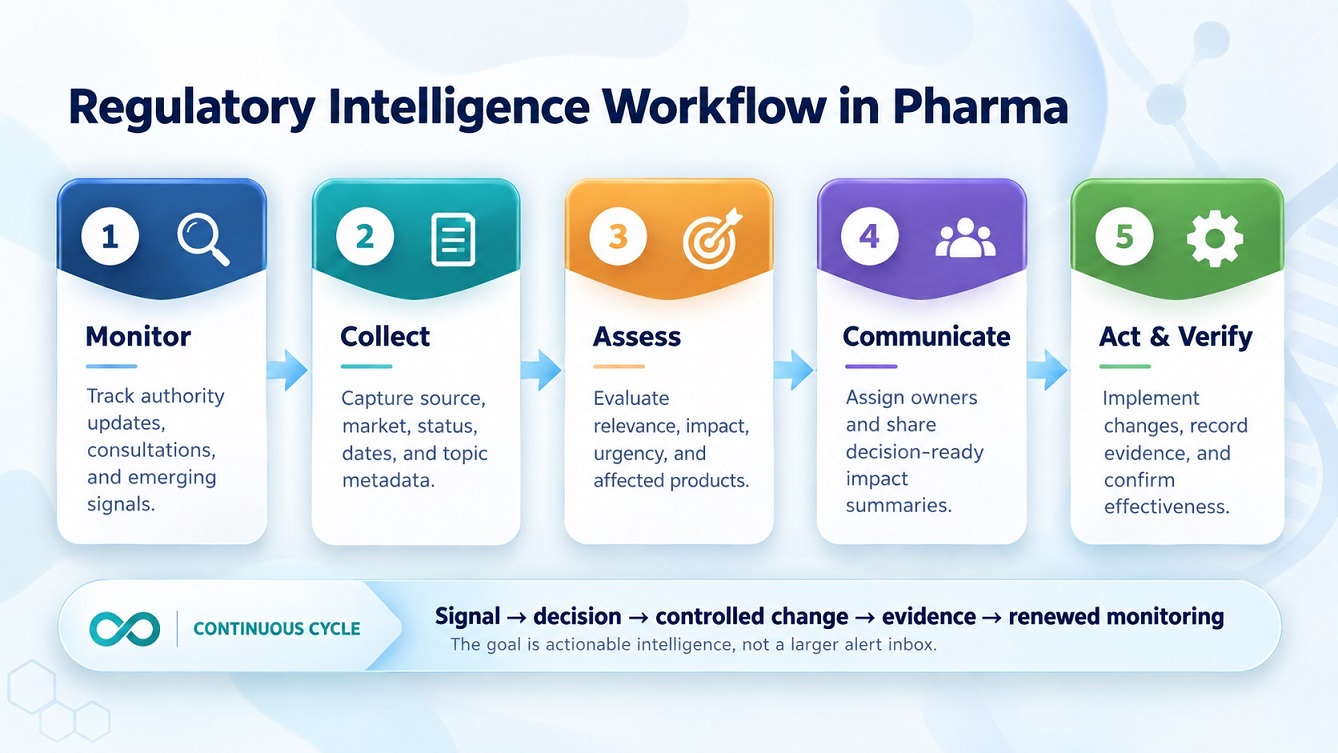
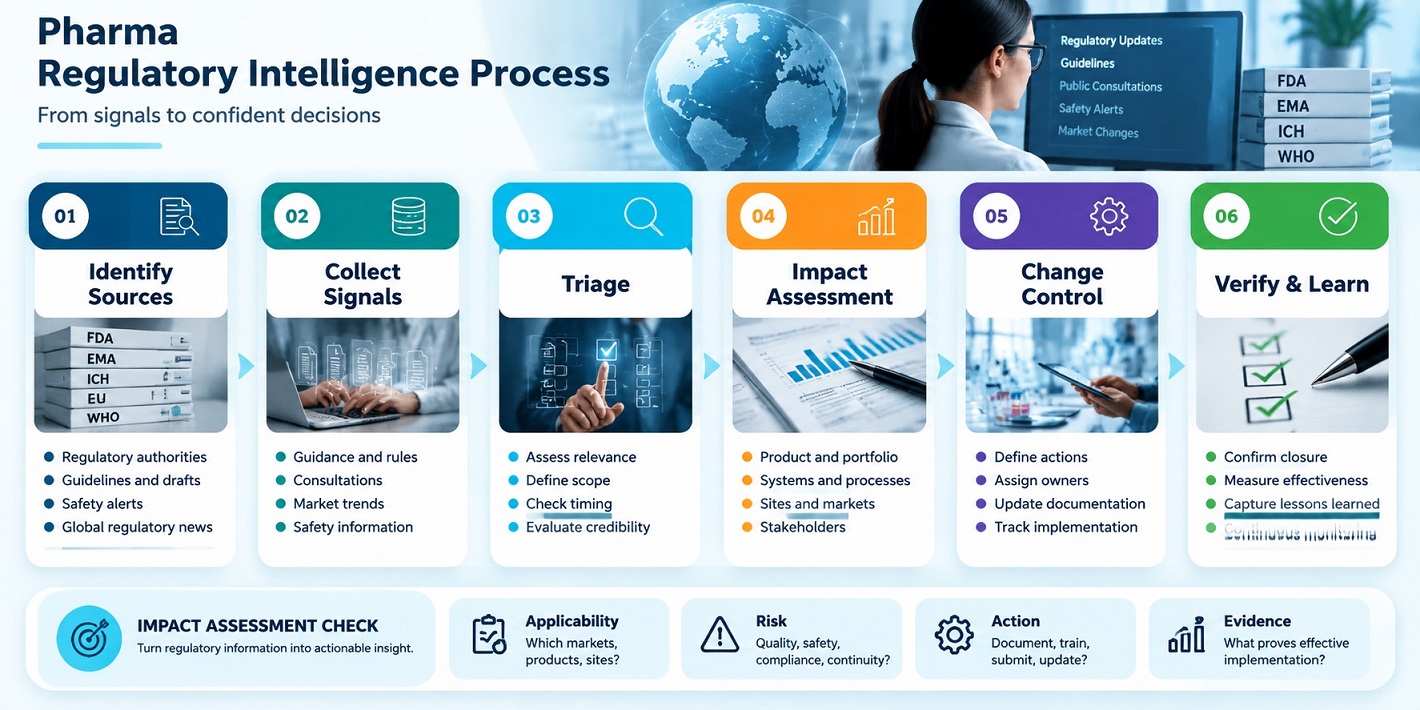
A strong process moves information through controlled decision stages. It prevents alerts from becoming disconnected emails or personal knowledge. The workflow should define inputs, owners, evaluation rules, outputs, and closure evidence. It should also connect with regulatory change management and quality systems. This workflow should align with broader pharma regulation governance.
Step 1: Monitor and collect regulatory signals
First, teams identify trusted sources for each product and market. They configure alerts for FDA regulatory updates, EMA guidelines, and ICH guidelines. They also monitor consultations, inspection trends, safety communications, and standards revisions. Next, teams capture each signal with consistent metadata. Useful fields include jurisdiction, topic, status, publication date, and effective date. A central repository reduces duplicated monitoring across departments. Monitoring should reflect the organization’s actual regulatory footprint.
Step 2: Analyze, prioritize, and communicate impact
Next, specialists assess relevance before distributing each update broadly. They compare the signal with products, processes, submissions, and controlled documents. High-impact changes receive owners, deadlines, and formal regulatory impact assessment. Communication should explain both requirement and practical consequence. Decision records should remain traceable after implementation. Finally, teams confirm completion and monitor later authority clarifications.
Some important questions are
- Which products, markets, sites, systems, or submissions could change?
- Is the source draft, final, effective, delayed, or under consultation?
- What compliance, quality, safety, or business risk exists?
Tools, Technology, AI & Best Practices in Regulatory Intelligence
Technology can increase coverage, consistency, and speed across regulatory monitoring. Regulatory databases centralize searchable requirements and authority content. Alerting systems reduce manual checking across multiple websites. Dashboards help leaders see open signals, deadlines, and implementation status. Workflow tools connect intelligence with owners, tasks, and regulatory change management. AI-assisted screening can classify, compare, summarize, and prioritize large document sets.
These controls make regulatory intelligence auditable:
- Use primary-source links as the evidence baseline for every important signal.
- Apply risk-based prioritization instead of treating every update equally.
- Separate monitoring, interpretation, approval, and implementation responsibilities clearly.
- Validate AI summaries before using them for regulatory decisions.
Core Functions of Tools in Regulatory Intelligence
| Tool Category | Core Function | Control Needed |
|---|---|---|
|
Regulatory databases |
Centralize searchable requirements and regulatory content |
Source currency and jurisdiction mapping |
|
Alerting systems |
Notify teams about new or changed source content |
Noise filtering and relevance rules |
|
Dashboards |
Track signals, deadlines, owners, and status |
Defined metrics and status definitions |
|
Workflow tools |
Route assessment, approval, change, and closure |
Role clarity and audit trail |
|
AI-assisted screening |
Classify, compare, summarize, and prioritize documents |
Human verification and source traceability |
Final Word
Regulatory intelligence works best as a controlled business capability. It should connect trusted sources with ownership, impact assessment, and documented action. Effective programs also connect regulatory monitoring with quality and lifecycle governance. Technology and AI can strengthen scale, but expert judgment remains essential.
Technical programs often track 100+ regulatory sources, including global authorities, guidelines, safety updates, and consultation documents. Mature teams may define service-level targets, such as reviewing critical regulatory signals within 24–72 hours. They also measure implementation effectiveness, for example, the percentage of regulatory-driven actions completed and verified within the planned timeline.
FAQs
It means systematically monitoring, interpreting, and applying regulatory information. Teams convert external change into product, submission, quality, and compliance actions.
Teams should prioritize official authorities and recognized standards organizations. Common sources include FDA, EMA, ICH, EudraLex, WHO, and relevant national agencies.
Regulatory intelligence focuses on external change and strategic interpretation. Regulatory affairs applies requirements through submissions, approvals, interactions, and lifecycle maintenance.

Ershad Moradi
Ershad Moradi, a Content Marketing Specialist at Zamann Pharma Support, brings 6 years of experience in the pharmaceutical industry. Specializing in pharmaceutical and medical technologies, Ershad is currently focused on expanding his knowledge in marketing and improving communication in the field. Outside of work, Ershad enjoys reading and attending industry related networks to stay up-to-date on the latest advancements. With a passion for continuous learning and growth, Ershad is always looking for new opportunities to enhance his skills and contribute to pharmaceutical industry. Connect with Ershad on Facebook for more information.

GMP Training Effectiveness 2026: Proven Ways to Build Real Competence
GMP training effectiveness goes beyond attendance records and quiz scores. Learn how role-based assessments, on-the-job observation, and meaningful KPIs help verify employee competence, strengthen training records, and address recurring performance gaps across pharmaceutical operations.

GMP Audit Checklist 2026: The Essential Guide for Risk-Based Audits
Master your GMP Audit Checklist with a practical, risk-based approach to pharmaceutical self-inspections. Explore five essential audit steps, FDA’s six-system model, GMP documentation and evidence sampling, audit findings, CAPA tracking, and effectiveness verification to strengthen compliance and inspection readiness.
Orphan Drug Designation in 2026: FDA and EMA Eligibility Criteria
Discover how orphan drug designation works in 2026. Compare FDA and EMA eligibility criteria, rare disease prevalence thresholds, scientific evidence requirements, and regulatory incentives. Learn what pharmaceutical sponsors need to prepare for successful regulatory submissions