


A drug master file provides confidential technical information directly to the FDA. It supports another regulatory submission without revealing proprietary manufacturing knowledge. However, a DMF never replaces an IND, NDA, or ANDA. The applicant still owns the application and its overall quality justification.
FDA records show more than 44,000 DMF numbers through June 2026. That total shows the system’s continuing importance across global supply chains. Strong DMFs help reviewers assess materials, processes, packaging, and supporting controls. They also connect suppliers with broader pharma regulation responsibilities.
This guide explains DMF types, authorization, electronic structure, review, and lifecycle maintenance. It also highlights common filing failures and practical prevention measures.
Table of Contents
What Is a Drug Master File
A Drug Master File is a confidential regulatory submission. A holder sends it directly to the FDA. The file may describe facilities, processes, articles, or supporting information. FDA reviews that content only when another submission references the DMF.
Submission remains voluntary under federal regulations. Nevertheless, many suppliers use DMFs for commercial and confidentiality reasons. The approach avoids repeating sensitive CMC information across several customer applications. It also supports consistent change management across multiple references.
Purpose and Regulatory Role of a DMF
The DMF separates confidential knowledge from the applicant’s accessible dossier. Therefore, the holder controls proprietary manufacturing details. Meanwhile, the applicant remains responsible for product quality and application accuracy.
A regulator can examine both information sets during one assessment. This arrangement protects intellectual property without weakening regulatory oversight. It also supports efficient sourcing when several applicants use one supplier.
DMFs also support supply continuity during global technology transfers. A consistent file reduces duplicated reviews across related applications. However, every applicant must still understand accessible supplier information.
Regulatory of DMF
| Party | Primary control | Regulatory responsibility |
|---|---|---|
|
DMF holder |
Confidential technical content |
Maintain DMF and answer deficiencies |
|
Applicant |
Product application |
Justify product quality and reference DMF |
|
FDA |
Regulatory assessment |
Review linked information for adequacy |
Is a Drug Master File Legally Required
FDA regulations do not generally require a company to submit a DMF. The holder chooses this route for referenced confidential information. However, specific business relationships may effectively require an acceptable file.
For example, an ANDA may reference a Type II API DMF. That file may need a completeness assessment under GDUFA. A missing fee or unavailable DMF can delay application acceptance. Therefore, legal status and operational necessity require separate consideration.
Who Is the DMF Holder
The holder owns and maintains the DMF. Typical holders include API manufacturers, excipient suppliers, packaging suppliers, and technology owners. They submit updates, annual reports, administrative changes, and authorization letters.
- Maintain accurate holder, agent, and contact information.
- Control confidential CMC content and supporting evidence.
- Authorize each applicant through a valid authorization letter.
- Notify affected customers before relevant manufacturing changes.
6 Technical Elements of DMF Authorization and Regulatory Referencing
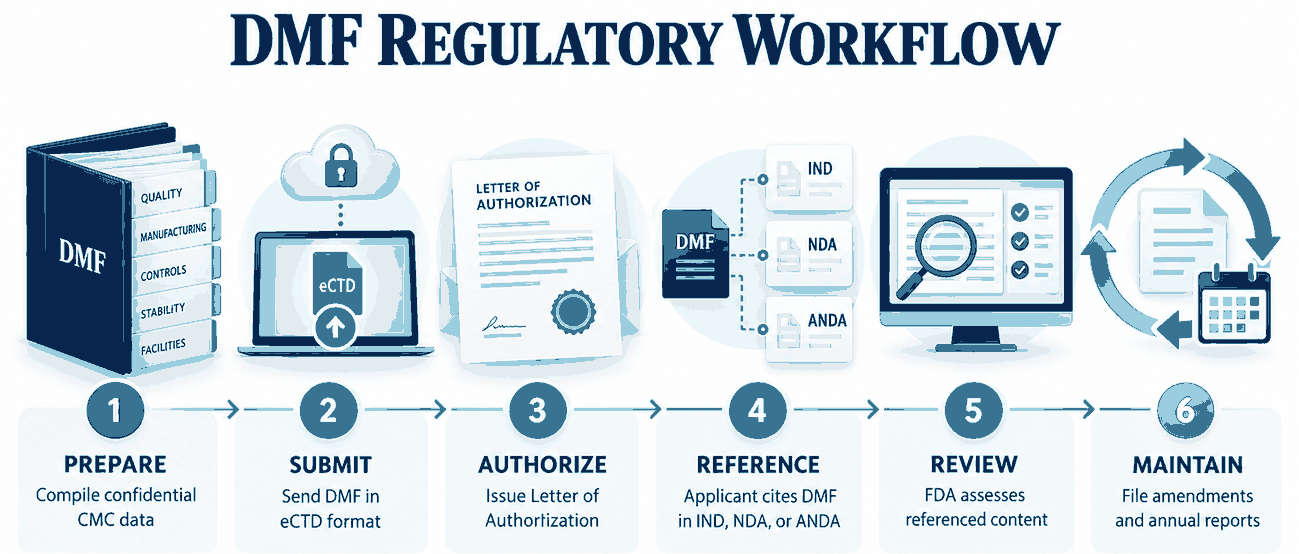
DMF referencing depends on clear responsibilities between the holder and application sponsor. Authorization, technical alignment, and lifecycle control must remain accurate throughout review. Strong coordination helps reduce deficiencies, delays, and regulatory inconsistencies.
- Holder & Sponsor Responsibilities — Align sites, specifications, supplier data, and change commitments.
- Letter of Authorization — Define the DMF, applicant, submission, and permitted regulatory reference.
- IND, NDA & ANDA Referencing — Link the DMF clearly to the product’s technical and control strategy.
- DMF vs ASMF vs CEP — Understand regional differences and avoid treating these pathways as interchangeable.
- Active DMF Conditions — Maintain valid authorization, current data, and technical relevance to the supplied material.
- Deficiencies & Lifecycle Management — Respond quickly to FDA questions and control updates, commitments, and changes.
Number 1 Regulatory Responsibilities of the DMF Holder and Application Sponsor
The holder maintains confidential data and regulatory correspondence. The sponsor evaluates supplier suitability and integrates accessible information. Both parties must align names, sites, specifications, and change commitments. Misaligned details often trigger review questions.
Quality agreements should define notification timelines and escalation routes. They should also address deviations, investigations, and significant process changes. Regulatory agreements then translate those responsibilities into submission actions.
Number 2 Confidential Data Protection and Letter of Authorization Requirements
A Letter of Authorization permits FDA review for a named application. It should identify the holder, DMF number, subject, applicant, and submission. The applicant includes a copy within its application. Authorization does not transfer ownership or disclose restricted content.
Number 3 DMF Referencing Within IND, NDA, and ANDA Submissions
Applicants may reference DMF information within IND, NDA, or ANDA submissions. The reference must support a specific technical need. FDA then reviews relevant DMF sections alongside the application. An active DMF alone never demonstrates application adequacy.
Applicants should describe how the referenced material fits their control strategy.
Number 4 Technical Differences Between FDA DMF, EU ASMF, and CEP Procedures
The FDA DMF system covers several information categories. The European ASMF procedure focuses on active substances. It separates an Applicant’s Part from a Restricted Part. A CEP instead confirms pharmacopoeial suitability through EDQM certification. These pathways are related but not interchangeable.
Number 5 Regulatory Conditions for Referencing an Active DMF
The holder must provide valid authorization before reference. Administrative information should remain current. Technical content must support the referenced material and intended use. For Type II API files, applicable GDUFA conditions also require attention.
Number 6 FDA Technical Review, Deficiency Assessment, and DMF Lifecycle Management
FDA usually reviews a DMF after an authorized application references it. Reviewers may issue deficiency communications directly to the holder. The applicant may receive limited status information. Consequently, fast holder responses protect the application timeline.
A response team should include regulatory, analytical, manufacturing, and quality experts. Teams should verify every commitment before submission. Uncontrolled promises can create future compliance risks.
Types of Drug Master Files
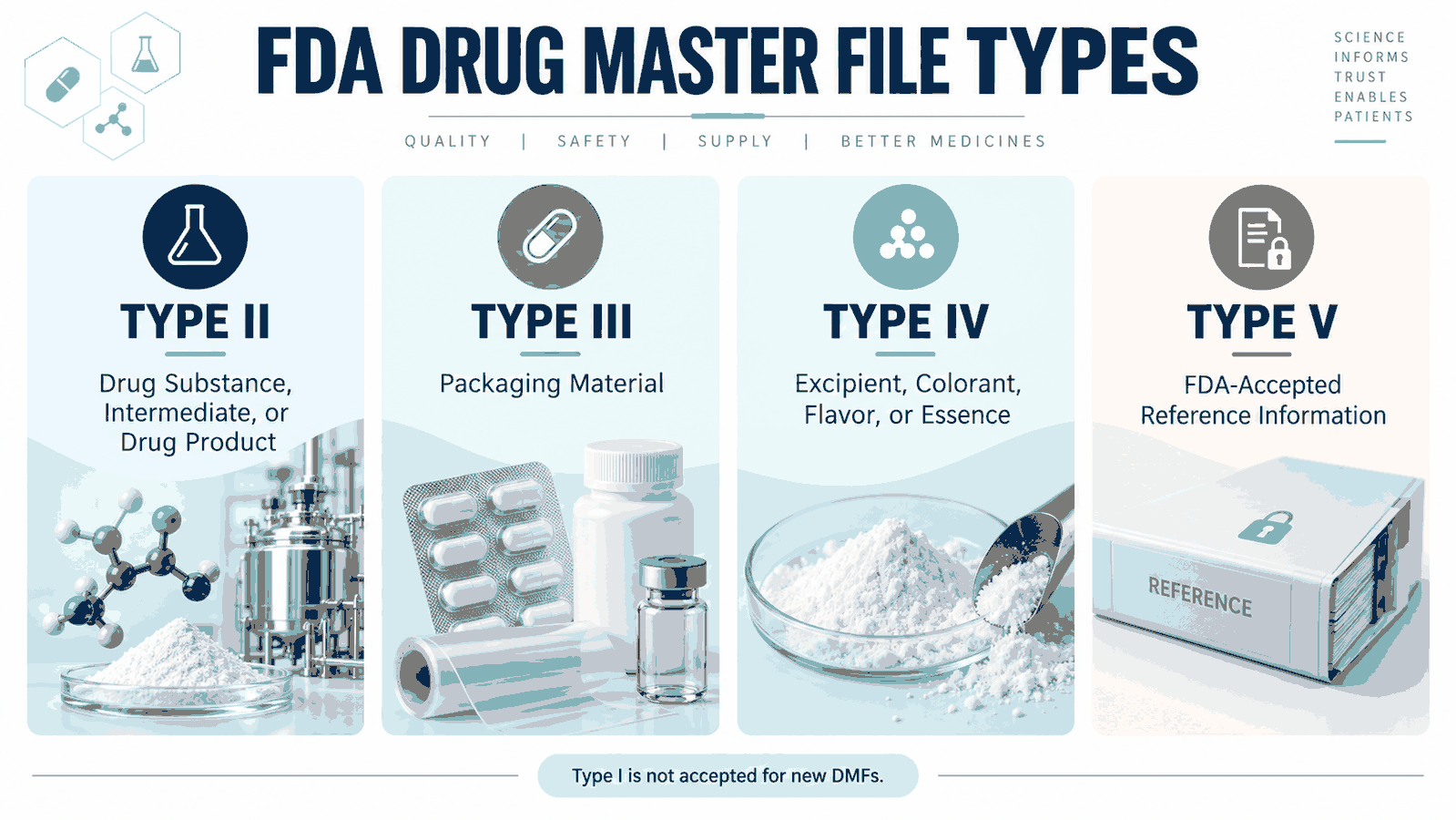
FDA currently accepts Types II, III, IV, and V for new DMFs. Type I is no longer accepted for new submissions. Each active type addresses a distinct information category.
- Type II covers drug substances, intermediates, related materials, or drug products.
- Type III covers packaging materials, components, and related technical controls.
- Type IV covers excipients, colorants, flavors, essences, and preparation materials.
- Type V contains FDA-accepted reference information outside Types II through IV.
How to Prepare and Submit a Drug Master File
First, confirm that a DMF is the correct regulatory pathway. Next, choose the proper type and define its subject narrowly. Build the dossier using current FDA electronic requirements. Finally, verify administrative consistency before transmission.
FDA Form 3938 accompanies new DMFs, amendments, and annual reports. The form standardizes key submission details. Electronic sequences should preserve lifecycle continuity and valid leaf titles. Technical content should follow relevant CTD quality principles.
Before publishing, perform technical, regulatory, and electronic validation. Confirm hyperlinks, granularity, file names, and document properties.
eCTD Structure and Essential Content
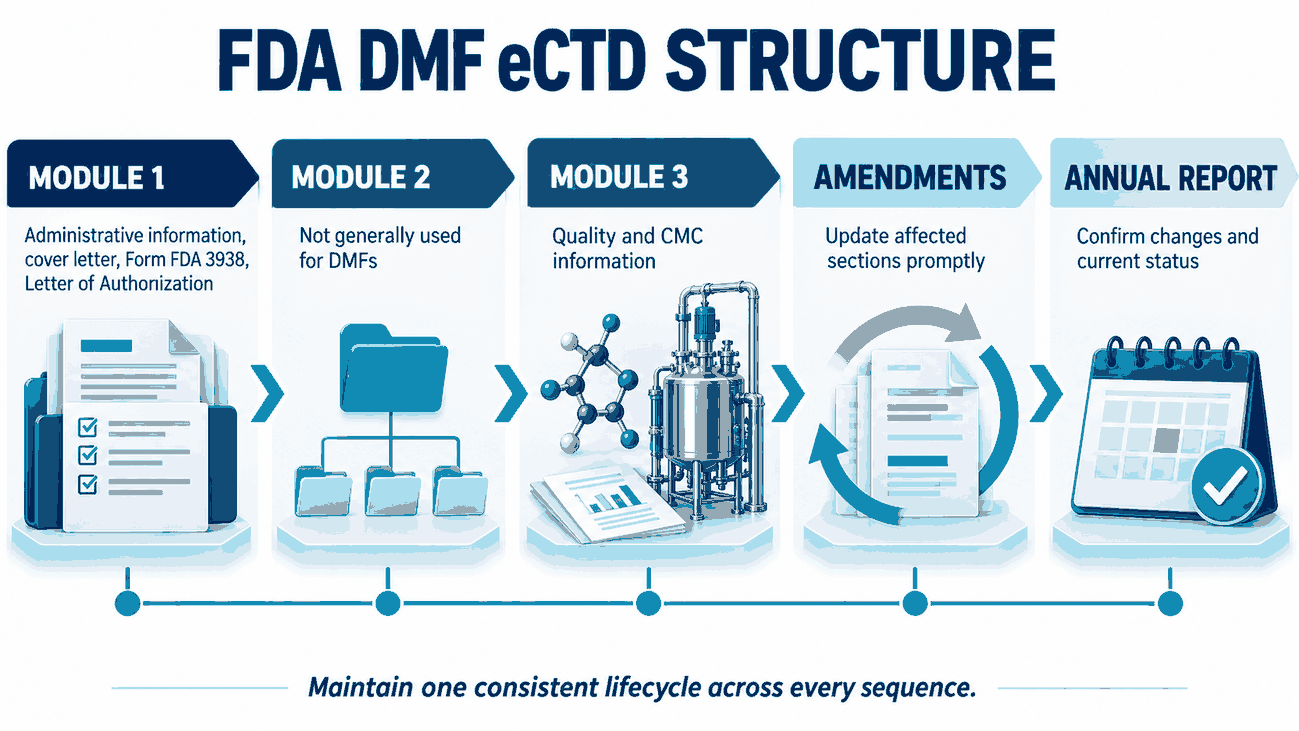
Module 1 contains regional administrative information. It may include the cover letter, forms, and authorization documentation. Module 2 is generally not used for standard DMF content. Module 3 contains quality and CMC information.
Content depth depends on the DMF type. Type II files often describe manufacturing, controls, impurities, specifications, methods, stability, and container systems. Each claim should connect with traceable supporting data.
Writers should use consistent terminology across summaries, specifications, and process descriptions. Cross-references must point to current lifecycle documents. Controlled templates improve consistency without replacing scientific judgment.
eCTD Structure
| Component | Expected content | Control point |
|---|---|---|
|
Module 1 |
Forms, cover letter, authorizations |
Current administrative data |
|
Module 3 |
Quality and CMC information |
Evidence supports every claim |
|
Lifecycle |
Amendments and annual reports |
Sequence continuity and traceability |
Submission Lifecycle Amendments Annual Reports and Closure
A DMF requires active lifecycle management after initial submission. Holders should submit amendments when relevant information changes. They should also communicate significant changes to authorized applicants.
- Classify each change and identify every affected eCTD section.
- Submit updated content using the established DMF lifecycle sequence.
- Explain change impact and provide supporting validation where necessary.
- File annual reports with current status and summarized changes.
- Withdraw authorizations or close the DMF through controlled correspondence.
Common DMF Mistakes and Best Practices
Common failures include incorrect types, inconsistent names, missing authorization, and incomplete technical data. Weak lifecycle control also creates conflicting sequences. Additionally, poor customer communication can leave applications referencing obsolete information.
Use a controlled DMF register and assign clear ownership. Reconcile regulatory, quality, and supply records before every submission. Track commitments, deficiencies, authorizations, and annual reporting dates. Moreover, assess customer impact before implementing reportable changes.
Final Word
A well-maintained drug master file protects confidential knowledge and supports efficient regulatory review. FDA currently recognizes 4 active DMF types—Types II, III, IV, and V; Type I is no longer listed as a current DMF category. Under FDA’s Guideline for Drug Master Files, holders should also provide an annual update once each year, identifying changes and confirming that the file remains current.
Success requires correct classification, complete CMC evidence, valid authorization, and disciplined lifecycle control. Therefore, holders and applicants should coordinate every significant change and confirm current FDA guidance before filing or referencing any DMF.
FAQs
A DMF protects confidential technical information while supporting FDA review. It lets applicants reference supplier data without receiving proprietary manufacturing details. The applicant still manages product quality and supplier oversight.
No. FDA does not approve a DMF as a standalone product application. Review occurs when an authorized application references relevant information. FDA evaluates adequacy within that application’s regulatory context.
It permits FDA to review specified DMF information for a named application. The applicant submits a copy within its dossier. Holders should track authorizations and withdrawals carefully.

Ershad Moradi
Ershad Moradi, a Content Marketing Specialist at Zamann Pharma Support, brings 6 years of experience in the pharmaceutical industry. Specializing in pharmaceutical and medical technologies, Ershad is currently focused on expanding his knowledge in marketing and improving communication in the field. Outside of work, Ershad enjoys reading and attending industry related networks to stay up-to-date on the latest advancements. With a passion for continuous learning and growth, Ershad is always looking for new opportunities to enhance his skills and contribute to pharmaceutical industry. Connect with Ershad on Facebook for more information.

Universities vs Pharmuni in 2026: Faster Pharma Career Readiness
Universities provide formal degrees, research depth and academic credibility. Pharmuni adds faster pharma-specific upskilling, assessments, Career Paths, CV tools and job-readiness support. Here is how the two models differ—and when using both makes sense.

Innopharma Education vs Pharmuni in 2026: The Ultimate Career Game-Changer?
Innopharma Education offers structured, accredited life-science programmes with formal academic pathways and career support. Pharmuni is a lighter, self-paced pharma career ecosystem combining courses, assessments, Career Paths, CV tools, and job matching. This guide compares where each model fits best.

ISPE Training vs Pharmuni in 2026: Deep Technical Training or a Full Pharma Career System?
ISPE offers deep specialist pharmaceutical training and respected technical certificate programs. Pharmuni combines 50+ pharma courses with free assessments, Career Paths, CV tools, competency benchmarking, and job matching. Here is where each platform fits best.