


In 2025, FDA’s CDER received 429,879 submissions, with 84% submitted in eCTD format. Therefore, regulatory teams increasingly depend on well-structured electronic dossiers to meet pharma regulation requirements. A compliant eCTD submission requires correct CTD placement, sequence control, metadata, publishing, and technical validation. Moreover, FDA supports eCTD 4.0 for new applications, requiring updated publishing workflows. Understanding modules, lifecycle management, and validation rules helps teams prevent avoidable technical delays.
Table of Contents
What Is an eCTD Submission?
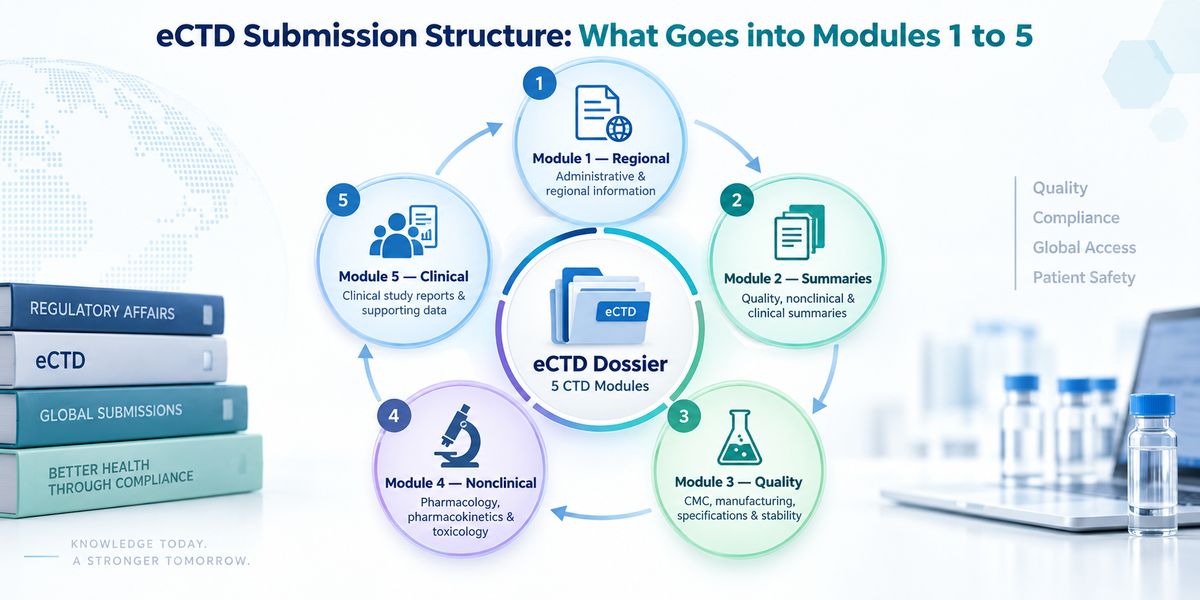
An eCTD submission is the structured electronic format used to organize and exchange regulatory dossier information with health authorities. It follows the electronic common technical document structure and divides application content into five CTD modules. Module 1 contains region-specific administrative information, while Modules 2–5 contain summaries, quality data, nonclinical reports, and clinical evidence. Moreover, the electronic structure supports consistent navigation, document tracking, and lifecycle management throughout regulatory review.
The table below summarizes the five CTD modules and the key regulatory information included in each section.
| CTD Module | Main Content | Typical Information |
|---|---|---|
|
Module 1 |
Regional information |
Forms, labeling, administrative documents |
|
Module 2 |
CTD summaries |
Quality, nonclinical, and clinical summaries |
|
Module 3 |
Quality |
CMC, manufacturing, specifications, stability |
|
Module 4 |
Nonclinical |
Pharmacology, pharmacokinetics, toxicology |
|
Module 5 |
Clinical |
Clinical study reports and related data |
This infographic shows how the five CTD modules organize regulatory information and support efficient eCTD publishing.
Why Technical Validation Matters Before Submission?
Technical validation helps regulatory teams detect structural, formatting, and metadata errors before a dossier reaches the health authority. Therefore, strong eCTD validation protects submission integrity and improves reviewability. It also confirms that documents, hyperlinks, XML structures, and lifecycle operations follow required technical rules. Moreover, early validation strengthens traceability and reduces the risk of technical rejection, delayed review, or costly rework.
How an eCTD Dossier Moves from Content to Submission
Regulatory teams follow a controlled workflow to prepare a dossier for health authority review. First, they organize content within the CTD structure. Then, they build the sequence, apply regional metadata, and manage lifecycle changes. Finally, technical validation confirms that the package meets regulatory requirements and is ready for transmission.
The process becomes clearer when you break it into four essential stages: dossier organization, lifecycle control, metadata application, and final validation.
Organize the Dossier Around the CTD Structure (PDF)
Build the Sequence and Control the Dossier Lifecycle (PDF)
Apply Regional Metadata and Controlled Vocabularies (PDF)
Validate the Package Before Regulatory Transmission (PDF)
Organize the Dossier Around the CTD Structure (PDF)
The CTD framework organizes regulatory content into standardized modules and sections. This structure helps reviewers find information quickly and supports consistent dossier preparation across regions.
Build the Sequence and Control the Dossier Lifecycle (PDF)
Each electronic sequence records a defined regulatory transaction and its relationship to earlier submissions. Proper lifecycle control ensures that added, replaced, reused, or withdrawn documents remain traceable over time.
Download Electronic Common Technical Document (eCTD) v4.0 Technical Conformance Guide Here
Apply Regional Metadata and Controlled Vocabularies (PDF)
Regional metadata identifies key application, submission, and document details required by the receiving authority. Controlled vocabularies standardize coded values and improve consistency across electronic regulatory systems.
Validate the Package Before Regulatory Transmission (PDF)
Technical validation checks the package for structural, XML, document, metadata, and formatting errors before transmission. Fixing these issues early reduces the risk of processing failure, rejection, or resubmission.
Download Specifications for eCTD v4.0 Validation Criteria Here
What Changes with eCTD 4.0?
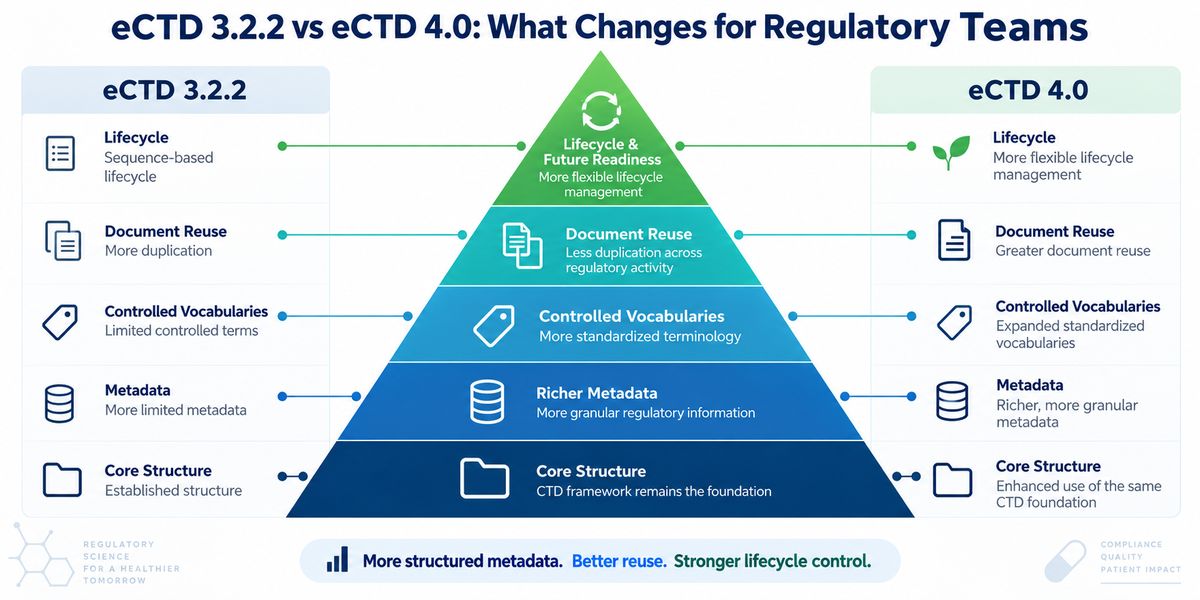
eCTD 4.0 changes how regulatory teams organize, identify, reuse, and maintain dossier content. It introduces richer metadata and Context of Use to describe where documents belong and how authorities should interpret them. Moreover, controlled vocabularies improve consistency, while document reuse can reduce unnecessary duplication across sequences. These changes strengthen eCTD lifecycle management and create a more flexible structure for future regulatory requirements.
This infographic compares eCTD 3.2.2 with eCTD 4.0 and highlights the practical changes regulatory teams need to understand.
Common eCTD Validation Errors and Submission Risks
Technical errors can delay a regulatory package before scientific review even begins. Under FDA validation criteria, a High Error can prevent processing and require resubmission. Therefore, strong eCTD validation should check XML structure, sequence data, document references, metadata, controlled terms, and files before transmission. Publishing teams should also review warnings because they can affect dossier reviewability.
The table below highlights common technical risks and the checks publishing teams should complete before transmission.
| Validation Error | Submission Risk | Preventive Check |
|---|---|---|
|
Invalid XML or schema |
A High Error can prevent package processing. |
Validate XML against the supported schema before publishing. |
|
Incorrect or duplicate sequence number |
The sequence may fail validation or require resubmission. |
Confirm sequence uniqueness and match the XML value to the sequence folder. |
|
Incorrect application information |
Mismatched application numbers can trigger a High Error. |
Cross-check the application number in metadata, XML, and FDA forms. |
|
Missing path or incorrect checksum |
FDA may be unable to locate or verify the submitted document. |
Test every document path and recalculate checksums before transmission. |
Final Word
FDA conducted 1,248 drug quality assurance inspections in FY2025, up from 972 in FY2024, showing stronger regulatory oversight across pharmaceutical operations. Therefore, accurate structure, traceable lifecycle control, and reliable validation matter more than ever. A well-prepared eCTD submission helps regulatory teams maintain data integrity, support efficient review, and respond confidently to evolving compliance expectations.
FAQs
FDA can reject a package when serious technical errors prevent processing. Common risks include duplicate sequences, incorrect application numbers, missing backbone files, invalid XML, corrupted files, or non-standard structure.
Teams should run the package against current FDA validation criteria before transmission. They should verify XML structure, sequence data, metadata, document paths, controlled values, PDFs, hyperlinks, and study data requirements.
Yes. FDA may refuse to file an NDA or BLA, or refuse to receive an ANDA, when required study data do not conform to applicable data standards. Therefore, teams should check study datasets and technical rejection criteria before regulatory transmission.
References

Mahtab Shardi
Mahtab is a pharmaceutical professional with a Master’s degree in Physical Chemistry and over five years of experience in laboratory and QC roles. Mahtab contributes reliable, well-structured pharmaceutical content to Pharmuni, helping turn complex scientific topics into clear, practical insights for industry professionals and students.

ANDA Application in 2026: FDA Requirements, Submission Process and GMP Inspection Readiness
Preparing an ANDA requires more than a complete dossier. This article explains FDA submission requirements, bioequivalence expectations, CMC consistency, facility readiness, and common review delays, helping regulatory and quality teams understand what can slow generic drug approval.
Regulatory Strategy in Pharma in 2026: From Drug Development to GMP Inspection Readiness
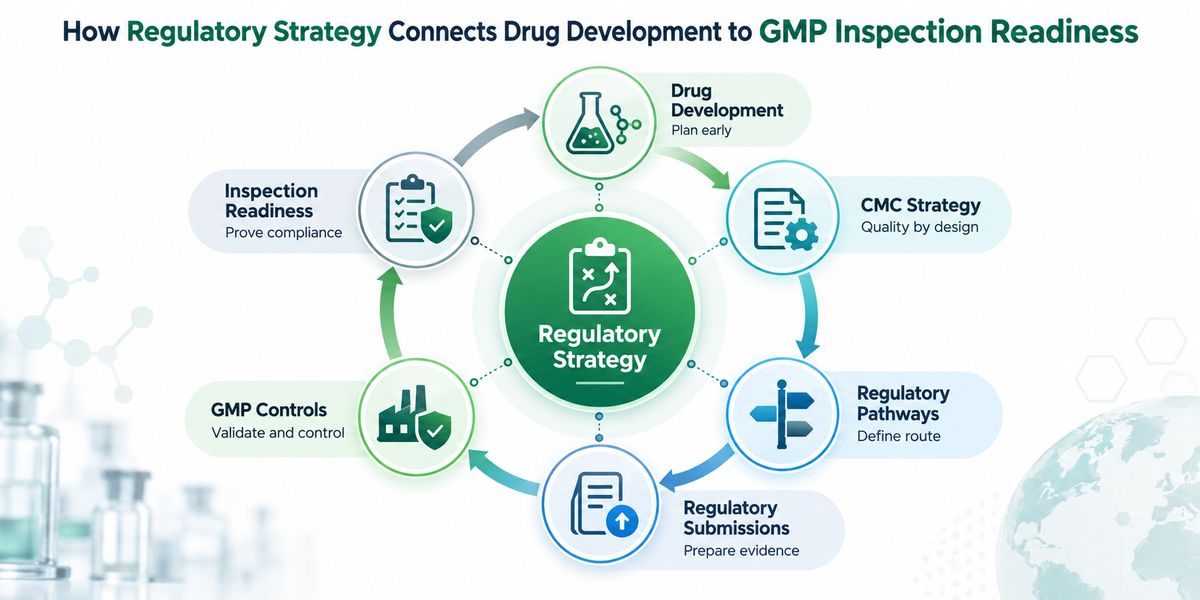
Effective regulatory planning connects drug development, CMC, submissions, manufacturing, and lifecycle obligations. This article explains how regulatory teams can reduce compliance gaps, prepare for inspections, manage post-approval changes, and make better decisions across the pharmaceutical product lifecycle.

Alison vs Pharmuni in 2026: Free Learning at Scale or a Guided Pharma Career System?
Alison offers 6,000+ free courses plus career tools and recruitment. Pharmuni is smaller but pharma-focused, with role assessments, Career Paths, CV tools, and 1,000+ life-science jobs.