


An IND application lets FDA review an investigational drug before U.S. human studies begin. It connects preclinical evidence, manufacturing controls, clinical design, and participant protection. The 1962 Kefauver-Harris Amendments strengthened FDA control over clinical trials and informed consent. Today, 21 CFR Part 312 defines the central U.S. IND framework. In 2026, FDA continues modernizing electronic regulatory submissions. Commercial CDER and CBER INDs generally require an FDA-supported eCTD standard. Moreover, commercial IND safety reporting changed on April 1, 2026.
Certain serious unexpected suspected adverse reactions now require electronic E2B(R3) reporting. Understanding these changes strengthens every pharma regulation strategy before human development. Many teams assume an IND proves effectiveness. Instead, FDA primarily evaluates whether proposed human exposure is reasonably safe. This guide explains requirements, exemptions, forms, content, review steps, and common risks.
Table of Contents
What Is an IND Application?
An Investigational New Drug application requests FDA authorization for clinical investigation of an investigational drug. Sponsors submit evidence supporting the product, dose, population, and monitoring plan. FDA reviewers examine product quality, nonclinical safety, and clinical safeguards together. The IND also creates an ongoing regulatory file throughout clinical development. Sponsors later submit amendments, safety reports, and annual reports under that file. Therefore, an IND is not a one-time permission document. It supports a controlled regulatory lifecycle for continued human investigation.
When Is an IND Required — and When Can a Study Be Exempt?
An IND usually applies before administering an unapproved drug to human participants. It can also apply to new uses of marketed drugs. However, some marketed-drug studies qualify for exemption under 21 CFR 312.2(b)(1).
- The drug must be lawfully marketed in the United States.
- The study cannot support a new indication or major labeling change.
- Prescription-drug research cannot support a significant advertising change.
- Dose, route, or population cannot significantly increase study risk.
- The study must follow IRB, consent, and investigational promotion requirements.
An exempt study still requires strong ethical and institutional oversight. When uncertainty remains, sponsors should consult the appropriate FDA review division.
Main Types of IND Applications
IND pathways differ because sponsors pursue different development, research, or treatment objectives. Each pathway has distinct regulatory expectations based on the study purpose, patient population, and urgency of access. Understanding these differences helps sponsors select the appropriate FDA pathway and prepare the required documentation.
Type 1 Comercial IND
Type 2 Research / Sponsor-Type 3 Investigator IND
Type 4 Emergency IND
Type 5 Treatment IND and Expanded Access
Number 1 Commercial IND
A commercial IND supports product development for commercial distribution. Commercial CDER and CBER INDs generally require eCTD submission.
Number 2 Research / Sponsor-Investigator IND
A sponsor-investigator both initiates and conducts the clinical investigation. That individual carries sponsor and investigator responsibilities. Research INDs are generally noncommercial and may use additional submission options.
Number 3 Emergency IND
An emergency IND supports urgent investigational treatment when standard timing is impossible. Physicians should contact FDA before treatment whenever practicable. Follow-up documentation and applicable IRB requirements still remain.
Number 4 Treatment IND and Expanded Access
Expanded access supports investigational treatment outside clinical trials under defined conditions. A treatment IND can support widespread use during active development. Expanded access requires serious disease, acceptable risk, and no satisfactory alternative. It also must not obstruct studies supporting marketing approval.
Number 5 IND-Exempt Studies Using Marketed Drugs
Some marketed-drug studies can proceed without an IND. However, every exemption condition must apply simultaneously. Increased risk or pivotal labeling intent can change that status.
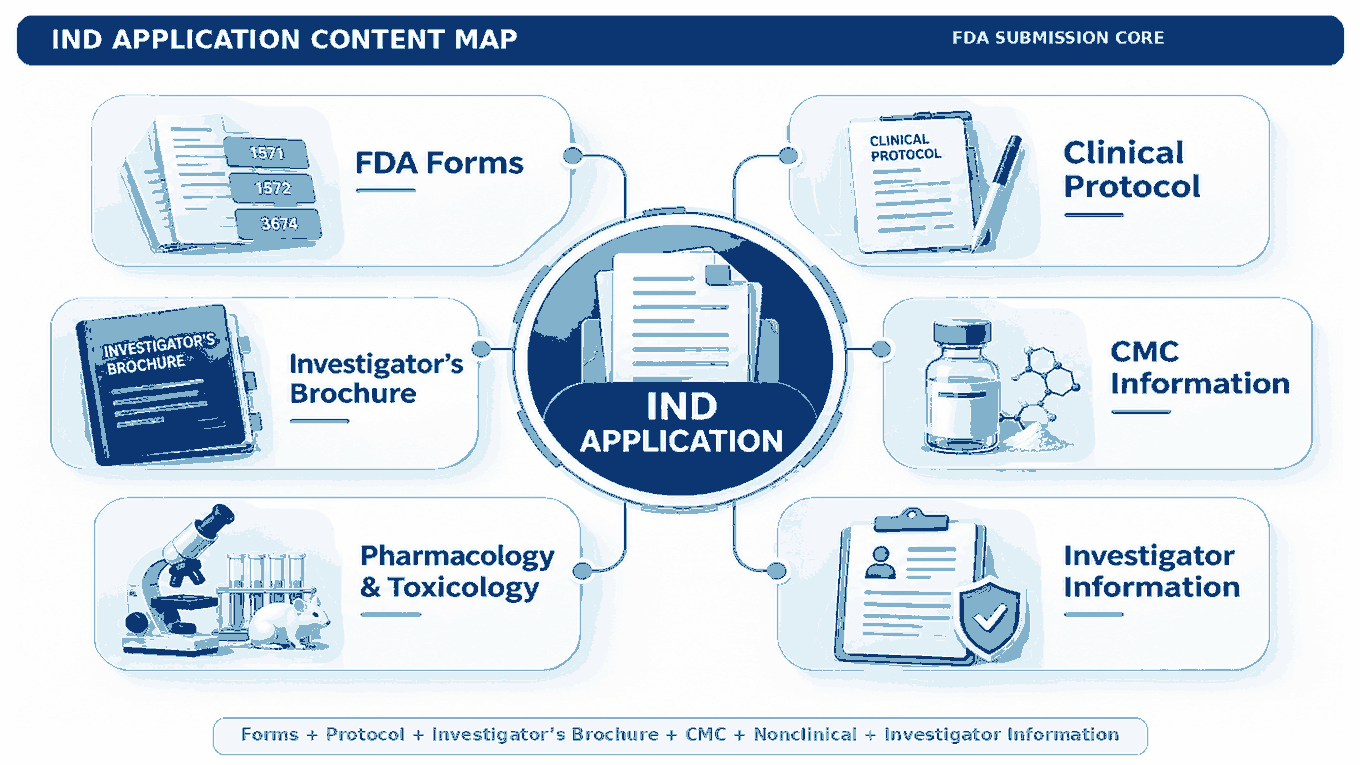
Core Components of an IND Application
FDA needs a submission that presents critical safety information clearly. Content depth depends on development stage, product risk, and proposed exposure.
- Administrative material includes the cover letter, forms, and table of contents.
- The introductory statement summarizes the product and investigational plan.
- The Investigator’s Brochure communicates relevant clinical and nonclinical information.
- Clinical protocols define dosing, eligibility, monitoring, and stopping safeguards.
- CMC information explains composition, manufacturing, controls, stability, and quality.
- Pharmacology and toxicology data justify human dosing and identify safety risks.
CMC information deserves special attention before first-in-human studies. FDA must understand identity, strength, quality, purity, and manufacturing consistency. Nonclinical data should justify starting dose and exposure duration. Protocols should translate identified risks into monitoring safeguards. An original IND without a clinical protocol is incomplete. Therefore, teams should align CMC, toxicology, and protocol decisions.
When Should You Use Swab Sampling vs Rinse Sampling?
Method selection should begin with equipment design and contamination risk. Teams should identify surfaces most likely to retain the previous product.
They should also consider sampling accessibility before choosing the final method. A risk-based plan may combine swab and rinse evidence when one method misses important areas.
How to Submit an IND Application: Step-by-Step
Step 1 — Confirm whether the study requires an IND. Next, identify the responsible FDA center and review division.
Step 2 — Establish the submission pathway and application tracking information. Commercial sponsors should prepare a compliant eCTD sequence.
Step 3 — Assemble technical, clinical, and administrative content. Then, perform cross-document consistency checks before transmission.
Step 4 — Submit and prepare subject-matter experts for FDA questions. Finally, maintain controlled processes for amendments, reports, and ongoing communication.
FDA Forms and Administrative Documents: 1571, 1572, 3674, and Financial Disclosure Forms
Form FDA 1571 serves as the central IND cover sheet. Form FDA 1572 records investigator commitments and site information. Form FDA 3674 addresses applicable ClinicalTrials.gov certification requirements. Forms FDA 3454 and 3455 address investigator financial interests. Sponsors should collect required financial information before investigator participation.
FDA Formsand Related Documents
| FDA form | Main function | Practical control |
|---|---|---|
|
1571 |
IND cover and lifecycle form |
Keep sponsor data consistent |
|
1572 |
Statement of Investigator |
Maintain accurate investigator records |
|
3674 |
ClinicalTrials.gov certification |
Confirm trial applicability |
|
3454/3455 |
Financial certification or disclosure |
Collect before participation |
|
3926 |
Individual-patient expanded access |
Use where appropriate |
Sponsors should verify current form versions before submission. Each eCTD sequence should also pass technical validation before transmission.
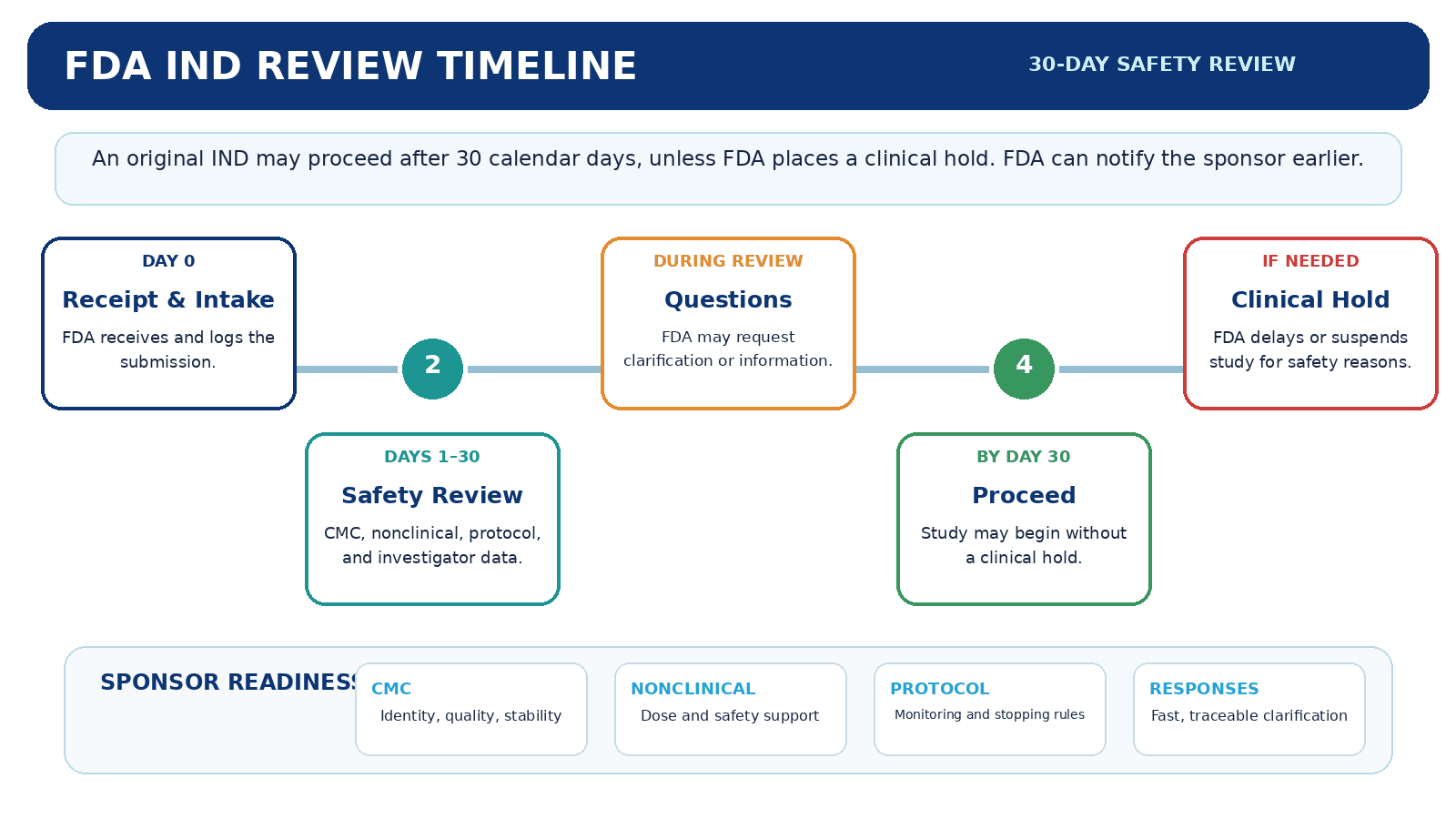
What Happens During the FDA 30-Day IND Review?
An original IND can become effective thirty calendar days after FDA receipt. FDA may also notify the sponsor that studies can begin earlier. Reviewers assess whether participants face unreasonable and significant risk. They examine CMC, toxicology, protocols, safeguards, and investigator qualifications. FDA may ask questions or request clarification during review. Sponsors should answer rapidly and consistently across affected documents.
FDA 30-Day IND Review
| Review point | FDA focus | Sponsor priority |
|---|---|---|
|
Day 0 |
Receipt and intake |
Confirm submission tracking |
|
Early review |
Safety evidence |
Prepare experts for questions |
|
Clarification |
Gaps or inconsistencies |
Provide traceable responses |
|
Day 30 |
Proceed unless held |
Confirm status before dosing |
|
Clinical hold |
Safety deficiencies |
Address every cited issue |
A clinical hold can affect one study or several investigations. Sponsors cannot start a held proposed study. FDA provides the hold basis and expects a complete response. FDA then reviews that complete response within thirty calendar days. Studies resume only after FDA communicates that the hold has lifted.
Common IND Submission Mistakes and Clinical Hold Risks
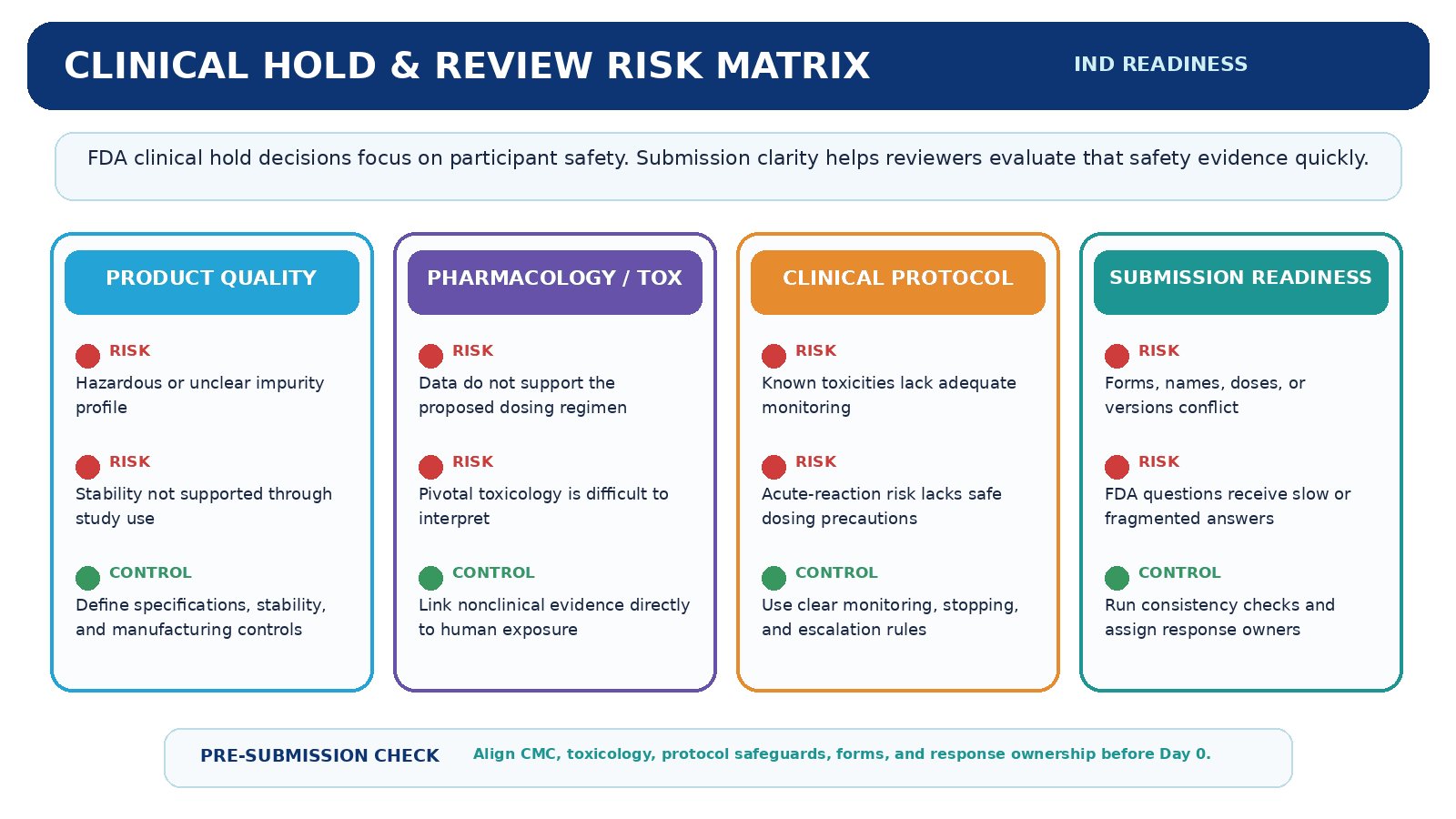
Clinical holds can arise from safety concerns across several technical disciplines. FDA examples include hazardous impurities and insufficiently defined impurity profiles. Insufficient toxicology can also fail to support proposed dosing.
- Incomplete CMC can obscure purity, stability, or manufacturing control.
- Weak toxicology can leave proposed human exposure unsupported.
- Unclear protocols can create dosing or monitoring uncertainty.
- Inconsistent forms can trigger avoidable administrative questions.
- Poor organization can hide important safety evidence.
- Slow FDA responses can increase timeline uncertainty.
Teams should run final consistency checks across forms and technical modules. They should verify doses, product names, investigator details, and document versions. Moreover, sponsors should assign response owners before FDA review begins.
Final Word
A strong IND application connects scientific evidence with practical participant safeguards. FDA reviews the initial IND during a 30-calendar-day period, focusing heavily on whether participants could face unreasonable risk. Clear alignment across CMC, pharmacology/toxicology, clinical protocols, and investigator information helps support that safety assessment.
Accurate regulatory forms and organized publishing also reduce preventable submission friction. Commercial INDs have been subject to FDA eCTD submission requirements since May 5, 2018, making technical structure and document quality important parts of submission readiness.
FAQs
No. Some studies involving lawfully marketed drugs can qualify for exemption. Every 21 CFR 312.2 criterion must apply. The study must also maintain IRB and informed-consent compliance. Investigators should document their exemption rationale before enrollment.
FDA focuses strongly on CMC, nonclinical safety, and clinical protocols. These sections work together to justify human exposure. Administrative forms and investigator information also matter. Reviewers need a complete, navigable package supporting participant protection.
Yes, but only after FDA provides earlier notification. Otherwise, the IND generally becomes effective after thirty days. A clinical hold prevents study initiation. Sponsors should confirm regulatory status before participant dosing.

Ershad Moradi
Ershad Moradi, a Content Marketing Specialist at Zamann Pharma Support, brings 6 years of experience in the pharmaceutical industry. Specializing in pharmaceutical and medical technologies, Ershad is currently focused on expanding his knowledge in marketing and improving communication in the field. Outside of work, Ershad enjoys reading and attending industry related networks to stay up-to-date on the latest advancements. With a passion for continuous learning and growth, Ershad is always looking for new opportunities to enhance his skills and contribute to pharmaceutical industry. Connect with Ershad on Facebook for more information.

GMP Training Effectiveness 2026: Proven Ways to Build Real Competence
GMP training effectiveness goes beyond attendance records and quiz scores. Learn how role-based assessments, on-the-job observation, and meaningful KPIs help verify employee competence, strengthen training records, and address recurring performance gaps across pharmaceutical operations.

GMP Audit Checklist 2026: The Essential Guide for Risk-Based Audits
Master your GMP Audit Checklist with a practical, risk-based approach to pharmaceutical self-inspections. Explore five essential audit steps, FDA’s six-system model, GMP documentation and evidence sampling, audit findings, CAPA tracking, and effectiveness verification to strengthen compliance and inspection readiness.
Orphan Drug Designation in 2026: FDA and EMA Eligibility Criteria
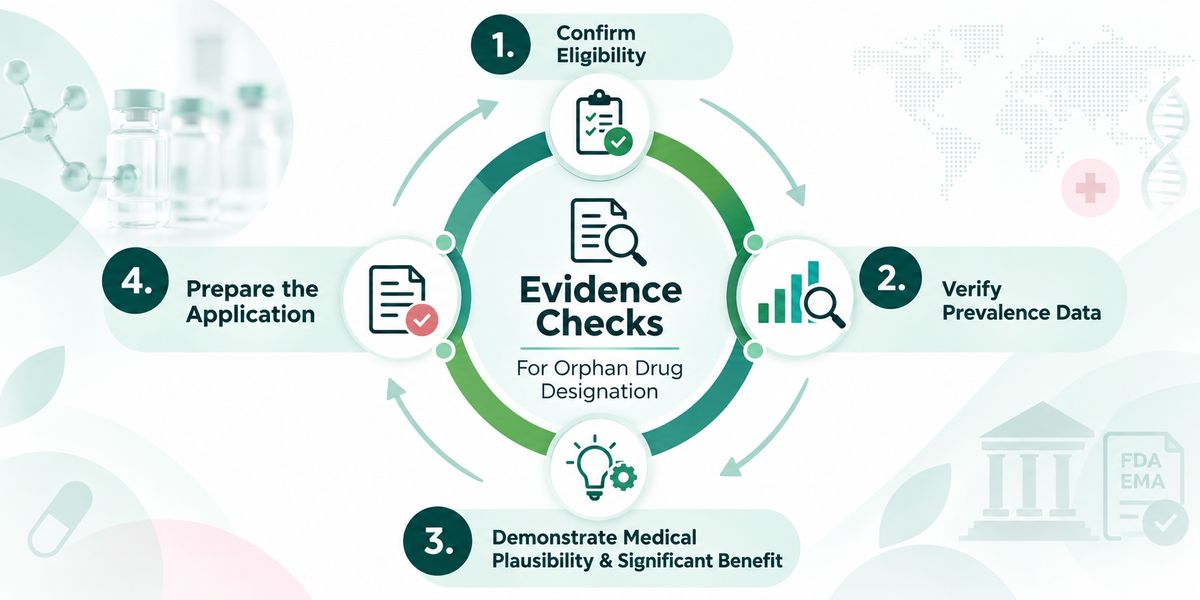
Discover how orphan drug designation works in 2026. Compare FDA and EMA eligibility criteria, rare disease prevalence thresholds, scientific evidence requirements, and regulatory incentives. Learn what pharmaceutical sponsors need to prepare for successful regulatory submissions