

Post Approval Changes in Pharma in 2026: Types, ICH Q12 and Change Management

More than 62% of FDA drug quality assurance inspections in FY2024 occurred at foreign sites, an all-time high. Therefore, teams managing post approval changes in pharma need robust risk assessment, documented change control, and GMP compliance. In the United States, 21 CFR 314.70 is a key pharma regulation that sets requirements for reporting changes to approved drug applications. Moreover, ICH Q12 supports a structured lifecycle approach to managing CMC changes. Strong governance helps protect product quality, regulatory compliance, and supply continuity after approval.

Table of Contents

What Are Post Approval Changes in Pharma?

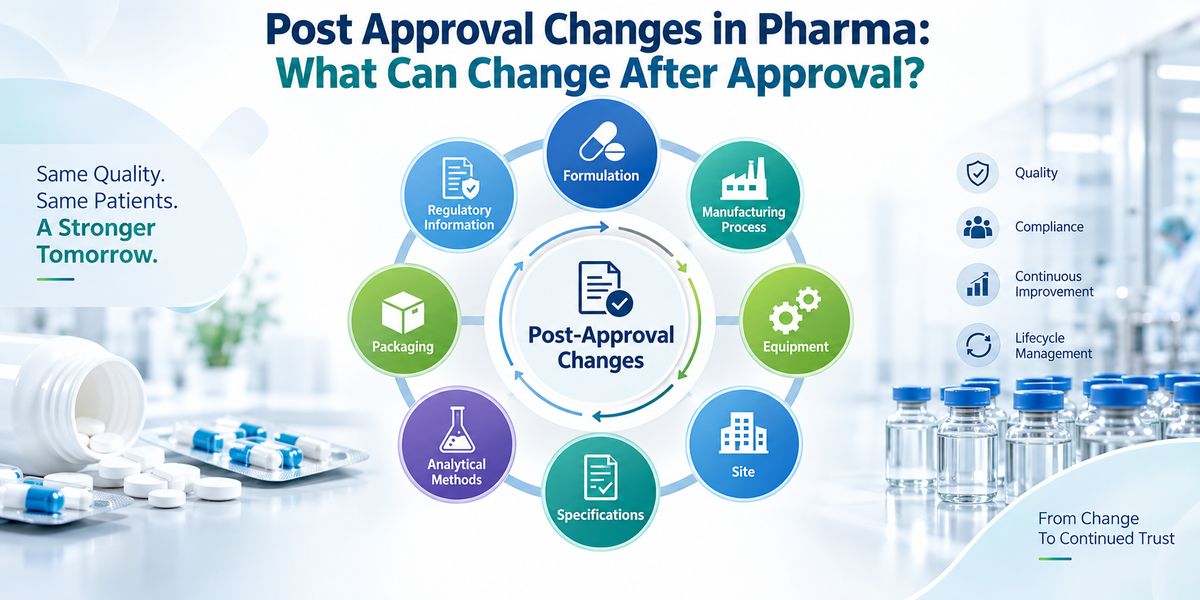
Post approval changes in pharma include modifications to formulation, manufacturing processes, equipment, sites, specifications, analytical methods, packaging, or regulatory information. Each change should be assessed for its impact on quality, safety, efficacy, validation, and regulatory reporting throughout the product lifecycle.

This infographic shows the main areas that can change after approval and why structured assessment is essential for compliant lifecycle management.

Infographic showing common post approval CMC changes involving formulation, manufacturing, equipment, sites, specifications, analytical methods, and packaging.
Key areas affected by post approval change management, from formulation and manufacturing to specifications, packaging, and regulatory information

Why Change Control Matters After Approval?

Change control keeps approved medicines within a controlled state throughout their lifecycle. It connects product knowledge, GMP assessment, validation, and regulatory impact before teams implement a change. Therefore, change control in pharma helps identify risks early and ensures that changes remain scientifically justified. Moreover, post-implementation review confirms that product quality, process performance, and regulatory commitments remain under control. This structured approach supports compliant pharmaceutical lifecycle management and continuous improvement.

How to Evaluate and Manage a Post Approval Change

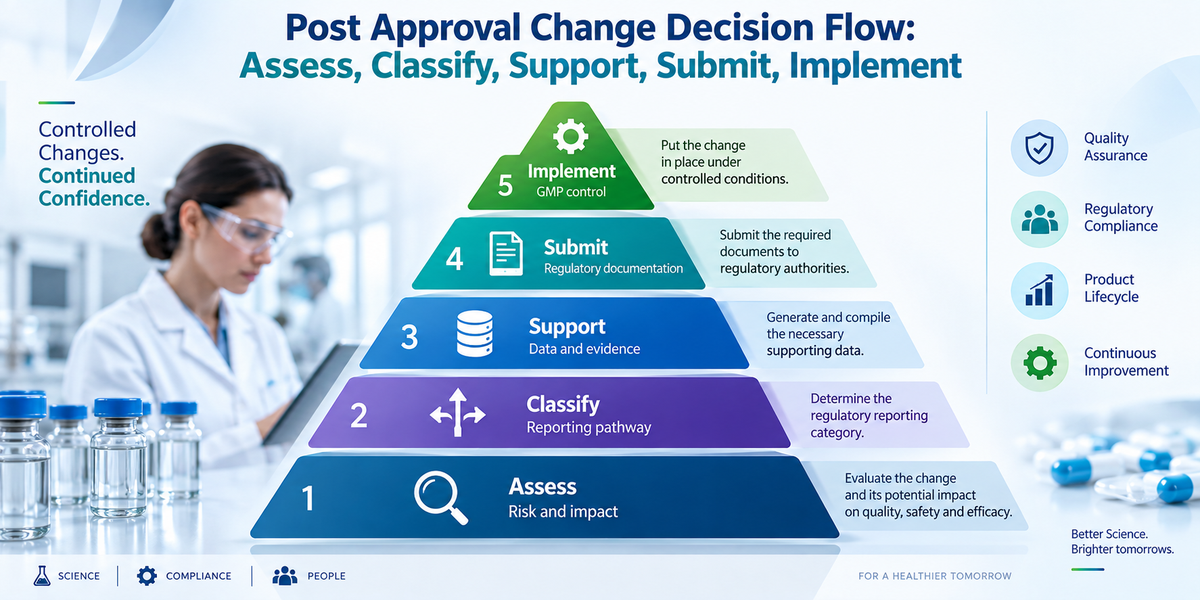
A post approval change should follow five key steps: assess risk, classify the change, define supporting evidence, submit required documentation, and implement under GMP controls. Teams should also evaluate product quality, validation, regulatory impact, and use tools such as PACMPs when appropriate to support predictable lifecycle management.

A practical evaluation becomes clearer when we break the process into four key areas: assessment, classification, regulatory support, and controlled implementation.

  • Determine the Regulatory Reporting Category (PDF)
  • Define Established Conditions and Lifecycle Commitments (PDF)
  • Plan Future Changes with a PACMP (PDF)
  • Apply SUPAC Requirements When Manufacturing Changes Affect Solid Dosage Forms (PDF)

This infographic shows the five key decisions that move a post approval change from initial assessment to controlled implementation.

Post approval change decision flow showing how pharma teams assess, classify, support, submit, and implement post approval CMC changes.
A practical post approval change management flow covering risk assessment, regulatory classification, supporting evidence, submission, and GMP implementation.

Determine the Regulatory Reporting Category (PDF)

FDA classifies post-approval changes based on their potential impact on product quality and performance. The reporting pathway may require prior approval, notification, or inclusion in an annual report.

Download Changes to an Approved NDA or ANDA Here

Define Established Conditions and Lifecycle Commitments (PDF)

ICH Q12 defines Established Conditions as approved CMC elements that require regulatory reporting when changed. The Product Lifecycle Management document helps organize these commitments and their associated reporting categories.

Download Q12 Technical and Regulatory Considerations for Pharmaceutical Product Lifecycle Management Here

Plan Future Changes with a PACMP (PDF)

A PACMP describes how a specific future change will be developed, studied, and evaluated before implementation. It can improve regulatory predictability by defining the required evidence, acceptance criteria, and reporting approach in advance.

Download Questions and answers on post approval change management protocols (PACMP) – Revision 1 Here

Apply SUPAC Requirements When Manufacturing Changes Affect Solid Dosage Forms (PDF)

How Regulatory Reporting Pathways Differ by Region

Regulators use risk to decide how companies should report and implement post-approval changes. However, the FDA and EU organize that risk through different regulatory systems. The FDA uses supplements and annual reports based on a change’s potential effect on product quality. Meanwhile, the EU uses variation categories based on the expected impact on quality, safety, or efficacy. Therefore, teams should assess each market separately instead of treating the categories as direct equivalents.

The table shows how each system links regulatory significance with submission timing and when a change may be implemented.

Region Regulatory Pathway Regulatory Basis When the Change Can Be Implemented
United States
Prior Approval Supplement (PAS)
Major change with substantial potential to adversely affect product quality
FDA approval is required before distributing product made with the change.
United States
CBE-30
Moderate change that may have a moderate potential to affect product quality
Distribution can generally begin 30 days after FDA receives the supplement unless FDA advises otherwise.
United States
CBE-0
Certain moderate changes eligible for immediate reporting
The applicant may generally distribute product made with the change when FDA receives the supplement.
European Union
Type IA / IA₍IN₎
Minor variation with minimal or no impact on quality, safety, or efficacy
Type IA changes can generally be implemented before notification. IA₍IN₎ changes require notification immediately after implementation.

Common Change Management Risks That Delay Implementation

Post-approval changes often stall because teams identify regulatory and technical risks too late. Poor impact assessment, incomplete validation, weak documentation, unclear ownership, and misaligned submission strategies can all delay implementation. Therefore, effective post approval change management requires early cross-functional review and clear decision-making. Moreover, teams should confirm regulatory requirements, supporting data, and implementation readiness before approving the change. Strong planning reduces rework, protects compliance, and helps changes move forward on schedule.

Final Word

EMA reported 10 GMP non-compliance statements in 2024, up from 7 in 2023. Therefore, manufacturers should treat post approval changes in pharma as part of continuous lifecycle control, not as isolated regulatory tasks. Strong risk assessment, documented change control, and effective verification help keep processes compliant as regulatory scrutiny continues.

FAQs

1️⃣ How do I know if a post-approval CMC change requires a PAS, CBE-30, CBE-0, or Annual Report?


FDA reporting depends on the change’s potential impact on product quality. Major changes use PAS, moderate changes may use CBE-30 or CBE-0, and minor changes are generally reported annually.

2️⃣ What are Established Conditions under ICH Q12, and what happens if they change?


Established Conditions are approved CMC elements linked to product quality. Changing them requires regulatory reporting according to the agreed reporting category.

3️⃣ When should a pharmaceutical company use a PACMP for a future manufacturing change?


Use a PACMP when a future CMC change can be planned in advance. It defines the studies, acceptance criteria, and reporting approach needed for more predictable implementation.

Picture of Mahtab Shardi

Mahtab Shardi

Mahtab is a pharmaceutical professional with a Master’s degree in Physical Chemistry and over five years of experience in laboratory and QC roles. Mahtab contributes reliable, well-structured pharmaceutical content to Pharmuni, helping turn complex scientific topics into clear, practical insights for industry professionals and students.

Technician performing swab and rinse sampling on pharmaceutical stainless-steel equipment.

Swab vs Rinse Sampling in Pharma 2026: Critical GMP Guide

Swab and rinse sampling answer different cleaning-validation questions. This guide compares their recovery behavior, equipment suitability, analytical needs, residue localization, and GMP expectations. Learn when each method works best, when limitations matter, and when a combined sampling strategy provides stronger evidence for validation.

Read More »
Prospective and Concurrent Validation Strategy

Prospective vs Concurrent Validation 2026: Essential Differences and Uses

Prospective and concurrent validation support different pharmaceutical manufacturing situations. This 2026 guide compares timing, batch release, documentation, GMP expectations, risk controls, and regulatory context. Learn when concurrent validation may be justified and how teams can select a compliant, science-based validation approach with confidence.

Read More »

Share