


Pharma jobs in Boston span discovery, development, manufacturing, quality, and commercial operations. The region connects global companies, emerging biotechs, hospitals, universities, and specialist vendors. Boston’s life science ecosystem includes more than 1,000 biotechnology companies, creating diverse career opportunities across the pharmaceutical industry.
However, opportunity does not remove competition. Candidates need focused targets, credible skills, and evidence-based applications. Many applicants assume every Boston opening requires a doctorate, but thousands of roles exist across quality, regulatory, clinical, manufacturing, and pharmacovigilance. The US pharmaceutical and medicine manufacturing sector employs over 300,000 professionals, showing the demand for varied industry skills. Explore current opportunities through the linked Pharma Jobs resource.
Table of Contents
What are Pharma Jobs in Boston?
Boston offers proximity between science, capital, healthcare, and experienced talent. Cambridge strengthens that network through Kendall Square and nearby research centers. Employers can recruit scientists, clinicians, engineers, quality specialists, and commercial leaders locally. Candidates can also move between companies without leaving the regional ecosystem.
Boston Pharma and Biotechnology Employment Landscape
The 2025 employment contraction changed hiring conditions, but not Boston’s underlying capabilities. Companies now scrutinize budgets, portfolios, and workforce needs more carefully. Some employers prioritize experienced specialists who can contribute quickly. Others build early-career pipelines through internships, fellowships, and contract roles.
Job-board totals change daily and require careful interpretation. One September 2026 search advertised more than 1,000 Boston pharma roles. That figure represents a live marketplace snapshot, not official employment data. Listings can also duplicate positions across recruiters and locations. Therefore, use counts for direction rather than certainty.
Leading Pharma & Biotech Employers in Greater Boston
| Employer Category | Examples | Main Career Areas |
|---|---|---|
|
Global Pharma Companies |
Takeda, Sanofi, Novartis, AstraZeneca |
QA, Regulatory, PV, Clinical, Manufacturing |
|
Biotech Leaders |
Vertex, Biogen, Moderna, Alnylam |
R&D, CMC, Process Development, Quality |
|
Biotech Startups |
Gene therapy, oncology, cell therapy companies |
Research, QA, Manufacturing, Regulatory |
|
CROs & Research Services |
IQVIA, ICON, Charles River |
Clinical Trials, PV, Data Management |
Leading Locations in Greater Boston
Boston and Cambridge anchor the market, but opportunities extend beyond both cities. Watertown, Waltham, Lexington, Somerville, and Seaport host important employers. Additional roles appear along suburban laboratory and manufacturing corridors. Commuting time can materially affect a position’s practical value.
Always verify the actual worksite before applying. A listing may use Boston for regional visibility. However, the position could require daily travel elsewhere. Hybrid labels also vary between employers and teams. Confirm expected onsite days, laboratory needs, and travel requirements.
What Pharma Jobs Are Available in Boston
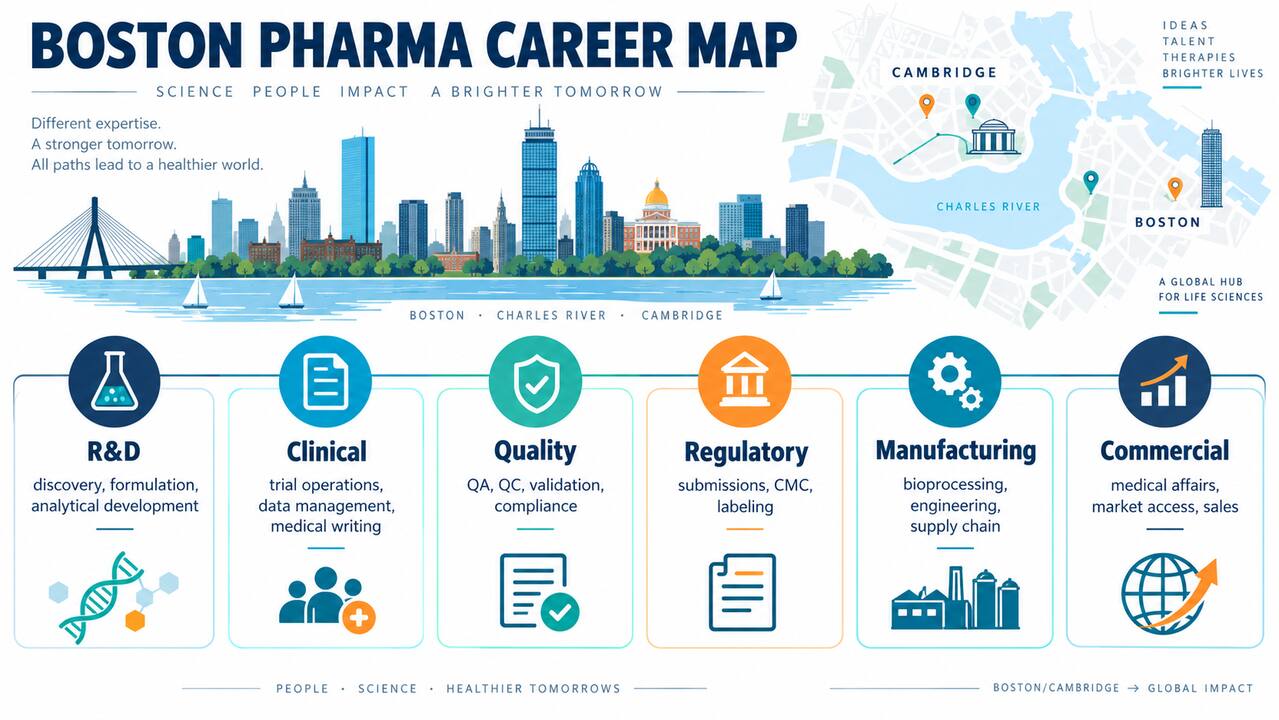
Boston’s market covers scientific, operational, compliance, and customer-facing functions. Each family requires different evidence from candidates. The following pathways provide a practical starting map.
Job Type 1 R&D: discovery, formulation, analytical development, and translational science.
Job Type 2 Clinical: trial operations, data management, safety, and medical writing.
Job Type 3 Quality: QA, QC, validation, auditing, and compliance systems.
Job Type 4 Regulatory: submissions, CMC, labeling, and agency coordination.
Job Type 5 Operations: manufacturing, engineering, automation, and supply chain.
Job Type 1 Research and Development Roles
R&D roles include discovery biology, chemistry, pharmacology, formulation, analytics, and translational science. Scientists design experiments, interpret results, and document decisions. Research associates often support laboratory execution and data generation. Senior scientists usually guide strategy, platforms, or therapeutic programs.
Employers value technical depth and reproducible documentation. They also expect clear reasoning under uncertainty. Candidates should describe experimental design, controls, failures, and corrective decisions. Publications help, but practical impact often matters more.
Job Type 2 Clinical Research and Clinical Operations Roles
Clinical teams plan and deliver human studies. Common roles include clinical trial assistants, associates, managers, and data specialists. Medical writers, safety professionals, and vendor managers support related activities. These positions require GCP awareness, organized documentation, and cross-functional communication.
Entry routes often begin through hospitals, research sites, vendors, or coordinators. Site experience can build valuable operational understanding. Additionally, candidates should learn protocols, informed consent, monitoring, and issue escalation.
Job Type 3 Quality Assurance and Quality Control Roles
Quality assurance governs systems, investigations, change controls, audits, and release decisions. Quality control tests materials, processes, environments, and finished products. Both functions support product quality and patient safety. However, their daily responsibilities remain different.
Boston employers seek GMP knowledge, data integrity awareness, and strong writing. Deviation, CAPA, OOS, and change-control experience provides valuable evidence. Candidates should explain how their actions reduced risk or strengthened compliance.
Job Type 4 Regulatory Affairs and Pharmacovigilance Roles
Regulatory professionals coordinate submissions, commitments, labeling, and agency interactions. CMC specialists connect manufacturing evidence with application requirements. Pharmacovigilance teams detect, evaluate, and communicate medicine safety information. Both fields reward precise writing and disciplined judgment.
Job Type 5 Manufacturing Engineering and Supply Chain Roles
Manufacturing roles cover upstream, downstream, fill-finish, packaging, maintenance, and operations. Engineers support equipment, automation, utilities, validation, and process improvement. Supply teams coordinate materials, planning, vendors, and distribution. These functions convert scientific progress into reliable patient supply.
Employers prefer candidates who understand controlled execution. They also value troubleshooting, shift flexibility, and clear escalation. Manufacturing experience can create strong routes into validation, quality, or technical operations.
Qualifications and Skills Boston Pharma Employers Seek
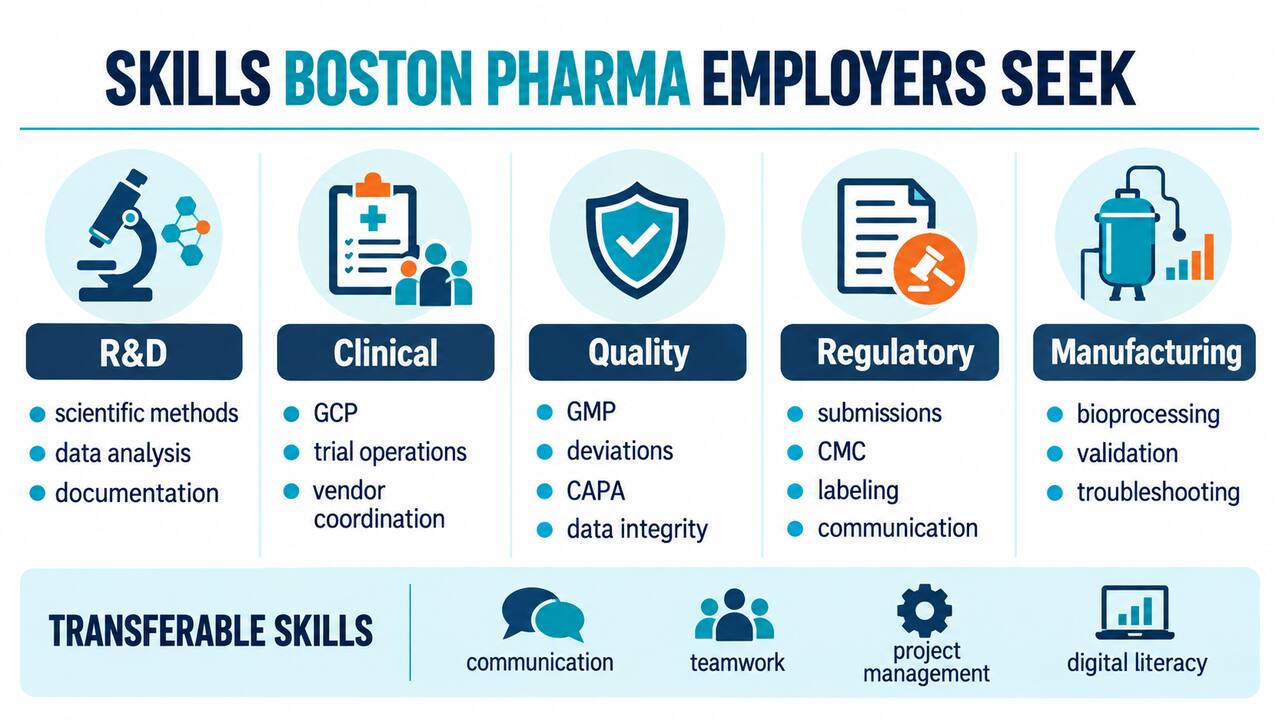
Experience must appear as evidence, not a task list. Describe the problem, your action, and the measured result. When measurements remain unavailable, explain risk reduction or process improvement. Employers also evaluate teamwork across complex matrix organizations.
- Role-specific scientific, clinical, engineering, or business knowledge.
- GMP or GCP understanding where the position requires compliance.
- Accurate documentation and disciplined data integrity practices.
- Clear communication across technical and nontechnical stakeholders.
- Problem-solving evidence with specific actions and outcomes.
- Digital literacy using relevant systems, tools, and data platforms.
Pharma Salaries and Hiring Trends in Boston
BLS reported a $103,410 national median for medical scientists during May 2025. Research and development industries reported a $125,700 median. Pharmaceutical manufacturing reported $106,800 for the same occupation. These figures provide occupational context, not Boston-specific guarantees.
BLS projects medical scientist employment to grow 13 percent through 2035. The projection includes about 10,500 annual openings nationally. Boston may benefit from that demand, but local cycles still matter. Recent Massachusetts contraction demonstrates this important distinction.
Pharma Salaries in Boston’s pharma and biotechnology companies
| Benchmark | Reported value | How to interpret it |
|---|---|---|
|
Medical scientists, national median |
$103,410 |
May 2025 BLS occupational median |
|
Medical scientists in R&D |
$125,700 |
National industry median, not Boston-specific |
|
Medical scientists in pharma manufacturing |
$106,800 |
National industry median, not a salary guarantee |
|
Projected medical scientist growth |
13% |
National projection for 2025-2035 |
Current demand, competition, and hybrid work patterns in Boston
Employers increasingly prefer precise matches for technical and therapeutic needs. General applications therefore receive weaker responses. Candidates should target adjacent roles where their evidence transfers directly. Contract positions may also provide faster entry and local experience.
How to Find and Secure Pharma Jobs in Boston
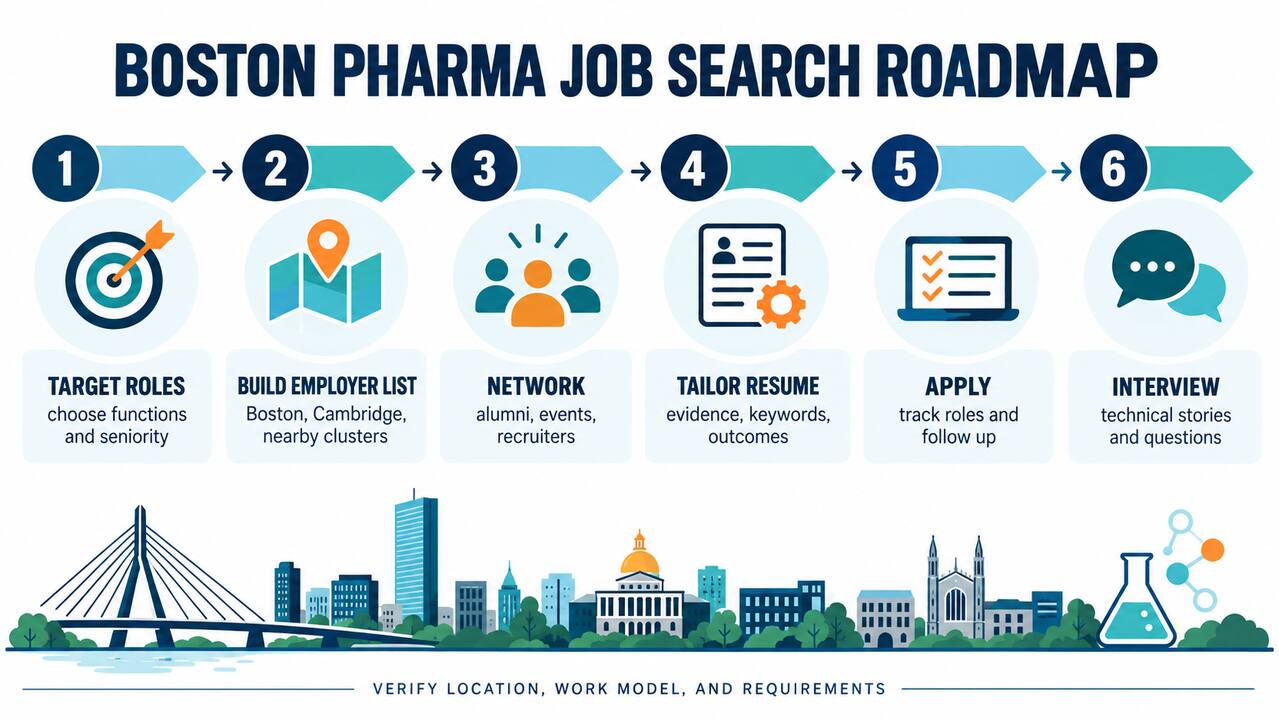
A successful search combines market mapping, networking, targeted evidence, and consistent follow-up. Random high-volume applications usually waste time. Use the following process for stronger positioning. Review current listings:
- Define two target functions and realistic seniority levels.
- Build a focused list of Boston-area employers and vendors.
- Network through alumni, professional events, and informed recruiter conversations.
- Tailor resumes using truthful keywords and measurable outcomes.
- Track applications, contacts, dates, responses, and follow-up actions.
- Prepare technical stories demonstrating judgment, teamwork, and learning.
Final Word
Boston remains one of the world’s strongest life science hubs, with more than 1,000 biotechnology companies across Greater Boston and Massachusetts supporting research, development, manufacturing, and healthcare innovation. The region also supports over 113,000 life science jobs in Massachusetts, creating opportunities beyond laboratory research.
Building a sustainable pharma career requires more than finding openings. Candidates must develop GMP knowledge, regulatory awareness, technical skills, and evidence-based experience. Focus on roles where your skills support product quality, compliance, operational excellence, and patient safety.
A successful career path comes from selecting the right function, building relevant expertise, and communicating your value through targeted applications and practical examples.
FAQs
Yes, several pathways do not require laboratory experience. Consider clinical operations, regulatory coordination, quality systems, supply chain, or medical writing. Transferable documentation and project skills remain important. Build targeted samples where appropriate.
Growth depends on capability, business demand, and company performance. Medical science, quality, regulatory, bioprocessing, and clinical operations offer broad pathways. BLS projects strong national medical scientist growth. Local demand still changes with funding cycles.
Remote availability depends heavily on the function. Laboratory and manufacturing positions usually require onsite work. Regulatory, safety, writing, and commercial positions may offer flexibility. Confirm exact expectations before interviewing.

Ershad Moradi
Ershad Moradi, a Content Marketing Specialist at Zamann Pharma Support, brings 6 years of experience in the pharmaceutical industry. Specializing in pharmaceutical and medical technologies, Ershad is currently focused on expanding his knowledge in marketing and improving communication in the field. Outside of work, Ershad enjoys reading and attending industry related networks to stay up-to-date on the latest advancements. With a passion for continuous learning and growth, Ershad is always looking for new opportunities to enhance his skills and contribute to pharmaceutical industry. Connect with Ershad on Facebook for more information.

Biopharma Institute vs Pharmuni: Which One Matches Your Pharma Career Goals in 2026?
Biopharma Institute and Pharmuni both serve pharmaceutical professionals, but they take different approaches to career development. This 2026 comparison explores their courses, certifications, pricing, career paths, competency tools, coaching, and job-support features to help learners understand which platform better matches their professional goals.

Pharma Lessons vs Pharmuni: Which Pharma Learning Platform Fits You in 2026?
Pharma Lessons and Pharmuni both serve pharmaceutical learners, but their models differ significantly. This comparison reviews courses, certificates, free learning, assessments, career paths, CV tools, competency benchmarking, coaching, and job discovery. Use it to identify which platform better matches your current career goal.

CRF vs eCRF in 2026: Essential Differences in Clinical Trials
CRF vs eCRF choices shape clinical trial data quality, speed, traceability, and compliance. This guide explains paper workflows, electronic data capture, audit trails, validation, query management, CDISC alignment, and practical selection factors. Read it to understand modern clinical data collection clearly and confidently.