


MedDRA coding in pharmacovigilance converts reported medical language into standardized regulatory terminology. Accurate coding supports consistent case processing, signal detection, analysis, and regulatory communication. MedDRA Version 29.1 contains 91,499 LLT records and 27,504 PTs.
It also organizes concepts across 27 System Organ Classes. These figures show the terminology’s breadth and operational importance. However, MedDRA does not replace clinical judgment or source information. Coders must preserve the reporter’s meaning while choosing specific current terms. This guide explains hierarchy, term selection, workflow, common errors, and quality controls. It also shows how SMQs support focused safety searches.
Table of Contents
What Is MedDRA Coding in Pharmacovigilance?
MedDRA coding standardizes medical concepts reported during safety case processing. It supports consistent storage, retrieval, review, and presentation across safety systems. Organizations use coded data throughout case review, aggregate reports, and signal management.
Standardization supports comparisons across products, periods, and reporting sources. Therefore, coding decisions can affect operational metrics and clinical interpretation.
How MedDRA Standardizes Adverse Event and Medical Terminology
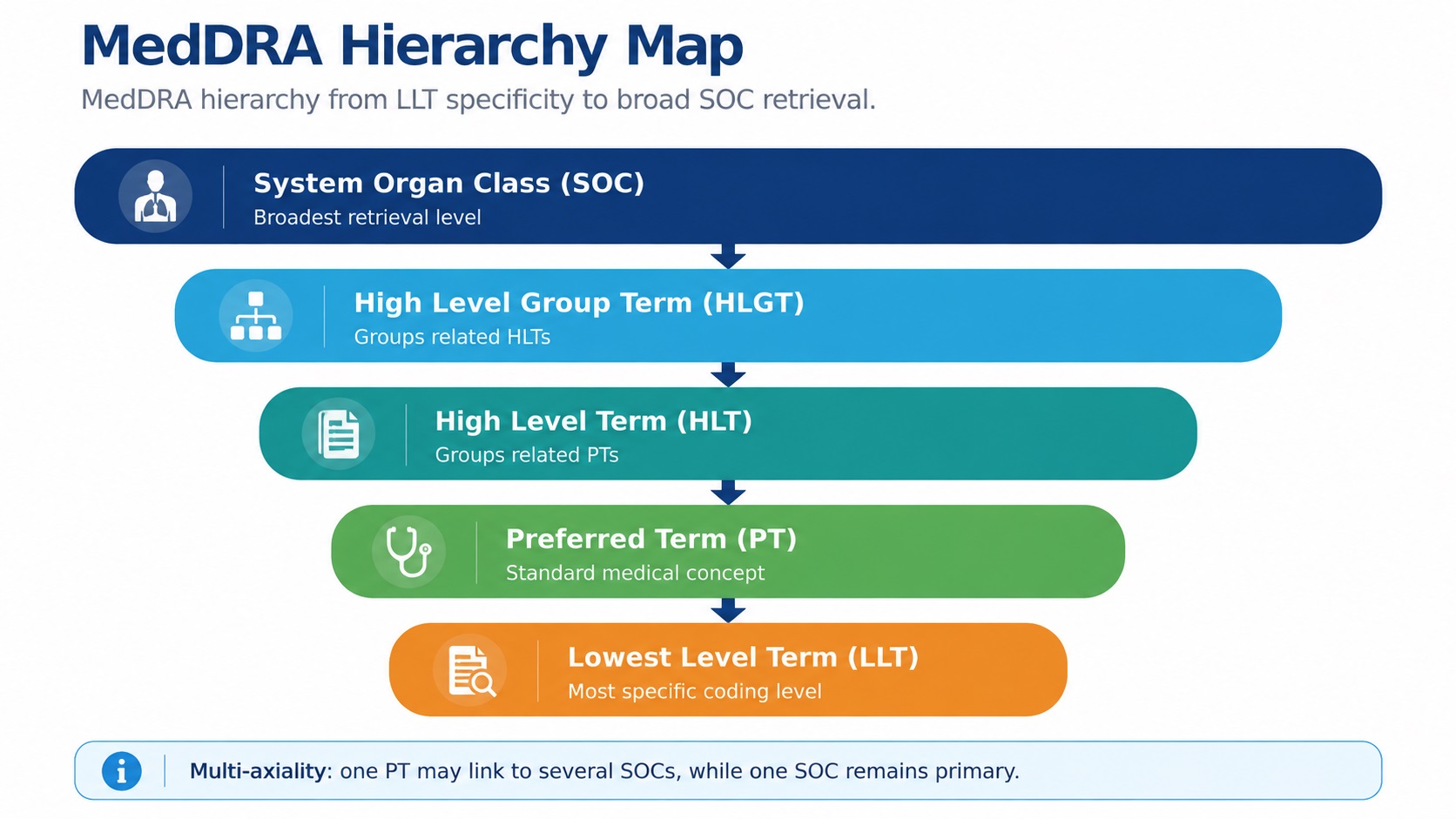
MedDRA provides shared terminology across regulators, sponsors, vendors, and safety databases. Each selected LLT maps upward through a predefined hierarchy. This structure reduces variation between coders and supports consistent aggregation.
MedDRA also covers events, history, indications, investigations, and procedures. Therefore, users can encode diverse safety information within one maintained terminology.
Where MedDRA Coding Fits in ICSR Processing and Safety Analysis
ICSR processing begins with source review and accurate medical interpretation. The coder translates reportable concepts into suitable current LLTs. The database then retains codes and associated hierarchy relationships. Safety analysts later retrieve cases using PTs, SOCs, or targeted queries. Poor coding can split similar events or combine different concepts. Consequently, coding quality directly influences aggregate safety analysis.
Key Concepts in MedDRA Coding
Understanding MedDRA coding requires more than memorizing five hierarchy levels. Multi-axiality, primary SOC assignment, and SMQs also affect downstream analysis.
Stage 1 — Understanding Multi-Axiality and Primary SOC Assignment
MedDRA uses multi-axiality for many PTs. One PT may link to several SOCs. However, every PT receives one primary SOC for standard presentation. Primary assignment reduces double counting across cumulative SOC summaries. Secondary links still support broader retrieval across clinically relevant classifications.
Stage 2 — Coding at the Lowest Level Term (LLT)
LLTs provide MedDRA’s greatest coding specificity. Each LLT links to only one PT. Coders should select current LLTs matching the reported medical concept. Some LLTs are synonyms, lexical variants, or detailed sub-concepts. Non-current LLTs remain available mainly for historical data retrieval.
Stage 3 — Mapping to the Preferred Term (PT)
PTs represent distinct medical concepts used for analysis and reporting. Multiple related LLTs can map to one PT. Therefore, specific source wording becomes standardized without losing its intended concept. Analysts often summarize coded data at PT level. The PT also determines higher hierarchy relationships.
Stage 4 — Moving Through High Level Term (HLT) and High Level Group Term (HLGT)
HLTs group related PTs using clinically meaningful relationships. HLGTs then group related HLTs at a broader level. These grouping levels support trend review and structured data presentation. Coders do not manually choose them during routine entry. MedDRA assigns them through predefined hierarchy relationships.
Stage 5 — Understanding System Organ Class (SOC)
SOCs form MedDRA’s highest hierarchical level. Version 29.1 uses 27 SOCs. SOCs group concepts by manifestation site, etiology, or purpose. Multi-axial links may connect one PT with several SOCs. The primary SOC supports standardized overall presentation.
Stage 6 — Using Standardised MedDRA Queries (SMQs) for Safety Searches
SMQs are predefined MedDRA searches for specific medical conditions or safety areas. They can combine terms across one or more SOCs. Version 29.1 contains 110 Level 1 SMQ topics. Those topics include 230 SMQs when sub-SMQs are counted. SMQs support consistent focused retrieval and signal evaluation.
Core Principles for Accurate MedDRA Term Selection
Accurate MedDRA term selection starts with the source, not the desired analysis. The Points to Consider emphasizes source quality and current LLT selection. Coders should encode reported concepts without adding unsupported diagnoses or interpretations. Medical judgment remains important when wording is incomplete or ambiguous. Organizations should maintain written conventions for recurring scenarios. These conventions reduce coder variability across teams and service providers. They also simplify training, reconciliation, and quality trending.
- Preserve the reporter’s information and intended medical meaning.
- Select the most specific supported current LLT.
- Avoid adding diagnoses that the source never reported.
MedDRA Key Source situation
| Source situation | Preferred coding approach | Quality-control question |
|---|---|---|
|
Specific diagnosis reported |
Select the matching current LLT |
Does the LLT preserve the diagnosis? |
|
Symptom only |
Code the symptom without inferring diagnosis |
Did coding add unsupported information? |
|
Multiple distinct concepts |
Code each applicable concept |
Were concepts missed or merged? |
|
Ambiguous wording |
Seek context and apply documented convention |
Is the interpretation reproducible? |
Step-by-Step MedDRA Coding Workflow
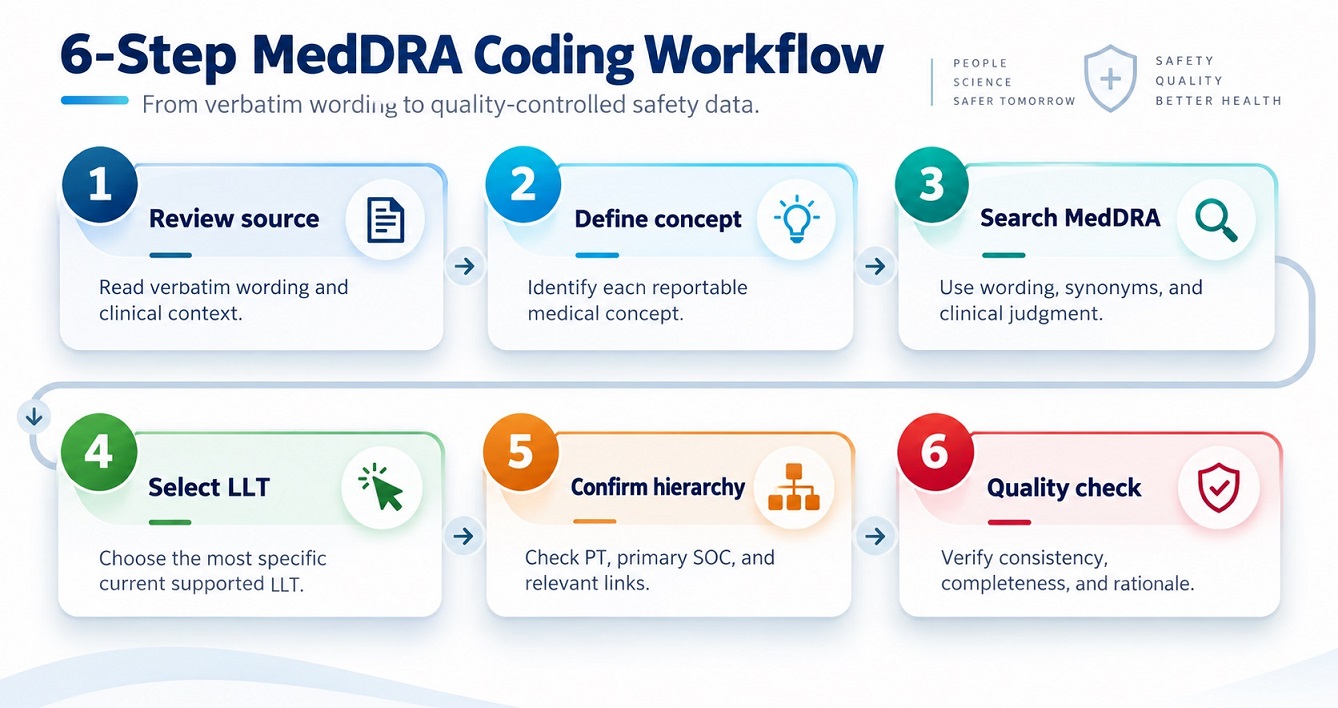
MedDRA coding transforms clinical descriptions into standardized safety data through a structured process based on a five-level hierarchy (SOC, HLGT, HLT, PT, and LLT). Accurate coding improves regulatory reporting and signal detection by ensuring consistent medical concept mapping.
Step 1 — Review the Verbatim Term and Relevant Clinical Context
Step 2 — Search for and Select the Most Specific Appropriate LLT
Step 3 — Confirm the PT/SOC Mapping and Perform a Consistency Check
Step 1 — Review the Verbatim Term and Relevant Clinical Context
Read the verbatim term before searching MedDRA. Review nearby narrative, laboratory data, diagnoses, and temporal context. Identify the exact concept requiring coding. Separate medical concepts from outcomes, product names, and background detail. Resolve obvious spelling variants without changing medical meaning. When wording remains unclear, follow the organization’s escalation process.
Step 2 — Search for and Select the Most Specific Appropriate LLT
Search using source wording and medically reasonable synonyms. Compare candidate LLTs before selecting a term. Prefer the most specific current LLT supported by documentation. Avoid broader terms when a precise supported concept exists. Also avoid excessive specificity based on inference. Check term currency and relevant concept descriptions when available.
Step 3 — Confirm the PT/SOC Mapping and Perform a Consistency Check
Confirm the selected LLT’s parent PT and higher hierarchy. Review primary and secondary SOC relationships when clinically relevant. Ensure mapping matches the source concept and coding convention. Then compare similar cases for coding consistency.
Common MedDRA Coding Errors and Quality-Control Checks
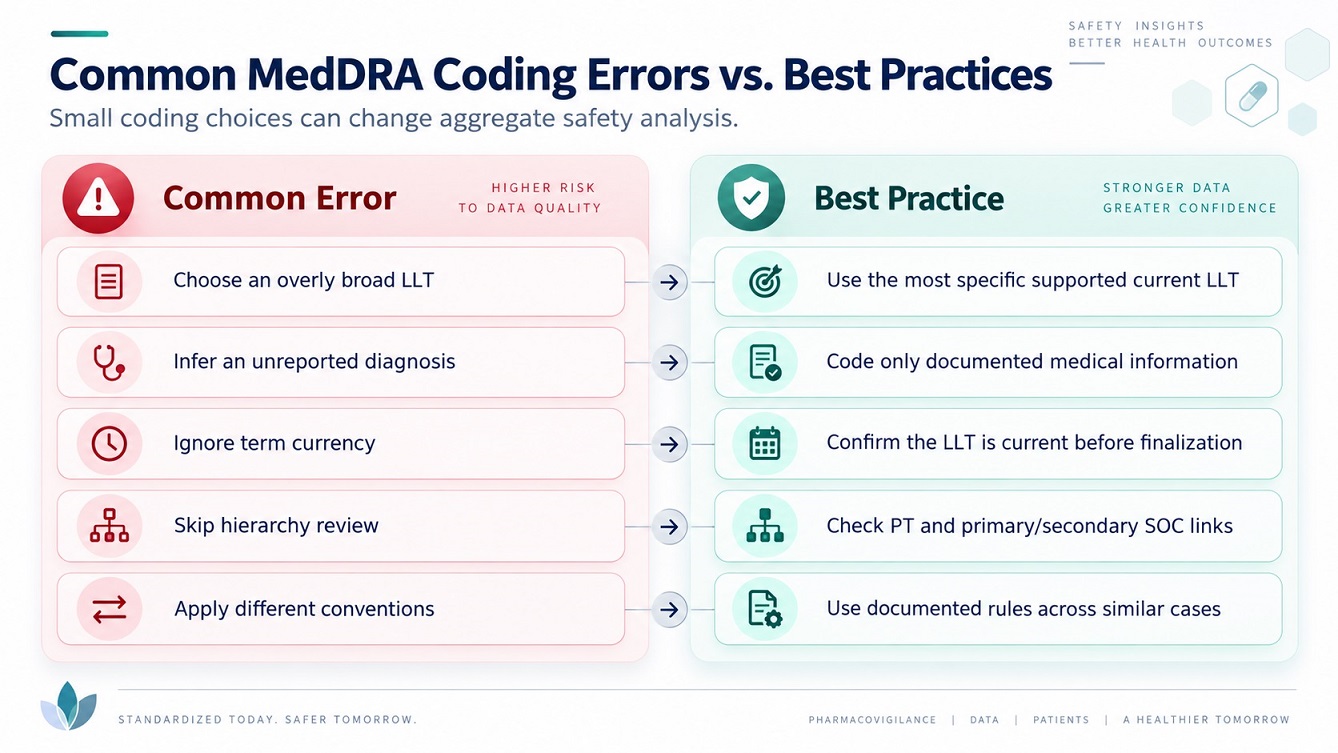
MedDRA coding errors often begin with interpretation rather than searching technique. Small coding differences can change aggregate counts and safety patterns. Therefore, organizations need both coding conventions and routine quality checks.
- Selecting a broad LLT despite specific source information.
- Inferring a diagnosis from symptoms or laboratory findings.
- Choosing a non-current LLT for new case coding.
- Ignoring contextual details that change the medical concept.
- Coding outcomes while missing the underlying reported event.
- Applying inconsistent conventions across similar cases.
Final Word
MedDRA coding in pharmacovigilance requires specificity, clinical context, consistency, and controlled judgment. The terminology uses a 5-level hierarchy (SOC, HLGT, HLT, PT, and LLT) to preserve reported meaning while enabling reliable safety analysis.
Multi-axiality improves retrieval across coded data, while SMQs support more than 100 focused safety searches for signal detection. Consistent training and quality checks strengthen regulatory reporting and patient safety decisions.
FAQs
Coders generally select the most specific appropriate current LLT. Each LLT maps to one PT. Higher hierarchy levels follow automatically through MedDRA relationships. The chosen LLT must remain supported by the reported information.
An LLT captures the most specific entry term. A PT represents one standardized medical concept. Several LLTs can share the same parent PT. This structure preserves wording while supporting consistent analysis.
A primary SOC is the designated SOC for standardized PT presentation. Multi-axial PTs can also link with secondary SOCs. Primary assignment helps prevent double counting in overall SOC summaries.

Ershad Moradi
Ershad Moradi, a Content Marketing Specialist at Zamann Pharma Support, brings 6 years of experience in the pharmaceutical industry. Specializing in pharmaceutical and medical technologies, Ershad is currently focused on expanding his knowledge in marketing and improving communication in the field. Outside of work, Ershad enjoys reading and attending industry related networks to stay up-to-date on the latest advancements. With a passion for continuous learning and growth, Ershad is always looking for new opportunities to enhance his skills and contribute to pharmaceutical industry. Connect with Ershad on Facebook for more information.

FDA Accelerated Approval Pathway in 2026: Requirements and Inspection Readiness
How does FDA accelerated approval affect drug development and GMP compliance? Explore clinical evidence requirements, confirmatory trials, postmarketing obligations, and inspection readiness. Learn how pharmaceutical manufacturers can reduce regulatory risks and prepare for FDA approval decisions in 2026.

Deviation vs Nonconformance 2026: 5 Critical GMP Mistakes to Avoid
Explore 5 critical differences between deviation and nonconformance in pharma, including GMP investigations, OOS, risk assessment, and CAPA.

Root Cause Analysis in Pharmaceutical Industry: 6 Powerful Methods in 2026
Explore 6 powerful root cause analysis methods in pharma to investigate deviations, strengthen CAPA, ensure GMP compliance, and protect patient safety.