


Germany offers one of Europe’s strongest pharmaceutical career markets. Pharma Jobs in Germany span research, quality, manufacturing, regulation, clinical development, and commercial functions. Germany recorded €67.9 billion in pharmaceutical industry revenue during 2025. The sector employed about 133,000 people across more than 650 companies. Companies also invested €10.7 billion in pharmaceutical research during 2024.
These figures show a deep industrial base and sustained innovation capacity. A LinkedIn snapshot on September 9, 2026 showed over 10,000 pharma vacancies. That count changes daily and does not represent official labor statistics. Still, it shows broad hiring activity across many functions and regions. This guide explains roles, qualifications, salaries, language needs, and work authorization. It also offers practical steps for building a focused German job search.
Table of Contents
What are Pharma Jobs in Germany?
Pharma jobs in Germany cover the complete medicine lifecycle. Teams discover molecules, develop products, manufacture medicines, and monitor patient safety. Other professionals manage regulatory submissions, quality systems, data, and market access.
These careers support product quality, compliance, reliable supply, and safer treatment outcomes. Employers include global manufacturers, biotechnology companies, contract organizations, laboratories, consultancies, and research institutes. Some roles require deep laboratory expertise. Others depend more on documentation, project management, communication, or regulatory knowledge.
Major Pharma and Life Sciences Hubs in Germany
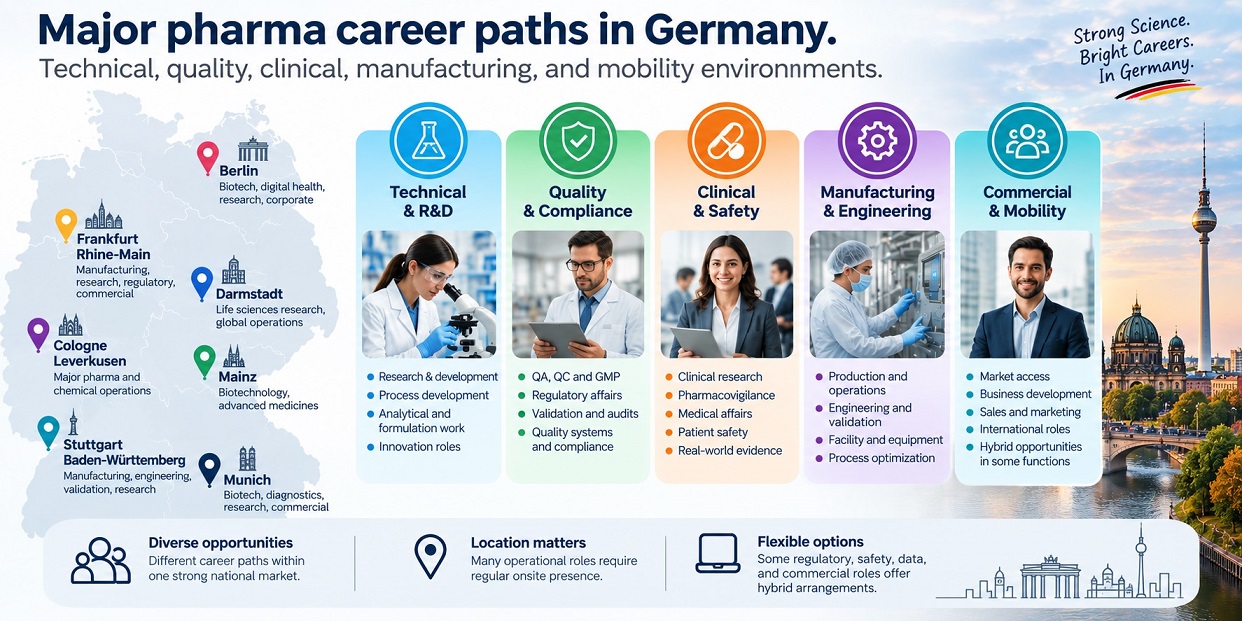
Germany’s pharmaceutical industry is distributed across several strong life sciences clusters, each offering different career opportunities. Choosing the right location can significantly influence access to employers, networking opportunities, and long-term career growth. Major hubs combine research, manufacturing, biotechnology, regulatory activities, and commercial operations.
- Berlin and Munich are strong centers for biotechnology, digital health, diagnostics, research institutes, and specialist commercial roles. They attract professionals interested in innovation-driven environments.
- Frankfurt, Darmstadt, Leverkusen, and Cologne support large pharmaceutical operations, including manufacturing, quality, regulatory affairs, research, and corporate functions.
- Mainz and Baden-Württemberg provide opportunities in biotechnology, advanced medicines, engineering, validation, production, and life sciences research.
Major pharma and life sciences hubs in Germany
| City / Region | Typical Focus | Example Presence |
|---|---|---|
|
Berlin |
Biotech, research, digital health, corporate roles |
Bayer; research institutes; biotech companies |
|
Frankfurt / Rhine-Main |
Manufacturing, R&D, regulatory, commercial |
Sanofi; regional life sciences employers |
|
Darmstadt |
Life sciences, research, corporate functions |
Merck |
|
Leverkusen / Cologne |
Pharma operations, research, manufacturing |
Bayer; regional chemical-pharma employers |
Most In-Demand Germany Pharma Career Paths
Current vacancies show demand across technical, scientific, quality, and business functions. Manufacturing advertisements alone exceed 1,000 positions on LinkedIn’s German platform. Employers also recruit specialists for QA, clinical research, regulatory affairs, and engineering. Demand varies by company pipeline, manufacturing investments, and product portfolio.
- Job Category 1 QA and QC: quality systems, laboratory testing, investigations, and release support.
- Job Category 2 Regulatory Affairs: submissions, variations, labeling, commitments, and authority coordination.
- Job Category 3 Clinical and PV: trial operations, monitoring, safety cases, and benefit-risk activities.
- Job Category 4 Manufacturing , Validation and engineering: qualification, utilities, automation, equipment, and technical reliability. and production execution, process control, troubleshooting, and continuous improvement.
Job Category 1 Quality Assurance (QA) and Quality Control (QC)
QA professionals maintain controlled systems and support compliant decision-making. They review deviations, CAPA, changes, training, audits, and batch documentation. QC professionals test materials, samples, and finished products against approved specifications.
Both functions protect data integrity and support reliable product release. EU GMP knowledge strongly improves readiness for regulated manufacturing environments.
Job Category 2 Regulatory Affairs
Regulatory Affairs teams connect development plans with legal submission requirements. They prepare dossiers, manage variations, track commitments, and coordinate authority responses. Strong writing and cross-functional communication are essential. Knowledge of European procedures can distinguish candidates from general scientific applicants. Entry roles often reward organized graduates with strong documentation discipline.
Job Category 3 Clinical Research and Pharmacovigilance
Clinical Research teams coordinate studies, sites, vendors, monitoring, and trial documentation. Pharmacovigilance teams collect and evaluate medicine safety information. Both areas require careful records, timelines, and escalation practices. Clinical roles may involve frequent communication with hospitals and research sites. Safety roles value medical terminology, case processing, and benefit-risk understanding.
Job Category 4 Manufacturing, Validation, Engineering, and Technical Operations
Manufacturing teams convert approved processes into reliable commercial supply. Engineers support equipment, utilities, automation, maintenance, and continuous improvement. Validation specialists confirm that facilities, systems, equipment, and processes perform consistently. EU GMP Annex 15 remains central for qualification and validation work. These roles combine technical knowledge with documentation, risk management, and operational discipline.
Qualifications, Skills, German Language, and Work Authorization
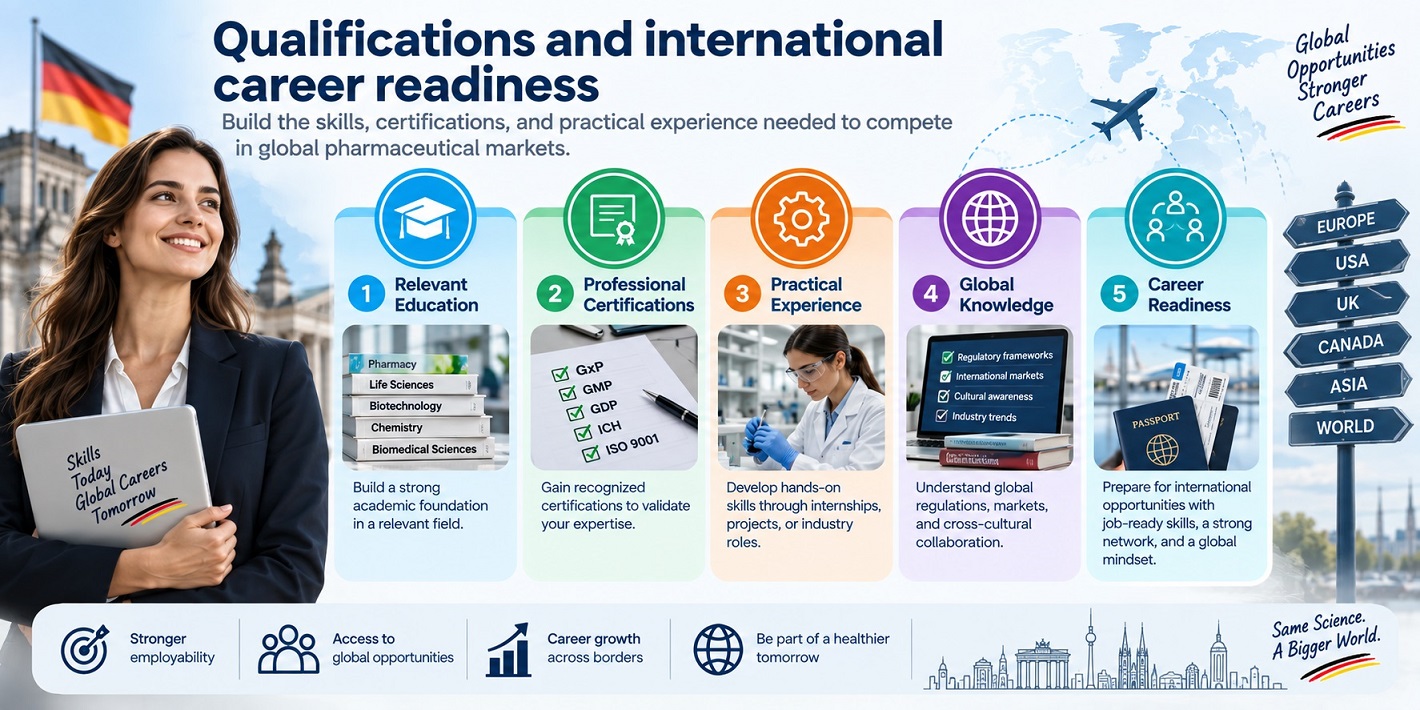
Most professional roles require a relevant scientific or technical qualification. Common backgrounds include pharmacy, chemistry, biology, biotechnology, engineering, and related disciplines. Some positions accept vocational laboratory or manufacturing qualifications. Advanced degrees can help in research, medical, or highly specialized scientific roles.
Typical qualifications and skills by role family
| Role Family | Common Background | Key Skills | German Use |
|---|---|---|---|
|
QA/QC |
Pharmacy, chemistry, biology, life sciences |
GMP, investigations, documentation |
Helpful to important |
|
Regulatory Affairs |
Pharmacy, life sciences, chemistry |
Dossiers, EU procedures, writing |
Helpful |
|
Clinical / PV |
Life sciences, pharmacy, medicine |
GCP, safety, case handling |
Helpful to important |
|
Manufacturing |
Engineering, pharmacy, biotechnology |
GMP, process control, operations |
Often important |
Germany’s EU Blue Card supports qualified professionals meeting defined conditions. The 2026 general annual salary threshold is €50,700. A €45,934.20 threshold applies in eligible shortage occupations. The lower threshold also supports qualifying recent graduates. Applicants must still meet role, qualification, and immigration conditions.
- Relevant degree
- GMP knowledge
- Clear documentation skills
- English fluency
- German proficiency
- Appropriate visa
Salary Expectations and Benefits for Pharma Jobs in Germany
German pharmaceutical salaries vary significantly by role and seniority. Location, employer size, product complexity, and responsibility also influence total compensation. Crowd-sourced salary platforms provide useful benchmarks, not guaranteed offers. Their estimates can also include employers outside pharmaceutical manufacturing. Therefore, candidates should compare several sources during salary discussions. Benefits can include bonuses, pensions, insurance, leave, and flexible working arrangements.
Entry-Level and Early-Career Roles
Entry-level candidates often start through junior specialist, trainee, associate, or technician roles. Internships and working-student experience can strengthen applications for regulated functions. Graduates should emphasize practical laboratories, GMP exposure, data skills, and project contributions. International graduates should also show relocation readiness and clear work authorization plans. Salary expectations should remain role-specific rather than industry-wide.
Experienced, Specialist, and Management Roles
Experienced professionals usually compete through specialization, leadership, or complex operational responsibility. Expertise in sterile manufacturing, biologics, validation, regulatory strategy, and quality systems can command stronger pay. Management positions also reward budgeting, people leadership, and cross-functional delivery. Employers may value inspection experience and successful remediation work. Candidates should document measurable outcomes rather than listing responsibilities alone.
How to Find and Apply for Pharma Jobs in Germany
A focused search produces better results than high-volume generic applications. Start with functions matching your technical background and recent experience. Then identify German clusters containing relevant employers and manufacturing sites. LinkedIn currently shows more than 10,000 broad pharma vacancies in Germany. Treat that figure as a live search snapshot. Search company career pages for more precise technical opportunities. German job titles can improve search coverage. Choose two or three target functions before searching.
- Map employers by Berlin, Rhine-Main, Bavaria, North Rhine-Westphalia, and Baden-Württemberg.
- Match resume evidence with each vacancy’s technical requirements.
- Use measurable achievements instead of generic responsibility statements.
- Prepare examples covering deviations, projects, audits, validation, or cross-functional work.
Final Word
Germany’s pharmaceutical sector offers diverse career routes across the full medicine lifecycle, from research and development to manufacturing, quality, regulatory affairs, and pharmacovigilance. The country is one of Europe’s largest pharmaceutical markets, with more than 100,000 people working in pharmaceutical manufacturing and related activities. Germany also invests heavily in life sciences research, supported by strong biotechnology networks, advanced production facilities, and global companies. These factors create opportunities for professionals with scientific, technical, and compliance skills.
Strong candidates succeed by matching their expertise to specific regulated responsibilities. They understand how GMP, quality systems, data integrity, and patient safety requirements influence daily work. Building targeted applications, gaining relevant certifications, improving German and international communication skills, and researching employers carefully can increase succes
FAQs
Yes. Multinational companies sometimes advertise English-speaking roles, especially in global functions. German skills still expand local operational opportunities. They also help with vendors, site teams, and daily workplace communication.
Salary depends on role, location, company, and responsibility. Current German benchmarks vary across specialized functions. Candidates should compare role-specific data before interviews and negotiations.
Some non-EU professionals can qualify through Germany’s EU Blue Card route. In 2026, the general salary threshold is €50,700. Lower thresholds can apply to shortage occupations and recent graduates.

Ershad Moradi
Ershad Moradi, a Content Marketing Specialist at Zamann Pharma Support, brings 6 years of experience in the pharmaceutical industry. Specializing in pharmaceutical and medical technologies, Ershad is currently focused on expanding his knowledge in marketing and improving communication in the field. Outside of work, Ershad enjoys reading and attending industry related networks to stay up-to-date on the latest advancements. With a passion for continuous learning and growth, Ershad is always looking for new opportunities to enhance his skills and contribute to pharmaceutical industry. Connect with Ershad on Facebook for more information.

Deviation vs Nonconformance 2026: 5 Critical GMP Mistakes to Avoid
Explore 5 critical differences between deviation and nonconformance in pharma, including GMP investigations, OOS, risk assessment, and CAPA.

Root Cause Analysis in Pharmaceutical Industry: 6 Powerful Methods in 2026
Explore 6 powerful root cause analysis methods in pharma to investigate deviations, strengthen CAPA, ensure GMP compliance, and protect patient safety.

Quality Culture in Pharma Industry 2026: Proven Ways to Build Trust
Explore how to build a strong quality culture in the pharmaceutical industry in 2026 through leadership commitment, ICH Q10 principles, meaningful GMP metrics, effective CAPA, and continuous improvement.